分类: world

  • What exactly is white phosphorus and why is it controversial?

    What exactly is white phosphorus and why is it controversial?

    Fresh accusations have emerged this week accusing the Israeli military of deploying white phosphorus artillery shells in populated areas of southern Lebanon, renewing long-simmering global debate over the controversial weapon’s legality and devastating humanitarian impact. Human rights monitors warn that using the incendiary munition near civilian communities qualifies as an indiscriminate attack that violates core standards of international humanitarian law.

    To contextualize the latest allegations, Middle East Eye has broken down the chemical properties, harmful effects, historical military use, and regulatory gaps that have allowed white phosphorus to remain a persistent weapon of war across decades of conflict.

    ### What is white phosphorus, and how is it used?
    Chemically derived from rock phosphate, white phosphorus is a pale, waxy solid with a unique volatile trait: it is pyrophoric, meaning it spontaneously ignites on contact with air or water, producing a thick, opaque white smoke. First commercialized in the 19th century for match production, the compound was quickly linked to a fatal occupational illness nicknamed “phossy jaw”, which caused bone necrosis and death among factory workers exposed to its fumes.

    Today, civilian applications of white phosphorus are limited to agricultural inputs and detergent chemical additives, with use declining amid growing environmental concerns over its toxicity. On the battlefield, however, militaries defend its use by arguing that its smoke screen capabilities effectively conceal troop movements and help identify targets for artillery and air strikes. But the same chemical properties that make it useful for battlefield masking also make it a devastating incendiary weapon, often deployed to flush enemy combatants out of enclosed spaces like tunnels or disperse crowds.

    ### The devastating human and environmental cost of white phosphorus exposure
    The harm caused by white phosphorus extends far beyond immediate battlefield injuries. In enclosed spaces, the compound quickly consumes oxygen, causing rapid suffocation. For those exposed via inhalation, symptoms include acute respiratory tract burning, nausea, fluid buildup in the lungs, and extreme, unquenchable thirst.

    White phosphorus’s most horrifying trait is its stickiness: it clings tenaciously to skin and clothing, burning at temperatures up to 2,500°C that can sear straight through flesh to reach the bone, leaving survivors with excruciating, permanently disfiguring injuries. Even when it appears extinguished, the compound can reignite hours after exposure. If it enters the bloodstream, it poisons vital organs, often leading to death. For medical providers, treating white phosphorus exposure is uniquely dangerous and challenging, as the compound continues to burn even after extraction from wounds, and there is no antidote for its systemic toxicity.

    Beyond human harm, white phosphorus’s extreme combustibility destroys civilian infrastructure and renders agricultural land infertile for years after use, leaving long-term damage to local communities.

    Bonnie Docherty, a leading expert on conventional weapons at Harvard Law School’s International Human Rights Clinic and senior arms adviser for Human Rights Watch, explains that when white phosphorus is detonated over populated areas, it cannot distinguish between civilian non-combatants and military targets. “When white phosphorus is airburst over a populated area, it spreads flaming wedges of the substance over a wide area and cannot distinguish between civilians and soldiers or between civilian objects and military targets,” she told Middle East Eye. “That use is inherently indiscriminate and violates general international humanitarian law, or the laws of war.”

    ### A long history of military use across global conflicts
    White phosphorus has been a staple of global military arsenals for more than a century. It saw widespread use among Allied forces during World War I, and the British Royal Air Force deployed it against Kurdish villages during the 1920 Iraqi revolt. U.S. forces used white phosphorus grenades during the 1944 Normandy campaign, and by the Vietnam War, troops nicknamed the munition “Willie Pete,” using it to flush Viet Cong combatants out of tunnel networks and ignite napalm strikes.

    Subsequent conflicts from the 1982 Falklands War to the 1990s Chechen Wars saw the weapon deployed by British and Russian forces respectively. During the 2020 Second Nagorno-Karabakh War, both Armenia and Azerbaijan accused one another of using white phosphorus as an incendiary weapon, with investigators from the Atlantic Council later confirming its presence on the battlefield. Similar allegations have been leveled against Russian forces following their 2022 full-scale invasion of Ukraine.

    Israel has a well-documented history of deploying white phosphorus across its military campaigns in the occupied Palestinian territories and Lebanon. As recently as March 2025, the Israeli military fired white phosphorus over residential areas in the southern Lebanese village of Yohmor during cross-border strikes. Since October 2023, leading human rights organizations including Amnesty International and Human Rights Watch have documented repeated Israeli use of the munition over populated areas of southern Lebanon and the Gaza Strip, where Israel’s ongoing military campaign has killed more than 72,000 Palestinians to date. Israel has repeatedly denied these accusations.

    Israeli officials have a history of acknowledging past use: the Israeli military publicly confirmed it deployed white phosphorus against Hezbollah targets during the 2006 Lebanon invasion, and it acknowledged firing roughly 200 white phosphorus munitions into populated Gaza during the 2008-2009 Gaza war, an operation that Human Rights Watch confirmed killed dozens of civilians. In 2013, Israel’s High Court of Justice rejected a public petition seeking to ban the Israeli military from using white phosphorus in populated civilian areas.

    The munition has also been deployed across other recent Middle Eastern conflicts: during the Syrian civil war and the U.S.-led campaign against the Islamic State, U.S.-coalition forces, the Turkish military, and the Syrian government were all accused of using white phosphorus. In 2005, the U.S. Pentagon publicly admitted it used white phosphorus as an incendiary weapon during the 2004 siege of Fallujah, Iraq. Human Rights Watch also accused the U.S.-led coalition of using white phosphorus in Afghanistan in 2009, while Washington countered that the Taliban had used the munition 44 times that same year.

    ### The regulatory gap that lets white phosphorus evade a global ban
    Despite its well-documented devastating humanitarian impact, white phosphorus is not explicitly banned under international law. The 1980 Convention on Conventional Weapons (CCW) Protocol III restricts the use of incendiary weapons, defining them as weapons “primarily designed” to start fires and cause burn injuries, and places heavy restrictions on weapons like napalm and flamethrowers.

    But the protocol’s definition deliberately excludes multi-purpose munitions like white phosphorus, which are officially classified as smokescreen and target-marking tools rather than primary incendiary weapons. This creates what Docherty calls a “major loophole in the protocol.” “Civilians suffer the same excruciating injuries from weapons that produce heat and flame regardless of what those weapons were designed to do,” she said. “Therefore, the definition should instead be based on the effects of the weapons.”

    A second loophole in Protocol III imposes stricter bans on air-dropped incendiary weapons than ground-launched variants, meaning even if white phosphorus were classified as an incendiary, most of the munitions recently used by Israel in southern Lebanon—fired from ground-based artillery—would not fall under the protocol’s prohibitions.

    Reforms to close these regulatory gaps, supported by the International Committee of the Red Cross and a group of member states, have repeatedly failed due to the CCW’s governance rules, which allow any single signatory to veto amendments. Russia has repeatedly used this power to block reform efforts. To date, 117 states have ratified Protocol III, including the U.S., China, India, Russia, and most European nations, but many major military powers in the Middle East and North Africa—including Israel, Iran, Turkey, Syria, and Egypt—are not signatories, and are therefore not bound by the protocol’s rules. Even non-signatories are required to follow core principles of international humanitarian law requiring distinction between civilians and combatants and the prohibition of unnecessary suffering, but these rules are rarely enforced.

    ### Tracing the global supply chain of Israeli white phosphorus
    Public information about the white phosphorus munitions supply chain remains limited, but investigations have traced most of the munitions used by Israel in recent years back to U.S. and Israeli suppliers. In October 2023, Amnesty International investigators identified U.S. Department of Defense identification codes on white phosphorus artillery shells recovered from Israeli strikes in Gaza. The shells are fired from U.S.-designed M109 155mm howitzers, currently manufactured by British multinational defense firm BAE Systems.

    A December 2023 Washington Post analysis of shell fragments recovered from the Lebanese village of Deira matched production codes to U.S. military stockpiles, indicating the munitions were manufactured at plants in Louisiana and Arkansas in 1989 and 1992. The U.S. Army’s Pine Bluff Arsenal in Arkansas, a key domestic hub for white phosphorus munitions production, was identified by both Amnesty and the Washington Post as the most likely origin of the Israeli munitions. In 2005, U.S. defense contractor Teledyne Brown Engineering was awarded a $10 million contract to upgrade the arsenal’s white phosphorus production facility.

    Other investigations have named Israeli firm ICL Group, formerly Israel Chemicals Ltd, as a major global supplier of white phosphorus for military use, including supplying raw material to the Pine Bluff Arsenal. Former U.S. agrochemical firm Monsanto, acquired by Germany’s Bayer in 2018, has also been linked to white phosphorus military supply chains in academic reporting. In October 2023, then-U.S. Deputy Pentagon Press Secretary Sabrina Singh declined to comment on accusations of U.S. supply of white phosphorus to Israel, saying only that “I just don’t have a comment on that. And I think, I think the spokesperson from the IDF said that they were not using that. So I just, I don’t have any further comment on that.”

  • London police refuse to investigate British nationals accused of war crimes in Gaza

    London police refuse to investigate British nationals accused of war crimes in Gaza

    London’s Metropolitan Police has confirmed it will not open any formal investigation into 10 British nationals and dual citizens accused of committing war crimes and crimes against humanity while serving with the Israeli military in Gaza, a decision that human rights groups say threatens to leave serious alleged abuses unaccountable.

    The controversial ruling comes more than a year after two human rights legal organizations—the Palestinian Centre for Human Rights (PCHR) and the Public Interest Law Centre (PILC)—submitted a 240-page evidence dossier to the Met’s specialized War Crimes Team in April 2023. The dossier laid out detailed allegations linking the 10 individuals to a string of serious violations, including targeted assassinations of Palestinian civilians and humanitarian aid workers, indiscriminate strikes on residential civilian zones, deliberate attacks on hospitals and other internationally protected sites, and the forced displacement of Palestinian civilians from their homes. The submission was backed by an open letter signed by more than 70 international legal and human rights experts, which called on the War Crimes Team to launch a full inquiry into every allegation of involvement in war crimes and crimes against humanity.

    In a formal decision notice released on April 27, 2024, police said they would not move forward with the probe, arguing there is no realistic prospect of securing a conviction and that a thorough, effective investigation could not be carried out. Notably, this decision stands even after the Metropolitan Police acknowledged that global international bodies have repeatedly assessed that Israeli military actions in Gaza could constitute war crimes, and the force initially identified at least four of the 10 named individuals as being of “particular interest” for investigation.

    Both PCHR and PILC have publicly voiced deep disappointment with the outcome, arguing that the dossier contained credible, verifiable evidence that merited a full formal investigation. The groups warn the ruling risks creating a dangerous accountability gap that allows British nationals and residents accused of severe international crimes committed abroad to avoid legal consequence.

    Paul Heron, a senior solicitor with PILC, said the organizations outright reject the Met’s conclusions, insisting the refusal to investigate was premature and that police applied an incorrect legal standard to the case. “This was not a charging decision made by prosecutors at the end of a full investigation—it was a decision about whether serious allegations of the most severe core international crimes should even be investigated at all,” Heron explained. He added that the police’s approach sets an unreasonably high barrier for any future war crime probes, noting “the entire purpose of an investigation is to gather and test evidence, including evidence that is not accessible to victims, their legal representatives or civil society groups.” Heron confirmed that the coalition of groups is currently reviewing all potential legal options and is highly likely to launch a judicial challenge against the Metropolitan Police over the decision.

    The police ruling also follows a string of related controversial developments in the UK’s approach to alleged Israeli war crimes. Last month, The Guardian revealed that the UK Foreign Office had closed a specialized unit tasked with tracking potential violations of international law by Israeli forces in Gaza and Lebanon, a move implemented due to government funding cuts. Reports at the time confirmed that the head of the Met’s War Crimes Team had previously warned the Foreign Office that data from the unit was critical to supporting the police’s assessment of war crime allegations against British nationals.

    Freedom of Information requests published last month by independent outlet Declassified UK also exposed that more than 2,000 British citizens have served in the Israeli military during Israel’s ongoing military campaign in Gaza.

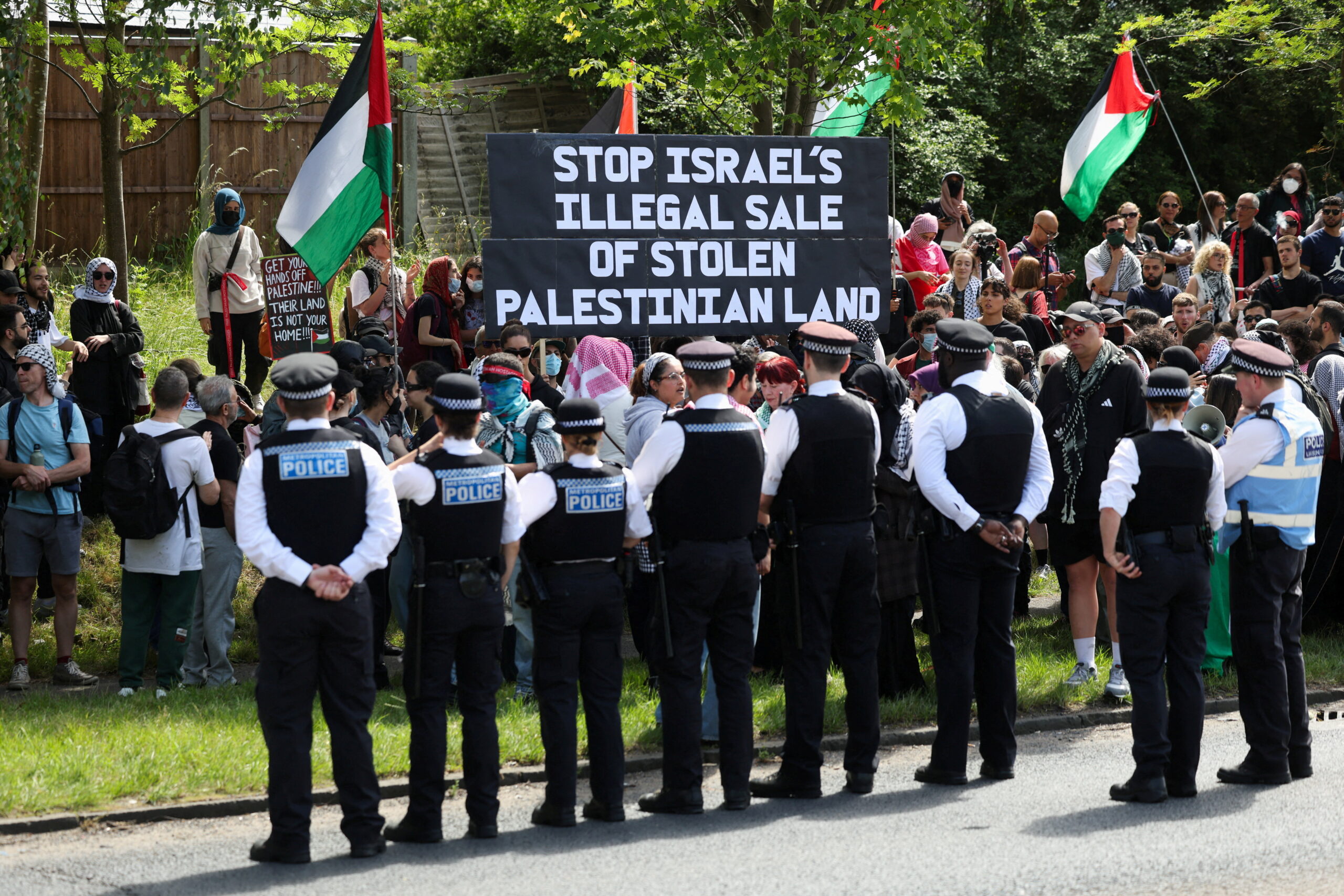
    The decision comes amid a growing UK government crackdown on pro-Palestinian protest action. Just days after the Met’s war crime probe ruling, the force confirmed it is reviewing a potential ban on upcoming pro-Palestinian marches across London, following a stabbing attack that injured two Jewish men, aged 34 and 76, in Golders Green, a northwest London neighbourhood with a large Jewish community. UK Prime Minister Keir Starmer publicly backed potential bans over the weekend, stating that the chant “globalise the intifada” should be completely off-limits for public protest. On Friday, Starmer called the chant an example of “extreme racism” and called for criminal prosecution of anyone who uses it. It should be noted that there have been no recorded instances of antisemitic attacks in the UK linked to the use of this phrase, despite police forces in London and Greater Manchester announcing in December 2023 that they would arrest anyone chanting the phrase or displaying it on protest placards.

    Since the start of Israel’s military campaign in Gaza in October 2023, official Palestinian health data records more than 72,000 Palestinians have been killed in Israeli attacks, including roughly 20,000 children. In April 2024, an Israeli drone strike on a vehicle operated by the humanitarian group World Central Kitchen in Gaza City killed seven aid workers, three of whom were former British service members. The family of James Kirby, one of the killed British aid workers, has repeatedly called for a full, independent public inquiry into his death. Two years after the strike, Kirby’s family says they have received only limited communication from the UK government and remain uncertain whether any full formal investigation is progressing. At the time of the attack, reporting from Middle East Eye noted that arms experts and human rights campaigners found the Elbit Hermes 450 drone used in the strike was powered by a British-manufactured engine.

    Last November, the UK government officially confirmed that British soldiers had continued to train in Israel throughout the military campaign in Gaza, marking the first official admission of UK military personnel presence at Israeli military academies since the start of the war in October 2023. It is also well-documented that Royal Air Force aircraft have conducted regular surveillance flights over Gaza since the war began, despite widespread allegations of war crimes against Israeli forces.

  • Oil tanker hijacked off coast of Yemen and taken towards Somalia

    Oil tanker hijacked off coast of Yemen and taken towards Somalia

    A new act of maritime piracy has roiled the strategically critical Gulf of Aden, with multiple Somali security sources confirming to the BBC that armed Somali pirates have seized control of a foreign-flagged oil tanker off Yemen’s coastline. This incident marks the fourth successful large vessel hijacking in just a 14-day window, marking a sharp resurgence of pirate activity that had been largely suppressed for more than a decade.

    The targeted vessel, identified as the MT Eureka, was sailing under the flag of West African nation Togo when pirates overran the ship at approximately 5:00 a.m. local time, which corresponds to 03:00 British Summer Time. The hijacking unfolded in international waters close to Yemen’s port of Qana, before the hijackers steered the captured tanker toward Somali territorial waters. Three independent security officials from Somalia’s semi-autonomous Puntland region confirmed the pirate group departed from a remote, unpatrolled stretch of coastline near the coastal town of Qandala, which sits on the Gulf of Aden shoreline. Regional maritime observers expect the MT Eureka to anchor in Somali waters within hours of the hijacking.

    This hijacking comes only 10 days after the same group of pirate operatives seized another oil tanker, the Honor 25, in the same general area. The Honor 25 was carrying 18,500 barrels of crude oil en route to Somalia’s capital Mogadishu when it was overtaken.

    In a separate, related incident just days prior, the United Kingdom Maritime Transportation Operation (UKMTO) issued a public warning on Friday about an attempted hijacking of a bulk carrier near Yemen’s Al-Mukala port. According to three senior security sources, the armed actors behind that attempted attack launched from a remote coastal zone near the fishing town of Caluula, located just 209 kilometers (130 miles) north of the departure point for the MT Eureka hijacking.

    The spread of coordinated pirate attacks across two distinct coastal zones 200 kilometers apart confirms a worrying trend: piracy is expanding rapidly across Somalia’s 3,333-kilometer coastline, the longest continuous shoreline on the African mainland. As of Monday morning, neither Somali national nor regional authorities, nor the European Union Naval Force (EUNAVFOR) which leads official anti-piracy operations in the region, have released an official statement addressing the latest hijacking incident.

    Regional security analysts trace this dramatic resurgence back to late 2023, when Houthi rebel attacks on commercial shipping in the Red Sea and Gulf of Aden shifted international naval priorities. Once focused heavily on countering Somali piracy — a threat that had fallen to near-zero levels after a decade of coordinated patrols starting in 2011 — global maritime forces have redirected their assets to counter Houthi attacks on commercial shipping. This security gap along Somalia’s coastline has allowed armed pirate groups to reorganize, rearm, and resume large-scale hijackings for ransom.

    One senior Puntland security official, speaking anonymously to the BBC, warned that the scale of the crisis is far greater than most international observers acknowledge. “The on-going crisis with the pirates is much worse than many realize. There are increasing movements of armed groups all over the coast,” the official said.

  • Germany says US troop withdrawal ‘foreseeable’ as Nato seeks clarification

    Germany says US troop withdrawal ‘foreseeable’ as Nato seeks clarification

    A deepening rift between the United States and Germany has triggered a major shift in American military posture in Europe, with Washington set to withdraw 5,000 active-duty troops from Germany over the next year, a move that has sent shockwaves through the 32-member NATO alliance and raised urgent questions about the future of transatlantic security.

    The drawdown, the latest in a series of American troop reductions across Europe under the second Trump administration, cuts the US military presence in Germany from the current 36,000 troops — by far the largest American force deployment on the continent, far outstripping roughly 12,000 troops in Italy and 10,000 in the United Kingdom. The decision follows a heated public exchange between US President Donald Trump and German Chancellor Friedrich Merz, sparked by comments Merz made criticizing American diplomatic strategy amid the ongoing conflict with Iran.

    Speaking to Germany’s DPA news agency, German Defence Minister Boris Pistorius struck a measured tone, framing the withdrawal announcement as a development that had long been foreseeable. He reaffirmed that the persistent American military footprint in Europe, anchored in Germany, serves the strategic interests of both Berlin and Washington. Even so, Pistorius emphasized that the geopolitical shift demands that European nations step up to take greater ownership of their own collective security. He noted that Germany has already made substantial progress in this area, having ramped up military spending dramatically in recent years after years of falling short of NATO’s previous 2% of GDP defence spending target — a point of consistent criticism from Trump. Under the current Merz government, Germany is on track to hit a total defence expenditure of 3.1% of GDP by 2027, including a €105.8 billion (£91 billion) annual defence budget and ongoing military aid to Ukraine as it defends against Russian invasion.

    NATO, for its part, has moved quickly to seek full clarity from Washington on the details of the drawdown plan. Alliance spokeswoman Allison Hart noted that the US decision reinforces the need for continued European defence investment and greater burden-sharing for transatlantic security. She added that the alliance is already seeing positive progress after member states agreed to a new target of investing 5% of GDP in defence at last year’s NATO summit in The Hague.

    The diplomatic row that preceded the troop withdrawal announcement erupted earlier this month, when Merz told university students that the US had suffered a public humiliation at the hands of Iranian negotiators. Merz argued that Washington lacked a coherent strategy for the ongoing conflict, accusing Iranian negotiators of skillfully stalling talks that saw American officials travel to Islamabad only to return without any diplomatic breakthrough. Trump hit back fiercely on his Truth Social platform, dismissing Merz as misinformed and falsely claiming that the German chancellor supported Iran acquiring a nuclear weapon. Within days, the troop withdrawal order was issued.

    Pentagon spokesman Sean Parnell confirmed that the drawdown directive came from US Defence Secretary Pete Hegseth, and that the full withdrawal of the 5,000 troops will be completed within a six to 12 month timeline. This move is the latest in Trump’s broader strategy to reorient American military focus away from Europe and toward the Indo-Pacific region, a policy that already saw a troop reduction in Romania last year. Trump has also openly floated the possibility of additional drawdowns from other major American deployments in Europe, including Italy and Spain, and has long been a vocal critic of NATO, arguing that the alliance burdens the US with unfair security costs while European allies underinvest in their own defence.

    The announcement has sparked widespread alarm across NATO and even among senior members of Trump’s own Republican Party. Two top Republican congressional leaders — Senate Armed Services Committee Chair Roger Wicker and House Armed Services Committee Chair Mike Rogers — issued a joint statement saying they are deeply concerned by the decision to withdraw an entire US brigade from German soil. They argued that maintaining a strong deterrent presence in Europe is a core core national interest of the United States, and that full withdrawal of forces from the continent runs counter to that goal.

    Polish Prime Minister Donald Tusk issued one of the starkest warnings from within the alliance Saturday, saying that the greatest threat facing the transatlantic community today is not external adversaries, but the ongoing internal disintegration of the NATO alliance. He called on all member states to take urgent, decisive action to reverse what he described as a dangerous and disastrous trend. Even as anxiety mounts, German officials have signalled they will move forward with deeper defence integration with other European allies, insisting Germany is already on the right path to shoulder a larger share of regional security responsibilities.

  • Old and new Gulf faultlines exposed by Iran war

    Old and new Gulf faultlines exposed by Iran war

    On April 28, the United Arab Emirates (UAE) made a landmark announcement that it would withdraw from the Organization of the Petroleum Exporting Countries (OPEC), a move that lays bare how ongoing Middle East conflict has not only deepened hostilities between Iran and its Gulf neighbors, but also fractured unity within the Gulf Cooperation Council itself.

    Founded in 1960, OPEC stands out as one of the few enduringly successful multilateral bodies in the Middle East. For decades, its coordinated pricing and production policies enabled Gulf oil-producing states to accumulate the capital needed to renationalize their energy resources and fund the rapid, transformative development that turned small desert nations into global economic players. The bloc has weathered nearly every regional upheaval, revolution and war in its 65-year history, even after Qatar departed in 2019 amid a regional blockade led by its Gulf neighbors.

    For years, tension has simmered between the UAE and Saudi Arabia, OPEC’s largest producer and de facto leader, which holds outsized influence over the bloc’s policy decisions. The UAE has long pushed to raise its own production quota, leveraging its untapped spare oil capacity, but repeated attempts have failed to yield changes that align with its economic goals. Yet industry friction alone does not explain the UAE’s decision to exit the organization entirely.

    Though the two Gulf powers maintained close alignment through the mid-2010s, the UAE and Saudi Arabia have drifted steadily apart in recent years, driven by sharp divergences on key regional priorities. Their strategies for ongoing conflicts in Yemen and Sudan differ dramatically, as do their approaches to normalization with Israel: the UAE established full formal relations with Israel in 2020, while Saudi Arabia has pledged it will only normalize ties once an independent Palestinian state is established. Beyond geopolitics, the two nations have emerged as fierce economic competitors, and the ongoing regional war connected to Iran has only accelerated their rivalry.

    After Iran responded to U.S.-Israeli attacks in February with strikes across Gulf states and a blockade of the strategic Strait of Hormuz, the conflict has laid bare the flaws in existing regional strategies. For Saudi Arabia, the war has exposed the limits of its gradual outreach to Iran and its reliance on the U.S., which is firmly aligned with Israel. In response, Riyadh has deepened defense cooperation with nuclear-armed Pakistan, a shift that has caused significant friction with the UAE, which maintains close strategic ties with Pakistan’s regional rival India. The UAE has publicly pushed Pakistan to issue a stronger condemnation of Iran during the current conflict, a demand Islamabad cannot meet due to its role as a neutral mediator in regional peace talks. Frustrated by Pakistan’s position, the UAE recently demanded Islamabad repay a $3.5 billion loan, only for Saudi Arabia to immediately step in with emergency financial support for Pakistan.

    Notably, the UAE’s OPEC withdrawal announcement was timed to coincide with a Gulf Cooperation Council summit in Riyadh, where leaders gathered to try to find common ground on the ongoing Iran conflict. The timing was widely interpreted as a deliberate public snub to Saudi leadership.

    The regional war has reignited a host of long-simmering disputes across the Gulf, including the decades-long sovereignty conflict between the UAE and Iran over three strategic islands: Abu Musa, Greater Tunb, and Lesser Tunb. Iran seized control of the islands in 1971, the same year the UAE gained independence from Britain, and the islands give Iran unrivaled strategic control over Gulf shipping lanes. The UAE has never relinquished its claim to the territory, while Iran maintains the islands have always been part of its sovereign territory. Historians believe the handover of the islands was part of a secret deal between Britain and the Shah of Iran in the early 1970s, in which the Shah agreed to abandon Iran’s long-held claim to Bahrain in exchange for control of the three islands. Access to historical records of these negotiations remains restricted, with multiple freedom of information requests for 1960s-era UK Foreign Office documents denied on national security grounds.

    Beyond the UAE-Saudi and UAE-Iran rifts, the conflict has hit other Gulf states hard. Kuwait, a small northern Gulf state, has faced repeated attacks from Iran-aligned Shia militias based in Iraq, a wave of violence that has revived traumatic memories of Iran-linked political unrest in the 1980s and Saddam Hussein’s 1990 invasion that left much of the country, including coastal Failaka Island, damaged and abandoned.

    Economically, the war has hit Gulf states unevenly. Nations that lack alternative shipping routes to bypass the blockaded Strait of Hormuz – including Bahrain, Kuwait, and Qatar – have suffered the worst economic damage. Bahrain, which already runs persistent budget deficits, relies on aid from wealthier Gulf neighbors to keep its economy afloat. By contrast, the UAE, Saudi Arabia, and Oman all have geographic access to alternative shipping routes that allow them to bypass Hormuz entirely. In fact, Oman, which controls one bank of the strait, could emerge as a long-term beneficiary of the disruption: it could earn revenue by charging tolls for alternative shipping routes under a new agreement with Iran, or see its Arabian Sea ports grow in global significance, potentially reviving its historical status as a major regional trading power. That outcome, however, is unwelcome to both the UAE and Saudi Arabia, which prefer to maintain their dominance of Gulf energy shipping.

    In sum, the U.S.-Israeli strike on Iran that triggered the current crisis has reactivated long-buried fault lines across the Gulf and created new divisions between regional states. It has also undermined the few remaining channels for multilateral regional cooperation, turning an already fragmented and volatile region even more unstable. This analysis is by Toby Matthiesen, Senior Lecturer in Global Religious Studies at the University of Bristol, republished with permission from The Conversation under a Creative Commons license.

  • Drone kills 2 in Kherson minibus strike, as Russia claims front-line progress

    Drone kills 2 in Kherson minibus strike, as Russia claims front-line progress

    On a Saturday marked by fresh violence across Ukraine, Russian drone attacks left two civilians dead and multiple others injured in the southern city of Kherson, continuing a pattern of targeted strikes on populated civilian areas that has defined Moscow’s full-scale invasion, regional authorities confirmed.

    Oleksandr Prokudin, the head of Kherson’s regional military administration, announced that the first attack on a civilian minibus claimed two lives and left seven people with wounds ranging from minor to severe. Just hours later, a second Russian strike targeted another minibus in the same region, leaving the vehicle’s driver injured. Further along Ukraine’s strategic Black Sea coastline, a separate Russian bombardment damaged critical port infrastructure in the major city of Odesa, though no casualties were reported in that incident.

    More than two years into Russia’s full-scale invasion, Ukrainian civilians continue to face unrelenting waves of aerial attacks across multiple frontline and rear areas. Diplomatic efforts brokered by the United States over the past 12 months have failed to deliver any de-escalation, as Moscow has repeatedly rejected Kyiv’s calls for a bilateral ceasefire. In recent weeks, the outbreak of conflict in Iran has shifted global media and diplomatic focus away from Ukraine’s ongoing humanitarian crisis, leaving many Ukrainian civilians facing heightened vulnerability with less international scrutiny.

    On the extended 1,000-mile front line stretching across eastern and northeastern Ukraine, Russian defense officials announced Saturday that their forces had seized full control of the village of Myropillia, located in Ukraine’s northeastern Sumy region. This battlefield claim could not be independently verified by independent open-source observers or international media, and Kyiv’s military command did not issue an immediate comment confirming or denying the territorial shift.

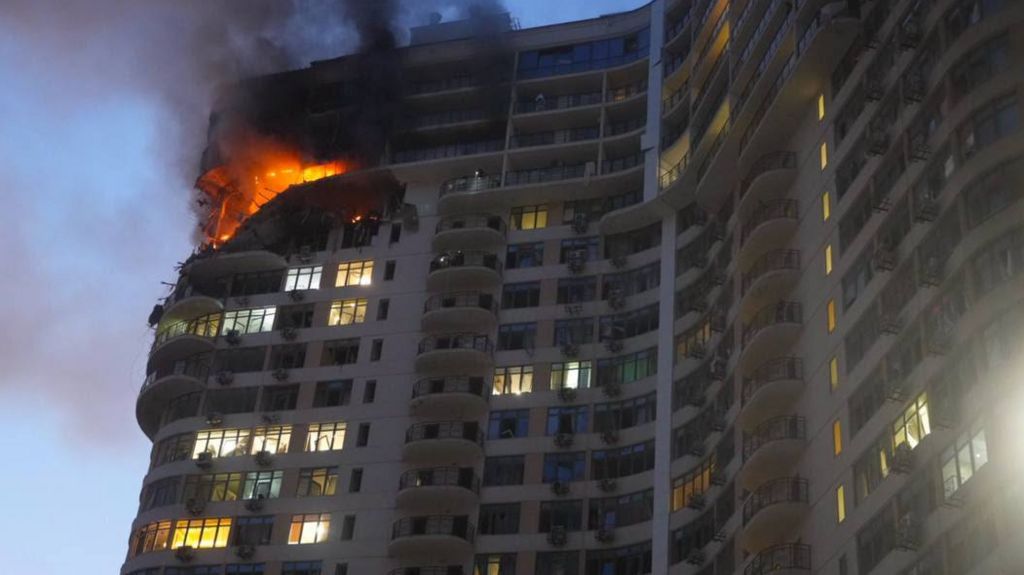
    Across the border in southern Russia, local authorities in the Krasnodar region confirmed Saturday that firefighters had fully extinguished a large blaze that broke out Friday at the Tuapse Black Sea oil terminal following a Ukrainian drone strike. This marked the fourth Ukrainian attack on the Tuapse refinery and export terminal in just over a fortnight, with previous strikes triggering large-scale fires, forcing temporary civilian evacuations, and sending thick plumes of black smoke visible for dozens of kilometers.

    Kyiv has steadily ramped up long-range drone strikes targeting Russian energy infrastructure in recent months, part of a deliberate strategy to disrupt Moscow’s oil export operations—one of the Kremlin’s largest single sources of revenue for its war campaign. To date, however, the broader economic impact of these strikes remains uncertain. Global oil price increases tied to the Iran conflict, paired with a concurrent easing of some U.S. secondary sanctions on Russian crude, have offset losses and helped replenish Russian government war coffers.

    Related recent developments include Ukrainian strikes on oil facilities deep inside Russian territory, which analysts warn could push domestic fuel prices higher inside Russia and blunt the impact of Kyiv’s energy targeting campaign. Ukrainian officials have confirmed the Tuapse terminal strike, and Ukrainian President Volodymyr Zelenskyy has stated that his administration is still gathering detailed information on a purported ceasefire proposal from Russian President Vladimir Putin tied to Russia’s annual May 9 Victory Day holiday. Coverage of the ongoing Russia-Ukraine conflict is updated continuously via the Associated Press’s dedicated conflict hub.

  • Ukraine is hitting oil facilities deep inside Russia. Soaring fuel prices could blunt the impact

    Ukraine is hitting oil facilities deep inside Russia. Soaring fuel prices could blunt the impact

    Over the course of the ongoing Russia-Ukraine conflict, Ukraine has dramatically expanded its deep-strike capabilities, launching a sustained campaign of long-range drone attacks against key Russian oil infrastructure hundreds and even thousands of kilometers behind the front lines. The explicit strategic goal of these strikes is to cut off Moscow’s primary source of war funding: global oil exports, a linchpin that has sustained Russia’s full-scale invasion of Ukraine.

    Recent months have seen a sharp uptick in these attacks, targeting critical energy hubs across vast swathes of Russian territory. In just over two weeks, the Black Sea coastal town of Tuapse, located 280 miles from the Ukrainian front lines, has endured four separate drone assaults on its major oil refinery and export terminal. Each strike has ignited massive infernos that forced local evacuations, sending plumes of smoke large enough to be visible from outer space. After the third attack on April 18, local emergency officials confirmed that superheated oil products spilled onto residential streets, damaging dozens of civilian vehicles. Further inland, Ukraine confirmed it carried out back-to-back strikes on an oil pumping station in Russia’s Perm region, nearly 900 miles from Ukrainian borders – a distance that underscores the rapid advancement of Ukraine’s domestic drone program. Russian officials have only acknowledged that unspecified industrial facilities were hit, declining to share further details. These attacks are not isolated: in late March, Ust-Luga, one of Russia’s largest Baltic Sea oil and gas export terminals situated more than 500 miles from Ukraine, was struck three times in a single week. In the wake of that assault, regional governor Alexander Drozdenko made the unprecedented admission that the area surrounding St. Petersburg, Russia’s second-largest city, now qualifies as a “front-line region” due to constant aerial threats.

    Ukrainian President Volodymyr Zelenskyy has framed these strikes as a parallel effort to international sanctions targeting Russia’s war economy. He argues the campaign has grown even more urgent amid the global energy market upheaval triggered by the Iran conflict and the closure of the Strait of Hormuz, which has generated massive windfall profits for Russian oil exporters. Zelenskyy estimates that Russia has suffered direct losses of at least $7 billion from oil infrastructure attacks since the start of 2024, noting that exports from key terminals including Ust-Luga and Primorsk have already dropped. Independent experts add that alongside disrupting export routes, the strikes have eroded Russia’s domestic oil refining capacity – a problem compounded by existing international sanctions that make it nearly impossible for Moscow to source replacement parts for damaged infrastructure.

    Yet the full economic impact of the campaign remains uncertain, as global market shifts have worked in Russia’s favor. Data from the International Energy Agency shows that Russian crude and oil product exports rose by 320,000 barrels per day month-over-month in March 2024, hitting a total of 7.1 million barrels daily. Soaring global oil prices pushed export revenues nearly double between February and March, jumping from $9.7 billion to $19 billion. It remains unclear whether the more recent April strikes will alter this upward trajectory. Chris Weafer, CEO of the international consultancy Macro-Advisory Ltd, notes that geopolitical tensions around Iran have unexpectedly propped up Russia’s energy sector and federal budget, pulling it back from a financial crisis that was emerging in late February. Weafer also adds that the visible damage from strikes is often less severe than the dramatic footage suggests: attacks on partially filled oil storage tanks produce spectacular fires from ignited vapors, but typically only delay deliveries by a few days, rather than destroying critical pumping or loading infrastructure that is far better protected than above-ground storage tanks.

    Militarily, the strikes have demonstrated just how far Ukraine’s domestic drone program has advanced since the start of the full-scale invasion in 2022. Ukraine’s Defense Ministry confirms the country has more than doubled the range of its deep-strike capabilities over the past two years, allowing drones to approach targets from multiple directions and significantly complicate Russian air defense efforts. Marcel Plichta, a security researcher at the University of St. Andrews, notes that this level of long-range domestic strike capability simply did not exist for Ukraine just four years ago. “Drone attacks have so far been a very successful case of leveraging simple, domestically assembled technology to attack Russia in places that, at the start of the war, they just would have never expected to be attacked,” Plichta explained.

    Beyond military and economic outcomes, the strikes have already brought severe, lasting environmental damage that is forcing ordinary Russians far from the front lines to confront the realities of the war. In Tuapse, a popular Black Sea tourist destination, officials confirmed dangerous levels of the carcinogen benzene were detected in the air during active fires, urging residents to stay indoors. Local residents have widely reported so-called “black rain” – oily, toxic droplets that stain skin, clothing and infrastructure. Local media has shared graphic footage of stray animals with fur stained gray by oil residue, while oil spills along the coastline have coated marine life, and photos of oil-covered beached dolphins have circulated widely across Russian social media.

    Vladimir Slivyak, co-chair of Russian environmental NGO Ecodefense, warned that the damage will have decades-long consequences for both human health and the regional ecosystem. “There is a lot of oil in the sea,” Slivyak said. “In the next few years, every storm will be bringing more oil pollution onto the coast.”

    So far, widespread public backlash against the war has not emerged, as Russian authorities continue a sweeping crackdown on anti-war dissent. But Slivyak argues that the visible, personal impact of these strikes is eroding trust in official government messaging. “I think a lot of people understand that there is a very big difference between what Putin says and what regional authorities are saying, and what’s really going on,” he noted.

  • ‘This tree was planted by my ancestor hundreds of years ago and my family settled here’

    ‘This tree was planted by my ancestor hundreds of years ago and my family settled here’

    On the windswept Atlantic coast of Ghana, in the quiet fishing town of Apam, an unassuming tree rises from rust-red clay, anchoring a story of migration, resilience, and intergenerational memory that stretches back further than most written records of the region. Tucked between two defining monuments of Ghana’s layered colonial and post-colonial history, the tree — called Santseo, meaning “Under” in the local Fanti language, for the shade it has offered communities for centuries — is barely noticed by daily passersby. But for one extended Ghanaian family, it is far more than a feature of the landscape: it is the living anchor of their identity.

    Oral tradition passed down through the Wilberforce family traces Santseo’s planting to the 13th century, when a small group of travelers led by Nana Asumbia, a royal spiritual leader from the Akwamu Kingdom’s historic capital of Akwamufie, set out on a westward journey along the coast. Though the exact cause of the group’s departure from Akwamufie has been lost to time, family accounts passed from generation to generation preserve the unique ritual Asumbia followed to choose the group’s new home: the travelers carried a sapling with them, and planted it wherever they paused. If the young tree took root and survived after several days, they knew they had found their permanent settlement. If it died, they continued onward.

    The tree species Asumbia chose was no accident. Today identified as *Piliostigma thonningii* — commonly called camel’s foot or monkey bread tree — it is a hardy, drought-resistant species native to much of sub-Saharan Africa, valued across the continent for its medicinal leaves and bark, its wide cooling canopy, and its ability to thrive in poor, harsh conditions where other species fail. For a nomadic community searching for a place to put down roots, the species’ legendary resilience made it the perfect symbol of their own journey.

    The group’s first stop after leaving Akwamufie was in what is now central Accra’s Otublohum neighborhood, around the site of the modern General Post Office. The sapling they planted there survived, and descendants of that first group still live in the area today. But the journey continued west, and the travelers next paused near Gomoa Buduburam along the Accra-Winneba highway, where they planted a second sapling. This time, the young tree did not survive. The group took this as a sign they had not yet reached their destination, and moved on once again.

    Their final stop came after a chance encounter in the coastal forest, according to oral history. A royal hunter named Inhune Akubuha from Gomoa Asin had wounded an elephant, which fled into the bush before collapsing. When he tracked the dead animal to its final resting place in what is now Apam, he called the traveling group to the spot. It was here that Asumbia planted her third sapling. Days later, when the tree sprouted new growth and took root in the red coastal soil, the group settled. Centuries later, the tree still stands, and the family built their home directly around it, naming the property Santsiwadzi in Santseo’s honor.

    Today, Santseo occupies a unique space between two eras of Ghana’s documented history: on one side sits Fort Patience, a Dutch trading fort completed in 1697 during the transatlantic gold and slave trade, when the region was known as the Gold Coast; on the other stands Apam’s Methodist Church, a monument to the spread of Christianity across Ghana’s coast in the centuries after European arrival. Yet according to family tradition, Santseo predates both structures by hundreds of years, making it a rare living marker of pre-colonial African history that outlasted the arrival of European powers and the transformation of local belief systems.

    As Christianity spread across Apam, the family that cares for Santseo donated the land on which the Methodist Church now stands. Over time, the tree’s traditional spiritual significance faded, as community members avoided being labeled idolaters for maintaining the old traditions. What remains is not a shrine, but a living memory: a connection to the ancestors who founded the community. Even so, tensions persist around preserving the tree: any extra care or maintenance is often misinterpreted as a return to old ritual practices, leaving the family to walk a careful line between honoring their history and adapting to modern beliefs.

    Roughly 40 years ago, members of the extended family reconnected with their ancestral roots in Akwamufie, making the journey east back to the kingdom their ancestors left centuries earlier. Oral tradition in Akwamufie had preserved the story of the traveling group for generations, with a repeated prophecy that they would one day return. The reunion was an emotional occasion, and a family member was installed as Nana Asumbia II, the new Queen Mother, mending the centuries-long divide between the two communities.

    Today, Apam’s rhythm is still shaped by the Atlantic Ocean that frames its coast. Fishermen haul nets to shore before dawn, children walk past Santseo on their way home from school along paths their grandparents and great-grandparents used, and every Tuesday, the town observes a long-held sacred tradition: no fishing boats leave the shore, and a gentle stillness falls over the coast, broken only by the quiet roll of the Atlantic.

    Santseo still stands through it all, its branches gnarled and shaped by centuries of salt wind and coastal storm, still rooted in the same red clay where Asumbia planted it so long ago. It has survived the rise and fall of kingdoms, the arrival of colonial powers, the transformation of local beliefs, and the slow passage of centuries. A guide for a displaced community, a source of shade and medicine, and a living archive of unwritten African history, the question Nana Asumbia asked when she planted the sapling all those years ago — will this tree take root? — still has the same clear answer, centuries later: yes.

  • Ghana becomes the latest African country to reject a US health deal, citing data sharing concerns

    Ghana becomes the latest African country to reject a US health deal, citing data sharing concerns

    On Friday, a senior Ghanaian official confirmed to the Associated Press that Accra has turned down a proposed bilateral health partnership with the United States, joining a growing list of African nations walking away from the agreement over unaddressed data privacy and national sovereignty risks. The core sticking point for Ghana was the deal’s provisions granting U.S. entities broad, unsupervised access to the country’s most sensitive health data without adequate regulatory safeguards, according to Arnold Kavaarpuo, executive director of Ghana’s Data Protection Commission, the government body directly involved in negotiation talks. Kavaarpuo emphasized that the scope of data access the U.S. demanded far exceeded the standard parameters aligned with the deal’s stated public health objectives.

    The U.S. State Department has not issued an immediate response to requests for comment on Kavaarpuo’s remarks. The framework of these health partnerships was first rolled out under the Trump administration’s “America First” global health strategy, which replaced a fragmented network of older health aid agreements overseen by the now-restructured U.S. Agency for International Development. To date, Washington has finalized similar deals with close to 24 African countries, offering hundreds of millions of dollars in funding to nations that previously faced U.S. aid cuts, with the stated goal of shoring up local public health systems and strengthening outbreak response capacity.

    Despite the financial incentives on offer, the agreements have sparked widespread criticism and pushback across the continent over long-standing concerns about data governance and national sovereignty. Zimbabwe became the first country to publicly reject the proposal back in February, citing identical worries around health data access, unfair terms, and threats to national sovereignty. Zambia has also pushed for revisions to problematic sections of the draft agreement, though it has not yet announced a final decision on whether to move forward.

    African privacy and public health activists have repeatedly flagged that most versions of the agreement lack sufficient guardrails for sensitive personal and population health data. In some cases, the deals also include restrictive provisions: for example, in Nigeria, the U.S. has committed to prioritizing funding exclusively for Christian faith-based healthcare providers, limiting access to support for broader public health infrastructure. Jean Kaseya, Director General of the Africa Centres for Disease Control and Prevention, previously told reporters that the organization holds “huge concerns” about the deal’s terms around both health data and pathogen sharing between African nations and U.S. entities.

    For Ghana, the proposed $300 million total agreement would have allocated roughly $109 million in U.S. funding to the country over a five-year period, with matching supplemental investment from the Ghanaian government. Kavaarpuo outlined that the most problematic provision allowed U.S. entities to de-identify patient data at their own discretion, a policy that effectively amounted to outsourcing Ghana’s entire national health data governance infrastructure to a foreign power. The agreement would have granted access not just to aggregated health datasets, but also to underlying metadata, public health dashboards, national reporting tools, standardized data models, and official data dictionaries. Up to 10 separate U.S. entities would have been permitted to access this full suite of data with no requirement for prior approval from Ghanaian authorities, regardless of the intended use case.

    “We did not get any assurance that Ghana would retain meaningful governance and oversight over how this sensitive data would be used,” Kavaarpuo explained. “The agreement only required U.S. entities to notify Ghana after they had already completed a project involving data access, rather than establishing a mandatory prior approval framework.”

    Kavaarpuo confirmed that Ghana has formally communicated its rejection of the current draft agreement to U.S. officials, and has requested revised negotiations to address the country’s core concerns around data governance and sovereignty before any new deal can be reached.

  • Thousands of ‘lost Canadians’ have applied for dual citizenship – is Canada ready?

    Thousands of ‘lost Canadians’ have applied for dual citizenship – is Canada ready?

    For more than a century, millions of people with French-Canadian roots across the United States have carried unrecognized ancestral ties to Canada, cut off from formal citizenship by outdated and discriminatory laws. That historic injustice began to be corrected in December 2024, when a landmark Canadian citizenship law came into force, opening the door for any descendant of a Canadian citizen to prove their ancestral connection and claim citizenship – a change that has sparked a surge of applications and reignited conversations about cultural identity across North America.

    The roots of this crisis stretch back to the 19th and early 20th centuries, when more than one million French-Canadians left Canada for New England in search of mill and farm work. In Maine, where many settled, state laws once banned French instruction in public schools, and social stigma labeled French speakers as second-class citizens. Compounding this displacement, outdated Canadian citizenship rules barred generations of descendants born in the U.S. from claiming citizenship, leaving millions of people now referred to as “lost Canadians” disconnected from their formal national identity.

    Joe Boucher, the youngest of five children growing up in a French-Canadian family in Maine, embodies this generational disconnect. While both his parents spoke French to one another and raised their children with pride in their heritage, Boucher never learned to speak the language; his older siblings defaulted to English when talking among themselves, shaped by the stigma and legal barriers that once marginalized French speakers in the state. Today, Boucher is among the thousands of applicants pursuing formal citizenship proof under the new law. For him, the process is not about seeking a new home – though he dreams of one day retiring in Quebec City, where his 17th-century ancestor Pierre Boucher once served as governor of the French colonial settlement – but about reclaiming a core part of his identity.

    “It’s nice to know that the connectivity to the home country, as it were, is there,” Boucher told the BBC. Growing up, his father instilled fierce pride in their Acadian and French-Canadian heritage, and now as a musician, Boucher celebrates that history, even adapting Henry Wadsworth Longfellow’s poem *Evangeline*, which chronicles the 18th-century expulsion of Acadians by British forces, into a original song. “My ancestors arrived in Canada 400 years ago and spent generations creating communities and cultivating the land in Quebec and Acadie. This is the family I know and this is in large part who I am,” he explained.

    For many applicants, the new law comes at a moment of particular uncertainty, coinciding with the start of the second term of U.S. President Donald Trump. Multiple applicants, including another Mainer of French-Canadian descent Tim Cyr, note that current political uncertainty has made securing a second citizenship an appealing safety net. “It’s not a great time to have an American passport,” Cyr said, though he added he has no plans to leave the U.S. permanently. Boucher emphasized that his own motivation goes beyond political contingency, centered on cultural identity rather than an “escape hatch” from the U.S., where his immediate family and life are rooted.

    In the first six weeks after the law took effect – between December 15, 2025, and January 31, 2026 – Canadian immigration officials received 12,430 applications, processed 6,280, and granted citizenship to 1,480 applicants. The surge in interest has upended industries that support the application process, most notably professional genealogy. Montreal-based genealogist Ryan Légère, who specializes in tracking French-Canadian ancestral records, says his former side business has quickly become a full-time occupation, so busy he is now considering hiring additional staff. “It’s completely taken over my life,” he said.

    But Légère also warns of growing challenges and unforeseen strains on the system. The law was passed after an Ontario court ruled that limiting citizenship eligibility to only first-generation descendants was unconstitutional, but Légère says Canadian institutions are understaffed, overwhelmed, and poorly prepared for the volume of applications they have received.

    Many applicants also face steep practical barriers to proving their ancestry. Quebec did not standardize civil birth certificates until the 1990s; before that, most births were recorded only in parish baptismal records, which are often handwritten in archaic, hard-to-read French script. Many families anglicized their surnames after moving to the U.S., erasing paper trails: Desjardins became Gardner, Bonenfant became Goodchild, and countless other names were altered to fit English language norms. The low nominal application fee of just C$75 (around $55 USD) can balloon to thousands of dollars when factoring in genealogist fees, record retrieval costs, and legal assistance, putting the process out of reach for some applicants.

    A spokesperson for Immigration, Refugees and Citizenship Canada confirmed to the BBC that all applications are reviewed on an individual basis to confirm eligibility, and warned that data from commercial online genealogy platforms cannot be used as the sole proof of ancestry. The law does include some parameters: applicants must trace their lineage to a direct parental ancestor who became a Canadian citizen on or after January 1, 1947, when Canada’s first Citizenship Act came into force. Going forward, any Canadian parent must have resided in Canada for at least 1,095 days to pass citizenship to their children born abroad. No limit is placed on how far back an eligible ancestor can be, however, meaning millions of U.S. residents could qualify for citizenship under the new rules.

    For people like Boucher, the law represents more than a change in immigration policy: it is a long-overdue recognition of a history of displacement and marginalization, and a chance to formalize the connection to the heritage his parents worked hard to preserve.