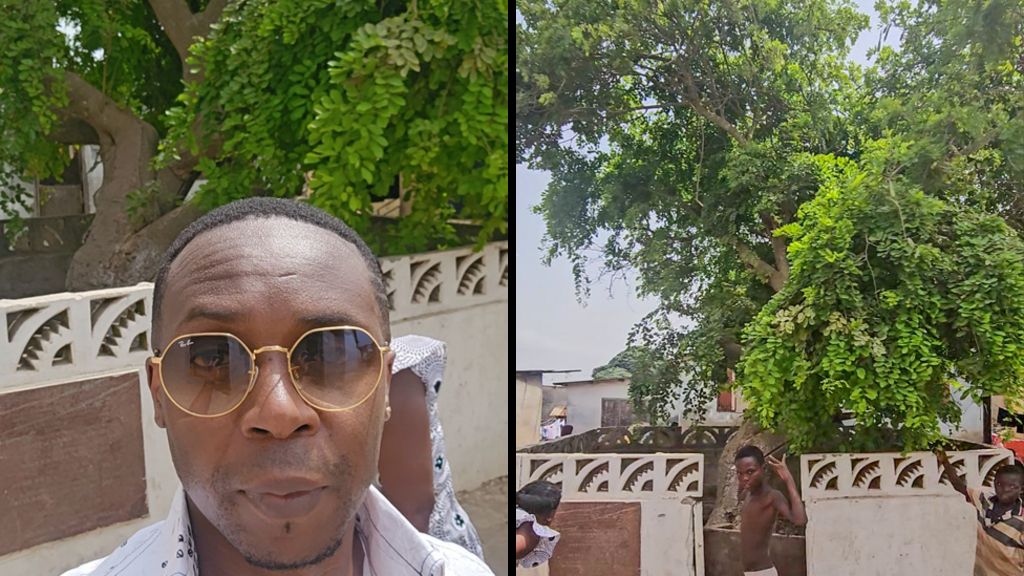
On the windswept Atlantic coast of Ghana, in the quiet fishing town of Apam, an unassuming tree rises from rust-red clay, anchoring a story of migration, resilience, and intergenerational memory that stretches back further than most written records of the region. Tucked between two defining monuments of Ghana’s layered colonial and post-colonial history, the tree — called Santseo, meaning “Under” in the local Fanti language, for the shade it has offered communities for centuries — is barely noticed by daily passersby. But for one extended Ghanaian family, it is far more than a feature of the landscape: it is the living anchor of their identity.
Oral tradition passed down through the Wilberforce family traces Santseo’s planting to the 13th century, when a small group of travelers led by Nana Asumbia, a royal spiritual leader from the Akwamu Kingdom’s historic capital of Akwamufie, set out on a westward journey along the coast. Though the exact cause of the group’s departure from Akwamufie has been lost to time, family accounts passed from generation to generation preserve the unique ritual Asumbia followed to choose the group’s new home: the travelers carried a sapling with them, and planted it wherever they paused. If the young tree took root and survived after several days, they knew they had found their permanent settlement. If it died, they continued onward.
The tree species Asumbia chose was no accident. Today identified as *Piliostigma thonningii* — commonly called camel’s foot or monkey bread tree — it is a hardy, drought-resistant species native to much of sub-Saharan Africa, valued across the continent for its medicinal leaves and bark, its wide cooling canopy, and its ability to thrive in poor, harsh conditions where other species fail. For a nomadic community searching for a place to put down roots, the species’ legendary resilience made it the perfect symbol of their own journey.
The group’s first stop after leaving Akwamufie was in what is now central Accra’s Otublohum neighborhood, around the site of the modern General Post Office. The sapling they planted there survived, and descendants of that first group still live in the area today. But the journey continued west, and the travelers next paused near Gomoa Buduburam along the Accra-Winneba highway, where they planted a second sapling. This time, the young tree did not survive. The group took this as a sign they had not yet reached their destination, and moved on once again.
Their final stop came after a chance encounter in the coastal forest, according to oral history. A royal hunter named Inhune Akubuha from Gomoa Asin had wounded an elephant, which fled into the bush before collapsing. When he tracked the dead animal to its final resting place in what is now Apam, he called the traveling group to the spot. It was here that Asumbia planted her third sapling. Days later, when the tree sprouted new growth and took root in the red coastal soil, the group settled. Centuries later, the tree still stands, and the family built their home directly around it, naming the property Santsiwadzi in Santseo’s honor.
Today, Santseo occupies a unique space between two eras of Ghana’s documented history: on one side sits Fort Patience, a Dutch trading fort completed in 1697 during the transatlantic gold and slave trade, when the region was known as the Gold Coast; on the other stands Apam’s Methodist Church, a monument to the spread of Christianity across Ghana’s coast in the centuries after European arrival. Yet according to family tradition, Santseo predates both structures by hundreds of years, making it a rare living marker of pre-colonial African history that outlasted the arrival of European powers and the transformation of local belief systems.
As Christianity spread across Apam, the family that cares for Santseo donated the land on which the Methodist Church now stands. Over time, the tree’s traditional spiritual significance faded, as community members avoided being labeled idolaters for maintaining the old traditions. What remains is not a shrine, but a living memory: a connection to the ancestors who founded the community. Even so, tensions persist around preserving the tree: any extra care or maintenance is often misinterpreted as a return to old ritual practices, leaving the family to walk a careful line between honoring their history and adapting to modern beliefs.
Roughly 40 years ago, members of the extended family reconnected with their ancestral roots in Akwamufie, making the journey east back to the kingdom their ancestors left centuries earlier. Oral tradition in Akwamufie had preserved the story of the traveling group for generations, with a repeated prophecy that they would one day return. The reunion was an emotional occasion, and a family member was installed as Nana Asumbia II, the new Queen Mother, mending the centuries-long divide between the two communities.
Today, Apam’s rhythm is still shaped by the Atlantic Ocean that frames its coast. Fishermen haul nets to shore before dawn, children walk past Santseo on their way home from school along paths their grandparents and great-grandparents used, and every Tuesday, the town observes a long-held sacred tradition: no fishing boats leave the shore, and a gentle stillness falls over the coast, broken only by the quiet roll of the Atlantic.
Santseo still stands through it all, its branches gnarled and shaped by centuries of salt wind and coastal storm, still rooted in the same red clay where Asumbia planted it so long ago. It has survived the rise and fall of kingdoms, the arrival of colonial powers, the transformation of local beliefs, and the slow passage of centuries. A guide for a displaced community, a source of shade and medicine, and a living archive of unwritten African history, the question Nana Asumbia asked when she planted the sapling all those years ago — will this tree take root? — still has the same clear answer, centuries later: yes.