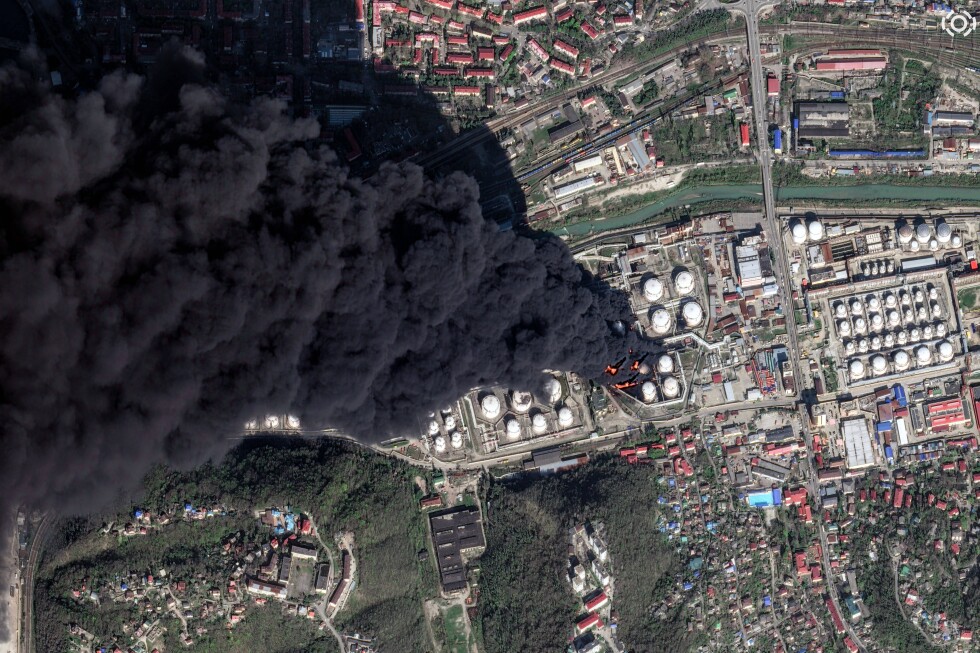
Over the course of the ongoing Russia-Ukraine conflict, Ukraine has dramatically expanded its deep-strike capabilities, launching a sustained campaign of long-range drone attacks against key Russian oil infrastructure hundreds and even thousands of kilometers behind the front lines. The explicit strategic goal of these strikes is to cut off Moscow’s primary source of war funding: global oil exports, a linchpin that has sustained Russia’s full-scale invasion of Ukraine.
Recent months have seen a sharp uptick in these attacks, targeting critical energy hubs across vast swathes of Russian territory. In just over two weeks, the Black Sea coastal town of Tuapse, located 280 miles from the Ukrainian front lines, has endured four separate drone assaults on its major oil refinery and export terminal. Each strike has ignited massive infernos that forced local evacuations, sending plumes of smoke large enough to be visible from outer space. After the third attack on April 18, local emergency officials confirmed that superheated oil products spilled onto residential streets, damaging dozens of civilian vehicles. Further inland, Ukraine confirmed it carried out back-to-back strikes on an oil pumping station in Russia’s Perm region, nearly 900 miles from Ukrainian borders – a distance that underscores the rapid advancement of Ukraine’s domestic drone program. Russian officials have only acknowledged that unspecified industrial facilities were hit, declining to share further details. These attacks are not isolated: in late March, Ust-Luga, one of Russia’s largest Baltic Sea oil and gas export terminals situated more than 500 miles from Ukraine, was struck three times in a single week. In the wake of that assault, regional governor Alexander Drozdenko made the unprecedented admission that the area surrounding St. Petersburg, Russia’s second-largest city, now qualifies as a “front-line region” due to constant aerial threats.
Ukrainian President Volodymyr Zelenskyy has framed these strikes as a parallel effort to international sanctions targeting Russia’s war economy. He argues the campaign has grown even more urgent amid the global energy market upheaval triggered by the Iran conflict and the closure of the Strait of Hormuz, which has generated massive windfall profits for Russian oil exporters. Zelenskyy estimates that Russia has suffered direct losses of at least $7 billion from oil infrastructure attacks since the start of 2024, noting that exports from key terminals including Ust-Luga and Primorsk have already dropped. Independent experts add that alongside disrupting export routes, the strikes have eroded Russia’s domestic oil refining capacity – a problem compounded by existing international sanctions that make it nearly impossible for Moscow to source replacement parts for damaged infrastructure.
Yet the full economic impact of the campaign remains uncertain, as global market shifts have worked in Russia’s favor. Data from the International Energy Agency shows that Russian crude and oil product exports rose by 320,000 barrels per day month-over-month in March 2024, hitting a total of 7.1 million barrels daily. Soaring global oil prices pushed export revenues nearly double between February and March, jumping from $9.7 billion to $19 billion. It remains unclear whether the more recent April strikes will alter this upward trajectory. Chris Weafer, CEO of the international consultancy Macro-Advisory Ltd, notes that geopolitical tensions around Iran have unexpectedly propped up Russia’s energy sector and federal budget, pulling it back from a financial crisis that was emerging in late February. Weafer also adds that the visible damage from strikes is often less severe than the dramatic footage suggests: attacks on partially filled oil storage tanks produce spectacular fires from ignited vapors, but typically only delay deliveries by a few days, rather than destroying critical pumping or loading infrastructure that is far better protected than above-ground storage tanks.
Militarily, the strikes have demonstrated just how far Ukraine’s domestic drone program has advanced since the start of the full-scale invasion in 2022. Ukraine’s Defense Ministry confirms the country has more than doubled the range of its deep-strike capabilities over the past two years, allowing drones to approach targets from multiple directions and significantly complicate Russian air defense efforts. Marcel Plichta, a security researcher at the University of St. Andrews, notes that this level of long-range domestic strike capability simply did not exist for Ukraine just four years ago. “Drone attacks have so far been a very successful case of leveraging simple, domestically assembled technology to attack Russia in places that, at the start of the war, they just would have never expected to be attacked,” Plichta explained.
Beyond military and economic outcomes, the strikes have already brought severe, lasting environmental damage that is forcing ordinary Russians far from the front lines to confront the realities of the war. In Tuapse, a popular Black Sea tourist destination, officials confirmed dangerous levels of the carcinogen benzene were detected in the air during active fires, urging residents to stay indoors. Local residents have widely reported so-called “black rain” – oily, toxic droplets that stain skin, clothing and infrastructure. Local media has shared graphic footage of stray animals with fur stained gray by oil residue, while oil spills along the coastline have coated marine life, and photos of oil-covered beached dolphins have circulated widely across Russian social media.
Vladimir Slivyak, co-chair of Russian environmental NGO Ecodefense, warned that the damage will have decades-long consequences for both human health and the regional ecosystem. “There is a lot of oil in the sea,” Slivyak said. “In the next few years, every storm will be bringing more oil pollution onto the coast.”
So far, widespread public backlash against the war has not emerged, as Russian authorities continue a sweeping crackdown on anti-war dissent. But Slivyak argues that the visible, personal impact of these strikes is eroding trust in official government messaging. “I think a lot of people understand that there is a very big difference between what Putin says and what regional authorities are saying, and what’s really going on,” he noted.