分类: world

  • The remains of 4 Italian divers killed in a Maldives cave dive have been repatriated

    The remains of 4 Italian divers killed in a Maldives cave dive have been repatriated

    A tragic deep-sea diving accident off the coast of the Maldives has claimed six lives total, including five Italian divers and one Maldivian recovery diver, and the remains of the four remaining Italian victims have finally been flown home nearly two weeks after the incident, a Maldivian government spokesperson confirmed Saturday.

    The disaster unfolded on May 14, when a group of five Italian divers set out to explore an uncharted underwater cave in the Vaavu Atoll region of the Maldives. The group descended far past the Maldives’ official recreational depth limit of 30 meters, reaching the cave mouth at 50 meters and eventually penetrating to the cave’s innermost chamber around 60 meters below sea level. Shortly after entering the cave, all five divers went missing, cutting off contact with surface teams. On the day of the disappearance, recovery crews retrieved the body of the group’s diving instructor, Gianluca Benedetti, just outside the cave entrance, and his remains were immediately returned to Italy.

    What followed was a complex, high-stakes recovery operation that itself turned deadly. When a Maldivian military diver assigned to the mission, Mohamed Mahudhee, died during an early recovery attempt, the operation was temporarily halted amid safety concerns. To overcome the extreme depth and challenging cave conditions, three specialized Finnish deep cave diving experts were brought in to join the mission. Last week, the expert team successfully located the four remaining bodies clustered together in the cave’s deepest chamber.

    The victims have all been formally identified: the group included Monica Montefalcone, an associate professor of ecology at the University of Genoa; her 24-year-old daughter Giorgia Sommacal; Federico Gualtieri, a practicing marine biologist; Muriel Oddenino, a marine researcher; and lead instructor Benedetti. Maldivian authorities have already revealed key inconsistencies in the group’s dive permit application: while the trip did receive official approval, the submitted proposal did not disclose the exact location of the cave the team planned to explore, and at least two of the five divers were not listed on the official researcher permit submitted to regulators.

    In a press statement Saturday, Maldives President’s Spokesperson Mohamed Hussain Shareef announced that two separate formal investigations have been launched into the tragedy. The first probe will examine the circumstances that led to the deaths of the five Italian divers, while the second will specifically investigate the on-duty death of Mahudhee during the recovery effort. Shareef added that Italian authorities have agreed to share any autopsy findings from the repatriated remains to support the Maldivian investigations. Early Saturday morning, the four remains were officially repatriated to Italy, bringing a painful chapter of the tragedy to a close as authorities work to uncover what went wrong.

  • Pope Leo visits Italy’s ‘Land of Fires’ as families seek justice for children lost to toxic waste

    Pope Leo visits Italy’s ‘Land of Fires’ as families seek justice for children lost to toxic waste

    In the hard-hit region surrounding Naples, southern Italy, grieving families whose loved ones fell victim to pollution-linked cancer are gearing up to welcome Pope Leo XIV on a pastoral visit Saturday, bringing decades of pain, unaddressed anger and quiet demands for accountability after a massive mafia-controlled toxic dumping scheme destroyed their community.

    The pontiff’s trip to the infamously nicknamed Terra dei Fuochi — or Land of Fires — falls on the eve of the 11th anniversary of Pope Francis’ landmark environmental encyclical *Laudato Si’*, a clear signal that Leo intends to uphold the environmental justice agenda laid out by his predecessor. This long-overdue visit was first scheduled for Francis in 2020, but the COVID-19 pandemic forced its cancellation, leaving local families waiting four more years to share their story with the Vatican.

    The crisis at the heart of the visit stretches back more than 35 years. For generations, the region’s powerful Camorra crime syndicate has run a multibillion-euro illegal toxic waste operation, dumping, burying and burning hazardous materials across farmland and residential areas spanning 90 municipalities near Naples and Caserta, home to 2.9 million Italian residents. Last year, the European Court of Human Rights sided with local residents in a decades-long legal battle, confirming their claims that the mafia’s reckless activities caused sharply elevated rates of cancer and chronic life-threatening illnesses across the region.

    The court’s binding ruling delivered a sharp rebuke to Italian national authorities, finding that government officials had been aware of the widespread toxic contamination since 1988 but failed to intervene to protect public health, despite the Camorra’s well-documented control of the region’s waste disposal industry. The ruling ordered Italy to complete two key targeted actions within a two-year window: create a comprehensive public database mapping all known toxic waste sites, and conduct independent, verifiable assessments of the long-term health risks faced by people living in affected areas.

    For locals, the pope’s visit is not just a symbolic pastoral stop: it is a chance to put a human face on the environmental catastrophe that has decimated a generation of young people. In Acerra, the small city of 58,000 where the meeting will take place, local Bishop Antonio Di Donna estimates that roughly 150 young people have died from pollution-linked cancer over the past 30 years alone. Di Donna emphasized that these young deaths are not random health tragedies: they are direct, preventable consequences of criminal dumping and government inaction.

    “These children and young people who have died are, to all intents and purposes, victims of environmental pollution. There is a clear, proven correlation between the contamination here and the sky-high incidence of cancer,” Di Donna explained in remarks ahead of the visit.

    Among the families waiting to meet the pope is Angelo Venturato, whose 25-year-old daughter Maria died of cancer in 2016. Venturato says he does not seek personal comfort from the meeting — he wants to use the pontiff’s platform to push for change for the children and families who still live in the contaminated region.

    “I’d like to give these young people a future, so I’m asking for the pope’s help with this,” Venturato said. “That is, I’m making a strong appeal to him to go to those in power and say, ‘Look, let’s heal this land of fires.’”

    Filomena Carolla, who lost her 24-year-old daughter Tina De Angelis to cancer, will bring a handcrafted memory book filled with mementos of her daughter’s life to share with the pope. Carolla says she carries unending anger at the criminal actors and officials who allowed the poisoning to continue, robbing young people of their lives before they had a chance to grow up.

    “I’m just angry at the people who poisoned the soil, because what did our children have to do with it? What did they have to do with it, so young,” Carolla said.

    The visit marks one of the first high-profile actions signaling Pope Leo XIV’s commitment to environmental justice, an issue that has grown in priority for the Vatican in recent years, following Francis’ groundbreaking 2015 encyclical that tied care for the natural world to global social justice.

  • Argentine freed from Venezuelan prison urges pressure to release remaining prisoners

    Argentine freed from Venezuelan prison urges pressure to release remaining prisoners

    BUENOS AIRES, Argentina – Nearly two months after walking free from a Venezuelan prison following 448 days of detention on disputed political charges, Argentine national Nahuel Gallo is urging the international community to ramp up pressure on Venezuela’s interim government to secure the release of hundreds of people still jailed for political motives.

    The 35-year-old was released on March 1, more than 14 months after he was arrested at a Venezuelan immigration checkpoint in December 2024 while traveling to meet his Venezuelan partner and their toddler son. At the time of his arrest, the country was still under the control of now-ousted former President Nicolás Maduro, who leveled accusations of espionage and terrorist activity against Gallo that he has repeatedly denied.

    Gallo shared a harrowing account of his detention in exclusive comments to the Associated Press, detailing systematic abuse and inhumane conditions he endured while held at the Rodeo I prison. From his initial interrogation by Venezuelan military counterintelligence agents to his eventual release, Gallo described a pattern of violence, psychological torment, and neglect that still haunts him months after gaining freedom.

    Upon his arrest, agents found WhatsApp conversations between Gallo and his partner discussing Venezuela’s volatile political and economic situation, which prompted immediate accusations of dissent. When a search of his phone uncovered contacts linked to Argentine judicial agencies, officers labeled him a spy outright. Gallo recalled being threatened with death, with a gun pressed to his skull and a Taser held to his body as agents threatened to throw him from a moving truck during interrogations. He said he was repeatedly beaten and kicked while handcuffed in the early days of his custody.

    Nearly three weeks after his arrest, then-Venezuelan Attorney General Tarek William Saab publicly announced formal charges that Gallo had participated in “terrorist actions” against the Maduro government.

    Transferred to Rodeo I prison to serve out his pre-trial detention, Gallo faced conditions that tested his ability to survive. As a foreign detainee, he was barred from receiving any outside visits, and he was cut off from all contact with Argentine consular officials for more than a year. He was given only limited access to medical care, and all inmates were restricted to just a few minutes per day for bathing, washing clothing, and using restroom facilities. Prison guards regularly sprayed detained people with pepper spray as punishment and intimidation, according to Gallo’s account.

    It was only after a full year of detention and a sustained hunger strike that Gallo was finally allowed his first phone call with his partner. For him, the worst abuse was not the violence inflicted on him directly, but the helplessness of watching other prisoners tortured nearby.

    “The greatest torture is seeing something being done to someone else and not being able to do anything,” Gallo said.

    Following Maduro’s ouster and capture by U.S. forces in January, interim President Delcy Rodríguez took power and pledged to implement sweeping democratic reforms. Her government has previously denied allegations of systematic human rights abuses in Venezuelan prisons. This week, National Assembly President Jorge Rodríguez – the interim president’s brother – announced plans to release 300 detainees, a number that includes many detainees classified as political prisoners by international human rights organizations.

    Despite this announced reform, critics warn that hundreds of people remain behind bars solely for their political views, a reality that leads Gallo to argue Venezuela’s old repressive system remains largely intact. Even after his release, Gallo says he still feels imprisoned until every one of his former fellow inmates is freed.

    “I think we’re still imprisoned until our fellow inmates are freed,” Gallo said. Before he left Rodeo I, he recalled, his cellmates shared one simple plea: “Gallo, don’t forget about us.”

    That promise has shaped Gallo’s work in the weeks since he returned to Argentina. He has turned to social media to shine a light on the abusive conditions inside Venezuelan prisons and advocate for the release of all remaining political detainees. “The person who’s still inside is waiting for the one who got out to do something,” he explained.

    On Thursday, Gallo met with U.S. Ambassador to Argentina Peter Lamelas in Buenos Aires. After the meeting, Lamelas released a statement reaffirming the U.S. position that the former Maduro regime “used the arbitrary detention of foreign citizens as a tool of political repression.”

  • Colombian army deploys hundreds of soldiers in country’s southwest after land dispute leaves 7 dead

    Colombian army deploys hundreds of soldiers in country’s southwest after land dispute leaves 7 dead

    BOGOTA, Colombia – Fresh deadly inter-communal violence has sparked a major security deployment in southwestern Colombia, after a long-running territorial dispute between two Indigenous groups erupted into open conflict that left multiple people dead and dozens more injured.

    On Thursday, violent clashes broke out in a rural zone of Cauca department’s Silvia municipality, pitting the Misak and Nasa Indigenous communities against one another. Both groups have laid overlapping claims to the same parcel of land, a source of simmering tension that has persisted for months. By Friday morning, official preliminary counts put the death toll at seven people, with more than 110 others wounded – most hit by gunfire. Defense Minister Pedro Sánchez cautioned that the number of fatalities and casualties could climb in the coming hours as rescue teams reach isolated areas of the conflict zone.

    In response to the violence, Colombian national security forces launched a large-scale deployment to the region on Friday. The national army announced via social media that more than 500 infantry soldiers, backed by air support, have entered the Silvia area to restore public safety for local residents and prevent further escalation of the conflict. The deployment aims to separate the rival groups and create a secure environment for dialogue to resume.

    Tensions between the two communities first began to rise in April of this year. Colombia’s state-run National Land Agency has been involved in the dispute since that time, taking part in formal mediation sessions and technical working groups designed to resolve ambiguity over the official territorial boundaries between the two Indigenous groups. In the wake of Thursday’s violence, the agency repeated its call for both communities to set down weapons and return to the negotiating table to resolve their differences through peaceful dialogue rather than armed confrontation.

    The violence drew swift international reaction: the Office of the United Nations High Commissioner for Human Rights’ Colombia mission released a statement Thursday calling for an immediate end to hostilities and urging national authorities to launch a full investigation into the violence, holding all those responsible for deaths and injuries legally accountable.

    The region where the clashes occurred already faces significant security challenges, with multiple illegal armed factions active across Cauca department. Among these active groups are dissident units of the former Revolutionary Armed Forces of Colombia (FARC) that refused to disarm under the terms of the landmark 2016 national peace agreement with the Colombian government. These armed groups often exacerbate local tensions over land and resources to extend their own control over territory in remote rural areas.

  • Russia’s Putin vows retaliation after accusing Ukraine of hitting student dormitory

    Russia’s Putin vows retaliation after accusing Ukraine of hitting student dormitory

    A recent drone strike on the occupied Ukrainian town of Starobilsk has escalated cross-border tensions, with Russian authorities accusing Kyiv of targeting a civilian student dormitory and Ukrainian forces confirming the attack as a strike on an elite Russian military unit.

    According to Russian President Vladimir Putin, the overnight three-wave assault using 16 drones left six people dead, 39 wounded, and 15 others unaccounted for as of Friday. Putin emphatically rejected any suggestion that the damage to the building could have resulted from Russian air defense or electronic warfare countermeasures, claiming no military infrastructure was located near the collapsed structure in Luhansk Oblast. He has formally ordered Russia’s military leadership to draft immediate proposals for retaliation against Ukraine.

    Local officials installed by the Kremlin have released visual evidence showing the extent of the destruction, with emergency response teams combing through collapsed concrete rubble for survivors. Russian state media has also featured an interview with a 19-year-old identified as an injured student, Diana Shovkun, though no imagery has been released of the people Moscow says were killed in the incident.

    Kyiv’s account of the strike differs sharply from Moscow’s narrative. Ukraine’s military has openly acknowledged carrying out the attack, but says the target was the headquarters of Russia’s elite Rubicon drone unit. The Ukrainian statement adds that Rubicon forces have repeatedly launched attacks on Ukrainian civilian populations and infrastructure, and that Ukrainian military operations strictly follow international humanitarian law and the established customs of war.

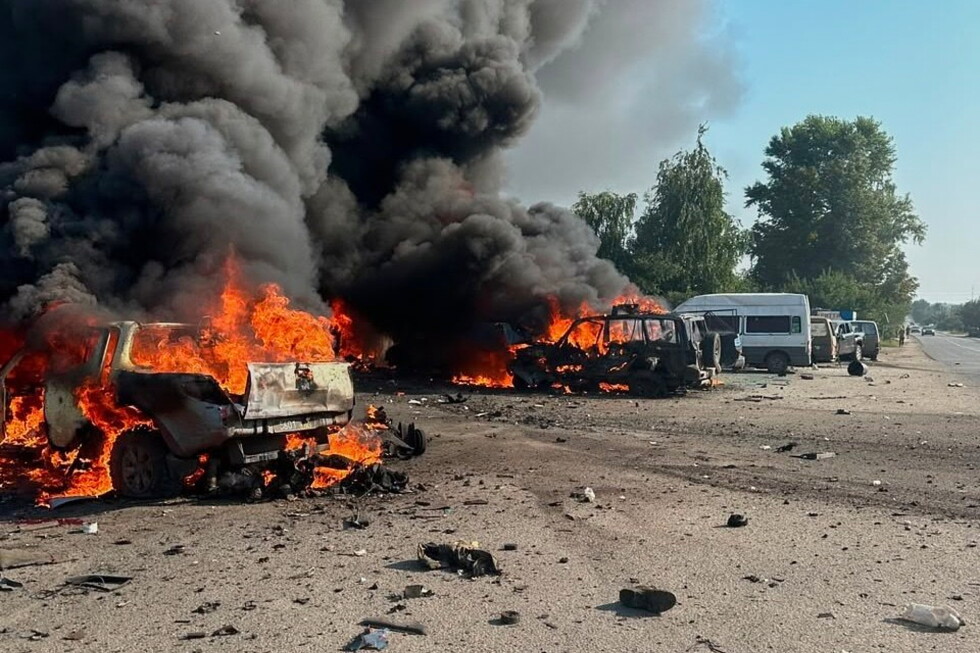
    The Starobilsk strike follows just one day after Ukrainian President Volodymyr Zelensky announced another successful strike on Russian-occupied territory: a hit on a Federal Security Service (FSB) headquarters in Moscow-controlled southern Kherson Oblast. Zelensky claimed that the strike left roughly 100 Russian occupying personnel dead or injured. Russia’s military has not issued any official comment on the Kherson attack, though a pro-Kremlin Telegram channel has acknowledged unspecified casualties following what it described as a large-scale drone assault.

    Independent verification of either side’s claims has not been possible, as the BBC notes it cannot confirm details of the Starobilsk incident on the ground. This exchange of strikes comes amid a long-running war of words over civilian casualties that stretches back to the start of Russia’s 2022 full-scale invasion of Ukraine. Ukraine has repeatedly documented and condemned what it says are deliberate Russian strikes on civilian targets, a charge the Kremlin consistently denies. Just one week prior, Ukrainian officials reported that a Russian missile strike on a multi-story residential apartment building in Kyiv killed 24 people, including three young girls.

  • Trump is putting pressure on Cuba – why and to what end?

    Trump is putting pressure on Cuba – why and to what end?

    Decades of fragile, strained relations between the United States and Cuba have plunged to new lows in recent weeks, following a series of aggressive moves by the second Trump administration that have put the Caribbean nation on high alert for potential military intervention.

    Since his return to the White House, US President Donald Trump has openly stated his goal of ousting Cuba’s current ruling leadership, even speculating publicly that the island’s government is on the brink of collapse. In March, he claimed Cuba was mired in deep crisis and teased the possibility of a so-called “friendly takeover” of the country. While no formal military invasion plans have been announced, heightened surveillance activity in the region has amplified Cuban anxieties. Over the past seven days, US military aircraft have intentionally kept their flight transponders active while operating near Cuban airspace, broadcasting their positions publicly on global flight-tracking platforms. Dr. Steve Wright, a UK-based expert in unmanned aerial and surveillance technology, called the choice to leave transponders enabled almost certainly intentional, noting the move is designed to send an unambiguous message that US intelligence maintains constant oversight of the island as it ramps up pressure.

    The most provocative recent US action came this week, when federal prosecutors unsealed an unprecedented murder and conspiracy indictment against 94-year-old Raúl Castro, Cuba’s former president and the symbolic “Leader of the Cuban Revolution.” The charges stem from a 1996 incident in which Cuban fighter jets shot down two small civilian aircraft operated by Brothers to the Rescue, a Miami-based Cuban exile group. Four people, three of them US citizens, were killed in the incident. Washington has long maintained the planes were shot down over international waters, while Cuba has consistently argued the aircraft entered its sovereign airspace after repeated incursions that posed a national security threat. Along with Raúl Castro, five other Cuban figures face charges including conspiracy to kill US nationals, murder, and destruction of US aircraft; a conviction could carry a life sentence or the death penalty. Acting US Attorney General Todd Blanche said the charges reflected that the US “does not, and will not, forget its citizens,” but Cuban leaders have denounced the indictment as a baseless political gambit to justify military action. Cuba’s current president Miguel Díaz-Canel called the prosecution “a political manoeuvre, devoid of any legal foundation,” reaffirming that the 1996 downing was a legitimate act of self-defense within Cuban national waters.

    Experts and Cuban officials note the indictment is a deliberate strike at the heart of Cuba’s ruling structure. While Díaz-Canel formally holds both the presidency and leadership of the Cuban Communist Party, the Castro name remains the most powerful symbolic and political force on the island, commanding deep loyalty within the military and security services that dominate Cuban politics and economics. Raúl Castro, who led the country from 2008 to 2018 after decades as defense minister under his older brother Fidel, remains the figurehead of the 1959 revolution that established the island’s anti-imperialist, one-party communist system. The Cuban military’s sprawling conglomerate GAESA controls most of the island’s key economic assets, underpinning the power of the ruling political-military elite. In a recent video address to the Cuban people, US Secretary of State Marco Rubio argued that GAESA operates as a “state within a state,” controlled by a corrupt, incompetent elite that blocks reform and any potential rapprochement with the US. Rubio confirmed that the White House prefers a diplomatic resolution to the current standoff, but said Trump retains the right and obligation to respond to any purported US national security threat, adding that the probability of reaching a peaceful agreement is “not high.” Cuban Foreign Minister Bruno Rodríguez has dismissed Rubio’s comments as an attempt to “instigate a military aggression.”

    Beyond the legal charges, the most impactful pressure on Cuba has come from a total US oil blockade and sweeping new sanctions that have crippled the island’s already fragile economy. For years, Venezuela and Mexico supplied the vast majority of Cuba’s crude oil and fuel, but both halted shipments after the Trump administration removed Venezuela’s sitting president in January and threatened tariffs on any country that sent petroleum to Havana. Since the blockade was implemented, only one Russian oil tanker has successfully delivered fuel to the island, leaving Cuba facing chronic fuel shortages that have sparked months of widespread, hours-long blackouts across the country. Shortages of food, medicine, and basic goods have also reached crisis levels, forcing hospitals to scale back critical care and forcing schools and government offices to close repeatedly. Public discontent has boiled over into repeated street protests across the capital Havana, including a demonstration this week where demonstrators blocked roads with burning debris and chanted anti-government slogans. This month, the US added new sanctions targeting senior Cuban officials in the energy, defense, finance, and security sectors, accusing them of human rights abuses and corruption.

    Washington has also offered $100 million in humanitarian aid to Cuba, but attached strict conditions requiring the aid be distributed through the Catholic Church and independent non-governmental organizations, completely bypassing the Cuban government. The Trump administration says Cuba has rejected the aid, but Rodríguez countered that Cuba does not refuse assistance offered in good faith, and the most meaningful help the US could provide would be lifting the blockade entirely.

    Unconfirmed intelligence reports published by US news outlet Axios have further escalated tensions, claiming that Cuba holds roughly 300 combat drones and is planning potential strikes on US targets including the Guantanamo Bay Naval Base, Key West, Florida, and US naval vessels operating in the region. The report also claimed Iranian military advisors are present in Havana, an allegation Cuban officials have dismissed as part of a fabricated pretext for military intervention. Rodríguez has repeatedly emphasized that Cuba “neither threatens nor desires war” but is fully prepared to repel any external aggression.

    Backchannel talks between the two governments were confirmed by both sides in March, but Cuba has so far responded only with formal public condemnation of US actions, characterizing the entire campaign as “collective punishment” of the Cuban people. Two of Cuba’s key international allies, China and Russia, have both spoken out against US actions, with Beijing calling on Washington to end its coercion and threats, and the Kremlin saying the pressure on Cuba “borders on violence.” As the blockade continues and rhetoric hardens on both sides, the Caribbean faces one of its most severe security crises in decades.

  • Pakistan military chief arrives in Tehran in push to end Iran war

    Pakistan military chief arrives in Tehran in push to end Iran war

    Nearly three months after a fragile ceasefire paused the open conflict between the US-Israeli alliance and Iran that ignited on February 28, top Pakistani military commander Asim Munir touched down in Tehran on Friday, stepping into the most high-profile mediation effort to date to lock in a permanent end to the devastating regional war. As Islamabad holds the official mediator role for talks between the two adversarial sides, the visit comes as Iran evaluates a new American peace proposal that has sparked cautious optimism from Washington — even as Iranian officials warn deep divisions remain far from resolved.

  • Newly declassified video shows fighter jet shoot down UFO

    Newly declassified video shows fighter jet shoot down UFO

    In a recent disclosure that has reignited public fascination with unexplained aerial phenomena, the U.S. government has released newly declassified footage showing a military fighter jet shooting down an unidentified flying object (UFO). The long-speculated event, once shrouded in classification barriers, has finally come into public view, but leading researchers and defense experts are already pushing back against widespread assumptions that the object came from beyond Earth.

    For decades, reports of military encounters with UFOs have circulated in fringe communities and mainstream media alike, fueled by classified government programs that explored unexplained aerial sightings across the country. This latest release marks one of the few times the federal government has publicly confirmed a hostile intercept of an unidentified object, with clear video footage capturing the sequence of the shootdown. Despite the sensational nature of the disclosure, experts who have analyzed the declassified video emphasize that the visual evidence provides no concrete confirmation that the downed craft relied on alien technology, nor does it offer any proof that extraterrestrial life was involved in the object’s origin.

    Many defense analysts have put forward alternative, more grounded explanations for the incident. Most common among these is the theory that the UFO was actually an unauthorized civilian drone, a high-altitude research balloon, or a piece of uncrewed surveillance technology developed by another nation-state. Officials have not yet confirmed any of these alternative theories, and the object’s origin remains officially unconfirmed following the video’s release.

    The declassification comes as the U.S. government has gradually increased transparency around UFO-related incidents in recent years, shifting away from the decades-long policy of dismissing or covering up unexplained sightings. A congressional mandated task force on unidentified aerial phenomena has published multiple reports in recent years, noting that the vast majority of unexplained sightings can be linked to natural atmospheric phenomena or human-made technology. This latest disclosure is expected to renew public and congressional interest in further declassification of government documents related to UFO encounters, as researchers continue to work through the backlog of classified material related to unexplained incidents.

  • Deported flotilla activists allege ‘sadistic’ sexual abuse and torture in Israeli captivity

    Deported flotilla activists allege ‘sadistic’ sexual abuse and torture in Israeli captivity

    After Israel’s unauthorized raid on a Gaza-bound aid flotilla in international waters, hundreds of detained activists who were finally deported have come forward with harrowing accounts of widespread abuse, torture, and sexual violence during their Israeli captivity, triggering global condemnation and diplomatic backlash against the Israeli government.

    A total of 430 activists participating in the Global Sumud Flotilla, a mission to deliver humanitarian aid to the blockaded Gaza Strip, were taken into Israeli custody when Israeli military forces intercepted and raided their vessels in open international waters. On Thursday evening, all detained activists were expelled from Israel and arrived in Istanbul, with public footage capturing the group stepping off the plane clad in gray prison tracksuits and traditional Palestinian keffiyehs, raising their fists in defiance as waiting family members and supporters welcomed them home.

    Since their release, multiple activists and journalists among the group have shared detailed, consistent accounts of brutal mistreatment starting from the moment of the raid. Italian journalist Alessandro Mantovani, one of the deported detainees, spoke to reporters at Rome’s Fiumicino Airport after being transferred from Israeli custody. He described how he and other detainees were transported to Israel’s Ben Gurion Airport in handcuffs with heavy chains bound around their ankles before being put on a deportation flight to Athens. He confirmed that Israeli soldiers beat the group during the process, kicking and punching detainees while taunting them with the words “Welcome to Israel.”

    Israeli human rights organization Adalah, which is representing the detainees, has corroborated many of these accounts. Miriam Azem, a representative from Adalah, shared that one female activist was forced to strip naked and run while prison guards stood by laughing at her humiliation. One anonymous activist described in a recorded video interview how Israeli soldiers dragged her across the ground while her hands and feet were bound, with tight cuffs cutting off circulation and leaving her hands completely numb. She emphasized that guards acted with open cruelty, laughing throughout the abuse, adding: “They took off my shirt, took pictures. Mistreated us all night long. They were super sadistic.”

    Australian activist Juliet Lamont, one of the high-profile detainees, gave a particularly chilling account of her captivity. She said she was bound with heavy cables, subjected to water torture, and sexually assaulted by Israeli personnel. Lamont also detailed the severe harm inflicted on other detainees, noting that multiple activists suffered broken ribs, some were shot with tasers directly to the face, and many were injected with unlabeled sedative substances with no medical explanation. Online photo shares from the activists show visible bruising, cuts, and other injuries consistent with their allegations of severe beatings.

    Brazilian activist Thiago Avila, who was previously detained by Israel during an earlier aid flotilla mission, shared a video confirming that the abuse extends far beyond this latest operation, alleging that multiple activists were raped by Israeli soldiers during the detention process. Avila stated that numerous cases of sexual violence were documented, occurring both on the prison transport boats and during transfer to the Israeli port of Ashdod.

    Adalah has emphasized that the entire Israeli operation, from the unprovoked raid on civilian aid vessels in international waters to the systemic torture, humiliation, and arbitrary detention of the activists on board, amounts to a blatant violation of longstanding international law. The deportations and release of the activists come after a wave of global outrage sparked by a leaked viral video showing far-right Israeli Security Minister Itamar Ben Gvir personally overseeing the abuse and humiliation of detained flotilla participants.

    The leaked footage shows Ben Gvir waving an Israeli flag while confronting bound detainees, who are being manhandled by Israel Prison Service officers and forced to kneel with their faces pressed to the ground. While the video sparked backlash within Israel, most domestic criticism focused not on the abuse itself, but on fears that the public release of the footage would severely damage Israel’s international reputation. The video also drew sharp condemnation from leaders and governments across the globe, particularly from nations whose citizens were among the detained activists.

    Antonio Costa, President of the European Council, stated publicly that he was appalled by the content of the leaked footage. In a coordinated show of diplomatic disapproval, multiple countries including the United Kingdom, Italy, Spain, and France have formally summoned Israel’s top diplomatic representative to their capitals to protest the abuse of their citizens.

  • Riot hits DR Congo hospital as Ebola response angers victims’ families

    Riot hits DR Congo hospital as Ebola response angers victims’ families

    In the epicenter of the latest deadly Ebola outbreak in the Democratic Republic of the Congo’s northeastern Ituri Province, widespread public anger, fear, and deep-rooted distrust of government authorities have boiled over into violent unrest that left key medical infrastructure destroyed. On Thursday, rioters set fire to isolation tents at Rwampara Hospital, leaving only charred, blackened frames behind after soldiers stepped in to disperse the crowd by firing warning shots. One nurse was injured by thrown stones during the violence, which was triggered by a dispute over the body of a 24-year-old man — the son of a serving soldier — who had died at the facility of suspected Ebola.

    Under international public health protocols for Ebola response, authorities cannot immediately release the bodies of infected victims to their families, as the virus spreads through direct contact with bodily fluids and infected remains, making unsafe burial practices one of the leading drivers of new transmissions. Even so, this requirement has sparked fierce suspicion in the conflict-wracked rural region, where state services have been largely absent for decades and residents have long been distrustful of central government institutions.

    The current outbreak, the 17th recorded Ebola event to hit the vast Central African nation, is caused by the Bundibugyo strain, for which no licensed vaccine or targeted treatment currently exists. The World Health Organization estimates the outbreak has already killed more than 177 people, forcing responders to rely almost entirely on precautionary measures and rapid contact tracing to slow spread.

    Many local residents remain unconvinced that Ebola is even the cause of recent deaths, dismissing the outbreak as an invention of state authorities. After the riot, as three bodies of suspected Ebola victims were prepared for official, controlled burial, multiple relatives rejected the official narrative. “My brother is not dead from Ebola, it’s an imaginary disease,” 22-year-old Jeremie Arwampara told reporters. Ezekiel Shambuyi, another grieving relative, added, “Why are they refusing to give us the bodies? He’s my big brother, I cannot be afraid of him.” Even among the rioters were active-duty soldiers who were relatives of the victim, who directly threatened hospital healthcare workers, according to an anonymous hospital source.

    As dusk fell over Rwampara’s rolling green hills, the three bodies were transported in black-and-white coffins to a remote cemetery outside the town, escorted by armored jeeps carrying heavily armed soldiers and police. After the coffins were sprayed down with disinfectant, workers in full hazmat suits lowered them into unmarked graves. Grieving family members, who were barred from close contact with the remains, wept openly as a pastor recited biblical verses and a relative sang a quiet funeral dirge. “They’re going to bury our father without us seeing him, it breaks my heart,” said Musa Amuri, whose father was among the dead.

    Local civil society leaders note that traditional mourning practices, which involve close contact with the deceased and large communal gatherings, continue to drive new infections even as the outbreak worsens. “Loved ones are throwing themselves at the bodies, touching the corpses and the clothes of the deceased, while organising mourning rituals bringing together loads of people,” explained Jean Marie Ezadri, a leading Ituri civil society figure. “Unfortunately, this is going on even during this epidemic, which explains the many instances of contamination.”

    Local residents already grappling with repeated massacres by dozens of armed active groups in Ituri say the government’s response to the outbreak has been woefully inadequate. In the nearby town of Mongbwalu, one hospital official reported that while local residents have begun to understand the risk posed by touching infected remains, critical response infrastructure is still missing. “Isolation and triage areas have still not been set up,” the official said, adding that “suspected cases are mixed in with other patients in the hospital wards, with a high risk of infection.” Congolese security forces, which have a long reputation for indiscipline in the region, have also been accused of worsening distrust during previous Ebola outbreaks, further complicating current response efforts.