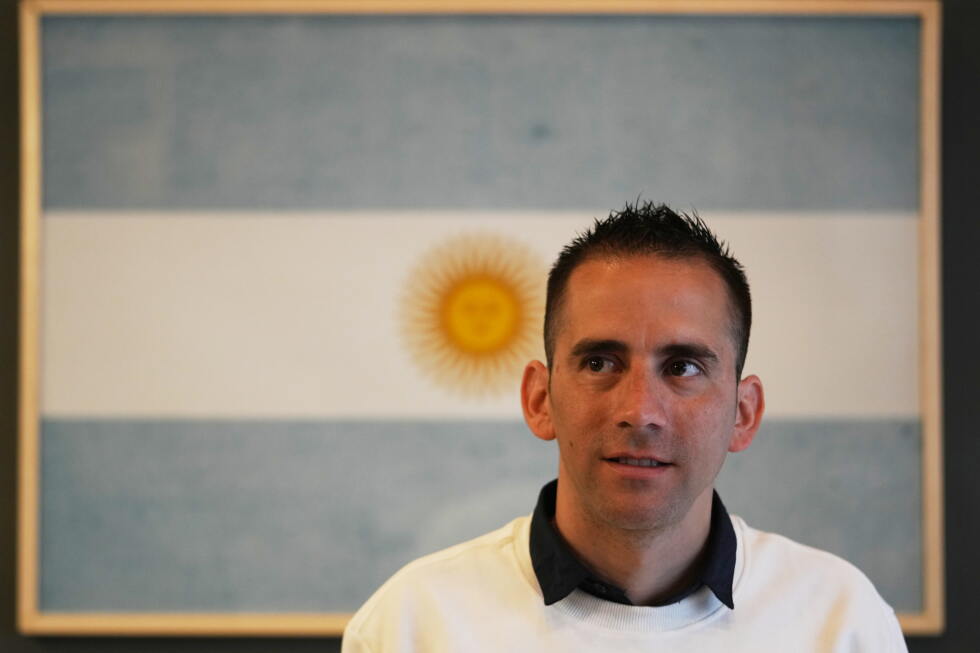
BUENOS AIRES, Argentina – Nearly two months after walking free from a Venezuelan prison following 448 days of detention on disputed political charges, Argentine national Nahuel Gallo is urging the international community to ramp up pressure on Venezuela’s interim government to secure the release of hundreds of people still jailed for political motives.
The 35-year-old was released on March 1, more than 14 months after he was arrested at a Venezuelan immigration checkpoint in December 2024 while traveling to meet his Venezuelan partner and their toddler son. At the time of his arrest, the country was still under the control of now-ousted former President Nicolás Maduro, who leveled accusations of espionage and terrorist activity against Gallo that he has repeatedly denied.
Gallo shared a harrowing account of his detention in exclusive comments to the Associated Press, detailing systematic abuse and inhumane conditions he endured while held at the Rodeo I prison. From his initial interrogation by Venezuelan military counterintelligence agents to his eventual release, Gallo described a pattern of violence, psychological torment, and neglect that still haunts him months after gaining freedom.
Upon his arrest, agents found WhatsApp conversations between Gallo and his partner discussing Venezuela’s volatile political and economic situation, which prompted immediate accusations of dissent. When a search of his phone uncovered contacts linked to Argentine judicial agencies, officers labeled him a spy outright. Gallo recalled being threatened with death, with a gun pressed to his skull and a Taser held to his body as agents threatened to throw him from a moving truck during interrogations. He said he was repeatedly beaten and kicked while handcuffed in the early days of his custody.
Nearly three weeks after his arrest, then-Venezuelan Attorney General Tarek William Saab publicly announced formal charges that Gallo had participated in “terrorist actions” against the Maduro government.
Transferred to Rodeo I prison to serve out his pre-trial detention, Gallo faced conditions that tested his ability to survive. As a foreign detainee, he was barred from receiving any outside visits, and he was cut off from all contact with Argentine consular officials for more than a year. He was given only limited access to medical care, and all inmates were restricted to just a few minutes per day for bathing, washing clothing, and using restroom facilities. Prison guards regularly sprayed detained people with pepper spray as punishment and intimidation, according to Gallo’s account.
It was only after a full year of detention and a sustained hunger strike that Gallo was finally allowed his first phone call with his partner. For him, the worst abuse was not the violence inflicted on him directly, but the helplessness of watching other prisoners tortured nearby.
“The greatest torture is seeing something being done to someone else and not being able to do anything,” Gallo said.
Following Maduro’s ouster and capture by U.S. forces in January, interim President Delcy Rodríguez took power and pledged to implement sweeping democratic reforms. Her government has previously denied allegations of systematic human rights abuses in Venezuelan prisons. This week, National Assembly President Jorge Rodríguez – the interim president’s brother – announced plans to release 300 detainees, a number that includes many detainees classified as political prisoners by international human rights organizations.
Despite this announced reform, critics warn that hundreds of people remain behind bars solely for their political views, a reality that leads Gallo to argue Venezuela’s old repressive system remains largely intact. Even after his release, Gallo says he still feels imprisoned until every one of his former fellow inmates is freed.
“I think we’re still imprisoned until our fellow inmates are freed,” Gallo said. Before he left Rodeo I, he recalled, his cellmates shared one simple plea: “Gallo, don’t forget about us.”
That promise has shaped Gallo’s work in the weeks since he returned to Argentina. He has turned to social media to shine a light on the abusive conditions inside Venezuelan prisons and advocate for the release of all remaining political detainees. “The person who’s still inside is waiting for the one who got out to do something,” he explained.
On Thursday, Gallo met with U.S. Ambassador to Argentina Peter Lamelas in Buenos Aires. After the meeting, Lamelas released a statement reaffirming the U.S. position that the former Maduro regime “used the arbitrary detention of foreign citizens as a tool of political repression.”