分类: world

  • Renewable energy is overtaking traditional power projects across Africa, industry leaders say

    Renewable energy is overtaking traditional power projects across Africa, industry leaders say

    Across the African continent, a profound shift is unfolding in energy infrastructure development, as governments and private investors increasingly pivot away from fossil fuels and large-scale hydropower to prioritize solar, wind, and battery storage projects. This transition is driven by demand for cheaper, more rapidly deployable, and more reliable electricity access to power growing populations and industrial expansion.

    The changing landscape of African energy development came into sharp focus in early May, when China and Zambia announced a $1.5 billion energy package that includes three 300-megawatt projects spanning solar, wind, and coal-fired power. While the inclusion of coal highlights Africa’s ongoing need for consistent baseload power to support unstable grids, the broader trend is clear: countries grappling with soaring fuel import costs triggered by geopolitical tensions like the Iran conflict, inconsistent grid reliability, and rising industrial demand are turning overwhelmingly to renewable energy, which can be brought online far faster and at lower cost than traditional fossil fuel or large hydropower facilities.

    Data from energy research firm Electron Intelligence underscores this momentum. Of the 322 new energy projects announced across Africa in 2025, 173 were solar developments, followed by hydropower at 46, wind at 34, natural gas at 22, and hybrid energy projects at 14. The International Renewable Energy Agency reports that Africa added a record-breaking 11.3 gigawatts of new renewable energy capacity in 2025, three times the volume added in the previous year. South Africa, Egypt, and Ethiopia accounted for the bulk of this growth.

    “Africa is not on the periphery of the global energy transition, it is sitting at its center,” explained Mugwe Manga, climate finance lead at FSD Kenya. “The continent holds the world’s best renewable resources, and the economics have now decisively turned in favor of clean energy.”

    Olamide Niyi-Afuye, CEO of the Africa Minigrid Developers Association (AMDA), noted that the shift goes beyond project numbers to represent a complete strategic rethinking of how energy infrastructure is built. African nations are now prioritizing modular systems that can be deployed quickly and expanded incrementally with flexible financing models, a framework that plays to the strengths of small-scale and distributed solar in particular.

    Plummeting technology costs have been the single biggest driver of this renewable boom. Globally, utility-scale solar costs have fallen by nearly 90% since 2010, while onshore wind costs have dropped roughly 70%. These price declines have made renewables the least expensive option for new electricity generation across most African markets.

    “Renewable energy is now unequivocally the fastest, cheapest, and most bankable way to connect people, companies and economies to the megawatts they need to grow,” said Matt Tilleard, CEO of CrossBoundary Energy, a firm that invests in African renewable projects. Much of the recent growth has come from distributed solar and battery systems, which are installed directly at mines, manufacturing facilities, telecom towers, and residential properties, eliminating the need for connection to overstretched central national grids.

    Official statistics often undercount this distributed growth, Tilleard noted, because traditional counting methods only track capacity connected to main national grids. Data from the Africa Solar Industry Association recorded 23.4 gigawatts of operational solar capacity across Africa by the end of 2025, but Chinese export data shows 58.1 gigawatts of solar panels have been shipped to African countries since 2017, suggesting actual adoption is far outpacing official tracking.

    For investors, renewables hold another key advantage: faster returns on investment and lower exposure to volatile global fossil fuel price shocks. Unlike coal-fired plants, which can take up to 12 years to complete, and large hydropower dams that often require a decade or more of construction, utility-scale renewable projects can generate revenue within 18 months of breaking ground.

    At the Kamoa-Kakula copper complex in the Democratic Republic of Congo, one of Africa’s largest copper mines, CrossBoundary Energy is developing a 233-megawatt solar and battery storage project. Tilleard said the project moved from contract signing to more than 80% completion in just 12 months. “Solar and wind projects are especially attractive at this moment because they combine strong commercial fundamentals with relatively lower investment risk,” Niyi-Afuye added.

    Progressive policy changes across the continent have also accelerated the renewable push. Ethiopia became the first country in the world to ban imports of internal combustion engine vehicles, spurring faster adoption of electric vehicles that in turn drives demand for new clean electricity generation. In South Africa, regulatory changes relaxing caps on private power generation have opened the door to a massive wave of new industrial renewable projects.

    Despite this rapid growth, significant barriers remain. Many African national utilities face deep financial instability, making lenders hesitant to sign onto long-term power purchase agreements. Perceived country risk also pushes financing costs for African renewable projects up to three times higher than costs for similar projects in advanced economies, according to data from the International Energy Agency.

    Multilateral development finance institutions, including the African Development Bank and the International Finance Corporation, have stepped in to bridge this gap, offering concessional loans, credit guarantees, and risk-sharing frameworks to de-risk private investment. Manga argues that the main obstacles to faster expansion are no longer technological or cost-related.

    “What remains is not a question of technology or cost,” he said. “It is a question of finance, political will and preparing bankable projects that will drive demand for power on the continent.”
    This reporting from The Associated Press on climate and energy transition is supported by funding from multiple private foundations, with the AP retaining full editorial control over all content.

  • Palestinian Authority warns against ‘dangerous’ plan to strip Jordan of Al-Aqsa custodianship

    Palestinian Authority warns against ‘dangerous’ plan to strip Jordan of Al-Aqsa custodianship

    A fresh and explosive controversy has erupted over the future of Jerusalem’s Al-Aqsa Mosque compound, after Palestinian officials issued a stark warning against reported US and Israeli efforts to dismantle Jordan’s century-old historic custodianship of the revered Islamic site, a shift that would reorient the holy space to align closely with Israeli interests.

    The public warning came just hours after Middle East Eye (MEE) first published its exclusive reporting revealing the ongoing US-Israeli push for a new governing arrangement at the site. In an official statement released Tuesday by the Palestinian Authority’s Jerusalem governorate, officials warned that the leaked proposal would effectively impose Israeli sovereignty over the holy compound and destroy the long-standing diplomatic status quo that has governed the site for decades.

    “The Hashemite custodianship of the Islamic and Christian holy sites in Jerusalem is an internationally recognised historical, legal and political authority,” the governorate affirmed in its statement. “It serves as a fundamental safeguard for protecting the Al-Aqsa Mosque complex and preserving its Arab and Islamic identity.”

    According to MEE’s Monday reporting, the draft plan seeks to end the 102-year governance of the Jordanian-backed Islamic Waqf, the religious trust that has overseen the site since the British Mandate era. Under the proposed changes, the Al-Aqsa compound would be rebranded as a “multi-faith centre”, granting Jews equal access to the site and formally allowing organized large-group Jewish prayer. The proposal would also grant Israel significant power over key administrative decisions, including the appointment of imams, senior mosque staff, and preachers, as well as formal oversight over the content of weekly Friday sermons.

    Two anonymous U.S. officials confirmed to MEE that Washington has already drafted a policy document outlining its vision for the site’s future. The officials noted that the previous Trump administration aimed to strip Al-Aqsa of its exclusive Muslim identity, repositioning the compound as a global tourist landmark open to all three Abrahamic faiths.

    The Palestinian Jerusalem governorate called the proposal a “dangerous escalation” if implemented, noting that its core goal is the deliberate erasure of the mosque’s exclusively Islamic character.

    Jordan’s Hashemite monarchy has held custodianship over both Muslim and Christian holy sites in Jerusalem since 1924, during the period of British Mandate rule over Palestine. This role was formally codified in Jordan’s 1994 peace treaty with Israel, which explicitly recognized Amman’s “special role” in overseeing Jerusalem’s Islamic holy sites.

    Despite this formal recognition, Palestinian and Jordanian leaders have warned for years that the status quo has been gradually eroded by successive Israeli governments, as well as increasingly emboldened far-right Israeli groups that demand greater Jewish control over the Al-Aqsa compound. Frequent Israeli police raids inside the mosque compound, a steady rise in visits by ultranationalist Jewish activists, and repeated public calls from sitting Israeli ministers for official Jewish prayer rights at the site have all fueled claims that Israel is quietly chipping away at the existing governing arrangement.

    Waqf officials have also repeatedly told MEE that beyond imposing harsh restrictions on Palestinian worshippers, Israel has systematically blocked the Waqf from carrying out critical maintenance and repair work across the Al-Aqsa compound.

    Jordan’s King Abdullah II has repeatedly issued public warnings against any attempts to alter the site’s status quo. Addressing the United Nations General Assembly last year, the king emphasized that any attack on Jerusalem’s holy sites would “ignite the feelings of more than a billion Muslims around the world.”

    The controversy comes amid a separate provocative move by Israeli authorities Tuesday: Israel’s civil administration, the body that enforces Israeli law and policy in the occupied West Bank, announced it was seizing full control of the tomb of the Prophet Samuel (Nabi Samuel), another major religious landmark currently managed by the Islamic Waqf.

    In its statement, the Palestinian Jerusalem governorate issued an urgent call for international intervention, urging the United Nations, UNESCO, the Organization of Islamic Cooperation, and the Arab League to step in immediately to block any attempts to undermine the status quo in occupied Jerusalem.

    The governorate warned that any move to weaken Jordan’s custodianship or alter the fundamental Islamic identity of Al-Aqsa Mosque would carry “serious repercussions for security and stability in the region.”

  • Deforestation in Brazil’s Amazon drops to lowest level since 2019

    Deforestation in Brazil’s Amazon drops to lowest level since 2019

    A landmark new report from Brazilian environmental monitoring network MapBiomas has confirmed that deforestation across Brazil’s Amazon rainforest dropped to its lowest annual level in 2025 since consistent recording began in 2019, delivering a key environmental win for the administration of leftist President Luiz Inácio Lula da Silva ahead of national elections this October.

    MapBiomas, a collaborative consortium of leading Brazilian universities, non-profit environmental organizations, and technology firms, released its findings Wednesday. Data shows Brazil lost 985,000 hectares (approximately 2.4 million acres) of native vegetation across all its biomes in 2025, marking a 20.6% decline in total forest and vegetation clearance compared to 2024. While the official count does not include vegetation destroyed primarily by wildfire, the 2025 fire season brought far less extreme destruction to the region after the all-time record blazes recorded in 2024.

    Deforestation reductions were recorded across all six of Brazil’s major ecosystems, with the Amazon seeing the steepest drop of 23.5% year-over-year. MapBiomas technical coordinator Marcos Rosa linked the downward trend directly to sweeping policy changes implemented by Lula after he took office, noting that sharp increases in federal enforcement operations and penalties for illegal logging have corresponded directly with falling clearance rates nationwide.

    Lula has positioned the fight against Amazon destruction as a core policy priority of his administration, after four years of surging unregulated logging under his far-right predecessor Jair Bolsonaro. The Brazilian president has pledged to eliminate all illegal deforestation across the country by 2030, a goal rooted in the global scientific consensus that intact old-growth Amazon forests are critical natural carbon sinks that slow global climate change. Last year, Lula leveraged Brazil’s role as Amazon steward to host the COP30 United Nations climate summit in the northern Amazonian city of Belém, using the gathering to highlight his environmental agenda.

    Despite the historic decline, the report underscores that mass deforestation remains a pressing crisis for the world’s largest rainforest. Even with the slowdown, an average of five trees are cut down every single minute second *[correction: every second*] in the Amazon. The Cerrado, a biodiverse tropical savanna ecosystem located south of the Amazon basin, remained the hardest-hit region, accounting for more than half of all vegetation clearance recorded in 2025. MapBiomas data confirms that agricultural expansion continues to drive nearly 99% of all native vegetation loss across Brazil.

    The progress on deforestation has also been tempered by ongoing criticism from environmental advocates, who have pushed back against Lula’s approval of a controversial large-scale oil exploration project near the mouth of the Amazon River, a development that threatens marine and terrestrial ecosystems in the estuary. With Lula campaigning for a fourth presidential term in October’s general election, the conflicting pressures of environmental protection and economic development look set to remain a central dividing issue in the race.

  • Haftar’s forces arrest Gaza aid convoy in Libya

    Haftar’s forces arrest Gaza aid convoy in Libya

    A group of international humanitarian activists traveling with a Gaza aid mission has been taken into custody by forces loyal to prominent eastern Libyan military leader Khalifa Haftar in the coastal city of Sirte, according to announcements from the aid organizing group. The Global Sumud Convoy, the coordinating body behind the mission, confirmed via a post on its official Instagram page that the last communication with the detained volunteers was logged at 3:22 p.m. local time on Tuesday. Among those held are civilian volunteers from eight nations across Europe, the Americas, North Africa and the Middle East: Spain, Poland, the United States, Argentina, Uruguay, Portugal, Tunisia and Italy. Most of the detainees work as medical professionals or veteran human rights advocates, who joined the mission voluntarily to deliver critical humanitarian assistance to residents of the Gaza Strip and express solidarity with the Palestinian people. The convoy organizers explained that the group entered the 5+5 Joint Military Commission security zone – a buffer area established under the October 2020 Libyan national ceasefire agreement that remains one of the country’s most contested territorial spaces – to coordinate and negotiate safe passage for the convoy onward to Gaza. Following the detention, the group confirmed that the activists are being held by the Government of National Stability (GNS), the eastern Libyan authority aligned with Haftar’s Libyan Arab Armed Forces (LAAF). The Global Sumud Convoy has issued an urgent call, asking citizens of the home countries of the detained activists to reach out to their respective national embassies in Libya and pressure diplomatic missions to secure the immediate release of the volunteers. Since the outbreak of large-scale conflict in Gaza in October 2023, grassroots activist groups have organized dozens of independent humanitarian missions to deliver aid to the besieged enclave, where widespread food, medicine and clean water shortages have pushed the population into a catastrophic humanitarian crisis. Most attempts to reach Gaza by sea have been intercepted early by Israeli naval forces, while overland missions aiming to cross through the Egyptian border with Gaza have repeatedly encountered a cascade of legal barriers and security disruptions that block their progress. According to reporting from Italy’s independent news agency Nova, Haftar’s security forces have already moved the two Italian citizens detained in the operation to the eastern Libyan city of Benghazi, where local authorities plan to classify the pair as potential irregular migrants rather than detained humanitarian volunteers. As of Thursday, Libyan security institutions operating under eastern Libyan control have not released any public statement explaining the motivation for the arrests, nor have they provided any update on the legal process or current status of the detained activists. The incident unfolds against a backdrop of more than a decade of prolonged political division across Libya, a split that followed the 2011 NATO-backed military intervention that ousted and killed longtime Libyan ruler Muammar Gaddafi. Today, the country is split between two competing governing blocs: the UN-backed interim Government of National Unity that controls western Libya, including the capital Tripoli, and the GNS led by Haftar, which controls most of eastern Libya and receives open military and political backing from the United Arab Emirates and Egypt.

  • Polish-Palestinian survivors take Israeli leaders to court over Gaza genocide

    Polish-Palestinian survivors take Israeli leaders to court over Gaza genocide

    Trauma does not easily loosen its grip, even when the bombs have fallen silent thousands of kilometers away. For five-year-old Malik Agha, the echoes of war live in small, daily habits: he still tucks extra bits of food next to his pillow each night, a quiet instinct born of months of hunger in a Gaza displacement camp. His four-year-old sister Razan automatically sets aside a portion of every meal, even when their plate in their new home in southern Poland is full. Malik mixes up the words “tent” and “home,” and both children flinch at the smell of smoke and the flash of red emergency lights, their small bodies bracing instinctively for another incoming strike. More than two years after their family escaped the deadly conflict in Gaza, these deep emotional scars remain.

    On a Monday in Wrocław, the children’s father Amjad Agha stepped into the city’s district prosecutor’s office alongside a second Palestinian-Polish survivor, prominent plastic surgeon Ahmed Elsaftawy, to file a landmark criminal complaint. The document accuses senior Israeli officials of genocide, war crimes, and crimes against humanity committed against Palestinian civilians in the Gaza Strip. Named in the complaint are former Israeli defense minister Yoav Gallant, his current successor Israel Katz, sitting and former Israel Defense Forces chiefs of staff, the Israeli navy commander, Israel’s energy and water minister, and current and former heads of the Coordination of Government Activities in the Territories (Cogat) – the Israeli body that controls all humanitarian access into Gaza and the occupied West Bank.

    This case marks one of the first formal legal actions of its kind in Europe brought by named, dual-citizen survivors of the Gaza conflict. Legal teams backing the complaint say the action is intended to test whether Polish prosecutors will uphold international law by holding alleged perpetrators of crimes against Polish citizens and their family members accountable, in line with legal obligations.

    Agha’s path to this moment traces back decades. Born in Khan Younis in southern Gaza, he moved to Poland to study, earning advanced degrees in food chemistry and management from Lodz University of Technology before returning to Gaza in 2005 to care for his aging parents. He took a role at the Palestinian agriculture ministry, running a laboratory that taught local Gaza farmers how to cultivate oyster mushrooms – an affordable source of protein and a rare small income stream in Gaza’s long-besieged economy. It was there he met Alaa, a microbiologist who would become his wife. The couple married in 2020, settling on the ground floor of a family home in central Khan Younis, with Agha’s brother and his family living upstairs, and a wide network of cousins, friends, and neighbors surrounding them. Their son Malik arrived in 2021, followed by daughter Razan a year later; both children inherited Polish citizenship through their father.

    When Israel launched its military campaign in Gaza in October 2023, Malik was just two years old, and Razan had only just turned one. One week into the conflict, on 14 October, the family was woken before dawn by an Israeli airstrike that hit their apartment building. They had already moved their mattresses into the home’s hallway, the most sheltered spot in the structure – a choice Agha says saved all their lives. Had they stayed in their bedrooms, with the children in their cots, he is certain none would have survived.

    Agha described the chaos that followed: “It was dark and very hot, and dust hung thick in the air. The children were crying desperately.” Shards of glass, chunks of ceiling, and broken concrete rained down around the family. Agha grabbed Malik, who had been sleeping beside him, before his wife screamed out asking where Razan was. Agha’s brother rushed down from the upper floor with a phone flashlight. Agha passed Malik to his uncle, then found Razan buried under debris. Both children were crying at first, but Razan quickly fell silent, terrifying her parents. Agha’s brother carried the two children out to a waiting ambulance, while Agha stayed behind to free Alaa, who was trapped up to her neck in rubble. By the time the ambulance reached the nearest hospital, Razan had stopped breathing. “At that moment, we were convinced that our little girl was already dead, that she was gone,” Agha recalled. It was only after Agha rescued his wife and reached the hospital himself that doctors told the couple Razan had been successfully resuscitated.

    Thirteen members of Agha’s extended family were killed in that single strike. The surviving family members lost every possession they owned, and spent months sheltering in overcrowded displacement tents. “It was cold, the water was contaminated, and there wasn’t enough food, especially for the children,” Agha said. Both children developed chronic diarrhoea and severe dehydration; Razan slipped into life-threatening malnutrition, while Malik developed anaemia. The family was finally able to evacuate Gaza in May 2024, relying on the children’s Polish citizenship to exit the strip. They now live in Wrocław, where Malik and Razan attend local preschool alongside Polish peers. Agha says his son’s first clear words after the strike were about a “broken window”: “His favourite spot was the windowsill, from which he watched the street, children playing with a ball, cars passing by. That space was his world, his point of reference. Suddenly, it was gone. He didn’t know who did it; he just said that they ‘broke it’, that ‘it’s gone’. He was not quite two years old, and those were practically his first words.”

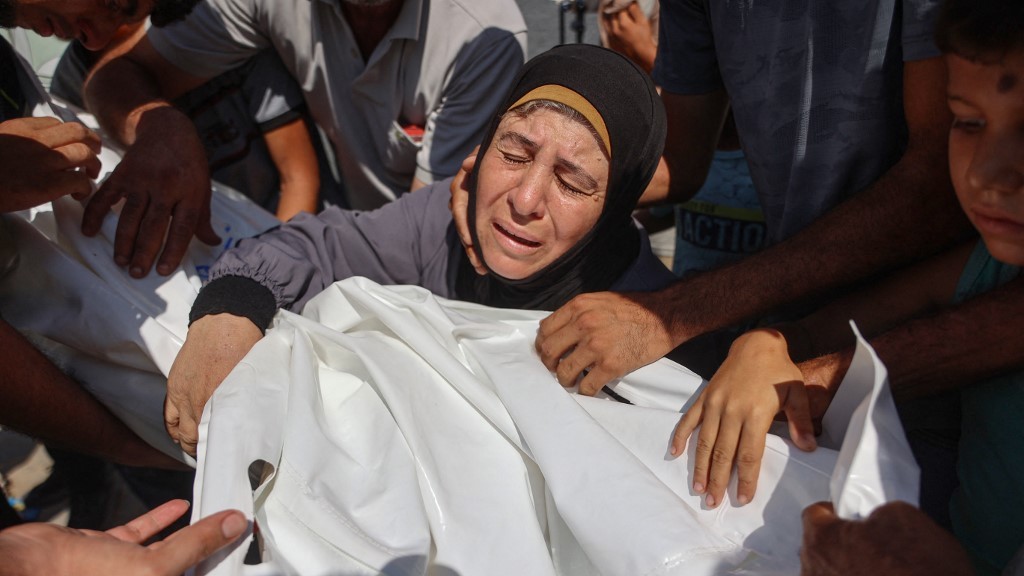
    Elsaftawy, the second complainant, brings his own generations-long history of displacement and grief to the case. A leading plastic surgeon who heads a department at a hospital in Trzebnica, just outside Wrocław, he has lived in Poland for more than 30 years. His own family’s story of displacement began in 1948, during the Nakba – the mass expulsion of Palestinians that accompanied the creation of Israel. His father, then eight years old, was forced out of al-Majdal, the territory that is now the Israeli city of Ashkelon. The family ended up living in refugee tents in Gaza, turned into stateless refugees overnight. Elsaftawy himself was born in Qatar, where his parents moved in the 1960s searching for work. He moved to Poland at 17 to study medicine – a field that was closed to non-citizens in Qatar at the time – and has built his life and career there ever since. After the Oslo Accords in the 1990s, many of his relatives moved back to Gaza. Since October 2023, 34 members of his extended family have been killed in Gaza. The most devastating loss, he says, was his sister, who died from complications of malnutrition after being denied access to urgent medical care. “This tragedy will forever remain a part of my life,” he told Middle East Eye.

    To evacuate his elderly father and his brother’s family from Gaza last year, Elsaftawy traveled to Egypt and paid $27,500 in cash to Hala, the Egyptian private company that controlled access to the Rafah crossing evacuation list for most of 2024. The fee was $5,000 for his father, and $2,500 for each of his brother’s three children. “In a world where freedom is not a right but a commodity, everything has a price,” he noted.

    The legal complaint argues that the ongoing humanitarian catastrophe in Gaza is not an accidental side effect of military operations, but the result of a deliberate, coordinated strategy that meets the international legal definition of genocide. It specifically highlights the use of starvation as a prohibited weapon of war, and the deliberate obstruction of life-saving humanitarian aid to Polish citizens and their family members in Gaza. The complainants are backed by the Hind Rajab Foundation, the Polish-Palestinian justice initiative Kaktus, and Polish activists Nina Ptak and Ewa Jasiewicz from the Global Sumud Flotilla mission.

    Elsaftawy emphasized he is not seeking special treatment, only equal application of the law. “I am demanding only the right to the truth, accountability and the protection of fundamental humanitarian values, which should apply regardless of nationality, religion or origin,” he said. “Poland has a duty to adhere to the principles of international law, the protection of human rights and responsibility for the safety of its citizens.” In a statement, Kaktus framed the case as a critical test for Polish democratic institutions, asking: “Will the law be applied equally to everyone, or selectively, depending on origin?”

  • Global heritage group offers to work with Peru’s government on improving conditions at Machu Picchu

    Global heritage group offers to work with Peru’s government on improving conditions at Machu Picchu

    LIMA, Peru — The global non-profit New7Wonders Foundation, best known for its initiative cataloging the world’s most iconic cultural sites, formally extended an offer Tuesday to collaborate with Peruvian authorities to address longstanding systemic issues at the legendary Inca citadel Machu Picchu. Thousands of visitors to the UNESCO World Heritage Site annually report hours-long entry queues, extreme overcrowding along narrow trails, and inconsistent, unreliable local transportation services that sour the experience of visiting one of the world’s most famous archaeological landmarks.

    The offer of assistance comes nine months after the foundation issued a stark September 2020 warning: Machu Picchu’s status as one of the organization’s official New Seven Wonders of the World, a designation it has held since an international public vote in 2007, was in jeopardy due to the poor visitor experience. Foundation director Jean Paul De la Fuente, who is currently in the Peruvian capital holding preliminary talks with national tourism officials, says he has observed zero meaningful improvement at the site since that formal warning. He directly blamed the lack of progress on ongoing political paralysis that has left Peru with unstable leadership over the past decade.

    Peru is gearing up for a pivotal presidential runoff election set for June 7, a vote that will install the country’s ninth head of state in just 10 years. The runoff pits two very different candidates against one another: Keiko Fujimori, daughter of former Peruvican President Alberto Fujimori who is currently imprisoned for convictions on human rights violations, and Roberto Sanchez, a former commerce secretary who has run on a platform of sweeping reforms to Peru’s large mining industry. The next president will appoint an entirely new cabinet and national leadership team, so no sitting government officials have issued an immediate response to the foundation’s offer. De la Fuente noted he is ready and willing to sit down with the incoming administration after the election to co-develop solutions to the site’s systemic service failures.

    For millions of global travelers, a trip to Machu Picchu ranks as a bucket-list dream, De la Fuente explained. “People travel to Machu Picchu thinking that they will visit a marvel of the world,” he said. “But for many that dream is turning into a nightmare.”

    Carved into the Andean mountains in the 15th century as a royal estate for the Inca empire, Machu Picchu was first named a UNESCO World Heritage Site in 1983 in recognition of its unique architectural and cultural significance. Fourteen years after that designation, the site won a spot in the New7Wonders Foundation’s global public vote, which drew more than 100 million participants worldwide to select the seven most remarkable cultural sites of the modern era. De la Fuente said international tourism to the site has exploded exponentially since the 2007 designation, but Peruvian governments have failed to update infrastructure, visitor management systems, and transportation networks to keep pace with growing visitor volumes.

    The foundation director stressed that revoking Machu Picchu’s New Seven Wonders status is not currently on the table. Instead, the organization is pushing for Peruvian leadership to adopt its comprehensive improvement plan to address the site’s most pressing problems. “We hope to be able to work with a new leadership once it’s in place, to find a positive outcome for Machu Picchu,” De la Fuente said. “Going from a negative situation to making sure that Machu Picchu can be an example that many of the other wonders of the world can look up to.”

  • Atrocities in Sudan backed by Colombian mercenaries trained at UAE bases, says report

    Atrocities in Sudan backed by Colombian mercenaries trained at UAE bases, says report

    A groundbreaking new investigation from Human Rights Watch (HRW) has uncovered damning evidence linking the United Arab Emirates to the deployment of hundreds of Colombian mercenaries in Sudan, where the foreign fighters have supported the Rapid Support Forces (RSF) — a paramilitary group accused of large-scale war crimes and genocide in the country’s ongoing civil conflict.

    According to the 38-page report, Abu Dhabi-based private security firm Global Security Services Group (GSSG) has actively recruited hundreds of Colombian special operations contractors since the start of 2024, deploying them directly to Sudan to fight alongside the RSF against the official Sudanese Armed Forces (SAF). HRW investigators confirmed that the contractors passed through UAE-operated military bases on Sudanese territory before joining frontline RSF units, a trail of evidence that the human rights organization says proves direct UAE complicity in widespread violence committed by the paramilitary.

    The RSF has faced mounting international accusations of genocide, systematic mass sexual violence, ethnic cleansing, and multiple other violations of international humanitarian law since Sudan’s civil conflict reignited in April 2023. HRW’s findings add new weight to global calls for punitive action against the UAE, which has long faced allegations of covertly backing the RSF despite consistent official denials.

    “The recruitment of Colombian private military contractors adds to a growing body of evidence that the UAE provides military support to the Rapid Support Forces, which have repeatedly carried out heinous atrocities in Sudan,” said Mausi Segun, executive director of HRW’s Africa Division. “Governments should publicly demand that the UAE stop supplying weapons, equipment, personnel, and other military support to the Rapid Support Forces.”

    HRW’s findings align with earlier independent investigations into RSF atrocities. In March 2024, Yale University’s Humanitarian Research Lab (HRL) corroborated United Nations claims of genocide in Sudan’s Darfur region, documenting that RSF forces had waged a deliberate campaign of starvation against the strategic city of el-Fasher. The lab’s report confirmed that RSF fighters razed dozens of rural farming villages, destroyed critical crop infrastructure, and systematically targeted civilian populations after seizing control of the city. Extensive on-the-ground interviews conducted by independent outlet Middle East Eye (MEE), alongside subsequent UN and HRL investigations, have documented widespread extrajudicial executions, mass rape, and extortion of el-Fasher’s civilian population by RSF fighters.

    The presence of Colombian mercenaries in Sudan first entered public view in November 2024, when a SAF-aligned armed group released social media videos showing an intercepted convoy of Colombian fighters that had crossed into Sudan from neighboring Libya. While the UAE has repeatedly rejected all accusations of supporting the RSF, MEE has published years of investigative work backed by satellite imagery, flight tracking logs, weapons serial numbers, and multiple anonymous insider sources confirming the UAE’s ongoing military backing for the paramilitary.

    Joey Shea, a lead HRW researcher on the investigation, told MEE that Colombian contractors transited through sensitive UAE military and government facilities prior to their deployment to RSF frontlines. She added that investigators have directly linked the foreign contractors to grave human rights abuses on the ground.

    “One contractor who I spoke to told me that he helped to support the training of child soldiers, boys as young as 13-14 years old,” Shea explained.

    The investigation also revealed that the military relationship between the UAE and Colombian private military contractors stretches back more than a decade. As early as 2011, The New York Times reported that UAE leader Mohammed bin Zayed Al Nahyan was building a foreign legion of up to 800 Colombian contractors to serve officially within the UAE armed forces. One retired Colombian contractor interviewed by HRW confirmed he took part in that 2011 recruitment drive, noting that the operation was entirely public, with all participants receiving formal work contracts for their service in the UAE.

    This report is based on independent reporting from Middle East Eye, a media outlet specializing in original, unfiltered coverage of the Middle East, North Africa, and global affairs.

  • UAE and Bahrain fail to join GCC condemnation of Somaliland opening embassy in Jerusalem

    UAE and Bahrain fail to join GCC condemnation of Somaliland opening embassy in Jerusalem

    A growing diplomatic rift has emerged across the Middle East and broader Muslim world over a controversial plan by the self-declared independent region of Somaliland to open an embassy in occupied East Jerusalem, with two Gulf Cooperation Council (GCC) members notably declining to join a widespread collective condemnation of the move.

    The proposal comes on the heels of a historic step last year: Israel became the first country in the world to formally recognize Somaliland as a sovereign state, a breakaway territory that declared independence from Somalia in 1991 but has not secured widespread international recognition. In comments delivered Tuesday, Mohamed Hagi, Somaliland’s ambassador to Israel, confirmed the reciprocal diplomatic arrangement, noting that Israel will also open its own embassy in Hargeisa, Somaliland’s administrative capital. Hagi framed the exchange of diplomatic missions as a reflection of deepening friendship, mutual respect, and expanding strategic cooperation between the two entities.

    Under longstanding international law, East Jerusalem is universally classified as occupied Palestinian territory. Israel seized control of the area from Jordan during the 1967 Six-Day War, and despite Israel’s annexation of the territory, the overwhelming majority of the global community has declined to recognize Jerusalem as Israel’s sovereign capital.

    The planned embassy opening has drawn sharp condemnation from a broad coalition of regional and international states. Foreign ministers from four of the six GCC member states—Kuwait, Oman, Qatar, and Saudi Arabia—joined more than a dozen other nations including Egypt, Jordan, Turkey, Pakistan, Indonesia, Djibouti, Somalia, Palestine, Sudan, Yemen, Lebanon, Mauritania, Algeria, Bangladesh, and Morocco to denounce what they called the “illegal and unacceptable step taken by the so-called Somaliland region in opening its purported embassy in occupied Jerusalem.” Even GCC Secretary-General Jasem Mohamed Albudaiwi joined the rebuke, stating that the diplomatic move violates international law and United Nations resolutions.

    Notably absent from the collective condemnation were the UAE and Bahrain, the two GCC states that have already normalized formal diplomatic relations with Israel as part of the 2020 Abraham Accords. Requests for comment from Middle East Eye to clarify the two countries’ positions on the Somaliland embassy plan went unanswered as of the publication of the original reporting.

    Beyond the diplomatic controversy over Jerusalem, the recognition of Somaliland by Israel has opened the door to discussions of deeper security cooperation. Multiple sources have confirmed that Somaliland officials have held talks with Israeli counterparts about constructing a permanent Israeli military base in the territory, a proposal that reverses earlier denials of such plans by Hargeisa’s foreign ministry. For Israel, a military foothold in Somaliland would place its forces within short striking distance of Yemen’s Houthi movement, which has launched repeated attacks on commercial shipping in the Red Sea since late 2023, actions the group says are in retaliation for Israel’s military campaign in Gaza.

    The status of Somaliland itself remains a contentious global issue. While the region has operated as a de facto independent state since 1991, the United Nations, African Union, and nearly all sovereign governments still recognize it as an integral part of Somalia. The UAE has maintained close diplomatic and security ties with Somaliland since 2017, when Hargeisa granted Abu Dhabi permission to establish its own military base in the region, a partnership Somaliland has leveraged to build international support for its independence bid.

    This close alliance has already sparked regional friction in recent months. In January, Saudi Arabia publicly accused the UAE of secretly evacuating Yemeni separatist leader Aidarous al-Zubaidi—who faced treason charges in Yemen—from Yemen to Somaliland, before he traveled onward to Abu Dhabi. Somalia reacted furiously to the incident, canceling all of the UAE’s commercial and military agreements related to Somaliland, even though Mogadishu holds little effective control over the territory. Unlike Saudi Arabia, which centers its diplomatic engagement on Somalia’s recognized central government in Mogadishu, the UAE’s approach to the Horn of Africa has long been structured around its separate ties to both Somaliland and the semi-autonomous Somali region of Puntland.

  • Paris ‘punishingly hot’ as Western Europe hit by heatwave

    Paris ‘punishingly hot’ as Western Europe hit by heatwave

    An unusual early-season heat dome has settled across much of Western Europe, driving temperatures far above the long-term average for May and bringing sweltering conditions to major population centers, with the French capital of Paris among the hardest-hit regions. BBC correspondent Hugh Schofield has reported on the ground from Paris, where the unseasonable heat has left residents and visitors grappling with unexpectedly high temperatures weeks before the typical summer heat season begins.

    Meteorological experts define a heat dome as a large, stationary high-pressure system that traps hot air beneath it, preventing it from dispersing and causing temperatures to climb steadily over time. This event marks an early arrival of extreme heat for the region, breaking historical temperature benchmarks for the month of May in multiple areas across Western Europe. Climate researchers have noted that early-season heatwaves are becoming increasingly frequent as global average temperatures continue to rise, making such unseasonable extreme weather events more common than they were just a few decades ago.

    Local authorities across Western Europe have begun issuing public health advisories urging vulnerable populations, including elderly residents, young children and people with pre-existing medical conditions, to stay hydrated, avoid prolonged exposure to direct sunlight, and seek cool shelter when necessary. Many urban areas have opened public cooling centers to accommodate residents without access to air conditioning, as cities prepare for the sustained period of high heat that the heat dome is expected to bring before it finally breaks up.

  • Protests escalate outside ICE facility over alleged inhumane conditions

    Protests escalate outside ICE facility over alleged inhumane conditions

    Public outrage has boiled over into escalating demonstrations outside a U.S. Immigration and Customs Enforcement (ICE) detention facility, as widespread allegations of inhumane living conditions for detained migrants push tensions to new heights. Demonstrators have gathered in growing numbers outside the facility, calling for urgent transparency, immediate reform of the detention system, and accountability for officials who oversee the facility’s operations.

    Protest organizers and advocacy groups have shared firsthand accounts from released detainees and family members that paint a grim picture of life inside the facility, including overcrowding, inadequate access to nutritious food, unsanitary housing, and delayed or denied medical care. These claims have galvanized broader public criticism of the U.S. immigration detention system, with civil rights organizations warning that systemic neglect is putting vulnerable detainees at severe risk.

    In response to the mounting protests, the U.S. Department of Homeland Security (DHS) issued an official statement pushing back against the allegations. According to DHS, all detainees held at the facility are provided with “medical, dental, and mental health services as available.” The agency did not address the additional claims of overcrowding, unsanitary conditions, and poor nutrition that have sparked the demonstrations, leaving protesters demanding more detailed clarification and independent oversight of the facility.

    The escalating unrest comes amid a years-long national debate over U.S. immigration policy and the treatment of people held in federal detention facilities awaiting immigration hearings. Many congressional Democrats and immigrant advocacy groups have pushed for major overhauls to the detention system, including reducing the overall number of people detained and implementing stricter standards for facility conditions, while conservative lawmakers have generally defended current enforcement practices. Independent observers note that this latest round of protests highlights the growing public divide over how the U.S. should manage immigration detention, with no clear legislative compromise on the horizon.