分类: world

  • Oil tanker hijacked off coast of Yemen and taken towards Somalia

    Oil tanker hijacked off coast of Yemen and taken towards Somalia

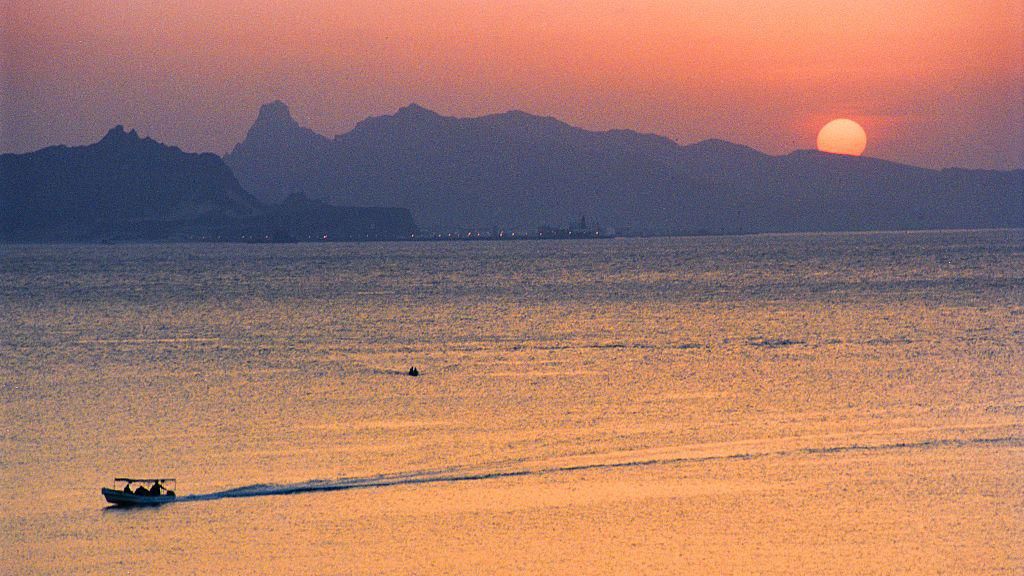
    A new act of maritime piracy has roiled the strategically critical Gulf of Aden, with multiple Somali security sources confirming to the BBC that armed Somali pirates have seized control of a foreign-flagged oil tanker off Yemen’s coastline. This incident marks the fourth successful large vessel hijacking in just a 14-day window, marking a sharp resurgence of pirate activity that had been largely suppressed for more than a decade.

    The targeted vessel, identified as the MT Eureka, was sailing under the flag of West African nation Togo when pirates overran the ship at approximately 5:00 a.m. local time, which corresponds to 03:00 British Summer Time. The hijacking unfolded in international waters close to Yemen’s port of Qana, before the hijackers steered the captured tanker toward Somali territorial waters. Three independent security officials from Somalia’s semi-autonomous Puntland region confirmed the pirate group departed from a remote, unpatrolled stretch of coastline near the coastal town of Qandala, which sits on the Gulf of Aden shoreline. Regional maritime observers expect the MT Eureka to anchor in Somali waters within hours of the hijacking.

    This hijacking comes only 10 days after the same group of pirate operatives seized another oil tanker, the Honor 25, in the same general area. The Honor 25 was carrying 18,500 barrels of crude oil en route to Somalia’s capital Mogadishu when it was overtaken.

    In a separate, related incident just days prior, the United Kingdom Maritime Transportation Operation (UKMTO) issued a public warning on Friday about an attempted hijacking of a bulk carrier near Yemen’s Al-Mukala port. According to three senior security sources, the armed actors behind that attempted attack launched from a remote coastal zone near the fishing town of Caluula, located just 209 kilometers (130 miles) north of the departure point for the MT Eureka hijacking.

    The spread of coordinated pirate attacks across two distinct coastal zones 200 kilometers apart confirms a worrying trend: piracy is expanding rapidly across Somalia’s 3,333-kilometer coastline, the longest continuous shoreline on the African mainland. As of Monday morning, neither Somali national nor regional authorities, nor the European Union Naval Force (EUNAVFOR) which leads official anti-piracy operations in the region, have released an official statement addressing the latest hijacking incident.

    Regional security analysts trace this dramatic resurgence back to late 2023, when Houthi rebel attacks on commercial shipping in the Red Sea and Gulf of Aden shifted international naval priorities. Once focused heavily on countering Somali piracy — a threat that had fallen to near-zero levels after a decade of coordinated patrols starting in 2011 — global maritime forces have redirected their assets to counter Houthi attacks on commercial shipping. This security gap along Somalia’s coastline has allowed armed pirate groups to reorganize, rearm, and resume large-scale hijackings for ransom.

    One senior Puntland security official, speaking anonymously to the BBC, warned that the scale of the crisis is far greater than most international observers acknowledge. “The on-going crisis with the pirates is much worse than many realize. There are increasing movements of armed groups all over the coast,” the official said.

  • Germany says US troop withdrawal ‘foreseeable’ as Nato seeks clarification

    Germany says US troop withdrawal ‘foreseeable’ as Nato seeks clarification

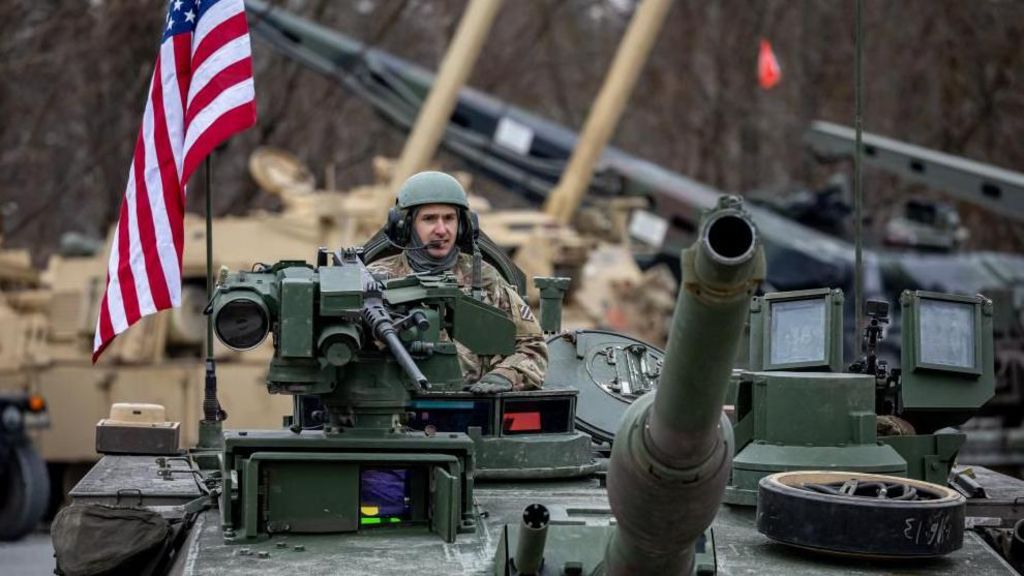
    A deepening rift between the United States and Germany has triggered a major shift in American military posture in Europe, with Washington set to withdraw 5,000 active-duty troops from Germany over the next year, a move that has sent shockwaves through the 32-member NATO alliance and raised urgent questions about the future of transatlantic security.

    The drawdown, the latest in a series of American troop reductions across Europe under the second Trump administration, cuts the US military presence in Germany from the current 36,000 troops — by far the largest American force deployment on the continent, far outstripping roughly 12,000 troops in Italy and 10,000 in the United Kingdom. The decision follows a heated public exchange between US President Donald Trump and German Chancellor Friedrich Merz, sparked by comments Merz made criticizing American diplomatic strategy amid the ongoing conflict with Iran.

    Speaking to Germany’s DPA news agency, German Defence Minister Boris Pistorius struck a measured tone, framing the withdrawal announcement as a development that had long been foreseeable. He reaffirmed that the persistent American military footprint in Europe, anchored in Germany, serves the strategic interests of both Berlin and Washington. Even so, Pistorius emphasized that the geopolitical shift demands that European nations step up to take greater ownership of their own collective security. He noted that Germany has already made substantial progress in this area, having ramped up military spending dramatically in recent years after years of falling short of NATO’s previous 2% of GDP defence spending target — a point of consistent criticism from Trump. Under the current Merz government, Germany is on track to hit a total defence expenditure of 3.1% of GDP by 2027, including a €105.8 billion (£91 billion) annual defence budget and ongoing military aid to Ukraine as it defends against Russian invasion.

    NATO, for its part, has moved quickly to seek full clarity from Washington on the details of the drawdown plan. Alliance spokeswoman Allison Hart noted that the US decision reinforces the need for continued European defence investment and greater burden-sharing for transatlantic security. She added that the alliance is already seeing positive progress after member states agreed to a new target of investing 5% of GDP in defence at last year’s NATO summit in The Hague.

    The diplomatic row that preceded the troop withdrawal announcement erupted earlier this month, when Merz told university students that the US had suffered a public humiliation at the hands of Iranian negotiators. Merz argued that Washington lacked a coherent strategy for the ongoing conflict, accusing Iranian negotiators of skillfully stalling talks that saw American officials travel to Islamabad only to return without any diplomatic breakthrough. Trump hit back fiercely on his Truth Social platform, dismissing Merz as misinformed and falsely claiming that the German chancellor supported Iran acquiring a nuclear weapon. Within days, the troop withdrawal order was issued.

    Pentagon spokesman Sean Parnell confirmed that the drawdown directive came from US Defence Secretary Pete Hegseth, and that the full withdrawal of the 5,000 troops will be completed within a six to 12 month timeline. This move is the latest in Trump’s broader strategy to reorient American military focus away from Europe and toward the Indo-Pacific region, a policy that already saw a troop reduction in Romania last year. Trump has also openly floated the possibility of additional drawdowns from other major American deployments in Europe, including Italy and Spain, and has long been a vocal critic of NATO, arguing that the alliance burdens the US with unfair security costs while European allies underinvest in their own defence.

    The announcement has sparked widespread alarm across NATO and even among senior members of Trump’s own Republican Party. Two top Republican congressional leaders — Senate Armed Services Committee Chair Roger Wicker and House Armed Services Committee Chair Mike Rogers — issued a joint statement saying they are deeply concerned by the decision to withdraw an entire US brigade from German soil. They argued that maintaining a strong deterrent presence in Europe is a core core national interest of the United States, and that full withdrawal of forces from the continent runs counter to that goal.

    Polish Prime Minister Donald Tusk issued one of the starkest warnings from within the alliance Saturday, saying that the greatest threat facing the transatlantic community today is not external adversaries, but the ongoing internal disintegration of the NATO alliance. He called on all member states to take urgent, decisive action to reverse what he described as a dangerous and disastrous trend. Even as anxiety mounts, German officials have signalled they will move forward with deeper defence integration with other European allies, insisting Germany is already on the right path to shoulder a larger share of regional security responsibilities.

  • Old and new Gulf faultlines exposed by Iran war

    Old and new Gulf faultlines exposed by Iran war

    On April 28, the United Arab Emirates (UAE) made a landmark announcement that it would withdraw from the Organization of the Petroleum Exporting Countries (OPEC), a move that lays bare how ongoing Middle East conflict has not only deepened hostilities between Iran and its Gulf neighbors, but also fractured unity within the Gulf Cooperation Council itself.

    Founded in 1960, OPEC stands out as one of the few enduringly successful multilateral bodies in the Middle East. For decades, its coordinated pricing and production policies enabled Gulf oil-producing states to accumulate the capital needed to renationalize their energy resources and fund the rapid, transformative development that turned small desert nations into global economic players. The bloc has weathered nearly every regional upheaval, revolution and war in its 65-year history, even after Qatar departed in 2019 amid a regional blockade led by its Gulf neighbors.

    For years, tension has simmered between the UAE and Saudi Arabia, OPEC’s largest producer and de facto leader, which holds outsized influence over the bloc’s policy decisions. The UAE has long pushed to raise its own production quota, leveraging its untapped spare oil capacity, but repeated attempts have failed to yield changes that align with its economic goals. Yet industry friction alone does not explain the UAE’s decision to exit the organization entirely.

    Though the two Gulf powers maintained close alignment through the mid-2010s, the UAE and Saudi Arabia have drifted steadily apart in recent years, driven by sharp divergences on key regional priorities. Their strategies for ongoing conflicts in Yemen and Sudan differ dramatically, as do their approaches to normalization with Israel: the UAE established full formal relations with Israel in 2020, while Saudi Arabia has pledged it will only normalize ties once an independent Palestinian state is established. Beyond geopolitics, the two nations have emerged as fierce economic competitors, and the ongoing regional war connected to Iran has only accelerated their rivalry.

    After Iran responded to U.S.-Israeli attacks in February with strikes across Gulf states and a blockade of the strategic Strait of Hormuz, the conflict has laid bare the flaws in existing regional strategies. For Saudi Arabia, the war has exposed the limits of its gradual outreach to Iran and its reliance on the U.S., which is firmly aligned with Israel. In response, Riyadh has deepened defense cooperation with nuclear-armed Pakistan, a shift that has caused significant friction with the UAE, which maintains close strategic ties with Pakistan’s regional rival India. The UAE has publicly pushed Pakistan to issue a stronger condemnation of Iran during the current conflict, a demand Islamabad cannot meet due to its role as a neutral mediator in regional peace talks. Frustrated by Pakistan’s position, the UAE recently demanded Islamabad repay a $3.5 billion loan, only for Saudi Arabia to immediately step in with emergency financial support for Pakistan.

    Notably, the UAE’s OPEC withdrawal announcement was timed to coincide with a Gulf Cooperation Council summit in Riyadh, where leaders gathered to try to find common ground on the ongoing Iran conflict. The timing was widely interpreted as a deliberate public snub to Saudi leadership.

    The regional war has reignited a host of long-simmering disputes across the Gulf, including the decades-long sovereignty conflict between the UAE and Iran over three strategic islands: Abu Musa, Greater Tunb, and Lesser Tunb. Iran seized control of the islands in 1971, the same year the UAE gained independence from Britain, and the islands give Iran unrivaled strategic control over Gulf shipping lanes. The UAE has never relinquished its claim to the territory, while Iran maintains the islands have always been part of its sovereign territory. Historians believe the handover of the islands was part of a secret deal between Britain and the Shah of Iran in the early 1970s, in which the Shah agreed to abandon Iran’s long-held claim to Bahrain in exchange for control of the three islands. Access to historical records of these negotiations remains restricted, with multiple freedom of information requests for 1960s-era UK Foreign Office documents denied on national security grounds.

    Beyond the UAE-Saudi and UAE-Iran rifts, the conflict has hit other Gulf states hard. Kuwait, a small northern Gulf state, has faced repeated attacks from Iran-aligned Shia militias based in Iraq, a wave of violence that has revived traumatic memories of Iran-linked political unrest in the 1980s and Saddam Hussein’s 1990 invasion that left much of the country, including coastal Failaka Island, damaged and abandoned.

    Economically, the war has hit Gulf states unevenly. Nations that lack alternative shipping routes to bypass the blockaded Strait of Hormuz – including Bahrain, Kuwait, and Qatar – have suffered the worst economic damage. Bahrain, which already runs persistent budget deficits, relies on aid from wealthier Gulf neighbors to keep its economy afloat. By contrast, the UAE, Saudi Arabia, and Oman all have geographic access to alternative shipping routes that allow them to bypass Hormuz entirely. In fact, Oman, which controls one bank of the strait, could emerge as a long-term beneficiary of the disruption: it could earn revenue by charging tolls for alternative shipping routes under a new agreement with Iran, or see its Arabian Sea ports grow in global significance, potentially reviving its historical status as a major regional trading power. That outcome, however, is unwelcome to both the UAE and Saudi Arabia, which prefer to maintain their dominance of Gulf energy shipping.

    In sum, the U.S.-Israeli strike on Iran that triggered the current crisis has reactivated long-buried fault lines across the Gulf and created new divisions between regional states. It has also undermined the few remaining channels for multilateral regional cooperation, turning an already fragmented and volatile region even more unstable. This analysis is by Toby Matthiesen, Senior Lecturer in Global Religious Studies at the University of Bristol, republished with permission from The Conversation under a Creative Commons license.

  • Drone kills 2 in Kherson minibus strike, as Russia claims front-line progress

    Drone kills 2 in Kherson minibus strike, as Russia claims front-line progress

    On a Saturday marked by fresh violence across Ukraine, Russian drone attacks left two civilians dead and multiple others injured in the southern city of Kherson, continuing a pattern of targeted strikes on populated civilian areas that has defined Moscow’s full-scale invasion, regional authorities confirmed.

    Oleksandr Prokudin, the head of Kherson’s regional military administration, announced that the first attack on a civilian minibus claimed two lives and left seven people with wounds ranging from minor to severe. Just hours later, a second Russian strike targeted another minibus in the same region, leaving the vehicle’s driver injured. Further along Ukraine’s strategic Black Sea coastline, a separate Russian bombardment damaged critical port infrastructure in the major city of Odesa, though no casualties were reported in that incident.

    More than two years into Russia’s full-scale invasion, Ukrainian civilians continue to face unrelenting waves of aerial attacks across multiple frontline and rear areas. Diplomatic efforts brokered by the United States over the past 12 months have failed to deliver any de-escalation, as Moscow has repeatedly rejected Kyiv’s calls for a bilateral ceasefire. In recent weeks, the outbreak of conflict in Iran has shifted global media and diplomatic focus away from Ukraine’s ongoing humanitarian crisis, leaving many Ukrainian civilians facing heightened vulnerability with less international scrutiny.

    On the extended 1,000-mile front line stretching across eastern and northeastern Ukraine, Russian defense officials announced Saturday that their forces had seized full control of the village of Myropillia, located in Ukraine’s northeastern Sumy region. This battlefield claim could not be independently verified by independent open-source observers or international media, and Kyiv’s military command did not issue an immediate comment confirming or denying the territorial shift.

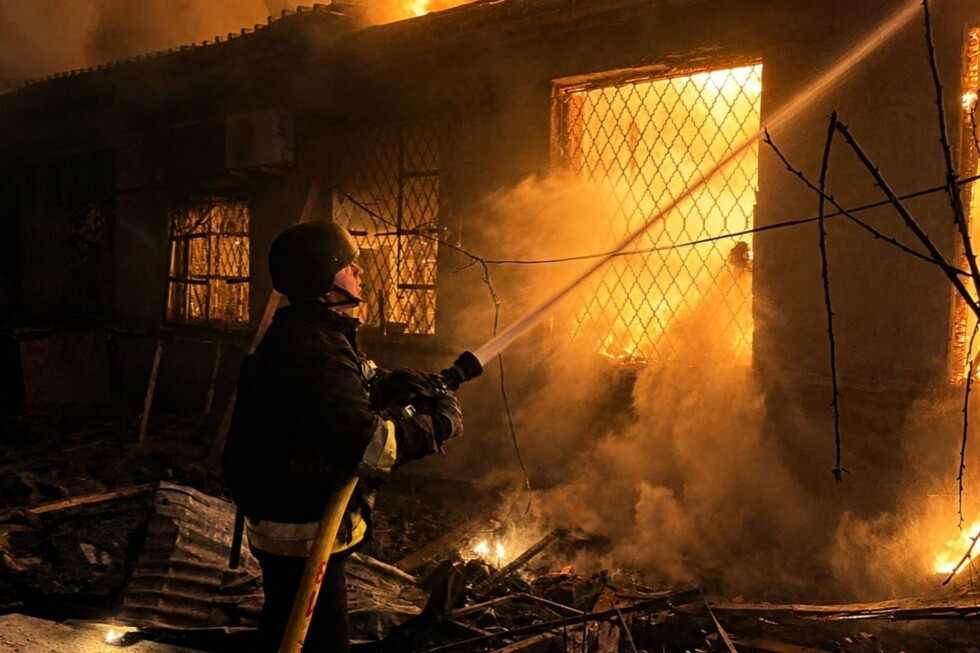
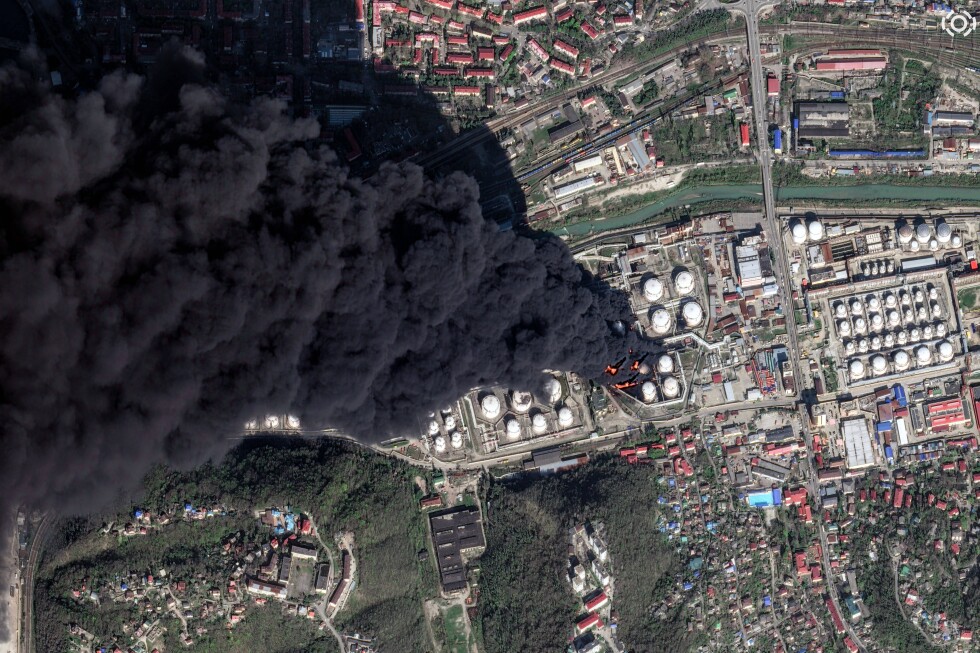
    Across the border in southern Russia, local authorities in the Krasnodar region confirmed Saturday that firefighters had fully extinguished a large blaze that broke out Friday at the Tuapse Black Sea oil terminal following a Ukrainian drone strike. This marked the fourth Ukrainian attack on the Tuapse refinery and export terminal in just over a fortnight, with previous strikes triggering large-scale fires, forcing temporary civilian evacuations, and sending thick plumes of black smoke visible for dozens of kilometers.

    Kyiv has steadily ramped up long-range drone strikes targeting Russian energy infrastructure in recent months, part of a deliberate strategy to disrupt Moscow’s oil export operations—one of the Kremlin’s largest single sources of revenue for its war campaign. To date, however, the broader economic impact of these strikes remains uncertain. Global oil price increases tied to the Iran conflict, paired with a concurrent easing of some U.S. secondary sanctions on Russian crude, have offset losses and helped replenish Russian government war coffers.

    Related recent developments include Ukrainian strikes on oil facilities deep inside Russian territory, which analysts warn could push domestic fuel prices higher inside Russia and blunt the impact of Kyiv’s energy targeting campaign. Ukrainian officials have confirmed the Tuapse terminal strike, and Ukrainian President Volodymyr Zelenskyy has stated that his administration is still gathering detailed information on a purported ceasefire proposal from Russian President Vladimir Putin tied to Russia’s annual May 9 Victory Day holiday. Coverage of the ongoing Russia-Ukraine conflict is updated continuously via the Associated Press’s dedicated conflict hub.

  • Ukraine is hitting oil facilities deep inside Russia. Soaring fuel prices could blunt the impact

    Ukraine is hitting oil facilities deep inside Russia. Soaring fuel prices could blunt the impact

    Over the course of the ongoing Russia-Ukraine conflict, Ukraine has dramatically expanded its deep-strike capabilities, launching a sustained campaign of long-range drone attacks against key Russian oil infrastructure hundreds and even thousands of kilometers behind the front lines. The explicit strategic goal of these strikes is to cut off Moscow’s primary source of war funding: global oil exports, a linchpin that has sustained Russia’s full-scale invasion of Ukraine.

    Recent months have seen a sharp uptick in these attacks, targeting critical energy hubs across vast swathes of Russian territory. In just over two weeks, the Black Sea coastal town of Tuapse, located 280 miles from the Ukrainian front lines, has endured four separate drone assaults on its major oil refinery and export terminal. Each strike has ignited massive infernos that forced local evacuations, sending plumes of smoke large enough to be visible from outer space. After the third attack on April 18, local emergency officials confirmed that superheated oil products spilled onto residential streets, damaging dozens of civilian vehicles. Further inland, Ukraine confirmed it carried out back-to-back strikes on an oil pumping station in Russia’s Perm region, nearly 900 miles from Ukrainian borders – a distance that underscores the rapid advancement of Ukraine’s domestic drone program. Russian officials have only acknowledged that unspecified industrial facilities were hit, declining to share further details. These attacks are not isolated: in late March, Ust-Luga, one of Russia’s largest Baltic Sea oil and gas export terminals situated more than 500 miles from Ukraine, was struck three times in a single week. In the wake of that assault, regional governor Alexander Drozdenko made the unprecedented admission that the area surrounding St. Petersburg, Russia’s second-largest city, now qualifies as a “front-line region” due to constant aerial threats.

    Ukrainian President Volodymyr Zelenskyy has framed these strikes as a parallel effort to international sanctions targeting Russia’s war economy. He argues the campaign has grown even more urgent amid the global energy market upheaval triggered by the Iran conflict and the closure of the Strait of Hormuz, which has generated massive windfall profits for Russian oil exporters. Zelenskyy estimates that Russia has suffered direct losses of at least $7 billion from oil infrastructure attacks since the start of 2024, noting that exports from key terminals including Ust-Luga and Primorsk have already dropped. Independent experts add that alongside disrupting export routes, the strikes have eroded Russia’s domestic oil refining capacity – a problem compounded by existing international sanctions that make it nearly impossible for Moscow to source replacement parts for damaged infrastructure.

    Yet the full economic impact of the campaign remains uncertain, as global market shifts have worked in Russia’s favor. Data from the International Energy Agency shows that Russian crude and oil product exports rose by 320,000 barrels per day month-over-month in March 2024, hitting a total of 7.1 million barrels daily. Soaring global oil prices pushed export revenues nearly double between February and March, jumping from $9.7 billion to $19 billion. It remains unclear whether the more recent April strikes will alter this upward trajectory. Chris Weafer, CEO of the international consultancy Macro-Advisory Ltd, notes that geopolitical tensions around Iran have unexpectedly propped up Russia’s energy sector and federal budget, pulling it back from a financial crisis that was emerging in late February. Weafer also adds that the visible damage from strikes is often less severe than the dramatic footage suggests: attacks on partially filled oil storage tanks produce spectacular fires from ignited vapors, but typically only delay deliveries by a few days, rather than destroying critical pumping or loading infrastructure that is far better protected than above-ground storage tanks.

    Militarily, the strikes have demonstrated just how far Ukraine’s domestic drone program has advanced since the start of the full-scale invasion in 2022. Ukraine’s Defense Ministry confirms the country has more than doubled the range of its deep-strike capabilities over the past two years, allowing drones to approach targets from multiple directions and significantly complicate Russian air defense efforts. Marcel Plichta, a security researcher at the University of St. Andrews, notes that this level of long-range domestic strike capability simply did not exist for Ukraine just four years ago. “Drone attacks have so far been a very successful case of leveraging simple, domestically assembled technology to attack Russia in places that, at the start of the war, they just would have never expected to be attacked,” Plichta explained.

    Beyond military and economic outcomes, the strikes have already brought severe, lasting environmental damage that is forcing ordinary Russians far from the front lines to confront the realities of the war. In Tuapse, a popular Black Sea tourist destination, officials confirmed dangerous levels of the carcinogen benzene were detected in the air during active fires, urging residents to stay indoors. Local residents have widely reported so-called “black rain” – oily, toxic droplets that stain skin, clothing and infrastructure. Local media has shared graphic footage of stray animals with fur stained gray by oil residue, while oil spills along the coastline have coated marine life, and photos of oil-covered beached dolphins have circulated widely across Russian social media.

    Vladimir Slivyak, co-chair of Russian environmental NGO Ecodefense, warned that the damage will have decades-long consequences for both human health and the regional ecosystem. “There is a lot of oil in the sea,” Slivyak said. “In the next few years, every storm will be bringing more oil pollution onto the coast.”

    So far, widespread public backlash against the war has not emerged, as Russian authorities continue a sweeping crackdown on anti-war dissent. But Slivyak argues that the visible, personal impact of these strikes is eroding trust in official government messaging. “I think a lot of people understand that there is a very big difference between what Putin says and what regional authorities are saying, and what’s really going on,” he noted.

  • ‘This tree was planted by my ancestor hundreds of years ago and my family settled here’

    ‘This tree was planted by my ancestor hundreds of years ago and my family settled here’

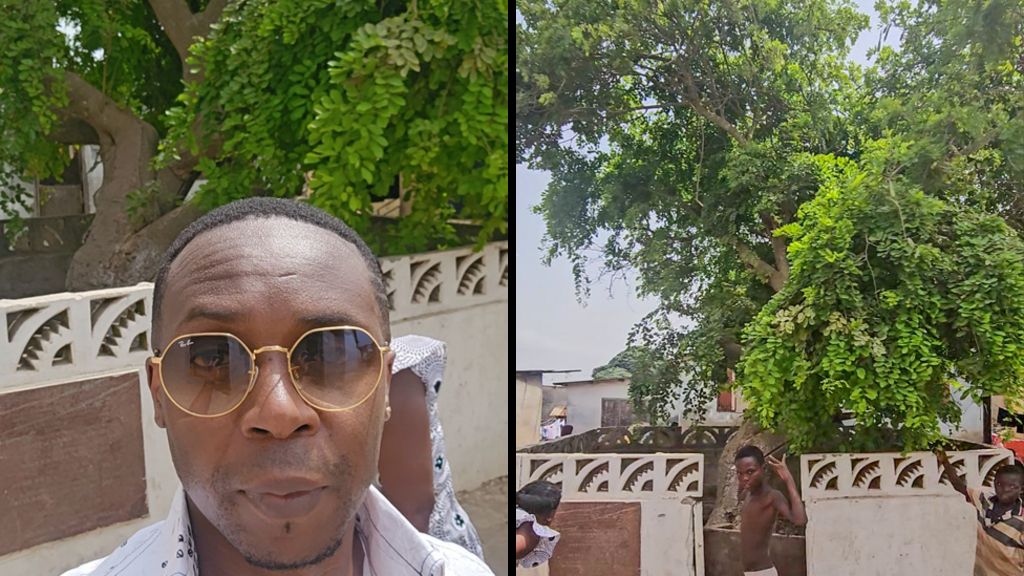
    On the windswept Atlantic coast of Ghana, in the quiet fishing town of Apam, an unassuming tree rises from rust-red clay, anchoring a story of migration, resilience, and intergenerational memory that stretches back further than most written records of the region. Tucked between two defining monuments of Ghana’s layered colonial and post-colonial history, the tree — called Santseo, meaning “Under” in the local Fanti language, for the shade it has offered communities for centuries — is barely noticed by daily passersby. But for one extended Ghanaian family, it is far more than a feature of the landscape: it is the living anchor of their identity.

    Oral tradition passed down through the Wilberforce family traces Santseo’s planting to the 13th century, when a small group of travelers led by Nana Asumbia, a royal spiritual leader from the Akwamu Kingdom’s historic capital of Akwamufie, set out on a westward journey along the coast. Though the exact cause of the group’s departure from Akwamufie has been lost to time, family accounts passed from generation to generation preserve the unique ritual Asumbia followed to choose the group’s new home: the travelers carried a sapling with them, and planted it wherever they paused. If the young tree took root and survived after several days, they knew they had found their permanent settlement. If it died, they continued onward.

    The tree species Asumbia chose was no accident. Today identified as *Piliostigma thonningii* — commonly called camel’s foot or monkey bread tree — it is a hardy, drought-resistant species native to much of sub-Saharan Africa, valued across the continent for its medicinal leaves and bark, its wide cooling canopy, and its ability to thrive in poor, harsh conditions where other species fail. For a nomadic community searching for a place to put down roots, the species’ legendary resilience made it the perfect symbol of their own journey.

    The group’s first stop after leaving Akwamufie was in what is now central Accra’s Otublohum neighborhood, around the site of the modern General Post Office. The sapling they planted there survived, and descendants of that first group still live in the area today. But the journey continued west, and the travelers next paused near Gomoa Buduburam along the Accra-Winneba highway, where they planted a second sapling. This time, the young tree did not survive. The group took this as a sign they had not yet reached their destination, and moved on once again.

    Their final stop came after a chance encounter in the coastal forest, according to oral history. A royal hunter named Inhune Akubuha from Gomoa Asin had wounded an elephant, which fled into the bush before collapsing. When he tracked the dead animal to its final resting place in what is now Apam, he called the traveling group to the spot. It was here that Asumbia planted her third sapling. Days later, when the tree sprouted new growth and took root in the red coastal soil, the group settled. Centuries later, the tree still stands, and the family built their home directly around it, naming the property Santsiwadzi in Santseo’s honor.

    Today, Santseo occupies a unique space between two eras of Ghana’s documented history: on one side sits Fort Patience, a Dutch trading fort completed in 1697 during the transatlantic gold and slave trade, when the region was known as the Gold Coast; on the other stands Apam’s Methodist Church, a monument to the spread of Christianity across Ghana’s coast in the centuries after European arrival. Yet according to family tradition, Santseo predates both structures by hundreds of years, making it a rare living marker of pre-colonial African history that outlasted the arrival of European powers and the transformation of local belief systems.

    As Christianity spread across Apam, the family that cares for Santseo donated the land on which the Methodist Church now stands. Over time, the tree’s traditional spiritual significance faded, as community members avoided being labeled idolaters for maintaining the old traditions. What remains is not a shrine, but a living memory: a connection to the ancestors who founded the community. Even so, tensions persist around preserving the tree: any extra care or maintenance is often misinterpreted as a return to old ritual practices, leaving the family to walk a careful line between honoring their history and adapting to modern beliefs.

    Roughly 40 years ago, members of the extended family reconnected with their ancestral roots in Akwamufie, making the journey east back to the kingdom their ancestors left centuries earlier. Oral tradition in Akwamufie had preserved the story of the traveling group for generations, with a repeated prophecy that they would one day return. The reunion was an emotional occasion, and a family member was installed as Nana Asumbia II, the new Queen Mother, mending the centuries-long divide between the two communities.

    Today, Apam’s rhythm is still shaped by the Atlantic Ocean that frames its coast. Fishermen haul nets to shore before dawn, children walk past Santseo on their way home from school along paths their grandparents and great-grandparents used, and every Tuesday, the town observes a long-held sacred tradition: no fishing boats leave the shore, and a gentle stillness falls over the coast, broken only by the quiet roll of the Atlantic.

    Santseo still stands through it all, its branches gnarled and shaped by centuries of salt wind and coastal storm, still rooted in the same red clay where Asumbia planted it so long ago. It has survived the rise and fall of kingdoms, the arrival of colonial powers, the transformation of local beliefs, and the slow passage of centuries. A guide for a displaced community, a source of shade and medicine, and a living archive of unwritten African history, the question Nana Asumbia asked when she planted the sapling all those years ago — will this tree take root? — still has the same clear answer, centuries later: yes.

  • Ghana becomes the latest African country to reject a US health deal, citing data sharing concerns

    Ghana becomes the latest African country to reject a US health deal, citing data sharing concerns

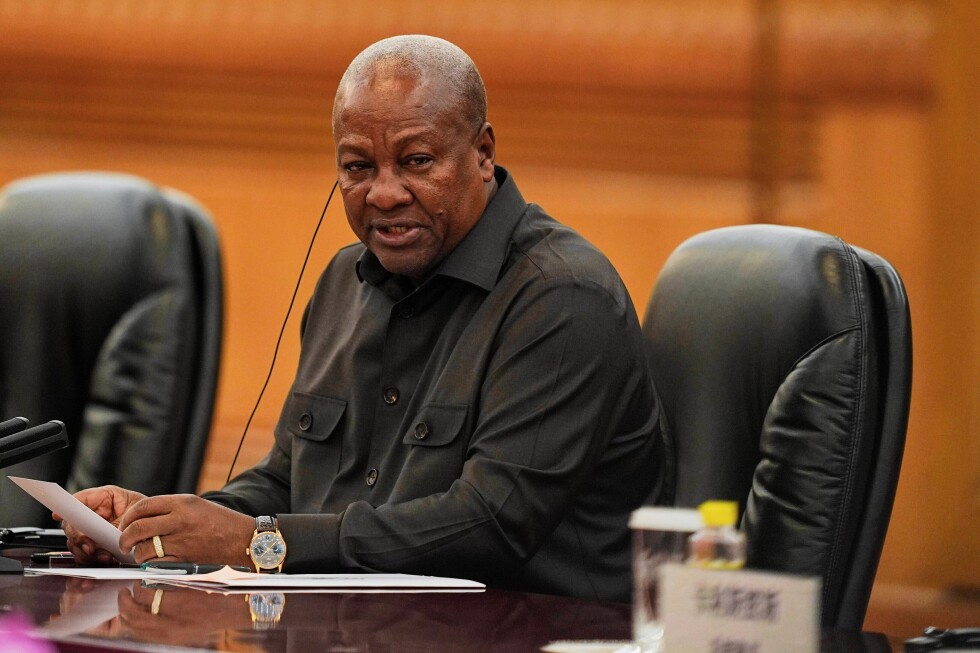
    On Friday, a senior Ghanaian official confirmed to the Associated Press that Accra has turned down a proposed bilateral health partnership with the United States, joining a growing list of African nations walking away from the agreement over unaddressed data privacy and national sovereignty risks. The core sticking point for Ghana was the deal’s provisions granting U.S. entities broad, unsupervised access to the country’s most sensitive health data without adequate regulatory safeguards, according to Arnold Kavaarpuo, executive director of Ghana’s Data Protection Commission, the government body directly involved in negotiation talks. Kavaarpuo emphasized that the scope of data access the U.S. demanded far exceeded the standard parameters aligned with the deal’s stated public health objectives.

    The U.S. State Department has not issued an immediate response to requests for comment on Kavaarpuo’s remarks. The framework of these health partnerships was first rolled out under the Trump administration’s “America First” global health strategy, which replaced a fragmented network of older health aid agreements overseen by the now-restructured U.S. Agency for International Development. To date, Washington has finalized similar deals with close to 24 African countries, offering hundreds of millions of dollars in funding to nations that previously faced U.S. aid cuts, with the stated goal of shoring up local public health systems and strengthening outbreak response capacity.

    Despite the financial incentives on offer, the agreements have sparked widespread criticism and pushback across the continent over long-standing concerns about data governance and national sovereignty. Zimbabwe became the first country to publicly reject the proposal back in February, citing identical worries around health data access, unfair terms, and threats to national sovereignty. Zambia has also pushed for revisions to problematic sections of the draft agreement, though it has not yet announced a final decision on whether to move forward.

    African privacy and public health activists have repeatedly flagged that most versions of the agreement lack sufficient guardrails for sensitive personal and population health data. In some cases, the deals also include restrictive provisions: for example, in Nigeria, the U.S. has committed to prioritizing funding exclusively for Christian faith-based healthcare providers, limiting access to support for broader public health infrastructure. Jean Kaseya, Director General of the Africa Centres for Disease Control and Prevention, previously told reporters that the organization holds “huge concerns” about the deal’s terms around both health data and pathogen sharing between African nations and U.S. entities.

    For Ghana, the proposed $300 million total agreement would have allocated roughly $109 million in U.S. funding to the country over a five-year period, with matching supplemental investment from the Ghanaian government. Kavaarpuo outlined that the most problematic provision allowed U.S. entities to de-identify patient data at their own discretion, a policy that effectively amounted to outsourcing Ghana’s entire national health data governance infrastructure to a foreign power. The agreement would have granted access not just to aggregated health datasets, but also to underlying metadata, public health dashboards, national reporting tools, standardized data models, and official data dictionaries. Up to 10 separate U.S. entities would have been permitted to access this full suite of data with no requirement for prior approval from Ghanaian authorities, regardless of the intended use case.

    “We did not get any assurance that Ghana would retain meaningful governance and oversight over how this sensitive data would be used,” Kavaarpuo explained. “The agreement only required U.S. entities to notify Ghana after they had already completed a project involving data access, rather than establishing a mandatory prior approval framework.”

    Kavaarpuo confirmed that Ghana has formally communicated its rejection of the current draft agreement to U.S. officials, and has requested revised negotiations to address the country’s core concerns around data governance and sovereignty before any new deal can be reached.

  • Thousands of ‘lost Canadians’ have applied for dual citizenship – is Canada ready?

    Thousands of ‘lost Canadians’ have applied for dual citizenship – is Canada ready?

    For more than a century, millions of people with French-Canadian roots across the United States have carried unrecognized ancestral ties to Canada, cut off from formal citizenship by outdated and discriminatory laws. That historic injustice began to be corrected in December 2024, when a landmark Canadian citizenship law came into force, opening the door for any descendant of a Canadian citizen to prove their ancestral connection and claim citizenship – a change that has sparked a surge of applications and reignited conversations about cultural identity across North America.

    The roots of this crisis stretch back to the 19th and early 20th centuries, when more than one million French-Canadians left Canada for New England in search of mill and farm work. In Maine, where many settled, state laws once banned French instruction in public schools, and social stigma labeled French speakers as second-class citizens. Compounding this displacement, outdated Canadian citizenship rules barred generations of descendants born in the U.S. from claiming citizenship, leaving millions of people now referred to as “lost Canadians” disconnected from their formal national identity.

    Joe Boucher, the youngest of five children growing up in a French-Canadian family in Maine, embodies this generational disconnect. While both his parents spoke French to one another and raised their children with pride in their heritage, Boucher never learned to speak the language; his older siblings defaulted to English when talking among themselves, shaped by the stigma and legal barriers that once marginalized French speakers in the state. Today, Boucher is among the thousands of applicants pursuing formal citizenship proof under the new law. For him, the process is not about seeking a new home – though he dreams of one day retiring in Quebec City, where his 17th-century ancestor Pierre Boucher once served as governor of the French colonial settlement – but about reclaiming a core part of his identity.

    “It’s nice to know that the connectivity to the home country, as it were, is there,” Boucher told the BBC. Growing up, his father instilled fierce pride in their Acadian and French-Canadian heritage, and now as a musician, Boucher celebrates that history, even adapting Henry Wadsworth Longfellow’s poem *Evangeline*, which chronicles the 18th-century expulsion of Acadians by British forces, into a original song. “My ancestors arrived in Canada 400 years ago and spent generations creating communities and cultivating the land in Quebec and Acadie. This is the family I know and this is in large part who I am,” he explained.

    For many applicants, the new law comes at a moment of particular uncertainty, coinciding with the start of the second term of U.S. President Donald Trump. Multiple applicants, including another Mainer of French-Canadian descent Tim Cyr, note that current political uncertainty has made securing a second citizenship an appealing safety net. “It’s not a great time to have an American passport,” Cyr said, though he added he has no plans to leave the U.S. permanently. Boucher emphasized that his own motivation goes beyond political contingency, centered on cultural identity rather than an “escape hatch” from the U.S., where his immediate family and life are rooted.

    In the first six weeks after the law took effect – between December 15, 2025, and January 31, 2026 – Canadian immigration officials received 12,430 applications, processed 6,280, and granted citizenship to 1,480 applicants. The surge in interest has upended industries that support the application process, most notably professional genealogy. Montreal-based genealogist Ryan Légère, who specializes in tracking French-Canadian ancestral records, says his former side business has quickly become a full-time occupation, so busy he is now considering hiring additional staff. “It’s completely taken over my life,” he said.

    But Légère also warns of growing challenges and unforeseen strains on the system. The law was passed after an Ontario court ruled that limiting citizenship eligibility to only first-generation descendants was unconstitutional, but Légère says Canadian institutions are understaffed, overwhelmed, and poorly prepared for the volume of applications they have received.

    Many applicants also face steep practical barriers to proving their ancestry. Quebec did not standardize civil birth certificates until the 1990s; before that, most births were recorded only in parish baptismal records, which are often handwritten in archaic, hard-to-read French script. Many families anglicized their surnames after moving to the U.S., erasing paper trails: Desjardins became Gardner, Bonenfant became Goodchild, and countless other names were altered to fit English language norms. The low nominal application fee of just C$75 (around $55 USD) can balloon to thousands of dollars when factoring in genealogist fees, record retrieval costs, and legal assistance, putting the process out of reach for some applicants.

    A spokesperson for Immigration, Refugees and Citizenship Canada confirmed to the BBC that all applications are reviewed on an individual basis to confirm eligibility, and warned that data from commercial online genealogy platforms cannot be used as the sole proof of ancestry. The law does include some parameters: applicants must trace their lineage to a direct parental ancestor who became a Canadian citizen on or after January 1, 1947, when Canada’s first Citizenship Act came into force. Going forward, any Canadian parent must have resided in Canada for at least 1,095 days to pass citizenship to their children born abroad. No limit is placed on how far back an eligible ancestor can be, however, meaning millions of U.S. residents could qualify for citizenship under the new rules.

    For people like Boucher, the law represents more than a change in immigration policy: it is a long-overdue recognition of a history of displacement and marginalization, and a chance to formalize the connection to the heritage his parents worked hard to preserve.

  • How Iranian monarchists have targeted anti-war activists

    How Iranian monarchists have targeted anti-war activists

    Across Western diaspora communities, Iranian dissidents who speak out against foreign military intervention in Iran and express solidarity with Palestine are facing an escalating, coordinated campaign of violence and harassment, perpetrated by pro-monarchist Iranian opposition groups with ties to far-right and pro-Israel actors. The pattern of abuse, enabled by inadequate law enforcement responses, has already resulted in a fatal stabbing in Canada and a non-fatal attack in the UK, leaving dozens of activists living in constant fear for their safety.

    Arjang Alidai, an Iranian-British engineer based in Greater Manchester, is one of dozens of activists who have been targeted in recent months. Alidai became a marked figure after he participated in the 2024 Iranian presidential election – a vote that many anti-government Iranian exiles boycotted, and which they frame as complicity with the current Islamic Republic government. His activism at anti-war rallies in support of Gaza and against a US-Israeli military strike on Iran has only intensified the abuse. He has received hundreds of grotesque threats, including the chilling line: “We’re going to find you, we’re going to rape you, we’re going to kill you.”

    Alidai told Middle East Eye that the intimidation campaign became relentless after large-scale protests erupted inside Iran this past January. Pro-monarchist counter-protesters regularly harass him at public demonstrations, hurling accusations of treason and personal, sexualized abuse. Monarchist-linked social media accounts have published his personal information, forcing him to shut down all his public online profiles. He has even received death threats via phone calls from untraceable international numbers. After reporting the full scope of abuse to Greater Manchester Police, the only guidance officers offered was to close his social media and change his phone number – a response Alidai calls deeply disappointing. “I’ve had to keep looking over my shoulder,” he said.

    Alidai’s experience is far from an isolated case. Ghazal Diani, an Iranian tech startup founder and anti-war activist, says she has received online threats to track her down and stab her, wiping her out entirely. At one recent anti-war demonstration, she said a monarchist counter-protestor directly threatened to stab her in person. Many of the insults targeting Diani are explicitly misogynistic, she added, and she no longer dismisses the threats as empty words. “At the beginning you think these are just words and don’t take it seriously, but these things can escalate. I genuinely feel scared,” Diani said. She reported the threats to London’s Metropolitan Police, but was told investigators would only open a case if a violent attack actually occurred.

    That “something more serious” Diani and police warned about has already happened. On April 22, Mohammed Reza, an Iranian father of two who was demonstrating against war on Iran outside London’s Downing Street, was stabbed multiple times by an Iranian-origin counter-protestor. Reza, who had previously faced repeated verbal and physical abuse in public, survived the attack, but the incident underscored the lethal danger the harassment campaign has created.

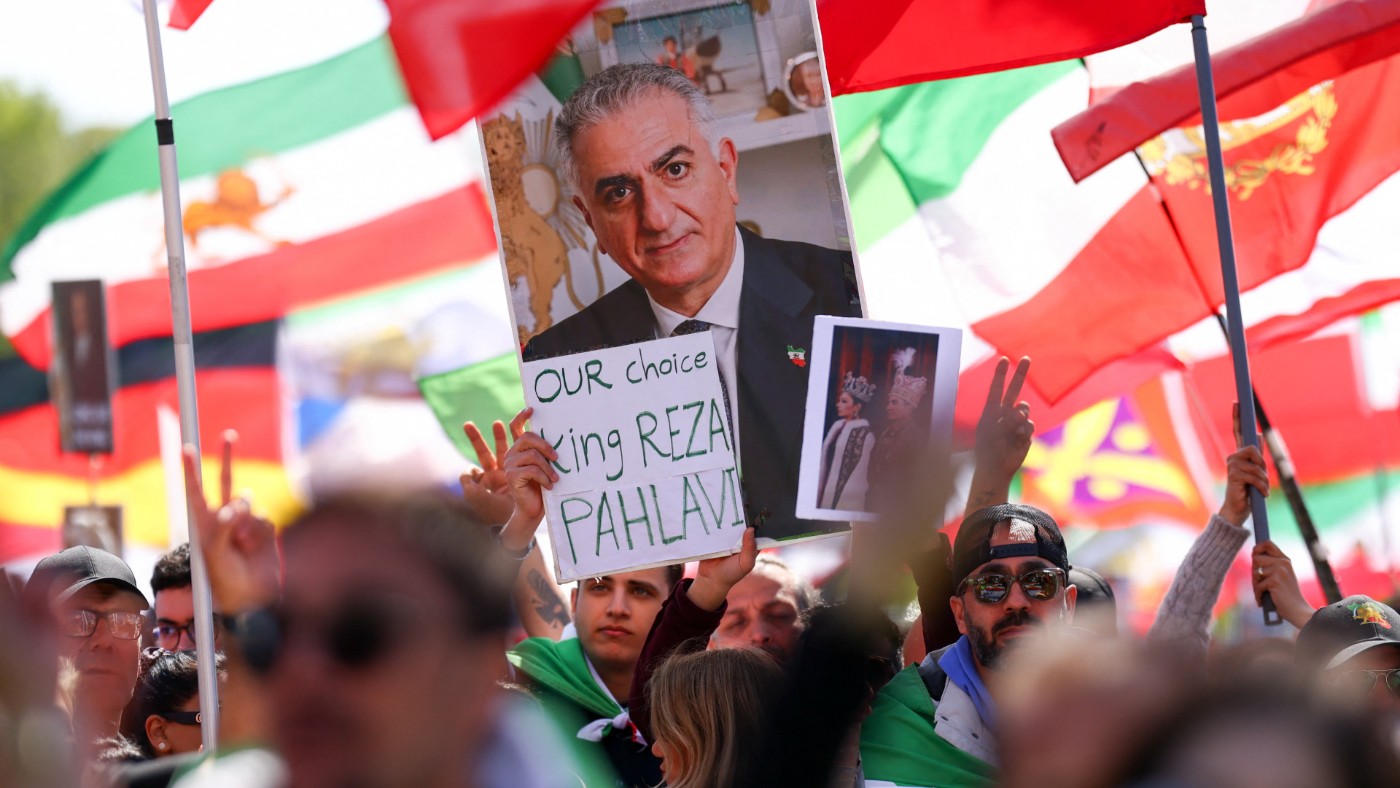
    To understand the ideological roots of this violence, experts point to the core ideology of the Iranian monarchist movement, which positions itself as the ideological opposite of the Islamic Republic that ousted the Pahlavi dynasty in the 1979 Islamic Revolution. Monarchists identify as secular nationalist, drawing heavily on imagery and language from Iran’s pre-Islamic history, often referring to themselves as “Children of Cyrus” after the ancient Achaemenid Empire founder. At rallies, they fly the historic lion and sun flag that served as Iran’s national standard under the shah.

    The movement is led by Reza Pahlavi, son of the last shah of Iran, whose dynasty built an ideology rooted in de-Islamicization and alignment with Western powers. Reza Shah, who founded the Pahlavi dynasty in 1925, launched a widespread campaign to remold Iranian national identity around pre-Islamic heritage, banning traditional Muslim practices, forcing women to abandon hijabs, and spreading state propaganda that blamed Arab conquests for Iran’s national decline. Reza Zia-Ebrahimi, a reader in the history of nationalism and race at King’s College London, describes this ideology as “dislocative nationalism.”

    “It is derived from European colonial ideas and aims to dislodge Iran from its objective reality as a Muslim country in the Middle East, and rather reimagines it as some kind of lost European nation where people who speak Indo-European languages become connected via the Aryan race theory,” Zia-Ebrahimi explained. “It is fundamentally Islamophobic and embraces colonialism and western hegemony.”

    This ideological framework explains why many monarchists actively support Western military intervention and sanctions against Iran, and back Israel’s military campaign in Gaza. “It stems from the fact that Palestinians are Arabs, and monarchists view Arabs as responsible for their downfall because they brought Islam to Iran,” Zia-Ebrahimi said.

    In recent months, the movement has increasingly targeted Iranian Muslim community spaces across the UK. Clashes have broken out outside the Islamic Centre of England, a London-based Shia institution linked to Tehran, and outside Birmingham’s Imam Reza Cultural Centre, where monarchists gathered for successive nights to hold loud, disruptive counter-protests during a public mourning ceremony following the death of Ayatollah Khamenei in February.

    A defining feature of the modern Iranian monarchist movement in diaspora is its formal, institutional alliance with pro-Israel groups and Western far-right actors, whose ideologies reinforce one another. At monarchist rallies, the lion and sun flag is often displayed alongside Israeli flags and British far-right St George’s Cross banners, with protesters chanting openly anti-Muslim slogans. High-profile Western far-right and pro-Zionist figures, including pro-Israel campaigner Mark Birbek, Campaign Against Antisemitism director Gideon Falter, and British far-right activist Tommy Robinson, have all appeared at monarchist events.

    Zia-Ebrahimi confirmed that this alliance has become fully formalized and institutionalized, and that the campaign targeting anti-war Iranians is part of a broader coordinated effort. “There has been a lot of Israeli investment in amplifying monarchist messaging on diaspora news channels and on social media, where they create an army of bots that attack, insult and intimidate alternative Iranian voices,” he said.

    In recent weeks, footage has emerged of monarchist activists marching through British cities clad in black, flying flags associated with the Savak – the brutal, notorious secret police force of the Pahlavi era that imprisoned and tortured thousands of political dissidents. Zia-Ebrahimi warned that what once seemed like a fringe movement is growing into a far more dangerous threat, emboldened by open backing from mainstream Western political figures. “Before we were dealing with a bunch of clowns, but now it is turning into something far more dangerous,” he said.

    The lethal potential of this rising extremism was demonstrated earlier this year in Canada, where Masood Masjoodi, an Iranian-Canadian university professor and public critic of both the Islamic Republic and Reza Pahlavi, was murdered. Two individuals with known ties to the monarchist movement, who had previously targeted Masjoodi with harassment, have been charged with his killing. Samira Mohyeddin, an Iranian-Canadian journalist and founder of On The Line Media, said Masjoodi repeatedly warned authorities he was under threat for months before his death – a failure that underscores how seriously the movement is being overlooked.

    “There are a lot of us being threatened on a daily basis, and unfortunately our police don’t do anything until something happens to someone,” Mohyeddin said. She added that community organizers have heard rumors of monarchist groups drawing up target lists of people they deem acceptable to attack. Mohyeddin warned that without urgent intervention to rein in the movement, violence will only escalate. She drew a parallel between the group’s authoritarian rhetoric and 20th-century fascist movements, noting that chants of “One flag, one leader one country” mirror slogans used by the Nazi regime.

    “Going down this path has nothing to do with liberty, justice, freedom, equality – we’re heading towards another kind of fascism that is very dangerous, and I think we’ll see a very hardcore group of people escalate even further,” she said.
  • Mali accuses military officers of working with jihadis to carry out attacks against government

    Mali accuses military officers of working with jihadis to carry out attacks against government

    In a stunning development that has deepened the security crisis across conflict-wracked Mali, Malian authorities confirmed late Friday that active and recently dismissed military officers colluded with jihadi and separatist insurgents to carry out the largest coordinated offensive the country has seen in more than 10 years. This wave of attacks has already forced government and allied Russian forces to retreat from strategic territory and claimed the life of the nation’s defense minister.

    The string of unprecedented assaults, which opened with near-simultaneous strikes targeting multiple population centers including Bamako’s main international airport, was launched earlier this month through a rare partnership between Jama’at Nusrat al-Islam wal-Muslimin (JNIM), an al-Qaida-affiliated jihadi group, and the Azawad Liberation Front (FLA), a separatist movement fighting for northern Mali’s independence. Fighters carried out the raids using motorcycles and heavy trucks, striking at least 10 separate locations across the country in coordinated action.

    By the start of this week, the offensive delivered a major blow to Mali’s ruling military junta, which seized power in a 2020 coup: insurgents seized control of Kidal, a major northern city, in the retreat that followed the attacks. The violence also killed Malian Defense Minister Sadio Camara, marking one of the highest-profile casualties of the Sahel’s long-running extremist conflict.

    On Friday, separatist commander Achafghi Ag Bouhanda announced in a verified online video that FLA fighters had captured another critical strategic site: the military camp in Tessalit, a northern town located near the Algerian border and adjacent to a key regional airport. The announcement came after Malian army troops and fighters from Russia’s Africa Corps withdrew from the camp ahead of the separatist advance. The Associated Press has not been able to independently verify conditions on the ground at the camp, and Malian officials have not yet issued an official response to requests for comment on the fall of Tessalit.

    The most shocking revelation of the unfolding crisis came via an official statement read on Malian state television from the public prosecutor of Bamako’s Military Court. Investigations into the coordinated attacks have uncovered “solid evidence regarding the complicity of certain military personnel” – including both currently serving and recently discharged officers – in the assault, the prosecutor confirmed. The statement added that these officers directly participated in “the planning, coordination, and execution” of the attacks, and also named exiled prominent opposition politician Oumar Mariko as a co-conspirator in the plot.

    The collapse of government control across swathes of northern Mali comes as the capital Bamako faces mounting pressure from insurgent blockades. JNIM this week announced a full blockade of all four major road arteries leading into Bamako, expanding on a partial fuel and supply blockade that militants imposed on the city late last year. Traffic into the capital was severely disrupted on Friday, with multiple confirmed militant roadblocks along major routes. The persistent instability and blockades have already forced multiple travel agencies to suspend operations, leaving residents facing dangerous and restricted travel across the country. “These days, traveling by road is a dangerous undertaking,” said Aminata Traoré, a frequent traveler between Bamako and the southern Sikasso region.

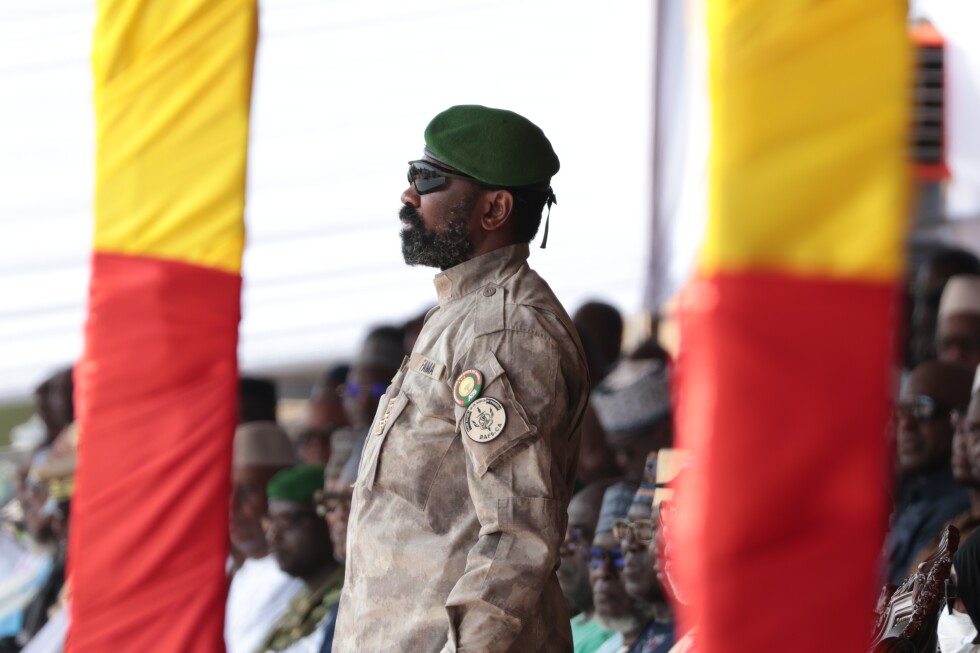
    Mali’s junta leader Assimi Goita has pledged to press forward with counteroffensives to retake lost territory. “Military operations will continue until the armed groups involved have been completely neutralized and security has been sustainably restored throughout the country,” Goita said earlier this week. The Sahel region, a vast expanse of land south of the Sahara Desert spanning multiple West African nations, has become the global epicenter of violent extremist activity in recent years, with jihadi groups expanding their control across remote border areas as national governments struggle to contain the insurgency.