分类: world

  • Mali’s defence minister killed as armed groups launch countrywide offensive

    Mali’s defence minister killed as armed groups launch countrywide offensive

    On Sunday, a wave of coordinated, large-scale attacks across Mali left the country’s defense minister dead and plunged multiple regions into heavy fighting, marking one of the most significant escalations of conflict in the Sahel nation in recent years.

    Sadio Camara, Mali’s top defense official, was killed after a suicide bomber rammed an explosive-laden vehicle into his private residence in Kati, a garrison town located just outside the capital Bamako. A violent gun battle erupted immediately following the blast, during which Camara engaged the attacking force, successfully neutralizing multiple assailants before succumbing to his injuries at a local hospital, an official government statement confirmed. The attack also claimed the lives of Camara’s second wife and two of his grandchildren. Mali’s government has since announced a two-day national period of mourning to honor the dead.

    The assassination of Camara was not an isolated incident: it formed a core component of a synchronized multi-front offensive launched jointly by two armed factions: the Tuareg-led separatist Azawad Liberation Front (FLA) and Jama’at Nusrat al-Islam wal-Muslimin (JNIM), an al-Qaeda-affiliated militant group. The coalition opened attacks across multiple strategic points spanning the country, from the Kati government stronghold near Bamako and Mopti’s Sévaré in central Mali, to the northern regional hubs of Gao and Kidal. Heavy fighting in Bamako’s Senou district forced a temporary closure of the capital’s international airport while security forces restored order.

    The highest-stakes confrontation of the weekend offensive unfolded around Kidal, a strategically critical northern city that was the FLA’s longtime stronghold before Malian government forces backed by Russia’s Wagner Group retook the city from separatist control in November 2023, ending a decade of insurgent rule. By Sunday evening, the status of Kidal remained contested: separatist spokespersons claimed the city had fallen to their forces after reaching an agreement to allow Russian paramilitary troops supporting the Malian government to withdraw from a besieged outpost on the city’s outskirts. Malian army chief of staff Oumar Diarra rejected the separatist claim, stating that government troops had carried out a tactical repositioning of forces and that active combat was still underway in the area.

    Mali has been mired in escalating instability since a 2020 military coup led by Assimi Goita ousted the country’s civilian government amid widespread public discontent over persistent insecurity. Goita’s junta pledged to crush the northern Tuareg rebellion and root out transnational militant groups, but more than four years later, large swathes of Mali remain outside central government control. Russian paramilitary support has been a cornerstone of the junta’s counterinsurgency strategy: after Wagner provided backing for the 2023 recapture of Kidal, the Moscow-aligned force was replaced by Africa Corps, a new paramilitary unit directly controlled by Russia’s ministry of defense, in mid-2025. According to Russian state broadcaster Vesti, Africa Corps fighters fought alongside Malian government troops over the weekend, repelling multiple insurgent attacks and preventing insurgents from seizing the presidential palace in Bamako. The outlet confirmed that several Africa Corps personnel suffered injuries in the fighting, but provided no additional details.

    The weekend offensive marks a major escalation in violence that has been building across Mali for years. JNIM, the al-Qaeda-aligned group, has steadily expanded its operations across the country in recent times: in September 2024, the group carried out a deadly attack on a paramilitary police training academy near Bamako’s airport that killed roughly 70 people. More recently, the group imposed a widespread fuel blockade that has cut off electricity and critical supplies to many residents and businesses in the capital.

    The coordinated attacks drew swift condemnation from the Alliance of Sahel States, the bloc made up of three West African nations all ruled by military juntas — Mali, Burkina Faso, and Niger. In a joint statement, the alliance described the offensive as “a monstrous plot backed by the enemies of the liberation of the Sahel”. All three bloc members have cut diplomatic and political ties with their former colonial ruler France and other Western powers in recent years, and have deepened their military and political alliances with Moscow.

  • At least four killed and dozens injured in Indonesia train crash

    At least four killed and dozens injured in Indonesia train crash

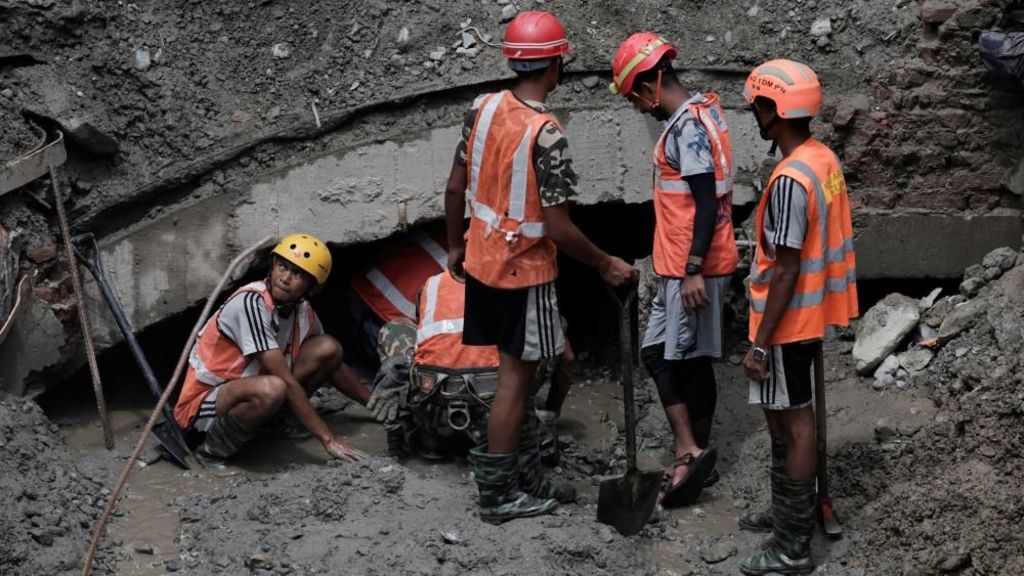
    A devastating rear-end train collision outside Indonesia’s capital Jakarta on Monday has left at least four people dead and dozens more injured, with emergency crews currently working to extract trapped passengers from the wreckage, Indonesian authorities confirmed.

    According to state media reports, the crash unfolded when an incoming long-distance commuter train struck a stationary commuter train that was idle on the same track near Bekasi Timur Station, roughly 25 kilometers (15.5 miles) from central Jakarta. Anne Purba, a spokesperson for Indonesia’s state-owned railway operator Kereta Api Indonesia (KAI), confirmed the initial fatality count and reported that 38 injured people have already been transported to local medical facilities for treatment.

    “KAI expresses its deepest condolences to the victims and their bereaved families,” Purba said in an official statement.

    Local media has broadcast footage from the crash site showing injured patients being moved on medical stretchers near the station, alongside images of rescue teams using specialized equipment to reach passengers still stuck inside damaged train carriages. Jakarta Police Chief Inspector General Asep Edi Suheri told reporters that six to seven people remain trapped in the wreckage as of the latest updates.

    Multiple eyewitnesses shared harrowing accounts of the collision with the BBC’s Indonesian service. One passenger recalled that commuters on board screamed hysterically immediately after impact, while other witnesses reported seeing large numbers of injured victims in the immediate aftermath of the crash.

    Sufmi Dasco Ahmad, Deputy Speaker of the Indonesian House of Representatives, who visited the crash site shortly after the incident, warned that the confirmed death toll could climb as rescue teams clear the wreckage and account for all passengers. Officials have not yet released a final count of total casualties, as operations to reach trapped passengers are still ongoing.

    This collision marks the latest major railway accident to hit Indonesia’s public transport network, which has long faced criticism for its high overall accident rate. Industry analysts and safety advocates have repeatedly linked the country’s poor railway safety record to chronically ageing infrastructure and insufficient systemic maintenance. In January 2024, a separate collision between two trains in a Cicalengka rice field killed multiple people and injured dozens more, leaving both trains’ carriages derailed and heavily damaged.

  • Separate goals, common enemy for Mali’s jihadists and separatists

    Separate goals, common enemy for Mali’s jihadists and separatists

    In a shocking escalation of instability in West Africa, coordinated unprecedented attacks across Mali carried out by an unlikely partnership of Al-Qaeda-linked jihadists and Tuareg separatists have left the country’s military leadership reeling, marking the first full-scale implementation of an alliance struck between the two rival groups one year ago. The assault, which resulted in the death of Mali’s defense minister and the capture of the strategic northern town of Kidal, has thrown the Sahel region’s already fragile security landscape into new turmoil.

    The joint operation was officially claimed Saturday by the Group for the Support of Islam and Muslims (JNIM), Al-Qaeda’s regional affiliate in the African Sahel, which fought alongside the Azawad Liberation Front (FLA), a 2024-founded ethnic Tuareg separatist movement pushing for full independence of Mali’s northern Azawad territory. Alongside seizing Kidal — a town Malian government forces backed by Russian paramilitary fighters had captured from rebel groups in November 2023 — the militants targeted government outposts in multiple major population centers and even launched strikes on the outskirts of the capital, Bamako. In addition to Defense Minister Sadio Camara, the head of Mali’s intelligence service Modibo Kone was wounded in gunfire during the attacks, and junta leader Assimi Goita has not been seen or made any public statement since the offensive began. Security sources also confirmed joint JNIM-FLA operations in the northern town of Gao, where government forces repelled the assault but the militant alliance retains a significant presence in surrounding areas.

    While the two groups hold fundamentally divergent core objectives, regional security experts emphasize their cooperation is rooted in a shared, urgent enemy: the military junta that has ruled Mali since a 2020 coup, and its Russian paramilitary backers, the current Africa Corps force that has replaced the earlier Wagner Group mercenaries. This is not the first time Tuareg separatists and Sahel jihadists have aligned: a 2012 alliance saw the two capture major northern hubs before their partnership collapsed into open conflict, with jihadists ousting the separatists from seized territory. For years after that split, relations remained deeply hostile, culminating in direct armed clashes between FLA and JNIM along the Mauritanian border in April 2024. But by the end of 2024, the two groups negotiated a new power-sharing partnership, according to Wassim Nasr, a jihadist movement researcher at the Soufan Center think tank.

    The terms of the new deal outline clear compromises from both sides: FLA has agreed to accept the application of sharia law in jointly held territory, and requires judicial appointments to receive approval from both organizations. In exchange, the agreement divvies up administrative control: the FLA will govern captured urban centers, while jihadists will oversee rural areas. The partnership also includes critical military knowledge sharing: Nasr notes that JNIM has agreed to share its specialized expertise in building and deploying improvised explosive devices (IEDs) and mortar fire, capabilities the FLA had long struggled to develop independently. Saturday’s offensive marks the first time the full terms of this agreement have been put into operational practice, Nasr explained.

    Jean-Herve Jezequel, Sahel project director at the International Crisis Group, pointed out that the coherence of the alliance depends entirely on its unifying opposition to the current Malian regime. “JNIM pursues a political-religious agenda, centred on the establishment of sharia law and the rejection of foreign forces, whilst the FLA champions a territorial and autonomist agenda, centred on Azawad,” Jezequel explained. “This convergence is based above all on the existence of common adversaries, namely the Malian authorities and their Russian partners.”

    For the Tuareg people, a historically nomadic ethnic group spread across Mali, Niger, Algeria, Libya and Burkina Faso, the push for autonomy stems from decades of documented political and economic marginalization, particularly in the Kidal region. Their alignment with JNIM reflects a growing desperation to reverse military gains made by the junta and its Russian allies over the past two years.

    Experts note that the alliance’s strategic objectives do not include an immediate push to capture Bamako and seize full national power. Instead, their near-term goal is to reassert control over northern Mali’s traditional rebel strongholds. The capture of Kidal, Nasr explained, was achieved by pinning Malian army forces in central Mali, delivering a paralyzing blow to junta leadership in the capital, and consolidating gains in the north. Going forward, the alliance may expand its offensive into central Mali to increase pressure on the junta, with the broader goal of accelerating the regime’s collapse and forcing regime change in Bamako.

    Jezequel added that the group’s strategy focuses on steadily eroding the junta’s legitimacy and capacity through sustained security pressure, rather than a direct assault on the capital, which would be logistically difficult in the short term. Unlike the 2012 alliance that fractured almost immediately, experts say the current partnership may prove more durable, though its long-term future remains uncertain. The true test of the alliance, Nasr argued, will come when the groups move into the post-offensive phase of governing captured cities like Kidal — a test that has yet to begin.

  • Germany: Trial of  ‘Ulm Five’ protesters accused of Elbit break-in postponed

    Germany: Trial of ‘Ulm Five’ protesters accused of Elbit break-in postponed

    A closely watched trial of five anti-occupation activists charged with damaging a site owned by Israel’s largest arms producer Elbit Systems in southern Germany has been delayed at the eleventh hour, after a disagreement over the defendants being isolated behind solid glass barriers that blocked confidential access to their legal teams.

    Dubbed the “Ulm Five” by supporters, the group stands accused of breaking into Elbit’s Ulm facility on September 8, 2025. Prosecutors allege the activists smashed a glass entrance to the site and destroyed on-site office equipment including desktop computers, display screens and communication devices. All five were taken into custody immediately after the incident, and have been held in separate pre-trial detention facilities across the southern German region ever since.

    The opening hearing was scheduled to kick off on the morning of the as-yet-undisclosed court date, but the proceeding ground to a halt before it could even get underway after defense teams raised formal objections to the seating arrangement. Images and accounts shared to the activist group’s official social media channels show that when lawyers arrived in the courtroom at the Stuttgart Correctional Facility, more commonly known as Stammheim Prison, they found their clients locked behind sealed glass partitions that cut off direct physical and private contact.

    Initial reports indicate defense teams first formally protested the unusual arrangement, but attempts to reach a compromise between legal representatives and the presiding judge fell through. No agreement could be reached on allowing the defendants to leave the glass enclosures to sit near their legal teams, and the judge ultimately made the call to postpone the entire hearing. A new opening session is now scheduled to take place next Monday, according to an official statement from the activists’ camp.

    The choice of Stammheim Prison as the venue for the trial has already drawn attention, given the site’s notorious history: it hosted the high-profile 1970s trial of members of the far-left Red Army Faction, a militant group labeled a terrorist organization by German authorities that carried out more than 30 killings over the course of its campaign.

    Beyond basic charges of trespassing and property damage, the five activists also face a far more serious allegation under Section 129 of the German penal code: membership in a criminal organization, specifically the German wing of Palestine Action, a protest group that opposes Israeli arms trade and occupation of Palestinian territory. This particular legal provision is most frequently used to prosecute cases linked to terrorism and organized crime, and a conviction on this count can carry a maximum prison sentence of up to five years.

    Cage International, a London-based advocacy organization that documents security and human rights issues, has found that Elbit Systems supplies roughly 86 percent of all weapons and surveillance technology used by the Israeli military in its operations in the Gaza Strip. In a public statement published on their official website, the Ulm Five pushed back against the charges, defending their actions as a moral stand against complicity in occupation.

    “We will not become complicit or resign ourselves to a system in which every available means is used to legitimize colonialism and occupation — and the unimaginable suffering they cause,” the statement reads. “It is our duty to put a stop to this and disrupt it until the truth comes to light and justice prevails.”

    Legal representatives for the group have also raised alarm over the conditions of the activists’ pre-trial detention, noting that the five have already been held in custody for more than seven months — exceeding the six-month maximum limit for pre-trial detention permitted under German law. The detainees include Daniel Tatlow-Devally from Ireland, Zo Hailu and Crow Tricks from the United Kingdom, Vi Kovarbasic from Germany, and Leandra Rollo, a Spanish-Argentine national.

    “The clients have been kept in custody for over seven months now, which effectively amounts to punishment without a final conviction,” defense attorney Nina Oner explained in a recent interview. Multiple reports from independent outlet Middle East Eye have detailed that the five are being held in extreme isolation, with strict constant monitoring that severely limits contact with friends and family. All incoming mail is read by authorities before it reaches the detainees, and all non-legal conversations are supervised and recorded by police.

  • French coastguard rescues more than 100 migrants crossing Channel

    French coastguard rescues more than 100 migrants crossing Channel

    Just five days after the United Kingdom and France formalized a new multi-million-pound agreement to curb dangerous smallboat crossings of the English Channel, French authorities have carried out three separate rescue operations that saved 119 migrants attempting the perilous journey.

  • Suspects in Scot’s murder in Kenya charged over attack on another man

    Suspects in Scot’s murder in Kenya charged over attack on another man

    A high-profile case linking four Kenyan men to the killing of a Scottish businessman has taken a new turn, as the quartet is now set to appear in court for an unrelated violent robbery charge against an American tourist.

    Campbell Scott Alistair, a 58-year-old businessperson hailing from Dunfermline, Fife, traveled to Nairobi, Kenya’s capital, for a professional conference in February 2025. Shortly after checking into his local hotel, Scott vanished without a trace. Days of frantic search efforts ended in tragedy when investigators located his body concealed inside a sack, dumped in a remote forest roughly 60 miles outside Nairobi.

    Earlier this month, Kenyan law enforcement announced the arrest of Bernard Mbusu, Isaac Kinoti Kobia, Evans Muthengi Mutaki and Kelvin Mwangi Njoroge, publicly naming the four as prime suspects in Scott’s murder. In an official social media statement shortly after the arrests, the Directorate of Criminal Investigations noted that the operation that took the suspects into custody was intelligence-driven and multi-agency, adding the men were tied not only to Scott’s abduction and killing but also to a string of violent robberies targeting foreign nationals.

    What has become a layered legal process now sees the four men facing separate charges for a violent armed robbery that took place on April 11 at a holiday apartment in the Nyali district of Mombasa, a coastal Kenyan tourist hub. Prosecutors allege the group attacked an American man staying at the property, stealing approximately £4,000 in cash alongside personal property including a laptop, smartphone and jewelry with a combined estimated value of £1,100. All four suspects have entered a plea of not guilty to the robbery charges.

    Notably, the Mombasa robbery case has no official connection to the ongoing investigation into Scott’s murder, according to court documents. In a recent ruling, the court granted bail to the four men, setting the total bail amount at 1,000,000 Kenyan shillings, equal to roughly £5,700. The robbery case is scheduled to resume in court on May 27.

    As of press time, Kenyan law enforcement officials have not responded to requests for comment on the current status of the Scott murder investigation, nor have they confirmed whether the four men still remain official suspects in his killing.

  • Pakistan accused of attacking Afghan university

    Pakistan accused of attacking Afghan university

    Fresh cross-border violence has reignited tensions between Pakistan and Afghanistan, after Pakistani jets and drones carried out strikes on the eastern Afghan province of Kunar that have left at least seven civilians dead and 75 more injured, multiple informed sources have confirmed to the BBC. Among the casualties are multiple students and one faculty member from Kunar University, with the ruling Taliban administration confirming that 30 of those wounded are currently enrolled university students.

    Local accounts from the strike zone paint a picture of chaos and destruction. A Kunar University professor who was on campus during the attacks described hearing deafening, terrifying explosions that rippled across the entire university grounds. Official statements from Afghanistan’s Ministry of Higher Education later confirmed that university buildings and their surrounding residential and public areas suffered extensive structural damage from the bombings.

    Pakistan’s Ministry of Information has issued a direct denial of the claims, dismissing reports that strikes targeted the university and residential neighborhoods as completely false manufactured information.

    This latest escalation comes just weeks after a far deadlier Pakistani air strike on a drug rehabilitation facility in Afghanistan’s capital Kabul. United Nations officials have confirmed that the earlier attack killed 269 people, making it one of the deadliest cross-border strikes in the region in recent years.

    The resumption of violence breaks a fragile ceasefire that had held across most of the shared border for nearly a month. That truce was brokered through Chinese diplomatic mediation, which brought representatives from both nations to talks in the Chinese city of Urumqi in early April aimed at de-escalating months of growing cross-border conflict.

    Over the past six months, hundreds of people have been killed or wounded in recurring clashes and cross-border strikes between the two neighboring nations. Pakistan has repeatedly justified its air operations inside Afghan territory, stating that all strikes are targeted exclusively at militant hideouts that it says operate from Afghan soil to launch attacks against Pakistani targets. Notably, Pakistan has recently taken on a diplomatic mediation role itself, working to de-escalate tensions between Iran and the United States amid their ongoing standoff.

  • Gunmen raid Nigerian orphanage and kidnap children

    Gunmen raid Nigerian orphanage and kidnap children

    A devastating targeted attack by armed gunmen on an unregistered orphanage in Nigeria’s north-central Kogi State has left 23 people abducted, with eight children still unaccounted for days after the assault, local authorities confirmed this week. The brazen Sunday raid also saw the owner of the unlicensed child care facility taken captive by the attackers, according to Kogi State Information Commissioner Kingsley Fanwo. Following a rapid, coordinated mobilization of local security agencies, 15 of the abducted children have been successfully rescued from captivity, Fanwo stated in an official briefing Monday.

    To date, no armed faction has publicly claimed responsibility for the attack. But senior security sources familiar with regional instability note that Kogi State hosts an active operational cell of the jihadist insurgent group Boko Haram, and the area has already seen a string of violent, opportunistic attacks targeting vulnerable communities in recent months.

    The orphanage attack is the latest high-profile incident in Nigeria’s growing national kidnap crisis, which has plagued regions across the country for years. Transnational criminal gangs regularly abduct civilians, including children, to demand large ransom payments. While the Nigerian federal government has formally outlawed ransom payments to kidnappers, the ban has done little to curb the frequency of these attacks, as criminal networks continue to profit from the practice despite increased security deployments.

    In his Monday statement, Commissioner Fanwo emphasized that the targeted orphanage had been operating illegally in a remote, bushy rural area without the knowledge or official approval of state regulatory authorities. He issued a formal warning to all operators of orphanages, schools, and residential care institutions across the state to complete required regulatory registration and coordinate regularly with relevant government agencies, particularly amid the country’s ongoing volatile security environment.

    Mass abductions of children at educational and care facilities have become increasingly common across northern Nigeria, where long-running insurgency and weak security infrastructure have created conditions for rampant kidnapping. This incident marks the first recorded attack specifically targeting an orphanage in the country. The attack echoes a much larger mass abduction in November 2025, when more than 300 students and their teachers were seized from a Catholic secondary school in neighboring Niger State, also in north-central Nigeria. All captives were eventually released in two separate batches, with the final group regaining freedom more than a month after their abduction. The Nigerian government has repeatedly denied widespread reports that it paid a large ransom to secure their release, or that it swapped two detained Boko Haram commanders for the hostages as part of a negotiated deal.

    Nigerian authorities have reaffirmed their commitment to locating and rescuing the eight remaining missing children from the Kogi State orphanage attack, saying security operations are ongoing in the area. “The government remains fully committed to ensuring the rescue of all the victims,” Fanwo said.

  • Plane crash in South Sudan kills all 14 on board

    Plane crash in South Sudan kills all 14 on board

    A devastating aviation disaster has killed every person onboard a small passenger aircraft that crashed in South Sudan early Monday, according to official confirmation from the country’s Civil Aviation Authority (SSCAA). The CityLink Aviation-operated flight, a Cessna 208 Caravan, had departed the city of Yei at 9:15 a.m. local time bound for Juba, a roughly 130-kilometer route southwest of the capital. Roughly 30 minutes into the journey, authorities lost all contact with the aircraft, which ultimately crashed approximately 20 kilometers outside Juba.

    Preliminary investigations point to severe weather as the most likely cause of the crash. In an official statement, the SSCAA noted that initial reports link the crash to poor atmospheric conditions, specifically extremely low visibility that hindered the pilot’s navigation. A specialized investigation team has already been deployed to the remote crash site to collect evidence and confirm the root cause of the incident.

    Official passenger and crew breakdowns confirm the flight carried 14 people total: one pilot and 13 passengers. Among those killed were 12 citizens of South Sudan and two Kenyan nationals. No survivors have been recovered from the crash site.

    The crash renews longstanding concerns about aviation safety in South Sudan, where air travel infrastructure remains chronically underdeveloped, and the country has a well-documented poor aviation safety record. Air accidents are relatively frequent across the nation, with most incidents commonly attributed to two key risk factors: overloaded aircraft and unpredictable, severe weather conditions. This is not the first deadly air disaster to hit the country in recent years: in January 2025, a plane carrying 20 oil workers crashed just three minutes after takeoff near Unity State’s northern oil fields, killing everyone onboard.

  • Plane crashes on the outskirts of South Sudan’s capital, killing 14 people

    Plane crashes on the outskirts of South Sudan’s capital, killing 14 people

    A devastating aviation disaster has claimed 14 lives near the capital of South Sudan, after a small Cessna aircraft went down on the outskirts of Juba earlier this week, South Sudan’s Civil Aviation Authority has confirmed. All 13 passengers and one pilot aboard the flight lost their lives in the crash, which occurred roughly 20 kilometers (12 miles) from the center of the capital.

    The aircraft was en route to Juba from the southern South Sudanese town of Yei when it experienced an emergency that led to its crash. Preliminary investigations into the incident point to severe weather conditions as the most likely cause. Dense fog and low cloud cover drastically reduced visibility for the pilot, creating dangerous flying conditions that contributed to the accident, the authority said.

    Among the casualties, two of the deceased hold Kenyan nationality, while all other 12 victims are South Sudanese citizens, the authority confirmed. No survivors have been found at the crash site.

    Shortly after the crash was reported, an official investigative and response team was deployed to the remote hilly location to recover remains and begin piecing together the full circumstances of the disaster. User-generated footage of the accident scene that circulated widely across social media platforms in the hours after the crash shows smoldering wreckage of the plane still engulfed in open flames. The landscape captured in the videos matches the civil aviation authority’s account of poor weather, with heavy mist blanketing the hilly terrain where the aircraft came down.

    The crash marks one of the deadliest aviation incidents in South Sudan this year, and it has prompted the national aviation authority to launch a full review to confirm the exact cause of the disaster and identify any safety gaps that may have contributed to the tragedy.