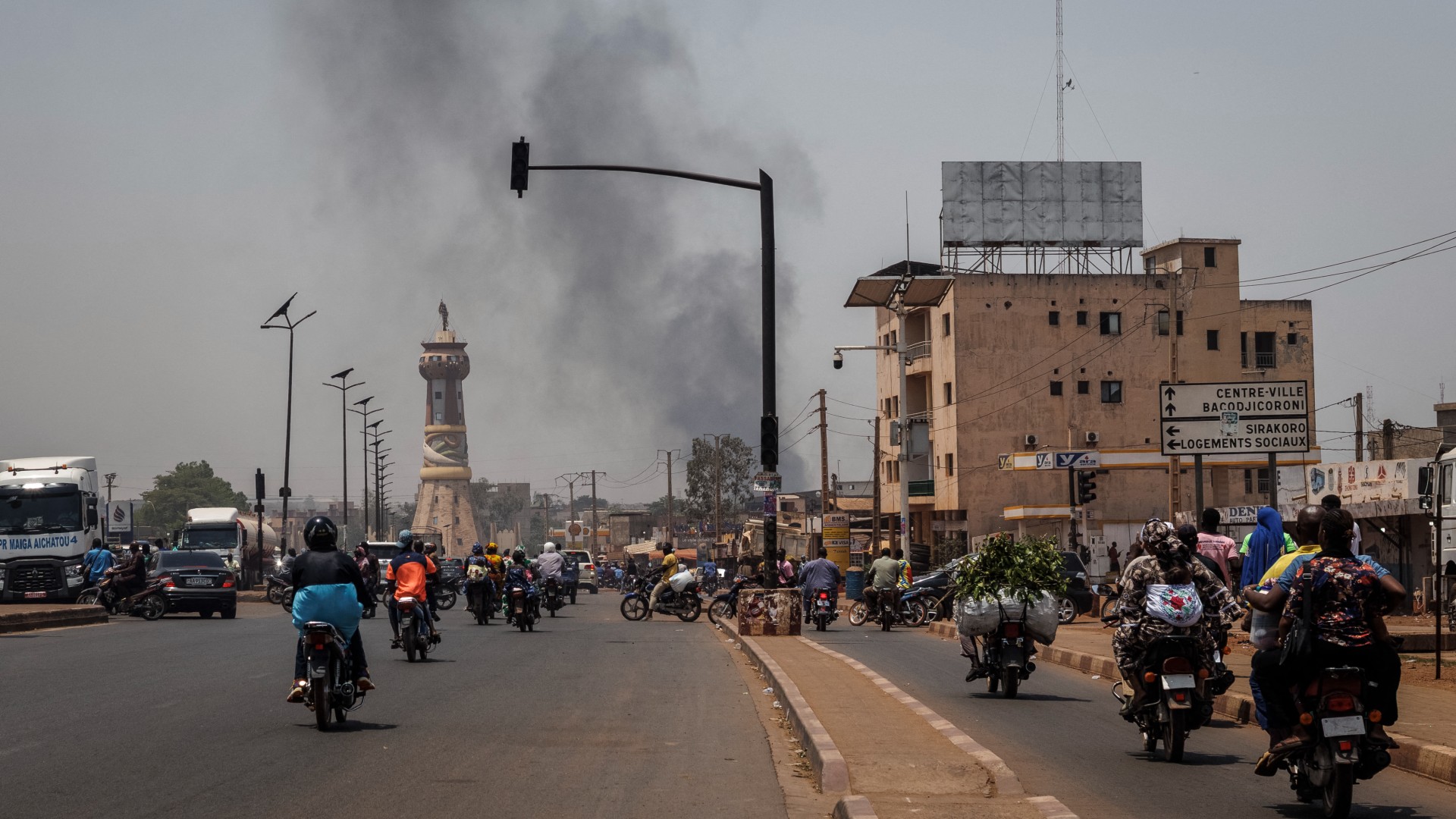
On Sunday, a wave of coordinated, large-scale attacks across Mali left the country’s defense minister dead and plunged multiple regions into heavy fighting, marking one of the most significant escalations of conflict in the Sahel nation in recent years.
Sadio Camara, Mali’s top defense official, was killed after a suicide bomber rammed an explosive-laden vehicle into his private residence in Kati, a garrison town located just outside the capital Bamako. A violent gun battle erupted immediately following the blast, during which Camara engaged the attacking force, successfully neutralizing multiple assailants before succumbing to his injuries at a local hospital, an official government statement confirmed. The attack also claimed the lives of Camara’s second wife and two of his grandchildren. Mali’s government has since announced a two-day national period of mourning to honor the dead.
The assassination of Camara was not an isolated incident: it formed a core component of a synchronized multi-front offensive launched jointly by two armed factions: the Tuareg-led separatist Azawad Liberation Front (FLA) and Jama’at Nusrat al-Islam wal-Muslimin (JNIM), an al-Qaeda-affiliated militant group. The coalition opened attacks across multiple strategic points spanning the country, from the Kati government stronghold near Bamako and Mopti’s Sévaré in central Mali, to the northern regional hubs of Gao and Kidal. Heavy fighting in Bamako’s Senou district forced a temporary closure of the capital’s international airport while security forces restored order.
The highest-stakes confrontation of the weekend offensive unfolded around Kidal, a strategically critical northern city that was the FLA’s longtime stronghold before Malian government forces backed by Russia’s Wagner Group retook the city from separatist control in November 2023, ending a decade of insurgent rule. By Sunday evening, the status of Kidal remained contested: separatist spokespersons claimed the city had fallen to their forces after reaching an agreement to allow Russian paramilitary troops supporting the Malian government to withdraw from a besieged outpost on the city’s outskirts. Malian army chief of staff Oumar Diarra rejected the separatist claim, stating that government troops had carried out a tactical repositioning of forces and that active combat was still underway in the area.
Mali has been mired in escalating instability since a 2020 military coup led by Assimi Goita ousted the country’s civilian government amid widespread public discontent over persistent insecurity. Goita’s junta pledged to crush the northern Tuareg rebellion and root out transnational militant groups, but more than four years later, large swathes of Mali remain outside central government control. Russian paramilitary support has been a cornerstone of the junta’s counterinsurgency strategy: after Wagner provided backing for the 2023 recapture of Kidal, the Moscow-aligned force was replaced by Africa Corps, a new paramilitary unit directly controlled by Russia’s ministry of defense, in mid-2025. According to Russian state broadcaster Vesti, Africa Corps fighters fought alongside Malian government troops over the weekend, repelling multiple insurgent attacks and preventing insurgents from seizing the presidential palace in Bamako. The outlet confirmed that several Africa Corps personnel suffered injuries in the fighting, but provided no additional details.
The weekend offensive marks a major escalation in violence that has been building across Mali for years. JNIM, the al-Qaeda-aligned group, has steadily expanded its operations across the country in recent times: in September 2024, the group carried out a deadly attack on a paramilitary police training academy near Bamako’s airport that killed roughly 70 people. More recently, the group imposed a widespread fuel blockade that has cut off electricity and critical supplies to many residents and businesses in the capital.
The coordinated attacks drew swift condemnation from the Alliance of Sahel States, the bloc made up of three West African nations all ruled by military juntas — Mali, Burkina Faso, and Niger. In a joint statement, the alliance described the offensive as “a monstrous plot backed by the enemies of the liberation of the Sahel”. All three bloc members have cut diplomatic and political ties with their former colonial ruler France and other Western powers in recent years, and have deepened their military and political alliances with Moscow.