分类: politics

  • Trial begins for 4 Indonesian service members charged over acid attack on activist

    Trial begins for 4 Indonesian service members charged over acid attack on activist

    On Wednesday, a high-stakes military trial got underway in Jakarta for four Indonesian military intelligence personnel, charged with carrying out a brutal acid attack on a leading human rights advocate that has reopened long-simmering national debates over unaccountable violence within the country’s armed forces. The defendants include three navy marines and one air force officer — Sgt. Edi Sudarko, First Lt. Budhi Hariyanto Widhi Cahyono, Capt. Nandala Dwi Prasetya, and Air Force First Lt. Sami Lakka — all assigned to the Strategic Intelligence Agency of the Indonesian National Armed Forces (TNI). They face charges of aggravated premeditated assault stemming from the March 12 attack, which carries a maximum sentence of 12 years’ imprisonment if the court returns a guilty verdict. The target of the attack was Andrie Yunus, a 27-year-old human rights lawyer and senior campaigner with KontraS, the Commission for the Disappeared and Victims of Violence, one of Indonesia’s most prominent human rights organizations.

    The attack unfolded as Yunus rode his motorcycle through central Jakarta on the evening of March 12, when assailants threw a vial of hydrochloric acid directly at his face. Prosecutor Mohammad Iswandi told the court that the assault left Yunus with chemical burns covering 20% of his body and permanent damage to 40% of his right cornea, resulting in total loss of vision in that eye. Iswandi confirmed that Yunus has undergone multiple emergency and reconstructive surgeries and remains in ongoing recovery, preventing him from attending the opening session of the trial. “The actions of the defendants who threw chemical liquid on Andrie Yunus, resulting in the loss of sight in his right eye and severe burns with no hope of complete recovery, were inappropriate actions for members of the TNI,” Iswandi told the court. Prosecutors have framed the attack as a coordinated act driven by personal motive, alleging the four assailants carried out the assault “to teach him a lesson and deter him from making disparaging remarks about the TNI.” Two of the defendants suffered minor acid splashes to the face and eyes during the attack, and all four declined to enter objections to the charges after prosecutors read the full indictment. Presiding judges have scheduled the next session of the trial for May 6, when witness testimony will begin.

    The handling of the case has drawn sharp criticism from domestic and international human rights groups, which have raised objections to both the official personal-motive narrative and the decision to try the defendants in a closed military court rather than an open civilian tribunal. Usman Hamid, executive director of Amnesty International Indonesia, argues that authorities have deliberately narrowed the scope of the investigation to only the four accused, offering no transparency into potential higher-level involvement. Hamid noted that there is no documented personal or professional connection between Yunus and the four defendants, and evidence shows official military assets were used to carry out the attack. “It is difficult to accept that state facilities were used solely for personal revenge,” Hamid said, warning that opaque handling of the trial risks eroding already fragile public trust in Indonesia’s military accountability mechanisms.

    Yunus has long been a leading voice against military impunity in Indonesia, campaigning for security sector reform and expanded civil liberties. Last year, he was a prominent organizer of widespread protests against proposed revisions to Indonesia’s military law that would expand the TNI’s role in domestic civilian governance, and colleagues confirm he has faced repeated threats and intimidation tied to his advocacy work. The attack and subsequent trial have drawn immediate comparisons to the 2004 assassination of Munir Said Thalib, the iconic human rights advocate and founder of KontraS, who was poisoned with arsenic on a flight to Amsterdam. While a handful of low-level actors were convicted in Munir’s murder, activists have long argued that the masterminds behind the killing were never identified or prosecuted, leaving the case a persistent symbol of military impunity in the country.

    Widespread public and civil society pressure to uncover the full chain of command behind the attack on Yunus has prompted a response from Indonesian President Prabowo Subianto, a former army general who took office with pledges to strengthen institutional accountability. Prabowo has pledged to hold all those responsible to account and confirmed he is considering establishing an independent fact-finding commission to investigate any unaddressed links to the attack. For rights advocates, the outcome of Yunus’s trial will serve as a critical test of the TNI’s stated commitment to accountability more than 25 years after the fall of longtime dictator Suharto. Following Suharto’s ouster in 1998, the Indonesian military formally withdrew from domestic politics, and a series of reforms were implemented to strengthen civilian oversight of the armed forces. But activists say persistent cases of unaccountable violence against critics and human rights campaigners show those reforms have yet to deliver on their promises.

  • King Charles to stress UK-US cultural, trade ties in New York

    King Charles to stress UK-US cultural, trade ties in New York

    As the four-day state visit of Britain’s King Charles III and Queen Camilla to the United States enters its third day, the British monarch will center his Wednesday itinerary in New York on reinforcing the deep cultural and economic bonds that have long defined the UK-US relationship, at a moment when the two allies’ so-called “special relationship” faces growing friction. The visit, which opened in Washington D.C. with a warm formal greeting from President Donald Trump for the royal couple, has been overshadowed from the start by escalating tensions over the ongoing conflict involving Iran. The New York leg of the tour will kick off with a solemn act of commemoration: the King and Queen will lay a wreath at the 9/11 Memorial, marking 25 years since the 2001 terrorist attacks that claimed the lives of nearly 3,000 people. In an address to the U.S. Congress delivered the previous day, Charles reflected on the global impact of that tragedy, noting “This atrocity was a defining moment for America and your pain and shock were felt around the whole world.” He added, “We stood with you then. And we stand with you now in solemn remembrance of a day that shall never be forgotten,” framing his speech as a call for unified action among Western powers. Following the wreath-laying, Charles is set to meet with 9/11 first responders and family members of those killed in the attacks. A lifelong advocate for environmental action and sustainable land management, the King will then tour an urban sustainable farming initiative that combines food access work with youth mentorship to address systemic food insecurity in New York City. While the King visits the agricultural project, Queen Camilla will carry out a separate engagement at the New York Public Library, where she will mark the 100th anniversary of A.A. Milne’s beloved fictional character Winnie-the-Pooh. She is expected to present the library with a custom-made plush toy of Roo, Pooh’s young friend from the Hundred Acre Wood. Later in the day, King Charles will gather with transatlantic business leaders — including investors, startup founders and industry executives — at an event dedicated to highlighting the deep interconnectedness of the British and American economies. This engagement comes at a sensitive moment: just weeks earlier, Trump threatened to walk back a bilateral trade agreement that currently mitigates the impact of U.S. tariffs on British goods, in a rebuke of Prime Minister Keir Starmer’s refusal to back the U.S.-led war effort against Iran. The final public event of Charles’s New York schedule will be a reception celebrating the work of The King’s Trust, the monarch’s long-running youth charity, while also showcasing the output of British and American cultural industries. Tight security measures have been implemented across New York for the royal visit, coming just days after an alleged assassination attempt targeting Trump at a Washington D.C. press gala. Zohran Mamdani, New York City’s leftist mayor, will not hold a private meeting with the King but will join him for the 9/11 commemoration ceremony. So far, British officials have expressed satisfaction with the ceremonial welcome extended to Charles and Camilla during their time in the U.S., which has included a 21-gun salute, a military flyover by U.S. fighter jets, and a formal state banquet hosted at the White House. Trump has adopted a warm, jovial tone toward the royal couple, even joking that his Scottish-born mother had a teenage crush on Charles. This amicable tone stands in sharp contrast to Trump’s sharp public criticism of Starmer over the UK’s refusal to join the Iran conflict, a disagreement that created diplomatic friction in the lead-up to the state visit. In his landmark address to Congress — the first by a British monarch since Queen Elizabeth II spoke to the body in 1991, delivered amid celebrations of the 250th anniversary of American independence from British rule — Charles sought to smooth over existing disagreements between the two nations. “Whatever our differences, whatever disagreements we may have, we stand united in our commitment to uphold democracy,” he told assembled lawmakers. He emphasized that the modern UK-US partnership “was born out of dispute, but no less strong for it,” framing the alliance as resilient enough to withstand temporary policy rifts.

  • King Charles III and Queen Camilla visiting 9/11 Memorial and other NYC landmarks as part of US trip

    King Charles III and Queen Camilla visiting 9/11 Memorial and other NYC landmarks as part of US trip

    LONDON, NEW YORK – Three days into their landmark first state visit to the United States as Britain’s reigning monarch and queen consort, King Charles III and Queen Camilla will arrive in New York City on Wednesday, a mid-trip stop that carries deep symbolic and diplomatic weight amid the 250th anniversary of American independence. This occasion marks the first time a sitting British monarch has visited New York since the late Queen Elizabeth II’s 2010 trip, drawing close international attention to the royal couple’s packed schedule of commemorative, charitable and diplomatic activities.

    The visit’s New York leg opens with a solemn wreath-laying ceremony at the National September 11 Memorial, timed ahead of the 25th anniversary of the 2001 terror attacks. During the event, the royal couple will meet with first responders who survived the attacks and family members of those killed, with New York City Mayor Zohran Mamdani and other high-ranking local and national dignitaries also in attendance.

    Following the memorial service, the royal pair will split for separate, themed engagements tailored to their individual public priorities. Queen Camilla will travel to the New York Public Library, where she will officially donate a new stuffed Roo doll to the institution’s iconic collection of original Winnie-the-Pooh toys. The donation comes as the beloved children’s literary franchise celebrates its centennial this year. The five original plush toys already on display at the library – Winnie-the-Pooh, Piglet, Tigger, Eeyore and Kanga – once belonged to Christopher Robin Milne, son of Winnie-the-Pooh creator A.A. Milne, and directly inspired the characters that appear in Milne’s classic 1920s children’s books. Donated to the library in 1987, the collection has become one of the most popular centerpieces of its world-famous children’s literature holdings. Roo, the young son of Kanga in the original stories, was the only original character plush that has not survived to the present day.

    For his part, King Charles will first tour a community after-school urban farming program that supports young people impacted by food insecurity, aligning with his long-standing focus on sustainability and youth opportunity. He will then hold a meeting with top business and finance leaders in Manhattan, before the couple reunites for a reception hosted by The King’s Trust, the global youth charity Charles founded in 1976 to support vulnerable young people across the Commonwealth and beyond.

    This four-day U.S. visit is King Charles’ first state visit to the country since he acceded to the throne following his mother’s death in 2022. The late Queen Elizabeth II completed four full state visits to the United States during her 70-year reign. The trip was scheduled to mark the 250th anniversary of the United States’ declaration of independence from British rule, a milestone that diplomats have framed as an opportunity to celebrate the long-standing close alliance between the two nations.

    The royal couple has already completed multiple high-profile events in Washington D.C. earlier this week. On Monday, they joined President Donald Trump and First Lady Melania Trump for a formal tea at the White House. A day later, King Charles held a closed-door bilateral meeting with President Trump in the Oval Office, before delivering a rare address to a joint session of U.S. Congress – an honor only granted to a handful of foreign heads of state, and the first time a British monarch has addressed Congress since Queen Elizabeth II’s 1991 speech. The day concluded with a formal state dinner hosted by the Trump administration at the White House.

    After wrapping up their New York engagements, the royal pair will travel to Virginia for additional stops before returning to the White House on Thursday for a formal farewell ceremony hosted by President Trump. Following the conclusion of his U.S. visit, King Charles will travel alone to Bermuda for his first visit to a British Overseas Territory as reigning monarch.

  • How the King and Queen spent their second day in the US

    How the King and Queen spent their second day in the US

    On the second day of their official visit to the United States, the British King and Queen took center stage at a prestigious state dinner hosted at the White House, where a deeply symbolic gift exchange underscored the longstanding ties between the two nations. In a moment that blended military history with modern diplomatic goodwill, the King presented the U.S. President with a unique, meaningful artifact: a bell originally from HMS Trump, the World War II submarine that shares his name. The gesture carried layers of historical resonance, connecting the present-day royal visit to the shared wartime legacy that binds Britain and the United States, turning a routine diplomatic gift into a memorable reflection of decades of alliance. The second day of the trip, capped by the formal state dinner, continued the royal couple’s program of diplomatic engagement, with the gift exchange emerging as the key highlight of the occasion.

  • Former US officials criticise Pentagon silence on deadly Iran school attack

    Former US officials criticise Pentagon silence on deadly Iran school attack

    Two months after a deadly missile strike hit a primary school in Minab, Iran, during the opening phase of the US-Israeli military campaign on February 28, a group of five former senior US officials have publicly condemned the Pentagon for its prolonged refusal to acknowledge potential American responsibility for the incident, which killed 168 people including roughly 110 children per Iranian government figures.

    The Pentagon has issued only one public update since the strike, stating that the incident remains under investigation. When the BBC submitted a series of detailed questions about the strike and allegations of institutional secrecy, a Pentagon spokesperson repeated only that the inquiry is ongoing, noting that additional information would be released once it becomes available. Independent US media reporting in early March, however, has cited unnamed military sources confirming that preliminary investigative work suggests American forces likely struck the school by accident, though no final formal conclusion has been released. Those same reports trace the error to outdated target coordinates provided by a US intelligence agency; the missile was intended for an adjacent Iranian Revolutionary Guard Corps (IRGC) military base, a target the Pentagon has repeatedly refused to confirm was on its list of pre-planned February 28 strikes, despite publicly disclosing details of dozens of other targets hit during the opening of the war.

    The BBC has independently verified authentic video footage showing a US Tomahawk missile striking the IRGC base adjacent to the destroyed school, corroborating the core claims of the earlier anonymous media reports. In contrast to the Pentagon’s current two-month silence, a BBC analysis of three high-profile past cases of civilian fatalities from US military operations found that in every instance, the Pentagon released substantial, detailed information to the public in less than 30 days.

    Retired US Air Force Lieutenant Colonel Rachel E. VanLandingham, a former top legal adviser at US Central Command (CENTCOM) during the Iraq and Afghanistan wars and one of the critics of the current response, called the Trump administration’s approach a “striking departure” from long-standing Pentagon standard operating procedures. VanLandingham noted that past US administrations, regardless of party, at least paid public lip service to upholding the laws of war and commitments to accountability. What is missing from the current administration’s statements, she argued, is any pledge to take responsibility and take steps to prevent similar civilian tragedies in the future.

    Wes Bryant, a former senior advisor for precision warfare and civilian harm mitigation at the Pentagon’s Civilian Protection Center of Excellence who left the department last year after Defense Secretary Pete Hegseth drastically cut staffing for the civilian harm unit, told the BBC that the Pentagon’s current investigative process itself confirms officials already know US forces were responsible. Bryant explained that formal investigations are only launched after a preliminary inquiry confirms two key facts: that civilian harm occurred, and that US forces were operating in the area and could have caused the incident. “From a process standpoint… that just points even more to the fact that they know already that the US caused this or else they wouldn’t be doing this investigation, and they just don’t want to acknowledge it or speak to it,” Bryant said, adding that the complete refusal to comment on any details of the incident is “unacceptable.”

    One anonymous former senior defense official agreed that while complex civilian harm investigations can take extended time, the level of secrecy in this case is entirely unwarranted. “But this is a case where… it’s unusually opaque in that I can tell from the situation it’s actually not that complicated,” the official told the BBC. “Normally the Pentagon would take immediate [or] relatively fast responsibility and then probably require a longer period of time to provide all the details, so to me it’s problematic.”

    Top congressional Democrats have repeatedly pressed Hegseth for answers, starting with a basic confirmation of whether US forces carried out the strike. The BBC has reviewed two formal response letters sent by the Pentagon on Hegseth’s behalf, neither of which answers any of the Democrats’ core questions. A most recent April 2 letter only confirmed that an investigating officer outside the CENTCOM chain of command has been appointed, and that results would be shared after the inquiry concludes. When the BBC reached out to 15 Republican members of Congress, including top leaders of House and Senate national security committees, all declined to comment on the administration’s handling of the strike. Only one Republican senator, John Kennedy of Louisiana, has publicly broken rank, telling the *New York Times* in March that “I think we made a mistake. It was a terrible, terrible mistake.”

    During closed-door congressional briefings on Iran war operations, Pentagon officials have repeatedly declined to answer questions about the Minab strike, citing the ongoing investigation. Adam Smith, the top Democrat on the House Armed Services Committee, called that response “pathetic and completely inadequate,” confirming that officials have refused to admit US responsibility even in private.

    The pattern of silence from current administration officials lines up with public comments from President Donald Trump, who has repeatedly denied any knowledge of evidence linking US forces to the strike and without evidence blamed Iran for the deaths. On March 7, Trump claimed Iran was responsible for the strike. Days later, when asked about verified video of a US Tomahawk hitting the adjacent military base, he claimed he had not seen the footage and falsely asserted that Iran also possesses Tomahawk missiles. When pressed later about reports that a preliminary probe found US forces were responsible, he again said he had no knowledge of the incident. Hegseth similarly told the BBC in March that “All I can say is that we’re investigating that. We of course never target civilian targets.”

    To contextualize the current response, the BBC compared the Minab incident to three prior high-profile cases of civilian deaths from US strikes across different administrations: the 2021 Kabul airport drone strike that killed 10 civilians including seven children, the 2015 MSF hospital bombing in Kunduz that killed 42 people, and the 1991 al-Amiriyah shelter bombing in Baghdad that killed 408 civilians. In all three cases, even when the US initially denied responsibility, senior officials acknowledged the strike and released substantial public details within a month at most, contrasting sharply with the two-month silence in the Minab case.

    Annie Shiel, a former State Department official focused on civilian harm reduction who now serves as US Advocacy Director for the Center for Civilians in Conflict (CIVIC), noted that the appointment of an external investigator is at least a nominal step toward procedural independence, but argued that any US role should be acknowledged publicly even before the full investigation concludes. Shiel added that past US administrations have often been forced to reverse initial denials after independent reporting confirms US responsibility, a pattern the current administration seems intent on avoiding by saying nothing at all.

    Independent corroboration of the strike’s details has been further complicated by the Iranian government’s refusal to grant independent investigators or journalists access to the blast site. The UN Fact Finding Mission on Iran announced March 17 that it had formally requested access to Minab but been denied permission to visit.

    Charles O Blaha, a 32-year veteran of the US foreign service and former director of the State Department’s Office of Security and Human Rights, now a senior advisor to Democracy for the Arab World Now (DAWN), said the administration’s lack of transparency most likely stems from a reluctance to contradict President Trump, who already publicly and falsely blamed Iran for the strike. Blaha called Trump’s claim “really far-fetched and very clearly not true,” adding that the silence also reflects the administration’s broader pattern of dismissing any negative news about the Iran war as unpatriotic.

  • Jerome Powell: Fed chair who stood up to Trump set to finish tenure on top

    Jerome Powell: Fed chair who stood up to Trump set to finish tenure on top

    For a soft-spoken, careful-worded central banker, Jerome Powell has carved out an unexpected place in modern U.S. political history: one of the few public figures to stand firm against relentless pressure from former (and current) President Donald Trump, and emerge on top as he prepares to wrap up his tenure as Federal Reserve Chair. On Wednesday, Powell will take the podium for what is widely expected to be his final press conference as head of the world’s most influential central bank, closing out a turbulent term marked by repeated attacks from the Republican president that many observers now agree Powell ultimately prevailed against.

    The turning point came last week, when the U.S. Department of Justice announced it would drop the unprecedented investigation into Powell and the Federal Reserve over alleged cost overruns on a headquarters renovation project. The probe was first revealed by Powell himself in January, when he warned that the inquiry was part of a broader pattern of threats and pressure from the Trump administration. The investigation gained new traction amid Trump’s attempt to oust sitting Fed Governor Lisa Cook over unproven mortgage fraud allegations, but key Republican Senator Susan Collins (per internal reporting) vowed to block any Trump nominee to replace Powell unless the probe was terminated. Powell also hardened his position in March, announcing he would refuse to step down from the Fed’s Board of Governors — where his term as a member runs through January 2028, regardless of his chair tenure — as long as the investigation remained open.

    Now that the probe has been dismissed, all attention shifts to Powell’s next move: whether he will remain on the Fed Board after stepping down as chair, an unusual but not unprecedented move that would block Trump from filling the board seat with his own nominee. EY-Parthenon chief economist Gregory Daco argues that Powell is more likely than not to stay on, noting that the decision would be driven by a desire for institutional continuity, not partisan gain. “The rationale is institutional continuity, not politics,” Daco explained.

    Powell’s path to this moment has been marked by tumult from start to finish. A 73-year-old former investment banker with deep cross-partisan policy experience, he was first tapped to lead the Fed by Trump in 2018, replacing outgoing chair Janet Yellen. It did not take long for tensions to emerge: Trump attacked Powell repeatedly for raising interest rates to cool a overheating economy, hurling verbal insults that were unprecedented for a sitting president attacking an independent central bank.

    When the COVID-19 pandemic hit in 2020, Powell led the Fed in a dramatic, swift response, cutting benchmark interest rates to near zero and rolling out sweeping emergency support measures that are widely credited with preventing a far deeper global economic collapse. After President Joe Biden nominated Powell for a second term in 2021 — a nod to his commitment to central bank independence even from the opposite party — Powell oversaw another tough policy turn: a series of aggressive rate hikes starting in 2022 to curb post-pandemic inflation, followed by cautious rate cuts beginning in 2024 as inflation cooled and the Fed adjusted to the economic impact of Trump’s new sweeping tariffs.

    After Trump won re-election and returned to the White House, the attacks on Powell resumed, with Trump branding the Fed chair a “numbskull” and a “moron,” and even suggesting he could be dismissed over “fraud” linked to the $2.5 billion renovation project that formed the basis of the now-dismissed Justice Department probe. In recent months, Powell has shown willingness to compromise on certain policy priorities aligned with the Trump administration, most notably rolling back the Fed’s climate-related financial oversight work. But his refusal to back down on defending the Fed’s independence, experts say, has already cemented his legacy.

    “He will be seen as the guy who stood up for the independence of the Fed, and the rule of law,” Brookings Institution senior fellow David Wessel told AFP, adding that Powell’s resistance will leave a lasting mark as “a Fed chair with a spine.”

    Prior to joining the Fed as a governor in 2012, an appointment from then-President Barack Obama, Powell worked as a scholar at the Bipartisan Policy Center, and earlier in his career he served as a Treasury Department official under Republican President George H.W. Bush.

  • ‘I’ve got a plane’: Pauline Hanson gifted private plane amid Rineheart criticism

    ‘I’ve got a plane’: Pauline Hanson gifted private plane amid Rineheart criticism

    Australia’s controversial One Nation leader Pauline Hanson has announced she will now travel via a privately donated Cirrus G7 aircraft, valued at up to $2 million, after a coalition of high-profile donors pooled contributions to gift the plane to the party ahead of the 2028 federal election. In an exuberant social media post shared Wednesday, Hanson confirmed the full donation of the single-engine aircraft, highlighting that the new asset will let her expand outreach to regional communities across Australia. “Yes it was donated. Yes I’m super happy. Yes it’s fast. Yes it’s amazing. Yes it means I can visit more regional towns across the country more often,” Hanson wrote in the post, describing the sleek Cirrus G7 aircraft as “sexy” in subsequent remarks. The $2 million plane was funded through three blocks of major contributions: a $1 million “investment” from Melbourne-based stockbrokers Angus and Sarah Aitken, who Hanson called “patriotic Australians”, followed by $500,000 donations each from former Northern Territory chief minister Adam Giles and prominent geologist and climate sceptic Ian Plimer. Both Giles and Plimer are currently employed by billionaire mining magnate Gina Rinehart, a long-time backer of conservative and climate-skeptic political causes in Australia. Hanson made clear the donated plane is a critical boost to One Nation’s campaign preparations ahead of the 2028 federal poll. “Their faith and investment in One Nation is an enormous help towards our next federal campaign and I can’t thank them enough,” she said, adding that the party still needs to raise additional funds before the December donation cutoff to challenge what she labelled the ruling “uni-party” establishment. The announcement comes after Hanson faced widespread public criticism and journalistic scrutiny over her previous use of Rinehart’s private jet. British-Australian newspaper The Guardian previously reported that Hanson failed to declare five private flights on Rinehart’s jet over a six-month period, a violation of federal political disclosure rules. In her Wednesday announcement, Hanson leaned into the tension with the publication, joking, “Yes it’s going to annoy the Guardian”. She also added a characteristically provocative line about the new aircraft, saying she would not be conducting a Welcome to Country ceremony every time the plane lands at a regional airport. The donation renews debates over large-scale private funding of Australian political parties, particularly from high-net-worth donors with strong ideological positions on climate and resource development policy.

  • Canada’s spring budget projects economy to grow and deficit to fall

    Canada’s spring budget projects economy to grow and deficit to fall

    Canada’s federal fiscal position has delivered a surprise upside, with Prime Minister Mark Carney announcing a far narrower deficit than initial projections, fueled by a sharp rally in global oil prices and unexpected economic resilience that has held firm amid growing trade pressures and worldwide geopolitical upheaval.

    New data released in the government’s spring economic update shows the national debt is currently roughly 14 percent below the figures forecast in earlier fiscal planning. In the previous autumn budget, Ottawa had projected a deficit of C$78.3 billion (equivalent to $57.2 billion USD or £43.4 billion GBP) for the 2025-26 fiscal year. The better-than-expected numbers land just 24 hours after the federal government unveiled plans for Canada’s first-ever sovereign wealth fund, earmarked for investments in domestic infrastructure and other national projects.

    Ahead of the release of the spring fiscal update, Carney previewed that positive results were coming, framing his administration as a prudent steward of public finances. “We were determined to get spending down with a lot of very… difficult decisions,” the prime minister told reporters on Monday. The unexpected fiscal savings have cleared room for billions in new public spending, including programs to train thousands of skilled workers and seed capital for the new sovereign wealth fund, dubbed the Canada Strong Fund.

    The landmark fund will allocate capital to key domestic sectors including energy, infrastructure, mining, agriculture and technology, with an upfront government contribution of C$25 billion. It will also open direct investment opportunities to ordinary Canadian citizens who have disposable savings to allocate. Despite the encouraging near-term fiscal results, the update issued a clear warning that Canada cannot escape long-term financial headwinds stemming from proposed U.S. tariffs and escalating geopolitical instability linked to the ongoing conflict between the U.S., Israel and Iran.

    “The economy is expected to continue growing, but the outlook is subject to heightened global uncertainty, including ongoing trade tensions and geopolitical risks,” the official fiscal document noted. Canada holds the world’s third-largest proven oil reserves, with oil and gas accounting for its largest export category, so the recent run-up in global crude prices has been a major tailwind for government revenue and overall economic performance.

    The spring update also incorporates two previously announced relief measures for households grappling with cost-of-living increases: a temporary fuel tax cut rolled out earlier this month by the Carney administration, and a one-time grocery rebate targeted at low-income Canadian households. Fiscal projections included in the update show Canada will remain in deficit over the next five years, with the shortfall projected to stabilize around C$50 billion annually by 2031.

    Canada’s fiscal trajectory has long been a central point of attack for the Conservative Party, the country’s official parliamentary opposition. Ahead of Tuesday’s update, Conservative leader Pierre Poilievre repeated his calls for Carney to implement deep spending cuts and balance the federal budget. Poilievre has argued that soaring national debt is the root cause of Canada’s ongoing affordability crisis.

    “He’s putting the nation’s spending on the credit card, and he’s forcing families to put their personal spending on their personal credit cards to pay for his high cost of living,” Poilievre told reporters on Sunday, doubling down on his criticism of the government’s fiscal management.

  • Under Trump, record numbers say personal finances getting worse

    Under Trump, record numbers say personal finances getting worse

    Just 12 months after former President Donald Trump claimed the United States was on the cusp of an economic “golden age,” new polling data reveals American households hold the most pessimistic views of personal finances recorded in a quarter-century.

    Gallup published its national survey Tuesday, which found 55% of U.S. adults report their personal financial situations are deteriorating. That figure tops all previous readings stretching back to 1999, outpacing prior peaks of economic anxiety: 49% of Americans said their finances were worsening at the start of the 2008 Great Recession, while 50% held the same negative view in early 2020 as COVID-19 shut down the global economy, and again in 2023 when post-pandemic inflation hit its highest point in decades.

    In its analysis of the poll results, Gallup noted that cost of living concerns remain the top financial stressor for American families, with worries about everyday expenses dwarfing all other economic issues. “When combined with the long-lasting impact of persistent inflation that emerged during and after the pandemic, public perceptions of personal finance and future economic outlook remain extremely guarded,” the organization added.

    The survey collected responses between April 1 and April 15, but economic pressures on consumers have only intensified in the weeks since data collection wrapped up. On April 15, Brent crude oil futures traded at roughly $95 per barrel; in the following weeks, global prices spiked past $111 per barrel. Data from the American Automobile Association (AAA) shows the national average retail price of gasoline has also climbed from $4.02 per gallon to $4.17 per gallon over the past seven days.

    This sharp oil price surge was triggered by an unprovoked military conflict between the United States and Iran that began in March, initiated under Trump’s order. In response to the U.S. attack, Iran closed the Strait of Hormuz, a critical global shipping chokepoint that carries roughly a fifth of the world’s daily oil supply, to most commercial traffic.

    Beyond energy market disruptions, the closure of the strait has created critical fertilizer shortages ahead of the Northern Hemisphere’s spring planting season. Agriculture experts have issued warnings that a full-blown global food crisis could unfold if the Strait of Hormuz does not reopen to commercial traffic in the very near future. That risk is amplified by climate scientists’ projections of an upcoming “super El Niño,” a large-scale climate pattern that would bring below-average rainfall to key agricultural regions across the globe, further suppressing crop yields.

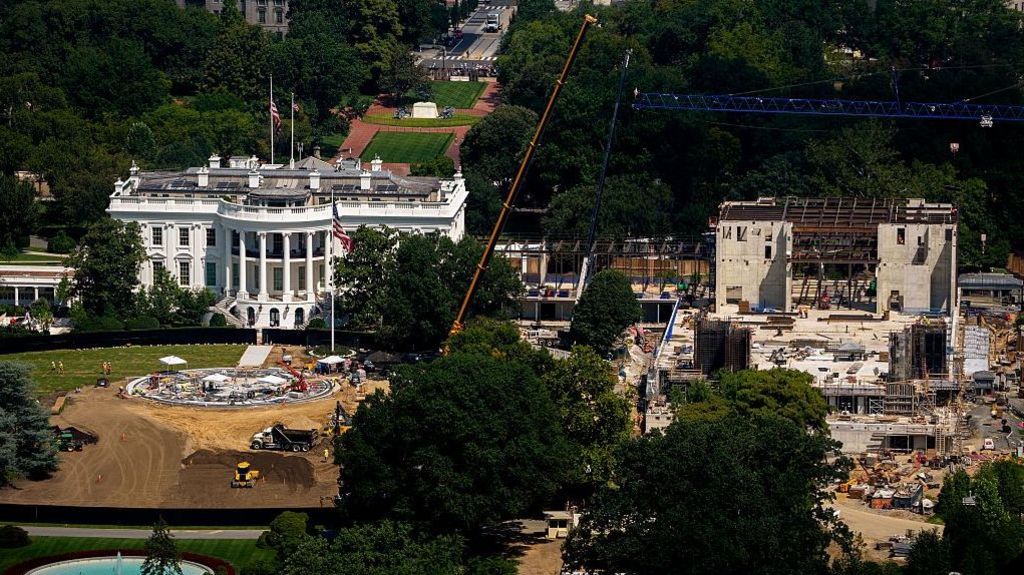
    While American households grapple with soaring energy and grocery costs, a faction of congressional Republican lawmakers led by Sen. Lindsey Graham (R-SC) has publicly pushed a plan to use U.S. taxpayer dollars to cover the $400 million cost of a luxury new ballroom Trump has ordered built at the White House complex.

    Hours after Graham unveiled his proposal, Rep. Riley Moore (R-WV) appeared on Fox Business to reiterate support for the project, dismissing cross-partisan criticism. “You would think this town would be tired of Donald Trump being right all the time,” Moore said. “This president has always had the ability to see around corners and make decisions that are best for the country or his business. We need to have that ballroom built. God bless the president for doing it.”

    Sarah Longwell, a veteran Republican pollster who left the GOP over opposition to Trump, pointed to aggregated polling compiled by data analyst Nate Silver that shows nearly 69% of Americans disapprove of Trump’s handling of the cost of living crisis. She slammed the taxpayer-funded ballroom proposal as wildly disconnected from the priorities of ordinary American voters, writing sarcastically: “You know what’ll turn these numbers around? A taxpayer-funded ballroom.”

    Graham held a press conference alongside fellow Republican Sens. Katie Britt (R-AL) and Eric Schmitt (R-MO) late Monday to announce their plan to expedite legislation to the full Senate that would allocate public funds for the new ballroom, which they frame as a national security necessity. Their push comes two days after an armed individual carrying multiple guns and knives attempted to breach the venue of the annual White House Correspondents Association (WHCA) dinner, exchanging gunfire with Secret Service agents before being taken into custody. Hours after being evacuated from the scene, Trump immediately cited the incident as proof the new ballroom was necessary, claiming future WHCA dinners could be held on secure White House grounds instead of the Washington Hilton, the event’s home for decades. It remains unclear whether the WHCA would ever agree to move its annual dinner to the White House.

    Trump has pushed for the construction of the ballroom for months, ordering preliminary demolition work to begin last year while promising the entire project would be paid for through private donations from major government contractors including Amazon, Lockheed Martin, and Google. That original plan drew widespread criticism over the significant conflicts of interest it would create, as the donating companies rely on federal government contracts for billions in annual revenue.

    Construction was temporarily halted after a federal district court ruled the project required formal congressional approval to move forward. However, a federal appeals court issued a ruling earlier this month allowing construction to resume while it reviews the lower court’s decision. The U.S. Department of Justice also filed a motion late Monday asking district judge Richard Leon to dissolve his original injunction blocking the project. Political observers noted the motion’s language closely matches the informal, confrontational style Trump regularly uses in his personal social media posts. The filing opens by dismissing the National Trust for Historic Preservation, the nonprofit that brought the lawsuit against the project, as a “FAKE” organization, and adds: “They suffer from Trump Derangement Syndrome, commonly referred to as TDS.”

    Graham told reporters Monday the $400 million for the ballroom would be drawn from existing taxpayer revenue collected through national park entry fees and customs duties, while the private donations Trump previously raised would be allocated to extras like custom fine china for the venue. Despite polling showing Trump’s national approval rating stood at just 40% in March, Graham claimed the American public would back the proposal. “If you don’t think $400 million of taxpayer money is a good investment to create a secure facility at the White House, then I disagree. I bet you 90% of Americans would love to have a better facility,” Graham said.

    Rep. Pramila Jayapal (D-WA) pushed back sharply on Graham’s claim, arguing the proposal is completely out of step with what most Americans need from their elected leaders. “Nope. Ninety percent of Americans would love to have affordable healthcare, housing, and childcare. Or lower gas prices. Or lower grocery prices. Not a frigging illegally constructed ballroom,” Jayapal responded.

    Graham defended the project by noting the ballroom would sit above national security-focused military infrastructure that would allow the president to host events on White House grounds without traveling off-site, eliminating security risks associated with presidential travel. Critics of the plan have questioned the need for a new luxury ballroom, pointing to multiple existing event spaces at the White House that already meet presidential security requirements.

  • Trump’s face to feature on commemorative US passports

    Trump’s face to feature on commemorative US passports

    The White House has officially confirmed a controversial new commemorative initiative: a limited run of United States passports featuring a portrait of sitting President Donald Trump, timed to coincide with the 250th anniversary of the signing of the Declaration of Independence this July. The plan was first broken by Fox News, before administration representatives verified details to multiple major international outlets.

    According to a senior anonymous administration official speaking to the BBC, the special design will be offered to any American citizen who submits a new passport application once the rollout begins. The limited-edition documents will only be issued through the Washington Passport Agency, and will remain available only while stock lasts. A pre-release rendering published by the US State Department shows Trump’s portrait framed by the full text of the Declaration of Independence and imagery of the American flag, with the president’s signature rendered in gold ink on the document.

    A White House spokesperson framed the new passport design as a contribution to national semiquincentennial celebrations, saying: “President Trump’s new patriotic passport design provides yet another great way Americans can join in the spectacular celebrations for America’s 250th birthday. Between the UFC250 Fight, the Great American State Fair, Freedom250 Grand Prix, and this new passport celebrating our freedom, President Trump continues to proudly lead a renewal of national pride and patriotism during our historic semiquincentennial celebration.”

    Standard-issue US passports currently feature curated depictions of key national historical moments, such as the 1969 Apollo Moon landing, alongside iconic American symbols like the Statue of Liberty. As of press time, it remains unclear whether applicants will have the option to request a standard non-commemorative passport instead of the special edition when applying through the Washington agency.

    This commemorative passport is the latest in a series of administration moves to tie Trump’s name and likeness to official government assets and national anniversary initiatives. The US Mint recently unveiled plans for a 250th anniversary commemorative gold coin that also features Trump’s image, and the president is on track to make history as the first sitting US president to have his signature added to official American banknotes.

    Other recent high-profile changes have drawn significant public and political backlash. In a move that drew condemnation from the Kennedy family, the board of the Kennedy Center for the Performing Arts voted to rebrand the venue the Trump-Kennedy Center to honor the current sitting president. Earlier in April, the White House revealed plans for a gold-accented 76-meter monumental arch in downtown Washington DC, dubbed the “Arc de Trump”. A federal oversight panel granted preliminary approval for the structure despite overwhelming negative public comment and fierce opposition from historic preservation groups.

    Trump has also altered the iconic White House itself, ordering the demolition of the building’s original East Wing to make way for a new presidential ballroom as part of a major renovation project. The National Trust for Historic Preservation has since filed a lawsuit against the White House over the project, alleging that construction work commenced before the administration submitted formal plans for review to the National Capital Planning Commission, violating federal historic preservation rules.