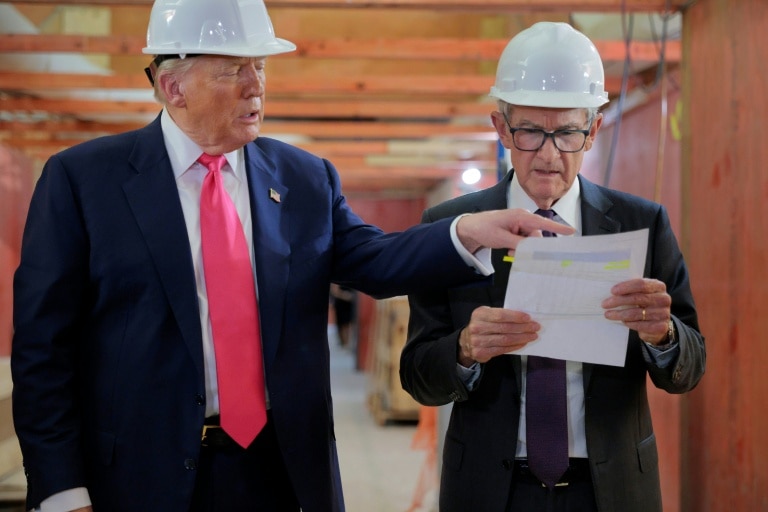
For a soft-spoken, careful-worded central banker, Jerome Powell has carved out an unexpected place in modern U.S. political history: one of the few public figures to stand firm against relentless pressure from former (and current) President Donald Trump, and emerge on top as he prepares to wrap up his tenure as Federal Reserve Chair. On Wednesday, Powell will take the podium for what is widely expected to be his final press conference as head of the world’s most influential central bank, closing out a turbulent term marked by repeated attacks from the Republican president that many observers now agree Powell ultimately prevailed against.
The turning point came last week, when the U.S. Department of Justice announced it would drop the unprecedented investigation into Powell and the Federal Reserve over alleged cost overruns on a headquarters renovation project. The probe was first revealed by Powell himself in January, when he warned that the inquiry was part of a broader pattern of threats and pressure from the Trump administration. The investigation gained new traction amid Trump’s attempt to oust sitting Fed Governor Lisa Cook over unproven mortgage fraud allegations, but key Republican Senator Susan Collins (per internal reporting) vowed to block any Trump nominee to replace Powell unless the probe was terminated. Powell also hardened his position in March, announcing he would refuse to step down from the Fed’s Board of Governors — where his term as a member runs through January 2028, regardless of his chair tenure — as long as the investigation remained open.
Now that the probe has been dismissed, all attention shifts to Powell’s next move: whether he will remain on the Fed Board after stepping down as chair, an unusual but not unprecedented move that would block Trump from filling the board seat with his own nominee. EY-Parthenon chief economist Gregory Daco argues that Powell is more likely than not to stay on, noting that the decision would be driven by a desire for institutional continuity, not partisan gain. “The rationale is institutional continuity, not politics,” Daco explained.
Powell’s path to this moment has been marked by tumult from start to finish. A 73-year-old former investment banker with deep cross-partisan policy experience, he was first tapped to lead the Fed by Trump in 2018, replacing outgoing chair Janet Yellen. It did not take long for tensions to emerge: Trump attacked Powell repeatedly for raising interest rates to cool a overheating economy, hurling verbal insults that were unprecedented for a sitting president attacking an independent central bank.
When the COVID-19 pandemic hit in 2020, Powell led the Fed in a dramatic, swift response, cutting benchmark interest rates to near zero and rolling out sweeping emergency support measures that are widely credited with preventing a far deeper global economic collapse. After President Joe Biden nominated Powell for a second term in 2021 — a nod to his commitment to central bank independence even from the opposite party — Powell oversaw another tough policy turn: a series of aggressive rate hikes starting in 2022 to curb post-pandemic inflation, followed by cautious rate cuts beginning in 2024 as inflation cooled and the Fed adjusted to the economic impact of Trump’s new sweeping tariffs.
After Trump won re-election and returned to the White House, the attacks on Powell resumed, with Trump branding the Fed chair a “numbskull” and a “moron,” and even suggesting he could be dismissed over “fraud” linked to the $2.5 billion renovation project that formed the basis of the now-dismissed Justice Department probe. In recent months, Powell has shown willingness to compromise on certain policy priorities aligned with the Trump administration, most notably rolling back the Fed’s climate-related financial oversight work. But his refusal to back down on defending the Fed’s independence, experts say, has already cemented his legacy.
“He will be seen as the guy who stood up for the independence of the Fed, and the rule of law,” Brookings Institution senior fellow David Wessel told AFP, adding that Powell’s resistance will leave a lasting mark as “a Fed chair with a spine.”
Prior to joining the Fed as a governor in 2012, an appointment from then-President Barack Obama, Powell worked as a scholar at the Bipartisan Policy Center, and earlier in his career he served as a Treasury Department official under Republican President George H.W. Bush.