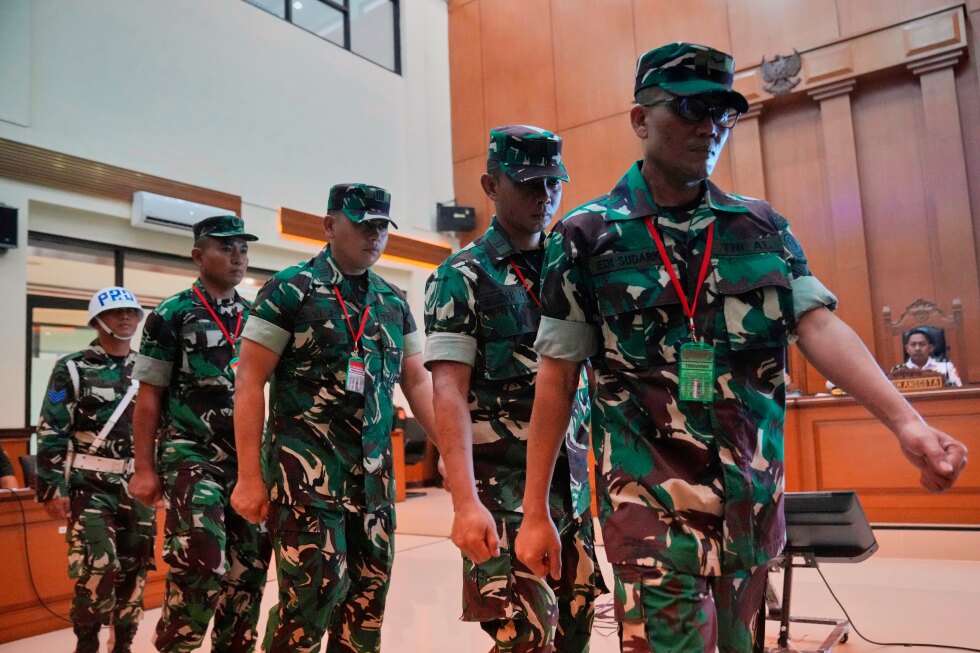
On Wednesday, a high-stakes military trial got underway in Jakarta for four Indonesian military intelligence personnel, charged with carrying out a brutal acid attack on a leading human rights advocate that has reopened long-simmering national debates over unaccountable violence within the country’s armed forces. The defendants include three navy marines and one air force officer — Sgt. Edi Sudarko, First Lt. Budhi Hariyanto Widhi Cahyono, Capt. Nandala Dwi Prasetya, and Air Force First Lt. Sami Lakka — all assigned to the Strategic Intelligence Agency of the Indonesian National Armed Forces (TNI). They face charges of aggravated premeditated assault stemming from the March 12 attack, which carries a maximum sentence of 12 years’ imprisonment if the court returns a guilty verdict. The target of the attack was Andrie Yunus, a 27-year-old human rights lawyer and senior campaigner with KontraS, the Commission for the Disappeared and Victims of Violence, one of Indonesia’s most prominent human rights organizations.
The attack unfolded as Yunus rode his motorcycle through central Jakarta on the evening of March 12, when assailants threw a vial of hydrochloric acid directly at his face. Prosecutor Mohammad Iswandi told the court that the assault left Yunus with chemical burns covering 20% of his body and permanent damage to 40% of his right cornea, resulting in total loss of vision in that eye. Iswandi confirmed that Yunus has undergone multiple emergency and reconstructive surgeries and remains in ongoing recovery, preventing him from attending the opening session of the trial. “The actions of the defendants who threw chemical liquid on Andrie Yunus, resulting in the loss of sight in his right eye and severe burns with no hope of complete recovery, were inappropriate actions for members of the TNI,” Iswandi told the court. Prosecutors have framed the attack as a coordinated act driven by personal motive, alleging the four assailants carried out the assault “to teach him a lesson and deter him from making disparaging remarks about the TNI.” Two of the defendants suffered minor acid splashes to the face and eyes during the attack, and all four declined to enter objections to the charges after prosecutors read the full indictment. Presiding judges have scheduled the next session of the trial for May 6, when witness testimony will begin.
The handling of the case has drawn sharp criticism from domestic and international human rights groups, which have raised objections to both the official personal-motive narrative and the decision to try the defendants in a closed military court rather than an open civilian tribunal. Usman Hamid, executive director of Amnesty International Indonesia, argues that authorities have deliberately narrowed the scope of the investigation to only the four accused, offering no transparency into potential higher-level involvement. Hamid noted that there is no documented personal or professional connection between Yunus and the four defendants, and evidence shows official military assets were used to carry out the attack. “It is difficult to accept that state facilities were used solely for personal revenge,” Hamid said, warning that opaque handling of the trial risks eroding already fragile public trust in Indonesia’s military accountability mechanisms.
Yunus has long been a leading voice against military impunity in Indonesia, campaigning for security sector reform and expanded civil liberties. Last year, he was a prominent organizer of widespread protests against proposed revisions to Indonesia’s military law that would expand the TNI’s role in domestic civilian governance, and colleagues confirm he has faced repeated threats and intimidation tied to his advocacy work. The attack and subsequent trial have drawn immediate comparisons to the 2004 assassination of Munir Said Thalib, the iconic human rights advocate and founder of KontraS, who was poisoned with arsenic on a flight to Amsterdam. While a handful of low-level actors were convicted in Munir’s murder, activists have long argued that the masterminds behind the killing were never identified or prosecuted, leaving the case a persistent symbol of military impunity in the country.
Widespread public and civil society pressure to uncover the full chain of command behind the attack on Yunus has prompted a response from Indonesian President Prabowo Subianto, a former army general who took office with pledges to strengthen institutional accountability. Prabowo has pledged to hold all those responsible to account and confirmed he is considering establishing an independent fact-finding commission to investigate any unaddressed links to the attack. For rights advocates, the outcome of Yunus’s trial will serve as a critical test of the TNI’s stated commitment to accountability more than 25 years after the fall of longtime dictator Suharto. Following Suharto’s ouster in 1998, the Indonesian military formally withdrew from domestic politics, and a series of reforms were implemented to strengthen civilian oversight of the armed forces. But activists say persistent cases of unaccountable violence against critics and human rights campaigners show those reforms have yet to deliver on their promises.