Positioned off the sunbaked coast of the British Overseas Territory of Gibraltar, hundreds of Royal Navy personnel aboard the Royal Fleet Auxiliary landing ship Lyme Bay are in a holding pattern, their impending mine-clearing deployment to the crisis-stricken Strait of Hormuz hanging in the balance amid ongoing diplomatic negotiations over a ceasefire with Iran.
The tense standoff traces back to February 28, when the United States and Israel launched military action against Iran. In retaliation, Tehran effectively choked off access to the strait — a strategic global chokepoint through which roughly 20 percent of the world’s daily oil supplies, critical natural gas shipments and fertilizer cargoes pass. The closure has paralyzed international commercial shipping, driven global energy prices sharply higher, and inflicted widespread economic disruption across the world.
U.S. President Donald Trump has repeatedly pressured U.S. allies, particularly the United Kingdom, to take a more active lead in securing the waterway. Back in March, Trump publicly told NATO allies that they should “go get your own oil” and take responsibility for securing the strait themselves. He has also lashed out at London, dismissing Britain’s Royal Navy as “toys” and dismissing Prime Minister Keir Starmer as an unworthy successor to wartime leader Winston Churchill. During remarks over the weekend, Trump confirmed that a peace deal to end the conflict has been “largely negotiated” following diplomatic calls with Israel and regional partners, though final details remain to be ironed out. “Final aspects and details of the Deal are currently being discussed, and will be announced shortly,” Trump announced on social media Saturday, offering no specific timeline for the agreement. This is not the first time in recent weeks that a deal has been framed as imminent, leaving military planners and diplomatic observers in a state of waiting.
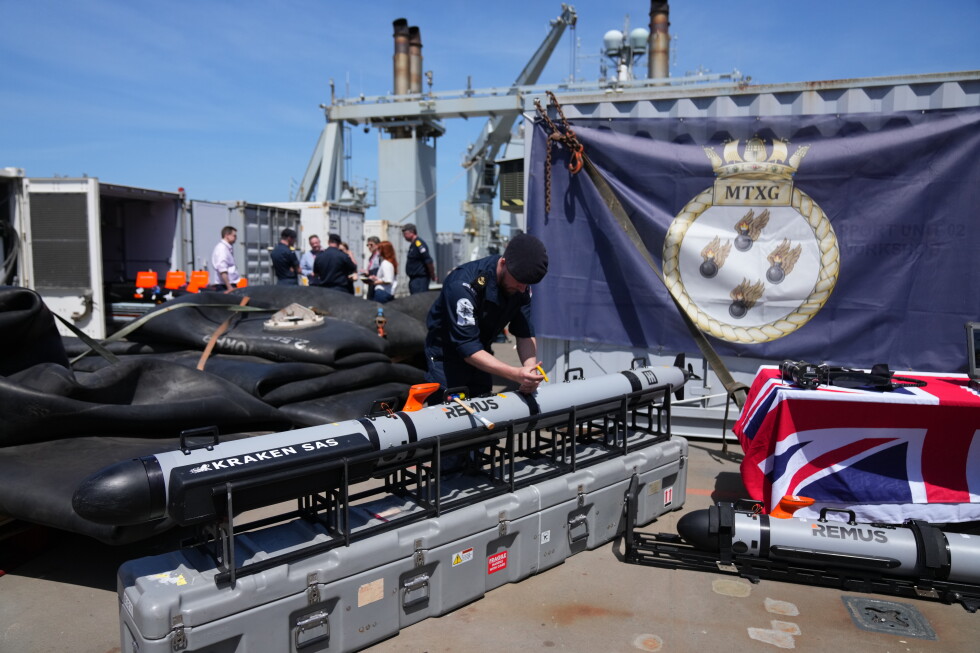
To demonstrate Britain’s readiness to lead an international mine-clearing coalition alongside France, UK Armed Forces Minister Al Carns recently invited a small group of journalists to tour the Lyme Bay as the vessel receives final pre-deployment preparations. Docked at the gateway between the Atlantic Ocean and Mediterranean Sea at the southern tip of the Iberian Peninsula, the amphibious ship is currently being stocked with ammunition and cutting-edge mine-hunting autonomous sea drones fitted with high-resolution sonar systems. Once diplomatic clearance is given, the Lyme Bay will sail from Gibraltar to link up with the Royal Navy destroyer HMS Dragon and allied aircraft providing overwatch, before transiting the Suez Canal en route to the Persian Gulf.
Responding to questions about whether the deployment amounts to a performative gesture to appease Washington, Carns pushed back on that suggestion. “Which other country can pull together 40 nations and come up with a solution to deal with a complex problem that we couldn’t predict because we weren’t involved?” he asked, referencing the UK’s ability to rally a broad multilateral coalition for the mission. He noted that more than 6,000 commercial vessels have been blocked from transiting the strait since the conflict began, and while some mines may have already drifted away or been destroyed, commercial shipping insurers require absolute confirmation that the waterway is safe before they will agree to underwrite voyages through the strait. “That’s what this capability will provide,” he said.
Commander Gemma Britton, who leads the Royal Navy’s Mine and Threat Exploitation Group, outlined the serious range of hazards the mission could face. She warned that Iran could have deployed a “huge” variety of mine types across the strait, from rocket-propelled drifting mines to fixed culled mines and seabed-laid devices triggered by sound, water movement or light.
Unlike traditional mine-clearing operations that rely on crewed vessels to map hazard zones, the Lyme Bay carries a suite of autonomous systems that can survey the seabed and water column in half the time of traditional missions. The sonar-equipped sea drones generate detailed imagery of underwater objects, ranging from discarded fishing traps to buried energy pipelines, that teams use to pinpoint potential mines. Once a device is identified, advanced acoustic sensors and remote cameras are deployed to confirm its identity. Many of these systems can be loaded onto smaller auxiliary vessels, launched from the Lyme Bay (which acts as a remote mother ship stationed outside the perimeter of suspected minefields) and operated autonomously, drastically reducing the risk to personnel.
Traditionally, after a mine is located, a diver must swim into the hazard zone to place an explosive charge before retreating to detonate it. However, the Lyme Bay is testing a new remotely operated vehicle (ROV) that can dive to the seabed, place the charge next to the mine, and trigger the detonation without putting any service member in harm’s way.
Britton explained that the mission’s first priority will be to clear a single outbound transit lane through the strait to allow the roughly 700 commercial vessels that have been stranded since the closure to depart. Once that lane is operational, teams will shift to clearing a second inbound lane for incoming cargo ships. She cautioned, however, that clearing the entire 21-mile-wide strait of all potential hazards could take months or even years of sustained work.
Even with all preparations complete, major uncertainty remains: there has been no definitive confirmation of how many mines (if any) are actually deployed in the strait, and no final green light has been given for the coalition deployment. The entire international mine-clearing operation is contingent on a finalized peace deal and a full cessation of hostilities.
“We don’t know when the Americans, Iranians and Israelis are going to come up with a suitable solution,” Carns acknowledged. For now, the crew of the RFA Lyme Bay remains on standby off Gibraltar, fully prepared to mobilize the moment the diplomatic process reaches a successful conclusion. “In the meantime, we will be waiting and will be really, really ready,” he said.