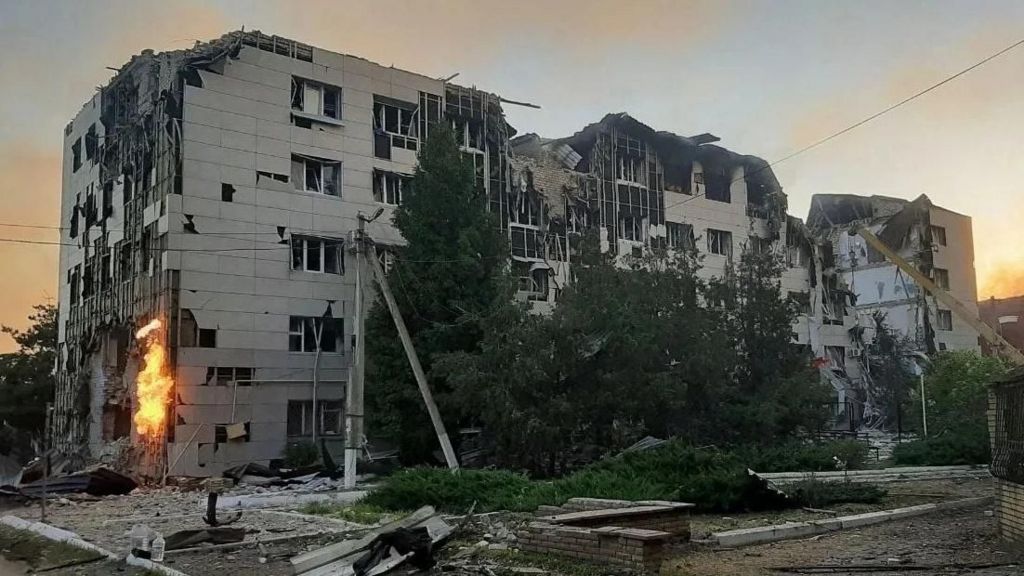
A devastating incident that reduced a five-story college building in Starobilsk to mounds of rubble has plunged the ongoing Russia-Ukraine conflict into a new phase of escalating tensions, triggering mutual accusations between Moscow and Kyiv, an urgent emergency gathering of the UN Security Council, and open threats of harsh retaliation from the Kremlin.
Starobilsk sits within the Luhansk region of eastern Ukraine, an area that has been under Russian military occupation since Moscow launched its full-scale incursion in 2022, and that Russia controversially claims to have formally annexed. Early Friday, the structure that collapsed housed the Starobilsk Professional College, a branch of Luhansk Pedagogical University, leaving a scene of widespread destruction visible in footage broadcast on Russian state television. Rescue crews could be seen working methodically through piles of concrete and twisted metal to pull survivors and victims from the wreckage.
Russian authorities have publicly blamed Ukraine for the carnage, framing the event as a deliberate drone strike targeting the college’s student dormitory. As of the latest official updates from Moscow, the death toll has climbed to 21, with 42 additional people sustaining injuries of varying severity. Russian state media has shared firsthand accounts from survivors, including 21-year-old Olga Kovaleva, who was trapped under fallen debris for hours before being pulled out alive and transported to a local hospital for treatment. The outlet also published a full list of the deceased students, alongside their dates of birth, to confirm the identities of those killed.
Russian President Vladimir Putin has labeled the incident a “terrorist strike”, rejecting any suggestion that the building was hit accidentally by Russian air defense or electronic warfare systems. “There had been no military facilities, intelligence service facilities or related services in the vicinity,” Putin stated, arguing this eliminates any plausible defense of unintended collateral damage from Russian operations. He has since formally ordered Russia’s Ministry of Defence to draft a comprehensive set of retaliatory measures in response to what Moscow calls an unacceptable attack on civilian targets.
Kyiv has pushed back entirely against Russia’s narrative. In an official statement released by the General Staff of Ukraine’s Armed Forces, the military confirmed it did conduct a targeted strike near Starobilsk overnight between May 21 and 22, but clarified that the attack hit a Russian military unit stationed in the area, not a civilian college dormitory. To date, Ukraine has not acknowledged any civilian casualties from the strike.
Within hours of the incident, Russia submitted an official request to the United Nations for an emergency meeting of the Security Council to address the attack. At the session, Russian Ambassador to the UN Vasily Nebenyza presented graphic photos of the destroyed college to council members, arguing that the strike “constitutes a war crime” under the standards of international humanitarian law.
Not all council members backed Russia’s framing of the event, however. Denmark’s representative to the UN pushed back against Russia’s call for condemnation, pointing to the widespread destruction and civilian casualties that Russia’s own military campaign has inflicted across Ukraine since 2022. “If we were to apply the same logic behind Russia’s call for today’s meeting, we would need twice-daily emergency Security Council meetings — including on the weekends — to only scratch the surface of the terror, death and destruction inflicted across Ukraine by Russia,” the Danish representative noted.
The incident has also emboldened hawkish, pro-Kremlin voices to push for aggressive retaliation that extends beyond Ukrainian territory. Sergey Karaganov, honorary chairman of the presidium of the Council on Foreign and Defence Policy, told Russian state outlet Vesti that Moscow should not limit its response to targets inside Ukraine. “We need to start punishing Europe for things like this, including with strikes,” Karaganov said. “Symbolic [strikes] to start with. Then, perhaps, less symbolic ones.”
By late Saturday, Russian emergency officials confirmed that search and rescue operations at the site had been fully completed, bringing an official end to efforts to recover additional victims or survivors from the rubble.