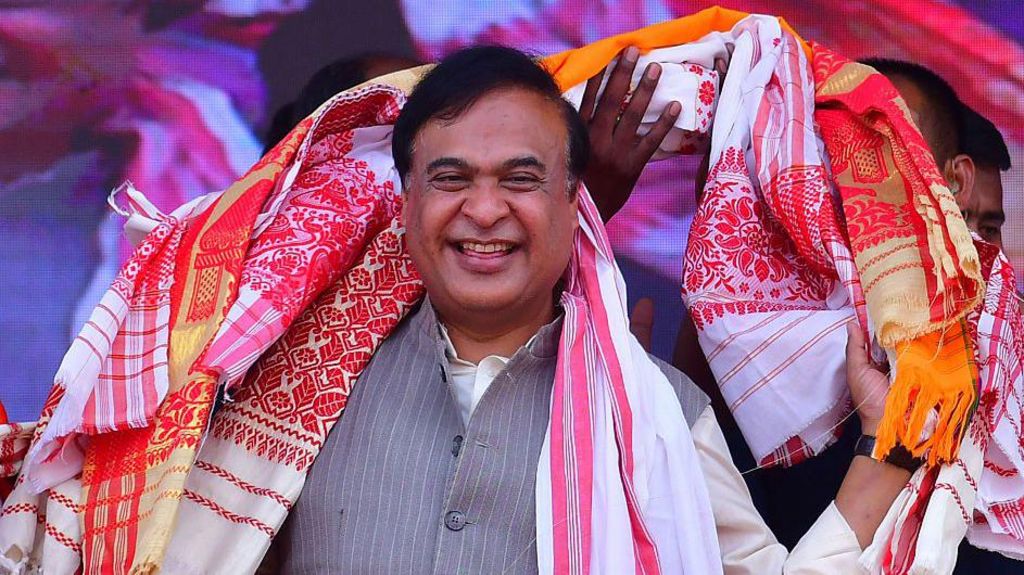
In a landmark political event held in Guwahati this week, senior Bharatiya Janata Party leader Himanta Biswa Sarma officially took the oath of office for a second consecutive term as Chief Minister of India’s northeastern state of Assam. The ceremony drew high-profile attendees, including Prime Minister Narendra Modi, multiple federal cabinet ministers, and BJP chief ministers from across the country, alongside thousands of supporters gathered from across Assam.
Sarma’s return to power follows a landslide victory for the BJP-led alliance in the recent Assam Assembly elections, held on April 9. The ruling coalition secured a commanding majority, with the BJP itself winning 82 of the 126 available seats, and its regional allies adding an additional 20 seats to the coalition’s total. This result extends the BJP’s uninterrupted control of Assam, which began when the party first won power in the state in 2016.
Widely regarded as one of the key architects of the BJP’s explosive growth in India’s northeast, a region once dominated by regional smaller parties and the national Indian National Congress, Sarma has been central to reshaping the state’s political landscape over the past decade. Just 10 years ago, the BJP held less than 12% of the popular vote in Assam; today, that share has climbed to 38%, a shift political analysts largely credit to Sarma’s organizational work and strategic leadership.
Sarma’s political career has been defined by striking longevity and strategic influence. Representing the Jalukbari constituency on the outskirts of Guwahati, Assam’s largest city, he has held the seat continuously since 2001, even after switching political affiliation. Prior to joining the BJP in 2015, Sarma was a top Congress leader and cabinet minister under former long-serving Chief Minister Tarun Gogoi. When he left the Congress alongside dozens of loyal legislators, the departure dealt a crippling blow to the state Congress party that has yet to fully recover, a moment widely viewed as the turning point for the BJP’s expansion across the entire northeast region.
In the years after joining the BJP, Sarma built his reputation as the party’s most effective behind-the-scenes organizer during former Chief Minister Sarbananda Sonowal’s tenure from 2016 to 2021, helping the party forge alliances with local groups and extend its influence into neighboring northeastern states including Arunachal Pradesh, Manipur, and Tripura. He first assumed the office of Chief Minister in 2021, and this latest election victory has significantly solidified his standing as one of the most powerful leaders within the national BJP.
Within the party, Sarma’s success is attributed to his relentless campaigning style, robust grassroots organizational control, and implementation of high-impact public welfare programs. Supporters hail him as a results-driven administrator who has prioritized core infrastructure development, including expanding road and bridge connectivity across the state. One of his most popular initiatives, the Orunodoi scheme, delivers direct monthly financial assistance to low-income women households, earning broad support among marginalized communities.
However, Sarma’s tenure and political rise have not been without intense controversy. Critics argue that his political messaging has increasingly leaned into divisive rhetoric centered on long-running debates over migration and communal identity, issues that have dominated Assam politics for generations. The state has grappled with political tensions around illegal immigration from neighboring Bangladesh for decades, with debates over language, land rights and indigenous identity shaping every recent election cycle.
Opposition parties and human rights organizations have repeatedly accused Sarma’s BJP government of systematically targeting religious minority communities, particularly Bengali-speaking Muslims. Policies pursued by his administration related to unregulated Islamic schools and child marriage have sparked fierce political pushback, and earlier this year, a deleted AI-generated deepfake video shared by the state BJP party showed Sarma shooting at images of political opponents wearing traditional Muslim skull caps, drawing widespread condemnation from opposition and civil society groups. Sarma and national BJP leaders have rejected these accusations, framing their policies as necessary measures to protect indigenous Assamese culture and address the ongoing crisis of illegal migration.
Despite these ongoing controversies, Sarma has emerged as one of the most influential BJP leaders in eastern India, and has become an increasingly prominent campaign surrogate for the party across national elections. Alongside Sarma, four other legislators – two from the BJP and two from its regional alliance partners – were also sworn in as cabinet ministers for the new state government this week.
Political analysts say Sarma’s winning electoral strategy in Assam rests on three core pillars: identity politics, targeted outreach to key voter blocs, and tangible development progress. “The BJP has worked to bring indigenous communities closer to a broader Hindu identity, while portraying certain minority groups as outsiders,” explained Akhil Ranjan Dutta, a professor of political science at Gauhati University. “At the same time, under Sarma’s leadership the party has effectively engaged women, young voters, farmers and small business owners through targeted welfare schemes and messaging tailored directly to their needs. Development also played a major role – improvements to roads and rural connectivity have significantly boosted the party’s appeal across the state.”