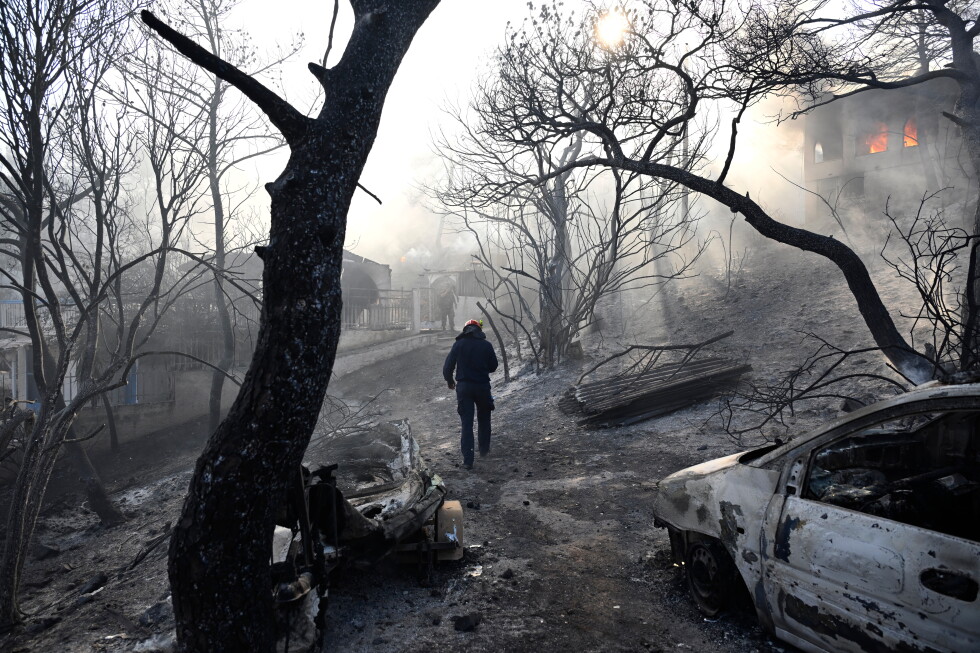
As Europe grapples with one of the hottest and driest summers documented in modern history, a crisis amplified by human-caused climate change according to recent research, multiple wildfire events across the continent have stretched emergency response capabilities and forced mass evacuations. In Belgium, one of the largest wildfires the country has ever seen continued to burn out of control on Monday, even as a welcome cold front brought overnight rain that softened conditions for hundreds of firefighters battling the blaze.
The fire, located in the eastern High Fens nature region roughly 5 miles from the German border, shifted into a dense pine forest on Sunday before spreading east toward German territory. As of Monday, the blaze in Liège province had charred an estimated 12 square miles of land, leaving a landscape of blackened tree trunks and smoldering undergrowth. By early Monday, a thin fog mixed with the acrid scent of wood smoke hung over the burned area.
Belgium’s King Philippe broke off his scheduled summer vacation to meet with the emergency teams deployed to the fire zone. Dozens of local firefighters have been reinforced by aerial support from Norway, Sweden, Germany and the Netherlands, with local police operating drones to track fire movement in hard-to-reach areas. While the overnight rain helped slow the spread of the fire and reduce the risk of smoldering hotspots reigniting, it failed to fully extinguish the core of the blaze, regional public services spokesperson Nicolas Yernaux explained.
Yernaux noted that containment crews have held the fire along their current operational lines, but a large section of the active burn remains in completely inaccessible terrain, advancing toward the German town of Monschau. “Where it is burning, I am not sure it [the rain] is really helping,” he added.
Precautionary evacuation orders for hundreds of local residents remained in place on Monday, and local tourism businesses have already taken a heavy financial hit. Thomas van Sante, owner of the Mont Dragon hotel near the fire zone, confirmed that tourists have fled the area en masse and dozens of upcoming reservations have been canceled. Echoing Yernaux’s assessment, he noted, “There’s rain now but it is not enough.”
To the south, Greece has been battling a wave of fire outbreaks across the country, just days after a fast-moving blaze on the island of Salamina, located just west of Athens, claimed two lives, injured nine others and destroyed multiple residential properties. On Monday, fire investigators continued processing the scene of the Salamina fire, while new blazes popped up across the country.
One new fire broke out in Spata, a suburban area east of Athens that is home to Athens International Airport, the country’s main air travel hub. Dozens of firefighters, supported by two water-dropping aircraft and two helicopters, were rapidly deployed to the site and contained the blaze within 30 minutes, preventing any disruption to airport operations.
In a separate development, Greek fire department officials announced the arrest of an 80-year-old man in the northern town of Kavala on deliberate arson charges, accusing him of intentionally setting fire to dry brush. The arrest is one of 302 fire-related detentions Greek authorities have made since the start of 2024: 31 of those arrests are for intentional arson, while 271 stem from negligent behavior that sparked accidental wildfires.
Further west in southwestern France, emergency officials have announced progress in taming a blaze in the Landes region. After four days of nonstop fire suppression work, the fire is now fully under control. Around 600 local residents were evacuated last week as extreme heat pushed the blaze to burn roughly 6.6 square miles of land. With temperatures starting to drop on Monday, around half of the evacuated residents have been allowed to return to their homes.
This report contains contributions from AP correspondents in Paris and Argostoli, Greece.