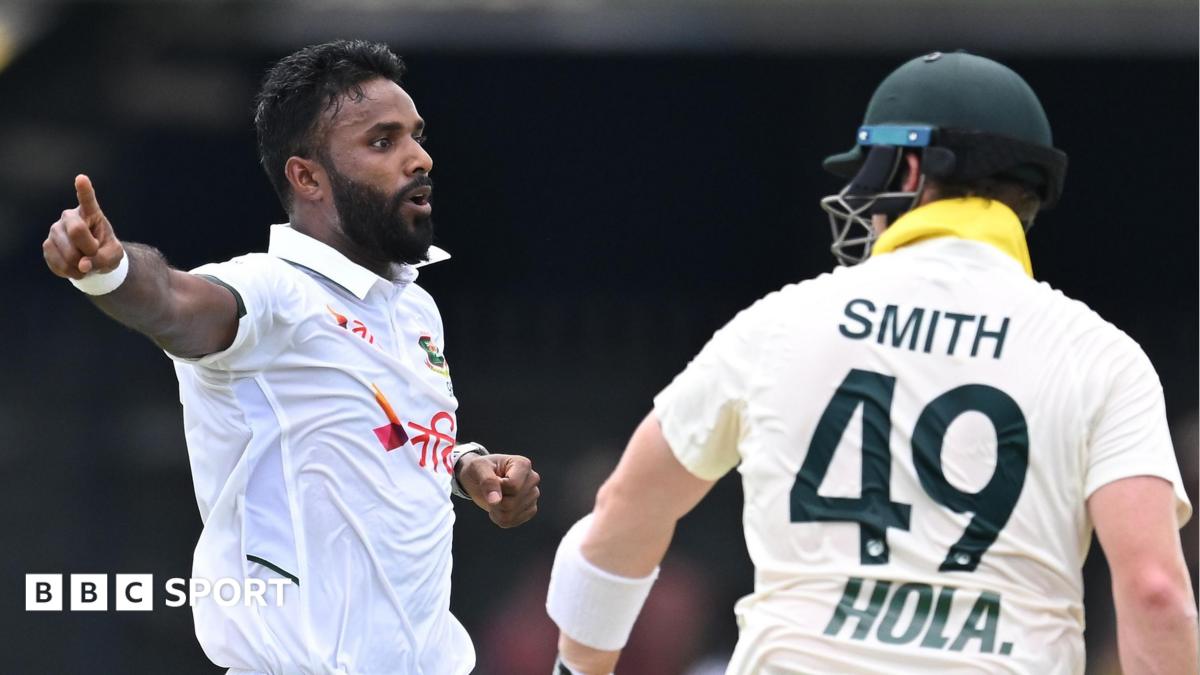
The opening day of the first Test between Australia and Bangladesh in Darwin delivered an unexpected storyline full of drama, controversy, and a stunning underdog performance, with a controversial technology decision and a career-best bowling display shaping the contest. After Australia captain won the toss and opted to bat first, Bangladesh’s bowlers turned in a relentless, clinical performance that left the fancied hosts reeling by the close of play.
The day’s biggest talking point emerged early in Steve Smith’s innings when Bangladesh pace bowler Ebadot Hossain delivered a ball that clipped the edge of Smith’s bat. Bangladesh immediately appealed for a caught-behind dismissal to on-field umpire Kumar Dharmasena, who ruled the batter not out. The touring side quickly called for a review, and even Smith himself began walking toward the pavilion, convinced he had edged the delivery. But to the surprise of Ebadot and the Bangladesh squad, Snicko — the edge-detection technology used to review close catching appeals — showed a completely flat audio line as the ball passed the bat. The original not out ruling was upheld, gifting Smith a reprieve when he had scored just seven runs.
Speaking after the day’s play, Smith acknowledged the luck that came his way. “I think so, yeah. I was lucky? Yeah, it seems that way. You got to take it sometimes,” he told reporters. “Maybe I didn’t nick it. I don’t know. But I certainly felt something. If I’d been given out, I was going to walk off. But yeah, technology saved me today, I guess.”
Smith went on to capitalise on his second chance, compiling a solid 71 runs before he eventually holed out a catch off the bowling of Hasan Mahmud. Notably, this was not the only let-off Smith received on the day; he was also dropped twice by Bangladesh fielders, allowing him to add crucial runs to Australia’s total. Even with Smith’s contribution, however, the rest of Australia’s batting line-up crumbled under pressure from Bangladesh’s attack.
Mahmud, Bangladesh’s fast bowler, produced the performance of his career to date, taking a stunning six wickets for just 55 runs. His late wicket burst saw Australia collapse from 152-5 to 198 all out, losing their final five wickets for only 46 runs. It was a collapse that few predicted heading into the match, with Australia having never lost a home Test to Bangladesh, and only one loss across the six previous meetings between the sides (a 2017 defeat in Mirpur).
The controversy around Snicko is nothing new for cricket in Australia, with the technology already at the centre of multiple high-profile disputes during the 2025 Ashes series. In that series, Australia wicketkeeper Alex Carey was reprieved after an error by the Snicko operator, while England wicketkeeper Jamie Smith was involved in two separate contentious decisions tied to the technology. Unlike those earlier incidents, which stemmed from misaligned audio and visual data, this week’s controversy came from the complete lack of an audio spike on Snicko’s readout, despite Smith acknowledging he felt contact on the ball.
By the close of play on day one, Bangladesh had responded strongly to Australia’s total, reaching 96 for the loss of one wicket. Opener Shadman Islam fell early to Mitchell Starc, edging a leading edge to the gully slip cordon, but batsmen Tanzid Hasan Tamim (32 not out) and Mominul Haque (35 not out) put on an unbroken 81-run partnership to steer the tourists to the close. At stumps, Bangladesh trails Australia by just 102 runs, with nine wickets in hand heading into day two of the five-day Test.
This opening match is the first of a two-Test series between the two sides, with Bangladesh sitting in a strong position to push for a historic first win on Australian soil after a dominant opening day of play.