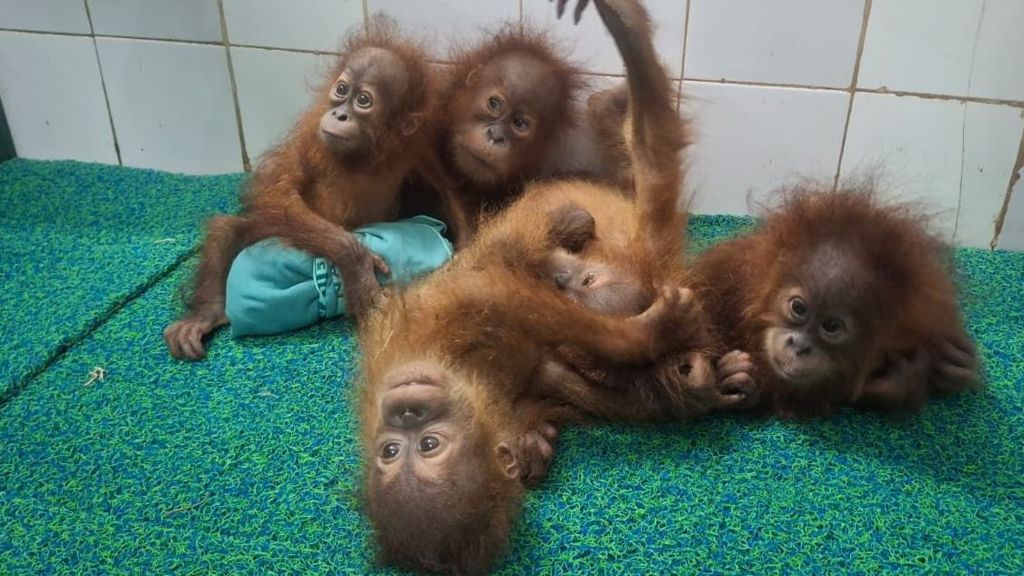
In a startling discovery that has spotlighted the persistent global crisis of endangered wildlife trafficking, five infant orangutans— a species classified as critically endangered and not indigenous to India—have been found in a sparse casuarina forest in India’s eastern state of Odisha, thousands of kilometers away from their only native range in the rainforests of Indonesia and Malaysia. Local residents first spotted the young apes, which are estimated to be between one and two years old, gathering on the forest floor and feeding on bananas in Ranakata, a proposed reserve forest in Bhogarai block of Balasore district, near Odisha’s border with West Bengal. After locals alerted authorities early Tuesday, forest rescue teams launched an immediate operation to extract the animals, who were given emergency first aid before being transported to Nandankanan Zoological Park in Bhubaneswar, the state capital, where they are currently undergoing mandatory quarantine and round-the-clock health monitoring.
Officials leading the probe have ruled out any possibility that the orangutans reached Odisha through natural migration, noting that their location just off a major state highway aligns with suspicions that the apes were trafficked into India by an international smuggling ring and abandoned mid-transit. “These animals could never have reached this region on their own,” Pratik Prakash Indalkar, Balasore District Forest Officer, told reporters. “The site is near a highway, which suggests they were transported here by road before being left behind.” An initial search of the surrounding forest area turned up no additional orangutans or direct evidence linking to the smuggling operation, and forest officials estimate the apes had only been in the area for two to three days before their discovery.
The unusual find has drawn alarm from wildlife conservation experts, who point to the vulnerable age of the rescued orangutans as an indicator of the cruelty of the illegal exotic pet trade. Young orangutans normally stay with their mothers for the first several years of life, learning critical survival skills, and female orangutans only produce offspring once every eight years on average, making every young individual vital to the species’ survival. All three recognized living orangutan species—Bornean, Sumatran, and Tapanuli—are listed as critically endangered by the International Union for Conservation of Nature (IUCN), with wild populations plummeting over the past decades due to widespread deforestation, habitat destruction, and poaching.
International commercial trade of orangutans is completely banned under the Convention on International Trade in Endangered Species of Wild Fauna and Flora (CITES), the global regulatory agreement for endangered wildlife, and the apes are also fully protected under India’s domestic wildlife protection laws. Even with these strict regulations, demand from private collectors for orangutans as exotic pets continues to drive widespread trafficking networks that operate across Southeast Asia and South Asia. This discovery is not an isolated incident in India: in 2022, two other baby orangutans were found abandoned at a border checkpoint between Assam and Mizoram, with investigators suspecting the apes had been trafficked into the country from neighboring Myanmar.
To expand the ongoing investigation, the Odisha state government has formally requested support from India’s national Wildlife Crime Control Bureau, with local police, forest department officials, and a special anti-trafficking task force all participating in the probe to trace the smuggling network responsible for the illegal shipment.