作者: admin

  • Thousands march in Pakistan-administered Kashmir as clashes kill at least 15

    Thousands march in Pakistan-administered Kashmir as clashes kill at least 15

    A fragile, unsettling quiet has settled over major population centers across Pakistan-administered Kashmir, following days of violent clashes between anti-government protesters and security forces that have left at least 15 people dead and dozens more wounded, local authorities confirmed this week.

    The unrest was triggered by a long-simmering political dispute over 12 reserved legislative seats set aside for Kashmiri refugees in the region’s upcoming July assembly election. The provision reserves these seats exclusively for refugees who do not currently reside in Pakistan-administered Kashmir, barring permanent local residents from contesting them. The Joint Awami Action Committee (JAAC), a coalition of local activist groups, organized a mass protest march to the regional capital Muzaffarabad demanding the full abolition of the reserved seats, arguing that all legislative positions should be held by people who actually live and vote in the region.

    In response to the protest call, regional authorities moved quickly to crack down on the coalition: they officially banned the JAAC on June 5 under regional anti-terrorism laws, levying sedition and terrorism allegations against the group, claiming its activities undermine regional peace and security. Authorities have also launched targeted legal action against the coalition’s senior leaders.

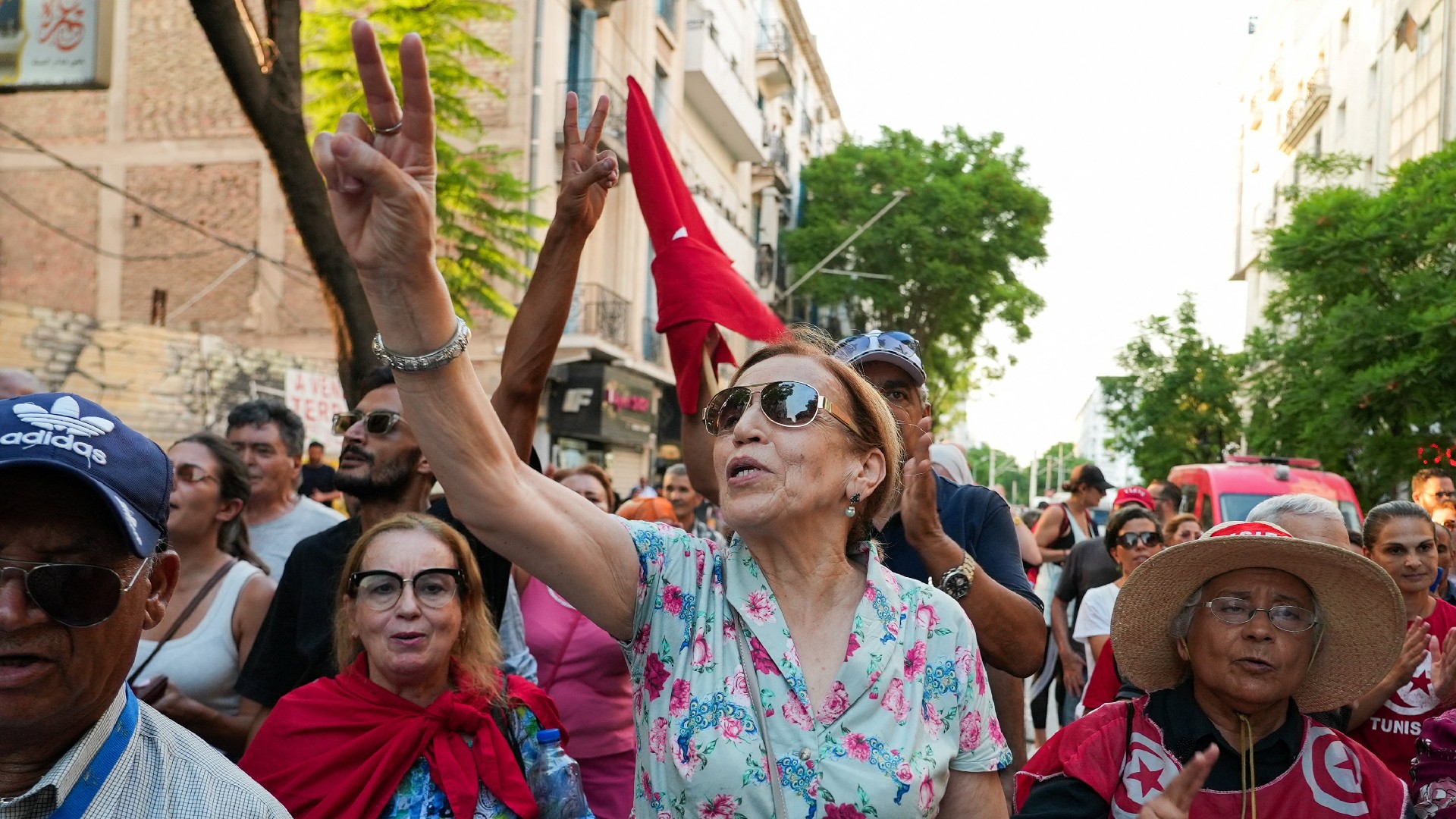
    The harsh crackdown failed to deter widespread participation, however. Thousands of local residents joined the protest march, sparking violent confrontations with security forces across multiple districts of the region. Official estimates place the size of the main protester convoy at more than 10,000 people, which is currently positioned just four kilometers outside the city of Rawalkot. Regional officials have explicitly blocked the convoy from advancing through Rawalkot on its route to Muzaffarabad.

    Sardar Waheed Khan, Poonch district commissioner for Pakistan-administered Kashmir, told BBC Urdu that enhanced security patrols have been deployed across the area to enforce public order, and local residents have been ordered to stay in their homes. Local mosques have also broadcast public announcements echoing the order to remain indoors. Air surveillance helicopters are now conducting regular flights over both Rawalkot and Muzaffarabad to monitor protester movements.

    The first major clashes erupted earlier this week in Rawalakot, with additional violent confrontations breaking out in the city of Kotli on Tuesday that left three more people dead. To date, the official death toll stands at 15: 11 civilian protesters and four security force officers. At least 50 people have been wounded in the unrest, and local officials have acknowledged the death toll may climb as violence continues.

    Global human rights group Amnesty International issued a sharp rebuke of the government response Tuesday, condemning what it called a “violent and sweeping crackdown” on the protests. The organization highlighted the implementation of a regional internet shutdown, mass arbitrary arrests of activists and protesters, and the use of deadly force against demonstrators, warning that the crackdown marks a dramatic, alarming deterioration of human rights protections in the region.

    Despite the violence and government restrictions, the protest march to Muzaffarabad is still moving forward, and the JAAC has called for a region-wide general strike to back its demands. Currently, the capital Muzaffarada remains under a heavy security presence: streets are largely empty, storefronts are shuttered, and uniformed police patrol quiet neighborhoods. It remains unclear whether most business closures stem from public safety fears or are part of the strike in solidarity with JAAC demands. One local Muzaffarabad trader told BBC Urdu he closed his shop voluntarily, and would keep it closed until the group’s demands are met or the strike is called off.

    The legal status of the 12 reserved seats has already been addressed by the Supreme Court of Pakistan-administered Kashmir, which issued a formal advisory opinion ruling that the seats are constitutionally protected and cannot be modified through administrative action, political negotiation, or public pressure.

    For context, Pakistan-administered Kashmir is a semi-autonomous region with its own independent regional government. The broader Kashmir region has been a flashpoint of conflict between India and Pakistan for more than seven decades. Both nations claim the entire Himalayan territory in full, and have fought two full-scale wars and one limited armed conflict over control of the region. Today, India and Pakistan each administer separate portions of Kashmir, with tensions regularly flaring along the de facto border dividing the two control zones.

  • Haiti forced to change World Cup kit over war imagery

    Haiti forced to change World Cup kit over war imagery

    Just days ahead of their opening 2023 Women’s World Cup Group C clash against Scotland, Haiti has been required to alter its official team kit after global governing body FIFA ruled out a design feature honoring a pivotal moment in the nation’s fight for independence. The original kit, produced by Colombian apparel manufacturer Saeta, included a subtle illustration of the 1803 Battle of Vertieres — the conflict that ultimately secured Haiti’s sovereignty from colonial rule — paired with the country’s national flag. Haitian players wore the original design in two warm-up friendly matches held in Florida earlier this month, triggering a review by FIFA’s equipment compliance team.

    In an official statement shared to Instagram Wednesday, Saeta clarified the original creative intent behind the controversial design, emphasizing it was never meant to carry a political message. “The final design we presented was crafted as a tribute to all the Haitian men and women who work every day to build a better future for their country,” the statement read. “Throughout the standard regulatory review process, FIFA concluded that specific visual elements in the design could be interpreted in a way that violates their equipment guidelines, and formally requested adjustments to the kit. While FIFA’s interpretation does not align with our original, non-political intent, Saeta respects the governing body’s processes and has fully implemented the required modifications to meet their final specifications.”

    The kit revision comes as Haiti prepares to make its long-awaited return to the World Cup stage, kicking off its campaign against Scotland in Boston on Saturday. This is only the second time in the nation’s history that it has qualified for the tournament, ending a 52-year drought since its last World Cup appearance. Ranked 83rd in the global FIFA rankings, the underdog Caribbean side faces a daunting group stage challenge: after facing Scotland, it will go up against five-time tournament champion Brazil and current African title holder Morocco.

    Haiti’s historic qualification has already been hailed as one of the most uplifting underdog stories of this year’s tournament. The team overcame extraordinary off-pitch obstacles to secure their spot, amid widespread gang violence and political instability that has plunged the impoverished Caribbean nation into chaos. The ongoing unrest made it impossible for the team to host any of its qualifying matches on home soil, forcing the side to play all home fixtures in neutral territories. Despite these crippling challenges, the squad pulled off one of the biggest upsets of the qualifying process to book their place in the 32-team tournament.

    For Haitian midfielder and team star Jean-Ricner Bellegarde, the World Cup berth offers a chance to reshape global perceptions of his crisis-stricken homeland. “We know many people around the world have a negative image of our country, that they only see all the problems we face,” Bellegarde told AFP in an interview. “But just being here, competing on this stage, will bring so much good for our country, our people, and our families.”

  • Climate change-fuelled storm decimated world’s rarest great ape: study

    Climate change-fuelled storm decimated world’s rarest great ape: study

    A single extreme weather event amplified by human-caused climate change has delivered a catastrophic blow to the world’s rarest great ape species, new research has confirmed, leaving fewer than 800 Tapanuli orangutans surviving in the wild. According to a study published Wednesday in the peer-reviewed academic journal Current Biology, last November’s Cyclone Senjaya triggered widespread mudslides and flash flooding across Indonesia’s Sumatra island that killed an estimated 58 Tapanuli orangutans. This toll accounts for roughly 7% of the species’ entire remaining wild population, and 11% of the apes that live in the affected Batang Toru Ecosystem – the only protected habitat the species still occupies. The broader flooding event killed more than 1,000 human residents across the region as well.

    Only formally recognized as a distinct species by the scientific community in 2017, Tapanuli orangutans are already one of the most vulnerable large mammals on Earth. The entire wild population is confined to a small, fragmented stretch of highland forest in northern Sumatra, after decades of human development pushed them out of their preferred lowland habitats. Conservation scientists have warned for years that overlapping threats of industrial encroachment and climate-driven extreme weather could push the species to extinction in just a few decades.

    To reach their population loss estimates, researchers from the University of Indonesia and conservation initiative Borneo Futures cross-referenced satellite imagery of landslide damage in Batang Toru with existing maps that track Tapanuli orangutan population density across the ecosystem. Their analysis found that roughly 8,300 hectares of critical forest habitat – more than 11% of the ecosystem’s total forest area – was destroyed or severely damaged by the cyclone-triggered landslides. In addition to the 58 confirmed or projected orangutan deaths, the storm wiped out critical food sources and shelter that the remaining apes depend on for survival.

    “This level of loss is substantial for a species with such a small total population,” explained Erik Meijaard, chief scientist at Borneo Futures. “For a population already on the brink, losing one out of every 14 individuals to a single weather event is a devastating blow that the species cannot absorb repeatedly.”

    Jatna Supriatna, lead researcher from the University of Indonesia, emphasized that the mass mortality event was directly tied to rising global temperatures that have increased the frequency and intensity of extreme tropical cyclones in the region. “The loss of an estimated 58 Tapanuli orangutans to a single climate-induced landslide event is a devastating demographic shock to the world’s rarest great ape,” he said.

    Conservation groups have campaigned for decades to stop planned industrial development in the Batang Toru Ecosystem, including a large proposed hydroelectric dam and ongoing illegal gold mining operations that have already fragmented the apes’ remaining habitat. Data from conservation advocacy group Mighty Earth, released earlier this year, underscores the growing risk: Sumatra lost more than 4.4 million hectares of forest between 2001 and 2024 – an area larger than the entire country of Switzerland – and widespread deforestation has left the island’s hilly landscapes far more vulnerable to catastrophic climate-driven landslides.

    To avoid what would be the first extinction of a great ape species in modern history, Supriatna said, both Indonesian authorities and global stakeholders must take urgent action. “Indonesia must permanently protect the Batang Toru ecosystem from further industrial encroachment,” he said. “But our international partners must also meet their global commitments by providing immediate biodiversity-recovery financing to support habitat restoration and protection efforts.”

  • Cape Town becomes first African World Marathon Major

    Cape Town becomes first African World Marathon Major

    In a landmark announcement that reshapes the global landscape of elite long-distance running, the Abbott World Marathon Majors series confirmed Wednesday that Cape Town Marathon has joined its prestigious roster, marking the first African-hosted race to earn a spot in the sport’s most exclusive circuit.

    Cape Town now takes its place alongside seven of the most iconic marathons on the planet: London, New York City, Boston, Chicago, Berlin, Sydney, and Tokyo. The addition brings a distinctly African cultural and geographic identity to the elite series, which has long been centered in North America, Europe, Asia, and Oceania.

    Dawna Stone, chief executive of Abbott World Marathon Majors, emphasized the transformative impact of the inclusion, noting that Cape Town’s one-of-a-kind cultural heritage, warm community hospitality, and breathtaking natural setting will add an entirely new dimension to the elite circuit. “I know runners in Africa and across the world will have a phenomenal experience at this race,” Stone added.

    The Cape Town Marathon has already built a reputation for attracting world-class elite competition. This year’s May edition, for example, drew 41-year-old double Olympic gold medalist Eliud Kipchoge, who made his first-ever marathon start on African soil, finishing 16th with a time of 2:13:29. The race was ultimately won by Ethiopia’s Mohamed Esa, who set a new course record of 2:04:55 — the fastest marathon time ever recorded across the African continent. Esa’s compatriot Yihunilign Adane took second place just four seconds behind at 2:04:59, while Kenya’s Kalipus Lomwai rounded out the podium in 2:05:06. All three top finishers ran new personal best times in the event.

    Cape Town Mayor Geordin Hill-Lewis celebrated the Majors inclusion as the payoff for years of coordinated effort to grow the race and meet the series’ strict standards. “It follows many years of hard work to secure inclusion in the Majors,” he said of the milestone decision.

    Beyond its impact on global running, organizers project that the new Major status will deliver a substantial economic boost to the Cape Town region, with an estimated $49 million in additional visitor spending on travel, accommodation, and dining expected to flow into the local economy.

    Looking ahead, the first edition of the Cape Town Marathon as an official World Major is scheduled for May 23, 2027. It is worth noting that the 2025 edition of the race was ultimately canceled over safety concerns, after unseasonably high winds created unsafe conditions for competing runners.

  • Macron says trust in France institutions ‘at stake’ after girl’s killing

    Macron says trust in France institutions ‘at stake’ after girl’s killing

    A brutal suspected murder of an 11-year-old girl in southwestern France has ignited nationwide fury, after systemic failures in the country’s child protection and justice systems allowed an alleged offender with a history of past accusations to remain free to strike. President Emmanuel Macron has acknowledged that public faith in France’s state institutions now hangs in the balance in the wake of the tragedy.

    The victim, identified only as Lyhanna, went missing from her home in the town of Fleurance on May 29, and her body was recovered by authorities one week later. The primary suspect in the case is 41-year-old Jerome B., a former school worker and father of one of Lyhanna’s classmates, who had previously been accused twice of raping a child. Both prior investigations were either closed without resolution or stalled indefinitely, long before Lyhanna’s disappearance.

    Addressing a weekly cabinet meeting on Wednesday, Macron stressed that the crisis extends far beyond the killing itself. Speaking to reporters after the meeting, government spokeswoman Maud Bregeon relayed Macron’s assessment that “it is trust in our institutions that is at stake.” While acknowledging the widespread public anger over the mishandling of prior allegations against the suspect, Macron called for measured response to the tragedy, noting that “We do not respond to a tragedy with shouting.” He added that investigators must now untangle what went wrong: “We must now understand what falls under individual responsibilities and what concerns systemic lapses within all the public services involved.”

    Public outrage boiled over on Monday, when an estimated 60,000 people joined silent marches and protests across the country. Many demonstrators called for the resignation of Justice Minister Gerald Darmanin, who has refused to step down but issued a public apology for what he admitted was a “huge failure” in Lyhanna’s case. As of Wednesday, authorities have not yet released results of the forensic examination of Lyhanna’s body, and the suspect has only been formally charged with abduction, pending further investigation. Lyhanna’s funeral is scheduled for Friday afternoon, and will be held in private per her family’s request, according to the family’s legal representative.

    The case has already shed new light on the deep, long-running flaws in France’s handling of child sexual assault allegations. Nine months before Lyhanna went missing, another mother filed a formal complaint against Jerome B., accusing him of repeatedly raping her 10-year-old daughter between September 2023 and May 2024. The accusation was supported by a formal medical report, but law enforcement never questioned the suspect before Lyhanna’s disappearance.

    Speaking to reporters on Tuesday, the accuser — who requested anonymity to protect her daughter — slammed the justice system for its inaction. “The justice system did not do its job,” she said. “I called every Monday morning, while my daughter was with the psychologist. I called the police. The last time I rang them, they told me that if I kept harassing them, they would press charges against me.”

    Independent and government data backs up claims of systemic failure. According to France’s independent commission on child sexual violence, CIIVISE, only 7% of reported complaints of child sexual assault in France result in a criminal conviction. A 2022 government report previously flagged chronic understaffing and limited time allocated to child abuse investigations, and data published by investigative outlet Mediapart this week revealed that 70% of cases end with no additional evidence collection — such as phone record pulls, security camera review or digital device searches — after investigators interview the suspect.

    Prime Minister Sebastien Lecornu told the French Senate on Wednesday that the specific investigation into the prior accusations against Jerome B. did not suffer from a lack of resources, but he conceded that the broader justice system does face widespread resourcing gaps. “But that does not mean the justice system does not have a resources issue,” he added.

    Lyhanna’s death is far from an isolated incident, and is the latest in a string of high-profile child protection failures that have shaken France in recent years. In Paris, dozens of kindergarten and primary school monitors have been suspended this year over allegations of sexual abuse against pupils in their care; Paris Mayor Anne Hidalgo confirmed Tuesday that 52 staff have been suspended so far in 2025 over suspected “sexual or sexist abuse.” In 2024, a French court sentenced a retired surgeon to 20 years in prison after he confessed to sexually assaulting or raping 299 child patients over a 25-year period between 1989 and 2014 — he continued practicing for decades even after a prior conviction for possessing child sexual abuse imagery.

    CIIVISE estimates that roughly 160,000 children experience rape or sexual assault in France every year, the vast majority at the hands of a family member or someone known to the victim. Following Lyhanna’s killing, thousands of French residents joined a silent march Tuesday in Saint-Jean d’Angely, where Lyhanna’s grandparents joined the crowd to call for sweeping reform to France’s child protection laws.

  • “I love the inflation”: Trump comment on latest price jump sparks backlash

    “I love the inflation”: Trump comment on latest price jump sparks backlash

    A controversial offhand remark from U.S. President Donald Trump has thrown the nation’s ongoing inflation crisis into the center of the 2026 midterm election campaign, after the commander-in-chief openly embraced the latest three-year high in consumer price growth driven by his administration’s war with Iran.

    Speaking to reporters Wednesday, Trump downplayed widespread alarm over the May inflation reading, which clocked in at 4.2% year-over-year — up from 3.8% in April and the highest recorded since early 2023. “The numbers were great… I love the inflation,” the president stated, a line that Democratic opponents immediately seized on as proof the Trump administration is disconnected from the financial strain facing working American households.

    The sharp uptick in inflation traces directly to the February U.S.-led military campaign against Iran, which triggered a near-total closure of the Strait of Hormuz by Tehran. Approximately one-fifth of the world’s daily oil and gas supplies pass through this critical chokepoint, and its closure sent global energy costs soaring. In May alone, national energy prices jumped 23.5% year-over-year, with retail gasoline surging 40.5%. Grocery costs added to the strain, rising 2.7% annually, with additional hikes hitting medical care, air travel, personal care and recreational services.

    Trump has pushed back against criticism, repeating his prediction that inflation will “come down like a rock” once the Iran conflict concludes. But independent economists have widely rejected that timeline, noting that oil markets will take months to stabilize even if a ceasefire is reached in the near term.

    Partisan fighting over the remark intensified rapidly in the hours after Trump’s comment. House Speaker Mike Johnson, a Republican, defended the president, arguing his words had been taken out of context. But Senate Democratic Minority Leader Chuck Schumer rejected that framing, posting on X that “Trump really said, ‘I love the inflation.’ On camera. For all of America to hear. His contempt for you knows no bounds.” The Democratic National Committee also released a new campaign ad featuring the full clip of Trump’s remark, framing it as an open admission of the administration’s disregard for household budgets.

    Long-running inflationary pressures have built in the U.S. economy for years, persisting long after the COVID-19 pandemic. Multiple overlapping shocks have kept prices elevated, including the Russian invasion of Ukraine, Trump’s trade tariffs, and now the Iran conflict. Still, some analysts see early signs that inflation may have hit its peak. Kathy Bostjancic, chief economist at Nationwide, noted that retail gasoline prices have stabilized in recent weeks. She projects that inflation will trend downward in the second half of 2026, provided the Strait of Hormuz is reopened quickly through a diplomatic resolution to the Iran conflict. Core inflation, which strips out the volatile food and energy sectors, only ticked up 0.1% to 2.9% in May, and EY-Parthenon chief economist Gregory Daco added that “there appears to be little passthrough of higher energy cost onto core inflation, outside of airfare.”

    The inflation surge has also created major uncertainty for the U.S. Federal Reserve, which holds a key policy meeting next week. The gathering will be the first for new Fed Chair Kevin Warsh, who was nominated by Trump and has faced sustained public pressure from the president to cut interest rates to boost economic growth.

    But the higher inflation reading has upended earlier market expectations. Before the Iran war, investors anticipated the Fed would begin cutting rates later this year, as inflation driven by Trump’s tariffs was expected to cool. Now, markets expect rates to hold steady next week, and are pricing in potential rate hikes later in the year — a shift that has rattled equity investors. Multiple Fed policymakers have publicly voiced growing concern over persistent inflation, which the central bank traditionally counters by raising borrowing costs. “The Fed will be in no position to cut rates if this continues,” explained Chris Zaccarelli, chief investment officer for Northlight Asset Management.

  • ‘We have to do better’: Trent Robinson’s powerful response to Kane Evans’ announcement

    ‘We have to do better’: Trent Robinson’s powerful response to Kane Evans’ announcement

    When former National Rugby League (NRL) player Kane Evans opened up about coming out as gay in a raw, vulnerable public interview this week, the praise quickly rolled in for Sydney Roosters head coach Trent Robinson, who has supported Evans through his years of inner turmoil. But the veteran coach has rejected the accolades, instead using the moment to challenge the sport to confront an uncomfortable truth: men’s rugby league still has not created a safe, inclusive environment where current players can be open about their sexuality.\n\nEvans, who spent six seasons with the Roosters before moving to other clubs, shared his decades-long struggle with denial in a primetime interview on the football program *100% Footy* on Monday night. The 31-year-old revealed that hiding his identity had left him suicidal, describing the crippling mental toll of staying in the closet throughout his professional playing career. He is only the second professional men’s rugby league player to ever come out as gay.\n\nWhile Robinson has stepped up to support Evans post-retirement — covering four weeks of his rent and paying for his mental health care alongside the Roosters organization — the coach made clear Thursday that this private support is not enough. Speaking to reporters, he questioned why Evans never felt safe enough to share his identity during his six years playing at the club.\n\n“I’m really proud of the club, but we still had a guy here for six years that didn’t feel open enough to say that he was gay while he was here,” Robinson said. “There’s a lot of positivity coming towards Kane, and then even towards us, but we’re still not at a place where somebody can come out while they’re playing. The reflection for me has been that we do things to support our players and former players, and we try and do our best, but have we got the complete right environment? I think we can be better.”\n\nRobinson pointed to a stark gap between public perception and lived reality within the sport, noting that statistical logic makes it clear there are far more LGBTQ+ players currently competing in men’s NRL who remain closeted. While women’s rugby league has seen far more openness around sexuality, the same has not held true for the men’s game, a divide Robinson says demands urgent reflection.\n\n“I’ve tried to reflect on why he didn’t feel comfortable at the time. And some of that’s personal with Kane, but some of that’s the environment we create,” he said. “And we need to create an environment where somebody can be themselves, where they know that they’re going to be accepted, that the language we use in clubs is in the right way, and the way that we casually reference each other is in the right way.”\n\nHis call for change has been echoed by other leading figures across the league. South Sydney Rabbitohs captain Cameron Murray, currently in camp with the New South Wales Blues State of Origin side, offered unwavering support to Evans, praising his courage in speaking out and hoping his story will pave the way for other closeted players.\n\n“That would have been a really hard thing to do, and I think he’s been pretty vocal and open about his mental health struggles and what he’s had to go through,” Murray said. “Someone like me, I could never understand what he’s gone through, but he’s got all my respect. I think there’s a lot of chatter about the statistics of the NRL and how that doesn’t really marry up with the statistics of the general public (with the number of gay men). Hopefully, he can be a role model and a leader for anyone else in that position and he gives somebody else the confidence to feel a little bit more confident in who they are and to accept who they are.”\n\nEvans’ announcement comes as NRL clubs have increasingly prioritized mental health outreach, rolling out new initiatives to encourage players to open up about personal struggles. But Robinson warned that the sport has not yet done enough, pointing to stubbornly high suicide rates among people hiding core parts of their identity as proof that incremental change is insufficient.\n\n“We’re heading in the right direction, but suicide rates are still very, very high because they don’t feel comfortable enough,” Robinson said. “We are better, we are doing things, we are saying things, but are we creating that environment where anybody – it doesn’t matter whether it’s being gay, having a religious belief, political belief – is our place safe enough and comfortable enough where we look after everybody and then we play tough footy on the back of it? That’s our role.”\n\nRobinson emphasized that he does not expect overnight change, but he hopes Evans’ bravery will spark a collective reckoning across the sport. He rejected any suggestion that the current system should be celebrated for supporting Evans after he came out post-retirement, arguing the goal should be to create a space where players never have to suffer in silence in the first place.\n\n“I think we should take it that we saw a really strong man do something that others haven’t felt comfortable to do, and hopefully that leads to other people feeling comfortable,” he said. “But we have to do better. We can do better than what we’re doing, and we’ll strive to do that.”’

  • Watch: Historic US-Canada border library gets new Quebec-only entrance

    Watch: Historic US-Canada border library gets new Quebec-only entrance

    One of the world’s most unique cross-border cultural institutions, the iconic Haskell Free Library and Opera House, has marked a new chapter in its long history with the opening of a dedicated new entrance located entirely on Quebec soil. The development comes nearly three years after the 2025 Trump administration implemented a pause on public use of the library’s historic main entrance, which sits on United States territory and had been freely accessed by visitors from both Canada and the United States for more than a century.

    Straddling the international boundary between Stanstead, Quebec and Derby Line, Vermont, the Haskell Library has occupied a one-of-a-kind space since its founding in the early 1900s. For generations, readers and guests from both countries moved seamlessly through its US-side main entrance, a quiet symbol of the open, cooperative relationship that long defined the world’s longest undefended border. Locals and frequent visitors relied on this access for decades, with many Quebec residents making regular trips to borrow books, attend community events, and enjoy the library’s programming without requiring border clearance.

    When the Trump administration suspended access to that main entrance in 2025, the move disrupted a long-standing informal arrangement that had shaped community life on both sides of the border. Facing ongoing restricted access, regional and institutional stakeholders moved forward with a plan to construct a fully Canadian entrance that would allow visitors from Quebec to enter the library without crossing into US territory at any point. That years-long planning and construction project has now come to fruition, delivering a new permanent access point that preserves the library’s role as a shared community resource for northern Vermont and southern Quebec.

    The new entrance marks a historic adjustment for an institution that has long embodied the close ties between the two neighboring countries. While the shift alters decades of border access tradition, it ensures that the library can continue to serve its full cross-border community amid changing border policies. Community leaders on both sides have emphasized that the project protects the library’s core mission as a public cultural space, even as it adapts to new restrictions on cross-border movement.

  • Known as ‘Sonaldo’ in Mexico, South Korea star Son feeling like a ‘young boy’ entering 4th World Cup

    Known as ‘Sonaldo’ in Mexico, South Korea star Son feeling like a ‘young boy’ entering 4th World Cup

    GUADALAJARA, Mexico — For South Korean captain Son Heung-min, the feeling of stepping into a FIFA World Cup never gets old. As the 33-year-old striker prepares to kick off his fourth consecutive World Cup tournament, he says the excitement matches that of a wide-eyed young player chasing the biggest dream in global soccer. What makes his 2026 campaign even more special? Early signs point to unexpected backing from local Mexican fans ahead of South Korea’s Group E opening match against the Czech Republic this Thursday in Guadalajara.

    Fresh off an illustrious 11-year tenure with English Premier League side Tottenham Hotspur, Son recently made the move to Major League Soccer, where he currently plays for the LA-based LA Galaxy. With a large Mexican community already embracing him in Southern California, the connection has carried over across the border into co-host nation Mexico, where fans have affectionately dubbed him “Sonaldo”. The nickname pays homage to two of the game’s greatest forwards — Portugal’s legendary Cristiano Ronaldo, and Brazil’s iconic two-time World Cup champion Ronaldo Nazário.

    In a press conference Wednesday held through a translator, Son opened up about the warm reception he has received from Mexican supporters. “I’m in L.A. now and there are a lot of Mexicans there,” he explained. “I can feel their passion and love for soccer, and they support me a lot. I’m very thankful and grateful.”

    Despite the flattering comparison, Son pushed back on the nickname, saying he does not feel ready to carry such a lofty title just yet. “It’s not enough [for me] to take that name, at least not yet,” he added.

    That fan support, however, will likely shift for South Korea’s second group-stage match, which will also be held in Guadalajara. Son’s side will face off against co-host Mexico, a fixture where the home crowd will overwhelmingly back the El Tri national side. The team’s final group match will be played further north in Monterrey against South Africa to wrap up the group stage.

    With three previous World Cup appearances under his belt dating back to his debut at Brazil 2014, followed by campaigns in Russia 2018 and Qatar 2022, Son says he still feels the same childlike wonder that made him fall in love with the game as a kid. “Whether it’s the first or fourth World Cup, I feel like a young boy again,” Son said. “It’s my dream stage. I’m happy to be back on a World Cup pitch, it’s what I dreamed of from a very young age.”

    The veteran striker also pushed back against recent widespread speculation that this tournament would mark his final World Cup appearance. “I never said that this would be my last World Cup,” he said. “How I do and perform is the most important thing.”

    As the most experienced member of the current South Korean squad, Son has stepped into a natural leadership role, working to calm the nerves of the younger, first-time World Cup players in the group. “Sometimes I have to calm them, I have to say ’calm down,’” he said. “Hopefully we will have a good result. It would be deserved. We are well prepared.”

    This tournament marks South Korea’s 12th World Cup appearance — more than any other Asian nation in the history of the competition. The country’s historic best run came during the 2002 World Cup, which it co-hosted with Japan, where the side advanced all the way to the semi-finals to finish in fourth place. In every World Cup campaign since 2002, South Korea has failed to advance beyond the round of 16, leaving the squad hungry to break that dry spell this year.

  • Canada proposes teen social media ban – with workaround for tech firms

    Canada proposes teen social media ban – with workaround for tech firms

    As global leaders prepare to gather for next week’s G7 summit in France, where child online safety and AI regulation will top the agenda, Canada has tabled ambitious new legislation that positions it at the center of the global debate over digital youth protection. Unveiled in the House of Commons Wednesday by Canadian Culture Minister Marc Miller, the Safe Social Media Act (officially labeled Bill C-34) proposes a ban on social media access for children and teenagers under the age of 16 – a framework modeled after Australia’s landmark national ban implemented six months ago, but with a key policy difference that sets it apart from other global regimes.

    Unlike Australia’s mandatory prohibition for under-16 users, Canada’s proposal includes a carve-out: tech companies can avoid the full ban if they can formally prove they have implemented robust policies to reduce harm to minor users. The bill goes far beyond social media restrictions, sweeping in broad new regulations for AI chatbots and sweeping powers to crack down on what the legislation defines as harmful online content. To enforce these new rules, the government plans to establish an independent oversight body, the Digital Safety Commission of Canada, whose members will be appointed directly by the federal cabinet. Violators face steep maximum penalties: the greater of CAD 10 million, or 3% of the company’s total global gross annual revenue.

    The proposal comes after two failed attempts by Canada’s previous Liberal government to pass online harm legislation, mounting pressure from child safety advocates and parents, and a high-profile national tragedy that intensified calls for action. In February, a mass shooting at a British Columbia school left eight people dead, including six young children. Investigations later revealed the 18-year-old suspect had used OpenAI’s ChatGPT to discuss gun violence months before the attack, sparking widespread public outrage and criticism of OpenAI for failing to flag the dangerous conversations to law enforcement. OpenAI CEO Sam Altman later issued a formal written apology to the victims’ families in the wake of the incident.

    Minister Miller framed the legislation as an urgent priority for the Canadian government, telling reporters this week that “kids are dying” and that the administration would pursue all reasonable steps to protect young people online. The timing of the bill is deliberate: it lands just one week before G7 leaders gather to discuss coordinated global action on AI safety and child protection, with Canada positioning itself as a policy leader on the issue.

    Not all stakeholders have welcomed the proposal, however. Free speech advocacy groups have raised sharp concerns that the new law will expand government censorship of online content, arguing that harm to minors can be adequately addressed through existing provisions in Canada’s criminal code, rather than new stand-alone legislation. The bill defines seven distinct categories of prohibited harmful content, including material that bullies children, incites violence, or foment racial and ideological hatred, but the Canadian justice and culture ministries did not immediately respond to a BBC request for additional clarity on how these criteria will be implemented and enforced.

    Child safety advocates, however, have struck a largely positive tone on the bill’s unique exemption clause. Sara Austin, CEO of child advocacy group Children First Canada, which has long pushed for federal online harm legislation, noted that the exemption creates a direct incentive for tech companies to implement stronger platform-wide safety protections that will benefit all users, not just children. “While Canada has lagged behind peer nations in rolling out online safety rules, this proposal gives the country an opportunity to set a new global precedent ahead of the G7 summit,” Austin said. She added that the framework “will not only benefit children, but will also benefit all Canadians” who use social media and AI platforms.

    Canada’s move comes as a growing wave of countries adopt or consider age-based restrictions on social media for minors. Six months ago, Australia became the first nation in the world to implement a national ban on under-16 social media use. The law requires platforms to deactivate existing under-16 accounts and block new account creation, and mandates the use of multiple age verification technologies including ID checks, face recognition, and voice recognition. Serious or repeat violations carry fines of up to AUD 49.5 million.

    But Australia’s policy has already faced significant criticism over its effectiveness. A recent Australian government survey of parents found that roughly 70% reported their under-16 children still have active social media accounts, and many noted that platforms had not requested any age verification following the ban’s implementation. To date, the Australian government has opened five formal investigations into alleged non-compliance by major platforms including Facebook, Instagram, Snapchat and TikTok.

    Other nations are moving forward with their own restrictions: the United Kingdom is expected to announce a national ban on under-16 social media use next week, while Greece will implement a ban for users under 15 that goes into effect in January 2026. The UK has already passed a broader Online Safety Act regulating digital content, joining other nations including France and New Zealand that have already enacted national online harm frameworks.