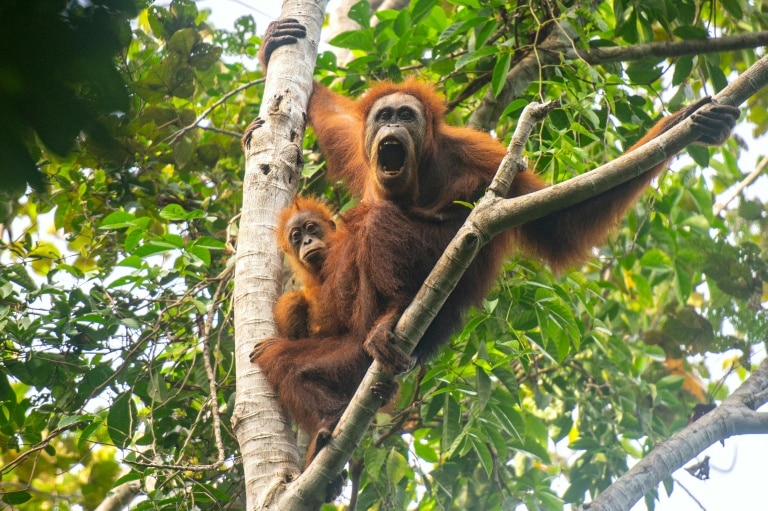
A single extreme weather event amplified by human-caused climate change has delivered a catastrophic blow to the world’s rarest great ape species, new research has confirmed, leaving fewer than 800 Tapanuli orangutans surviving in the wild. According to a study published Wednesday in the peer-reviewed academic journal Current Biology, last November’s Cyclone Senjaya triggered widespread mudslides and flash flooding across Indonesia’s Sumatra island that killed an estimated 58 Tapanuli orangutans. This toll accounts for roughly 7% of the species’ entire remaining wild population, and 11% of the apes that live in the affected Batang Toru Ecosystem – the only protected habitat the species still occupies. The broader flooding event killed more than 1,000 human residents across the region as well.
Only formally recognized as a distinct species by the scientific community in 2017, Tapanuli orangutans are already one of the most vulnerable large mammals on Earth. The entire wild population is confined to a small, fragmented stretch of highland forest in northern Sumatra, after decades of human development pushed them out of their preferred lowland habitats. Conservation scientists have warned for years that overlapping threats of industrial encroachment and climate-driven extreme weather could push the species to extinction in just a few decades.
To reach their population loss estimates, researchers from the University of Indonesia and conservation initiative Borneo Futures cross-referenced satellite imagery of landslide damage in Batang Toru with existing maps that track Tapanuli orangutan population density across the ecosystem. Their analysis found that roughly 8,300 hectares of critical forest habitat – more than 11% of the ecosystem’s total forest area – was destroyed or severely damaged by the cyclone-triggered landslides. In addition to the 58 confirmed or projected orangutan deaths, the storm wiped out critical food sources and shelter that the remaining apes depend on for survival.
“This level of loss is substantial for a species with such a small total population,” explained Erik Meijaard, chief scientist at Borneo Futures. “For a population already on the brink, losing one out of every 14 individuals to a single weather event is a devastating blow that the species cannot absorb repeatedly.”
Jatna Supriatna, lead researcher from the University of Indonesia, emphasized that the mass mortality event was directly tied to rising global temperatures that have increased the frequency and intensity of extreme tropical cyclones in the region. “The loss of an estimated 58 Tapanuli orangutans to a single climate-induced landslide event is a devastating demographic shock to the world’s rarest great ape,” he said.
Conservation groups have campaigned for decades to stop planned industrial development in the Batang Toru Ecosystem, including a large proposed hydroelectric dam and ongoing illegal gold mining operations that have already fragmented the apes’ remaining habitat. Data from conservation advocacy group Mighty Earth, released earlier this year, underscores the growing risk: Sumatra lost more than 4.4 million hectares of forest between 2001 and 2024 – an area larger than the entire country of Switzerland – and widespread deforestation has left the island’s hilly landscapes far more vulnerable to catastrophic climate-driven landslides.
To avoid what would be the first extinction of a great ape species in modern history, Supriatna said, both Indonesian authorities and global stakeholders must take urgent action. “Indonesia must permanently protect the Batang Toru ecosystem from further industrial encroachment,” he said. “But our international partners must also meet their global commitments by providing immediate biodiversity-recovery financing to support habitat restoration and protection efforts.”