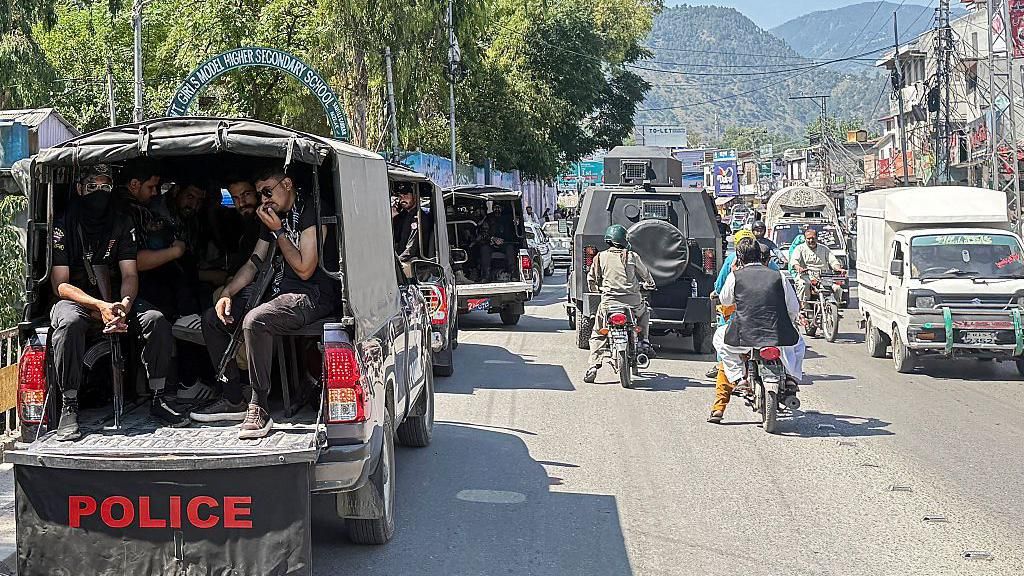
A fragile, unsettling quiet has settled over major population centers across Pakistan-administered Kashmir, following days of violent clashes between anti-government protesters and security forces that have left at least 15 people dead and dozens more wounded, local authorities confirmed this week.
The unrest was triggered by a long-simmering political dispute over 12 reserved legislative seats set aside for Kashmiri refugees in the region’s upcoming July assembly election. The provision reserves these seats exclusively for refugees who do not currently reside in Pakistan-administered Kashmir, barring permanent local residents from contesting them. The Joint Awami Action Committee (JAAC), a coalition of local activist groups, organized a mass protest march to the regional capital Muzaffarabad demanding the full abolition of the reserved seats, arguing that all legislative positions should be held by people who actually live and vote in the region.
In response to the protest call, regional authorities moved quickly to crack down on the coalition: they officially banned the JAAC on June 5 under regional anti-terrorism laws, levying sedition and terrorism allegations against the group, claiming its activities undermine regional peace and security. Authorities have also launched targeted legal action against the coalition’s senior leaders.
The harsh crackdown failed to deter widespread participation, however. Thousands of local residents joined the protest march, sparking violent confrontations with security forces across multiple districts of the region. Official estimates place the size of the main protester convoy at more than 10,000 people, which is currently positioned just four kilometers outside the city of Rawalkot. Regional officials have explicitly blocked the convoy from advancing through Rawalkot on its route to Muzaffarabad.
Sardar Waheed Khan, Poonch district commissioner for Pakistan-administered Kashmir, told BBC Urdu that enhanced security patrols have been deployed across the area to enforce public order, and local residents have been ordered to stay in their homes. Local mosques have also broadcast public announcements echoing the order to remain indoors. Air surveillance helicopters are now conducting regular flights over both Rawalkot and Muzaffarabad to monitor protester movements.
The first major clashes erupted earlier this week in Rawalakot, with additional violent confrontations breaking out in the city of Kotli on Tuesday that left three more people dead. To date, the official death toll stands at 15: 11 civilian protesters and four security force officers. At least 50 people have been wounded in the unrest, and local officials have acknowledged the death toll may climb as violence continues.
Global human rights group Amnesty International issued a sharp rebuke of the government response Tuesday, condemning what it called a “violent and sweeping crackdown” on the protests. The organization highlighted the implementation of a regional internet shutdown, mass arbitrary arrests of activists and protesters, and the use of deadly force against demonstrators, warning that the crackdown marks a dramatic, alarming deterioration of human rights protections in the region.
Despite the violence and government restrictions, the protest march to Muzaffarabad is still moving forward, and the JAAC has called for a region-wide general strike to back its demands. Currently, the capital Muzaffarada remains under a heavy security presence: streets are largely empty, storefronts are shuttered, and uniformed police patrol quiet neighborhoods. It remains unclear whether most business closures stem from public safety fears or are part of the strike in solidarity with JAAC demands. One local Muzaffarabad trader told BBC Urdu he closed his shop voluntarily, and would keep it closed until the group’s demands are met or the strike is called off.
The legal status of the 12 reserved seats has already been addressed by the Supreme Court of Pakistan-administered Kashmir, which issued a formal advisory opinion ruling that the seats are constitutionally protected and cannot be modified through administrative action, political negotiation, or public pressure.
For context, Pakistan-administered Kashmir is a semi-autonomous region with its own independent regional government. The broader Kashmir region has been a flashpoint of conflict between India and Pakistan for more than seven decades. Both nations claim the entire Himalayan territory in full, and have fought two full-scale wars and one limited armed conflict over control of the region. Today, India and Pakistan each administer separate portions of Kashmir, with tensions regularly flaring along the de facto border dividing the two control zones.