作者: admin

  • US must learn to navigate its pay-for-play world to find a pipeline to World Cup competitiveness

    US must learn to navigate its pay-for-play world to find a pipeline to World Cup competitiveness

    As Argentina prepares to face Spain for its fourth FIFA World Cup title, a stark contrast in soccer development models has renewed longstanding questions about why the United States, a nation of 330 million people, has never reached the upper echelons of men’s international soccer success. After the U.S. men’s team’s early exit from the 2026 World Cup, soccer leaders and analysts across the country are zeroing in on one core issue: the pay-to-play system that dominates American youth soccer, and how it is holding back the nation’s soccer potential.

    Unlike Argentina, where developing a homegrown star who goes on to play for the national team is the highest honor for a local club, the U.S. youth soccer ecosystem is built around charging families for access to competitive play. Most youth organizations rely on player fees to stay operational, retaining players as long as their families can keep paying. For elite programs, the costs are staggering: a 2024 Project Play report found the average U.S. family spends $1,016 per year on a child’s primary youth sport, a 46% jump from five years prior. For elite soccer, that annual figure can top $12,000 once team dues, equipment, and tournament travel are added up. Retired Colorado salesman Dan Chisesi, who raised two children who played youth soccer, estimates he spent tens of thousands of dollars on the sport over decades. Even though his children gained positive memories, he echoes a common concern: “I believe youth sports have become somewhat elitist. I think we’re missing out on a lot of talent because people just can’t afford these travel competitive teams.”

    This financial barrier means countless talented young players never get the chance to showcase their skills. With between 4 million and 6 million children playing soccer across the U.S., the sport’s elite tier remains out of reach for low-income families. Longtime U.S. men’s national team goalkeeper Kasey Keller summed up the issue bluntly, noting that even a generational talent like Erling Haaland would likely be pushed into the NFL rather than professional soccer if he grew up in the current American system, where football and basketball dominate the attention of sports fans and athletes alike.

    The fragmented governance of U.S. youth soccer only exacerbates the problem. The sport is overseen by more than seven national governing bodies and 54 state federations, creating a fractured system that former U.S. Youth Soccer CEO Skip Gilbert describes as more focused on poaching players between competing leagues than building a cohesive talent pipeline. Gilbert, who recently updated his proposal for structural reform, argues that consolidating all youth soccer organizations under the umbrella of the U.S. Soccer Federation (USSF) would create a unified national talent database, eliminating the fragmented competition for paying players that currently plagues the system. Critics warn the plan would only consolidate power among existing governing bodies, but Gilbert counters that the current status quo leaves families with no alternative to the pay-to-play model: “And parents, God love all of us, we’re more than happy to write checks if we think it’s going to help our kids. The downside is, there isn’t another pathway. You have to go into that pay-or-play model.”

    Major League Soccer (MLS), which took over the country’s primary national development program as MLS Next in 2020 after the USSF shuttered its previous program amid COVID-19-related financial losses, is currently the closest thing to an official national talent pipeline. This fall, the league will serve roughly 53,000 players, but only a tiny fraction receive full subsidies for training, physical therapy, travel, and equipment. The top-tier homegrown division has more than 17,000 players, with just 3,000 playing for free in MLS club academies. While MLS has launched a grant program that compensates grassroots clubs for developing players who go on to join the top league, the fledgling system pales in comparison to the open talent ecosystems common in Argentina, Europe, and other South American soccer powerhouses.

    In those countries, a system of promotion and relegation across hundreds of pro and semi-pro leagues creates constant incentive for clubs to scout and develop undiscovered talent wherever it exists. Young players can earn a spot on a top team through performance alone, and transfer fees for top talent create a steady revenue stream that funds grassroots scouting and development. This system is far from perfect: Argentina’s top academies have faced decades of allegations of minor exploitation and sexual abuse, and constant high-stakes talent evaluation takes a heavy emotional toll on young players. But it also eliminates the financial barrier that locks talented low-income players out of elite development in the U.S.

    “If you’re not in that ecosystem, you might have a hard time understanding, ‘Well, how could what happens at the professional level have any impact on my son or daughter’s 12-year-old soccer team?’ But it has a huge impact. It’s just a very different bar to cross” than in America, explained Pennsylvania grassroots coach Rory O’Neill.

    USSF and MLS leaders are not calling for copying international models wholesale, however. USSF CEO JT Baston explained the federation’s current strategy: “Our strategy should not be to copy and paste what works in another country. It’s, how do we, in partnership with the pro clubs, design the right youth pathways here. It looks like the hub-and-spoke model where you’re leveraging the best of the professional clubs, leveraging the best of the rest of the ecosystem here and the national team program.”

    MLS leaders point to small wins that show the potential of improving the current system rather than replacing it. Brad Sims, CEO of MLS side NYCFC, shared the story of Seymour Reid, an 18-year-old Jamaican-born player from New York who was discovered playing pickup soccer five years ago, with no prior experience in an organized club. Reid has now signed a professional contract with NYCFC and was a finalist for the 2025 MLS Pathway Player of the Year. But Sims acknowledges that success stories like Reid’s are rare: “I wonder how many kids like that are playing around the country who don’t have the connections or don’t have the finances to play. But this is a bigger problem that’s not on MLS clubs or maybe even the MLS league to solve independently. I think U.S. Soccer obviously wants to figure that out as much as anybody.”

    Former U.S. men’s national team captain Michael Bradley, now head coach of MLS side New York Red Bulls, says the U.S. must build a model that fits its own unique sports culture rather than trying to mimic global powers. “We have our own soccer culture,” he said. “The way the game looks in this country, the way it feels, what we are as a soccer nation, is going to be different than other places, and that’s OK. We don’t need to pretend to be something that we’re not.”

    Even so, experts and families agree that overhauling the pay-to-play model and unifying the fragmented youth system will take decades. While incremental improvements to the current system can yield better results sooner, creating a sustainable pipeline of top-tier talent that can compete for World Cup titles will require long-term, structural change that addresses the core inequalities of the current American system.

  • France beats Japan 42-15 in Nations Championship rugby as Lucu tallies 15 points

    France beats Japan 42-15 in Nations Championship rugby as Lucu tallies 15 points

    In a decisive display of attacking rugby at Tokyo’s National Stadium on Saturday, the Six Nations champions France wrapped up a three-week summer tour with a 42-15 win over host Japan in the inaugural 12-team World Rugby Nations Championship. The result caps off a mixed but ultimately successful run for the French side, which opened the new tournament with a narrow 34-32 defeat to New Zealand’s All Blacks before bouncing back to beat Australia 42-26 in Brisbane a week prior to facing the Brave Blossoms.

    The opening half of the match proved far more competitive than the final scoreline suggests, with Japan matching France’s physical intensity across the pitch and keeping the game within one score going into the halftime break. France got off to a blistering start, taking the lead just two minutes in after hooker Maxime Lamothe crossed the line following a close-range lineout drive. Japan responded quickly, however: fullback Takuro Matsunaga slotted a penalty to cut the deficit, then sparked a blistering long-range counter-attack from his own 22-meter line that saw winger Kippei Ishida finish the move in the left corner, putting Japan up 8-5 by the 15th minute.

    France seized control of the match over the next 20 minutes, capitalizing on sustained forward pressure that earned Japan lock Harry Hockings a yellow card for repeated infringements. Fullback Matthieu Jalibert scored his first try of the night in the 19th minute, followed just four minutes later by a five-pointer from No. 8 Alexandre Roumat that extended France’s lead. Skipper and scrumhalf Maxime Lucu put the result out of immediate reach for Japan just before the half-hour mark, darting over the line after a strong, contact-breaking run from Lamothe to secure France’s fourth try and the all-important bonus competition point.

    Japan refused to wilt under pressure, though, and crossed for a second try four minutes before halftime to cut France’s lead to 28-15 going into the break, keeping their hopes of an upset alive.

    Those hopes faded quickly in the early stages of the second half, as France scored two quick tries to pull away out of sight. Jalibert notched his second try of the match in the 43rd minute, adjusting his running angle to take a short inside pass from Lucu and cross near the posts for an easy score. Lamothe followed suit eight minutes later, touching down after another sustained period of pressure from France’s powerful forward pack to push the score to 42-15.

    The final 20 minutes saw a shift in momentum after Jalibert was sent to the sin bin for a high tackle in the 58th minute. While Japan was unable to convert their one-man advantage into any points during the 10-minute power play, they successfully halted France’s scoring run. A late Japanese try was disallowed by officials in the 63rd minute, and the home side failed to put any more points on the board in the final half-hour of the hot, humid Tokyo evening.

    For Japan, the result leaves them with a 1-2 record after the first phase of the Nations Championship, having opened the tournament with a 27-10 win over Italy before dropping consecutive matches to Ireland and France.

  • Russian online retail warehouses hit by deadly Ukrainian strikes

    Russian online retail warehouses hit by deadly Ukrainian strikes

    A deadly wave of Ukrainian drone attacks targeting two logistics warehouses belonging to Russia’s largest e-commerce giant Wildberries has left eight people dead and 62 others injured, Russian regional officials confirmed this week, marking one of the most high-profile cross-border strikes on Russian commercial infrastructure in months.

    The deadliest incident unfolded in Tambov, a city located roughly 475 kilometers southeast of Moscow, where a nighttime drone strike killed seven workers on the night shift and left 25 people injured, seven of whom remain in critical condition. Evgeniy Pervyshov, governor of the Tambov region, wrote on Telegram that the attack was the “largest and most inhumane” strike the region has faced since the start of the full-scale invasion, noting that 28 incoming drones were intercepted and shot down before the strike. Most of the injuries reported were shrapnel wounds from the blast, he added.

    A second strike hit another Wildberries warehouse in Elektrostal, a city in the Moscow Oblast, killing one more person and injuring 37, eight of whom are in serious condition. Moscow region governor Andrei Vorobyov added that 48 drones were shot down across the region overnight, and a separate falling drone debris hit a local Russian oil depot, causing what he called the incident with the “most serious consequences” of the overnight attacks. Ukrainian President Volodymyr Zelensky later confirmed that Ukrainian forces had struck an oil facility alongside the logistics targets.

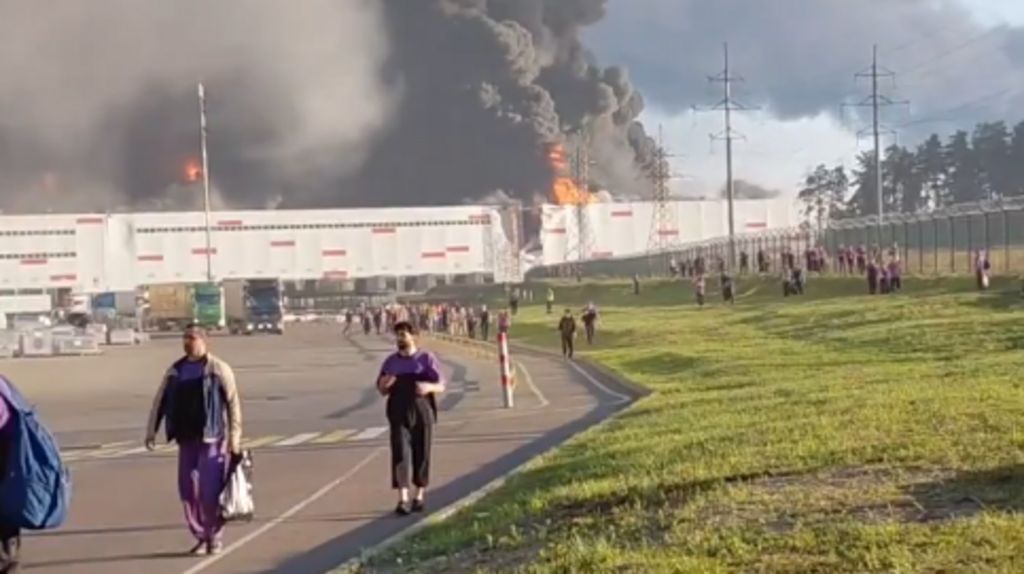
    Unverified footage circulating from the strike sites shows massive flames engulfing the large industrial warehouse buildings, with thick plumes of black smoke billowing into the sky over the facilities. Dozens of workers can be seen fleeing the burning structures to gather in adjacent parking lots, as emergency response teams including firefighters and local emergency services raced to contain the blaze and treat casualties. As of Thursday, response operations were still ongoing at both strike locations, with officials yet to release full details of structural damage to the facilities.

    In comments following the attacks, Zelensky framed the strikes as a targeted operation against Russian military supply chains, saying the hit facilities were “major logistics facilities” that had been used to store and move “sanctioned components for drone production and navigation equipment” for the Russian military. He added that the strikes were part of a broader set of operations that also hit military and infrastructure targets in the Sea of Azov, the Black Sea, and Russian-annexed Crimea. Zelensky emphasized the attacks were a direct retaliation for recent Russian strikes on Ukrainian civilian infrastructure, which killed 14 people across Ukraine overnight Tuesday.

    Wildberries, often described as the Russian equivalent of Amazon, is the country’s dominant online retail platform. In 2026, the combined RWB Group — which merged Wildberries with domestic advertising firm Russ — was valued at roughly $12.6 billion by Forbes Russia. In a statement following the strikes, Wildberries CEO Tatyana Kim called the incident a “terrible night” for both Russia and the company.

    The attack comes as Ukraine has significantly intensified its long-range drone campaign targeting Russian critical infrastructure over the past month, particularly focusing on the country’s energy and refining sector. Ukrainian officials claimed earlier this July that nearly 43% of Russia’s total oil refining capacity has been disabled as a result of these repeated strikes, a figure that the BBC has not been able to independently verify. Ukraine justifies targeting Russian energy facilities by noting that fossil fuel exports are the largest source of revenue for the Russian government, which relies on those funds to finance its full-scale invasion that launched in February 2022.

    Last month, Russian President Vladimir Putin made a rare public acknowledgment that Ukrainian strikes had caused widespread domestic fuel shortages across Russia. In early July, he signed into law emergency legislation designed to boost domestic fuel supplies by restricting exports and increasing domestic production. Prior to the Wildberries strikes, the ongoing drone campaign had already created significant disruptions to Russian fuel distribution networks and driven up domestic fuel prices in many regions.

  • Paris’ Grand Mosque celebrates its 100th anniversary and interfaith dialogue

    Paris’ Grand Mosque celebrates its 100th anniversary and interfaith dialogue

    One hundred years after its construction to honor colonial Muslim soldiers who fought and died for France in World War I, the Grand Mosque of Paris is celebrating its centenary, even as worshippers and leaders grapple with rising religious tensions and growing far-right rhetoric ahead of the country’s 2025 presidential election. Nestled in the heart of Paris’ bustling Latin Quarter, the mosque has grown far beyond a place of worship over the past century, evolving into an integral landmark of the French capital that draws worshippers and tourists from across the globe.

    Designed with architectural inspiration from Spain’s Alhambra palace, the 33-meter minaret of the mosque stands overlooking the Seine River, complementing the silhouette of nearby Notre Dame Cathedral without overshadowing the iconic landmark. Its ornate, carpeted prayer room is listed as a top must-see attraction on Paris City Hall’s official tourism portal, and the site also hosts a popular traditional tea room and public hammam steam bath that attract both local Parisians and international visitors. For the Muslim community that gathers here weekly, however, the mosque’s meaning is rooted in a century-old promise of inclusion.

    When French authorities approved and inaugurated the mosque in 1926, the project was framed as a tribute to the estimated 100,000 Muslim soldiers from French colonial territories across Africa and beyond who died defending France in the trenches of World War I, from Verdun to the Western Front. Then-French President Gaston Doumergue emphasized in his opening address that France’s cultural and religious diversity would only strengthen the national community, a message that current rector Chems-eddine Hafiz says remains just as relevant today.

    Hafiz, who has led the mosque for years, frames the historic site as a enduring symbol of interfaith dialogue and the richness of France’s pluralistic society. But he has raised urgent alarms over escalating religious divisions in the country, stoked by ongoing conflicts in the Middle East and the increasingly polarizing rhetoric of the upcoming presidential election campaign. “It’s the responsibility of everyone to see Muslims as a part of the national community,” Hafiz told the Associated Press in an interview ahead of the centenary celebrations.

    Today, Islam is the second largest religion in France, which is home to Western Europe’s largest Muslim population. But decades of stigma, amplified by deadly Islamic extremist attacks across the country over the past 15 years, have left many French Muslims facing systemic discrimination and social exclusion. As campaigning for the 2025 presidential election ramps up, far-right leader Marine Le Pen and her National Rally party have centered their platform on targeting Islam and restricting immigration, amplifying anti-Muslim rhetoric across national political discourse.

    Fatma Chouchane, a volunteer at the Grand Mosque, spoke to the AP about the daily barriers many Muslim women face across France, including legal restrictions on wearing traditional Muslim headscarves in public schools and certain workplaces. “I ask France to leave these people alone and let them make their religious choices,” she said. Despite these challenges, Chouchane joined other worshippers in framing the centenary as an occasion to reaffirm messages of tolerance and solidarity. “It’s a symbol, it is the Paris museum for Muslims,” she said. “We must all be in solidarity.”

    For centenary prayers held Friday, worshippers traveled from across the greater Paris region, representing generations of Muslim communities in France: some born in the country, others who migrated over decades from Algeria, Senegal and other former French colonies, with many tracing their family roots to the very colonial soldiers the mosque was built to honor. For Ibrahima Seye, who first visited the mosque shortly after moving to France from Senegal, it has long served as a welcoming home for new arrivals and a point of pride for the entire community. “It’s always open,” he said. “It’s good for the Muslim community, and I see that it is a mosque that is appreciated by a lot of tourists, too.”

    Hafiz emphasized that the core political promise of the mosque, as a testament to Muslim contributions to French national life, has not wavered since its opening 100 years ago. “The problem lies in people’s attitudes,” he said. “Today, anti-Muslim acts are still being committed against Muslims. Islam is often misunderstood, and talking about Muslims or Islam can trigger hostility.” As the mosque marks its 100th year, community leaders say its centenary is not just a moment to celebrate history, but to reaffirm the founding vision of a diverse, inclusive France where all religious communities belong.

  • Ship at centre of record cocaine seizure finally leaves Cork

    Ship at centre of record cocaine seizure finally leaves Cork

    After nearly 10 months of detainment at Ireland’s Cork Harbour following one of the country’s largest ever cocaine seizures, the Panama-registered cargo vessel MV Matthew has finally exited Irish waters. The 28,000-tonne freighter was first seized by Irish authorities in September 2023, when officials found 2.2 tonnes of unprocessed cocaine hidden onboard. The illicit drug shipment was estimated to have a street value of roughly €157 million, or approximately £133.5 million, marking a historic bust for Irish law enforcement.

    For the entire duration of its detention, the MV Matthew was retained as critical evidence for ongoing criminal proceedings connected to the smuggling plot. Irish legislation and judicial rules required the vessel to remain in state custody until all legal processes wrapped up, which did not conclude until December 2024. Over the 10-month period, maintaining the idle cargo ship imposed a significant financial burden on Irish taxpayers. Running and upkeeping essential onboard systems including the main engine, electrical networks, and ventilation infrastructure pushed total state costs for the vessel to roughly €17 million.

    Last summer, the legal process against the individuals behind the smuggling operation concluded, with eight men convicted on drug trafficking charges. The group received a combined total prison sentence of 129 years for their roles in the plot, bringing the criminal prosecution phase of the case to a close. Once the vessel was no longer required as evidence, Irish authorities opened a process to dispose of the ship, ultimately agreeing to sell it to an international shipping company for the nominal price of just $1. As part of the sales agreement, the new owner is responsible for towing the vessel to the Bulgarian port of Varna for its next phase of use or refitting.

    The Republic of Ireland’s Revenue service, which leads customs and drug enforcement operations in the country, officially confirmed the MV Matthew’s departure from Cork Harbour on Saturday. The seizure and subsequent detention of the vessel highlighted the persistent threat of large-scale drug smuggling operating through European Atlantic ports, while also drawing attention to the unexpected public costs that can come with major law enforcement busts.

  • New Zealand beats Ireland 40-21 to stay unbeaten in the Nations Championship

    New Zealand beats Ireland 40-21 to stay unbeaten in the Nations Championship

    AUCKLAND, New Zealand – Decades of unbroken dominance at Auckland’s iconic Eden Park stretched further Saturday, as the New Zealand All Blacks delivered a clinical 40-21 defeat to a confidence-high Ireland side. The victory, which marked the All Blacks’ 53rd consecutive win at the venue across 32 years, validated head coach Dave Rennie’s tactical push for an aggressive, ball-in-hand playing style that had been inconsistent earlier in the Nations Championship tournament.

    Rennie’s young squad had previously secured wins over France and Italy while trialing this open, attack-focused approach, but those performances were marked by spotty execution, costly disciplinary lapses, and inconsistent momentum. Against Ireland, however, the team translated their practice-field preparation into polished, decisive action that kept the opposition off-balance for most of the 80 minutes.

    From the opening whistle, the All Blacks corrected a recurring flaw that plagued their earlier matches: slow starts that forced them to climb back from early deficits. Ireland did not push into New Zealand’s 22-meter line until the 12th minute, and that venture came to nothing when Tadhg Beirne was called for offside. New Zealand opened the scoring in the 15th minute, after a powerful break from Tupou Vaa’i – who impressed following a positional shift from lock to backrow – put the All Blacks deep in Irish territory. Sustained possession and smart distribution opened space for Patrick Tuipulotu to cross the line, scoring his first test try of the 2024 Nations Championship.

    The home side doubled their lead seven minutes later, turning down a straightforward penalty kick at goal to opt for a 10-meter scrum. Caught off-guard by the choice to prioritize a try rather than three points, Ireland’s defense split as they expected a wide pass to the All Blacks backline. Instead, Ardie Savea broke directly from the back of the scrum to score New Zealand’s second try. By the 25-minute mark, Ireland had already missed 19 tackles, with visible fractures starting to appear in their defensive structure.

    A brief disruption came for New Zealand in the 28th minute, when backrower Luke Jacobson was sin-binned for a dangerous cleanout at the ruck. Ireland capitalized quickly, with Jack Conan finishing off a structured attack to score his side’s first try off a short pass from Jamison Gibson-Park. But the All Blacks responded almost immediately off the subsequent restart: a loose Irish pass in their own 22 was intercepted by Will Jordan, who crossed for his 51st test try in the 35th minute. Four minutes later, Asafo Aumua scored his first try of the match on his second carry over the Irish line, sending the All Blacks into halftime with a commanding 28-7 lead that left Ireland playing perpetual catch-up.

    Ireland struck back early in the second half, with Joe McCarthy driving over the line to score after a well-worked lineout following a break from Gibson-Park. Just as they had earlier, however, the All Blacks quashed the comeback attempt almost instantly. A sustained attacking sequence earned New Zealand a penalty, and after multiple forward carries opened the Irish defense, a long pass to Ruben Love was stopped short of the line – only for Damian McKenzie to pick up the loose ball and score. Ireland rallied once more, with fullback Hugo Keenan crossing for a try in the 63rd minute, but could not close the substantial gap.

    Even after holding out against more than 20 consecutive phases of All Blacks attack near the 70-minute mark, Ireland’s tired defense broke one final time. Center Anton Lienert-Brown crossed for the All Blacks’ sixth try in the 79th minute, closing out a comprehensive six-tries-to-three victory.

    Individual performances highlighted the All Blacks’ strength across the pitch. Midfielder Quinn Tupaea was a relentless dynamic force in the center of the park, while McKenzie proved consistently dangerous both in his starting role at fullback and when shifting to flyhalf later in the match. Speaking after the final whistle, McKenzie emphasized the team’s tactical balance that won out over Ireland’s attempt to slow the pace of play.

    “We wanted to start well and we did,” McKenzie said. “We had a pretty good balance between our kick game and our run game.”

    Tactically, New Zealand’s edge was clear across all areas of the pitch. Strong set piece work, aggressive physical play at the breakdown, and consistent ability to win front-foot ball allowed the All Blacks to maintain their expansive attacking structure. When Ireland attempted to slow the match tempo to disrupt New Zealand’s rhythm, the All Blacks adapted effectively, forcing frequent turnovers and limiting their kicking to keep pressure on the Irish defense. Backline play was also far more precise than in earlier tournament matches, while aggressive pressure forced Ireland into repeated unforced errors in the opening half.

  • The challenges facing UK’s next PM Andy Burnham

    The challenges facing UK’s next PM Andy Burnham

    When Andy Burnham accepts the keys to 10 Downing Street on Monday, he will step into a role that has seen rapid turnover: he will become the United Kingdom’s seventh prime minister in just 10 years. The former Greater Manchester mayor secured an overwhelming vote to take over as leader of the Labour Party this Friday, following Keir Starmer’s resignation last month. Political and economic analysts widely agree that Burnham inherits a lengthy, high-stakes to-do list, with many of the unresolved issues that forced his predecessors out of office now falling to his new administration.

    First on the agenda is addressing the persistent cost-of-living crisis that has left millions of UK voters struggling to cover basic expenses. Skyrocketing energy and food prices, spurred by the ongoing Russia-Ukraine war, have eroded household purchasing power for years, and voters are demanding urgent action to make daily life more affordable. Burnham’s room for policy maneuver is tightly constrained, however: the UK is grappling with stagnant economic growth, sky-high public debt, and binding fiscal rules that require the government to balance spending against tax revenue.

    In his first speech after being confirmed as Labour leader, Burnham laid out his core economic vision, promising to build a nation “where life is more affordable”. A central pillar of his growth strategy is devolving more governing power to regional economic hubs, a policy designed to unlock local potential that can drive national growth. As Philip McCann, a senior researcher at the Productivity Institute, explained, this approach shifts growth leadership outside London, turning underperforming regional economies into national growth engines. Burnham has also outlined plans to back small and medium-sized businesses, drive “reindustrialization” across former industrial regions, and expand public ownership of key public services including water, public transport, and energy. Early reporting from the *Financial Times* indicates he may loosen long-standing restrictions on new oil and gas drilling in the North Sea as a short-term measure to cut domestic energy bills for consumers. The ideological direction of his economic agenda will largely hinge on his upcoming pick for finance minister, a decision that has not yet been announced.

    A second major challenge is tackling the UK’s rapidly ballooning welfare budget, a problem Burnham has publicly acknowledged requires targeted reduction. His predecessor Starmer faced fierce backlash from both the public and his own party over proposed welfare reforms that included cutting winter fuel payments for low-income elderly pensioners. Starmer ultimately was forced to backtrack on the changes, a policy reversal that significantly eroded his public approval and contributed to his resignation. As a member of Labour’s soft left faction, Burnham faces intense internal pressure to avoid deep cuts to working-age and pensioner benefits, even as he must address the growing cost of the welfare system. He has also pledged to fix long-standing underfunding in the social care sector, a portfolio he first attempted to overhaul during his tenure as UK health secretary in 2009. With personal experience caring for a father living with Alzheimer’s, Burnham said in his Friday speech that he was “prepared to grasp the nettle” of reform, adding that the current social care system “is broken”.

    On the defence front, Burnham inherits a critical £4.7 billion (US$6.3 billion) funding gap in the Labour government’s four-year defence investment plan. The long-delayed strategy was published by Starmer’s government last month, but full delivery of the plan now falls to Burnham’s new administration. Beyond closing the funding gap, he faces growing pressure from within Labour and from key allies including the United States to further increase defence spending to meet NATO’s new target of devoting 3.5 percent of GDP to defence by 2035. Burnham has previously committed to taking full “responsibility” for funding the defence plan and making “no compromise” on UK national security.

    One of Burnham’s most pressing political challenges is reversing the flow of Labour voters to rival fringe parties, particularly the surging support for Nigel Farage’s hard-right, anti-immigration Reform UK. Labour has also lost support to the left-wing Green Party in recent years, with both parties making major gains in 2024 local elections — a shift that piled increasing pressure on Starmer to step aside for a leader who could reverse these losses. In his Friday speech, Burnham laid out a clear new political strategy, promising to build a “distinctly Labour” policy direction that is independent of both fringe parties. “We win by being us,” he said. “We won’t try to out-Green the Greens, or out-Reform Reform, or doing what we’ve done in the past of wearing too many Tory clothes.” London School of Economics politics professor Tony Travers said this signals a clear break from Starmer’s centrist approach. “What this signals is that the Labour Party under Burnham will want to try to win back voters from Reform and the Greens with a different offer,” Travers told Agence France-Presse.

    In foreign policy, Burnham will need to quickly navigate a complex and volatile global landscape. Top of the international agenda is building a working relationship with unpredictable U.S. President Donald Trump, who has already publicly labeled Burnham “extremely liberal”. According to Travers, Starmer maintained a relatively cooperative relationship with Trump until the escalation of the U.S.-Iran conflict, leaving Burnham to chart a new course for the special relationship. Beyond U.S.-UK relations, Burnham must manage the ongoing wars in Ukraine and the Middle East, two conflicts that have significant ripple effects on UK energy prices and domestic stability. So far, Burnham has signaled he will maintain broad continuity with Starmer’s widely praised foreign policy, retaining close ties to NATO and all key UK allies. “Our relationship with the US will remain critical as our most important defence and security ally. And Britain’s support for Ukraine will not waver,” Burnham wrote in a recent op-ed for *The Times*.

  • Laos says it can’t determine cause of  tourist deaths linked to methanol

    Laos says it can’t determine cause of tourist deaths linked to methanol

    A 2024 tragedy that claimed the lives of six foreign backpackers in the popular Laotian tourist town of Vang Vieng has left international authorities frustrated after Laotian officials announced they cannot formally assign blame or confirm the exact cause of the deaths, all linked to locally produced alcohol contaminated with dangerous levels of methanol.

    The fatal incident unfolded in mid-November 2024, when a group of international travelers fell ill after a night out drinking at local establishments. The victims have been identified as 28-year-old British national Simone White, 19-year-old Australian Bianca Jones, 19-year-old Australian Holly Morton-Bowles, 20-year-old Danish citizen Anne-Sofie Orkild Coyman, 21-year-old Dane Freja Vennervald Sorensen, and 57-year-old American James Louis Hutson.

    In an official statement released Saturday by the Laos Ministry of Public Security, authorities confirmed that investigators lack the forensic evidence required to definitively tie the deaths to methanol poisoning or the actions of any specific individual. The gap in evidence stems from the fact that no autopsies were performed on the victims’ remains, a restriction that prevented officials from reaching a formal conclusion on cause of death. Despite this limitation, the ministry did confirm that testing found excessive concentrations of methanol in vodka produced by a local distillery connected to the incident.

    Methanol is a cheap toxic chemical most commonly used in products like paint thinner. Unethical alcohol producers sometimes illegally add it to homemade spirits to cut production costs, as it shares a similar taste and appearance to ethanol. Even small doses of the chemical can be fatal: after being absorbed into the bloodstream through the gut, the body’s natural metabolic process breaks methanol down into formaldehyde and formic acid, toxic compounds that can cause organ failure and death within hours or days. Early symptoms of poisoning include vomiting, impaired decision-making, loss of coordination and drowsiness, while advanced cases develop within 12 to 48 hours, bringing abdominal pain, breathing difficulty, vision damage that can lead to permanent blindness, coma, and convulsions.

    In the weeks following the tragedy, legal action has been taken, but the limited scope of charges has drawn sharp criticism from foreign governments. The owner of the implicated distillery is currently facing two charges: selling harmful food products and operating an unlicensed business. Notably, the charges do not reference the six deaths, and carry a maximum penalty of just one year in prison and a fine equivalent to roughly $1,100 USD. Earlier this year, 10 staff members connected to the Nana Backpacker Hostel, where many of the victims were staying, were charged with destroying evidence, each receiving suspended sentences and a fine of around $185 USD.

    The Australian government has publicly condemned the limited legal action, saying it is “deeply frustrated and bitterly disappointed” that more severe charges have not been filed over the deaths of the two Australian backpackers. In response to the outcome, Australian foreign ministry officials summoned Laos’ ambassador to Canberra to discuss the case. The British government has also responded by launching a new public awareness campaign to warn British travelers visiting Southeast Asia of the severe risks of unregulated methanol-tainted alcohol, publishing a full list of poisoning symptoms to help tourists seek urgent care if exposed.

    Vang Vieng, a scenic riverside destination in central Laos, has long been a key stop on the Southeast Asian backpacker trail, drawing thousands of young international travelers every year. The tragedy has highlighted ongoing risks of unregulated alcohol production in popular tourist regions, and raised questions about accountability for incidents that harm foreign visitors.

  • White House tightens rules for visa holders

    White House tightens rules for visa holders

    In a sweeping policy shift announced Thursday, the second Trump administration will end a nearly 50-year-old immigration provision by imposing strict fixed-duration stay limits on non-immigrant visa holders including international students, cultural exchange participants and foreign journalists.

    The final amended rule, released by the U.S. Department of Homeland Security (DHS), replaces the long-standing “Duration of Status (D/S)” admission system that allowed F-class student visa holders and J-class exchange scholar visa holders to remain in the U.S. for the full duration of their academic programs or exchange appointments, regardless of how long that took. Under the new framework, all F, J, and I-class journalist visa holders will only receive fixed-period admission capped at a maximum of four years total.

    Additional restrictions in the rule bar graduate students from changing their academic goals or transferring to a new institution without explicit government approval. It also cuts the post-program grace period that allows visa holders to wrap up their affairs and depart the country from 60 days to just 30 days. For journalists holding I visas, the caps are far stricter: most are limited to 240-day stays, while Chinese journalists face an even shorter limit of 90 days.

    DHS officials justified the overhaul, arguing the 1978-era D/S policy had become outdated, was regularly abused for immigration fraud, and posed unacceptable risks to U.S. national security. “By implementing clear, finite limits on these visas, the United States is reclaiming its ability to properly screen, vet, and monitor individuals within our borders,” DHS Secretary Markwayne Mullin said in a statement. “This final rule ensures that foreign students remain focused on their primary purpose: completing their studies and returning home.”

    China swiftly condemned the new restrictions Friday, with Chinese Foreign Ministry spokesman Lin Jian calling on the U.S. to immediately reverse the discriminatory policy targeting Chinese journalists. Lin noted that Washington’s new barriers to people-to-people exchanges offer no benefit to either country, and confirmed China retains the full right to implement reciprocal countermeasures in response to the move.

    Within U.S. academic communities, the policy change has already triggered widespread chaos, anxiety, and uncertainty among the more than 1.1 million international students and 220,000 international scholars currently residing in the U.S. Lihua He, an immigration attorney based in California’s San Francisco Bay Area, told China Daily her office has been inundated with hundreds of calls and emails from visa holders desperate to secure information about how to maintain their legal status.

    While the DHS rule does allow students and scholars in good standing to apply for extensions to complete their programs, there is no guarantee extensions will be approved. “It creates uncertainty for the future of international students, and became an emotional burden for their families,” He explained.

    Jade Wen, who works in the international student services office at a San Francisco community college, said she has also been flooded with inquiries from panicked students. “They are very concerned about deportation or removal from the United States if they can’t finish their degree as scheduled,” Wen said.

    Russell Jeung, a professor of Asian American Studies at San Francisco State University, argued the new rule is part of a broader pattern of escalating anti-immigrant policy pushed by the Trump administration, which has framed restrictive measures as necessary to protect U.S. national security and advance its “America First” agenda. Jeung called the restrictive visa framework an extension of long-running racial exclusion policies targeting Asian and non-Western visitors to the U.S.

    The new rule is scheduled to enter into force on September 15, and will undergo a mandatory congressional review period before taking full effect.

  • Massive fire destroys 100 homes in Norway and forces hundreds to evacuate

    Massive fire destroys 100 homes in Norway and forces hundreds to evacuate

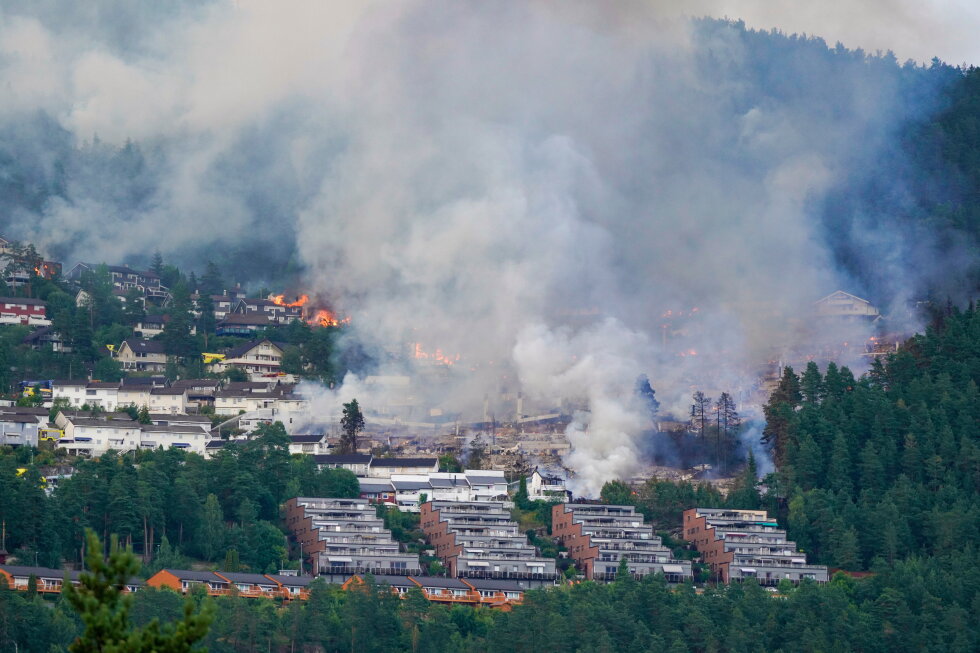
    A devastating large-scale wildfire-urban blaze has swept through a residential area in southern Norway, leaving more than 100 homes completely destroyed and prompting emergency evacuation orders for hundreds of local residents, Norwegian law enforcement and national public broadcasting confirmed Friday.

    According to official police statements, the destructive inferno ignited in a private townhouse located in the city of Drammen at approximately 3:30 p.m. local time Friday. What started as a contained residential fire quickly accelerated, spreading rapidly across the dense neighborhood before jumping into adjacent forested areas, amplifying the challenge for emergency response teams.

    As of Saturday morning, firefighting crews remained on the scene working around the clock to corral the out-of-control blaze and prevent it from spreading to additional populated areas. Norway’s national public broadcasting network, NRK, reported that hundreds of displaced residents have sought temporary shelter at official evacuation centers set up by local authorities.

    In an update released Friday, police confirmed that no residents have been reported missing following the mass evacuation, a small glimmer of good news amid the widespread destruction. At this early stage of the investigation, officials have not yet been able to identify the root cause of the fire, and a full probe into the incident is ongoing.

    Drammen, the city impacted by the disaster, sits roughly 34 kilometers, or 21 miles, southwest of Norway’s capital city of Oslo, a relatively short distance from the country’s most populous urban center.