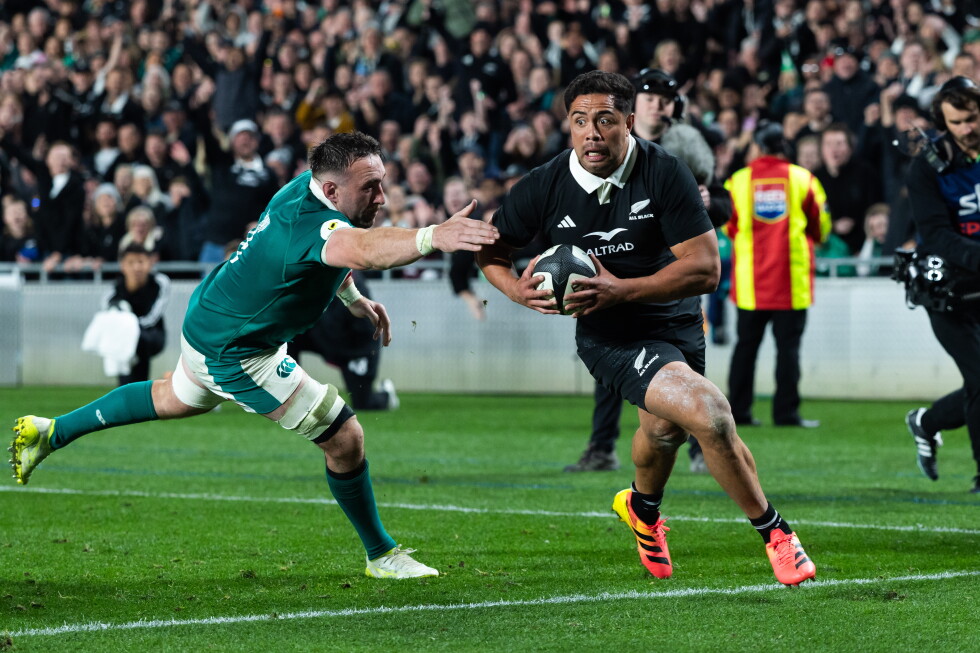
AUCKLAND, New Zealand – Decades of unbroken dominance at Auckland’s iconic Eden Park stretched further Saturday, as the New Zealand All Blacks delivered a clinical 40-21 defeat to a confidence-high Ireland side. The victory, which marked the All Blacks’ 53rd consecutive win at the venue across 32 years, validated head coach Dave Rennie’s tactical push for an aggressive, ball-in-hand playing style that had been inconsistent earlier in the Nations Championship tournament.
Rennie’s young squad had previously secured wins over France and Italy while trialing this open, attack-focused approach, but those performances were marked by spotty execution, costly disciplinary lapses, and inconsistent momentum. Against Ireland, however, the team translated their practice-field preparation into polished, decisive action that kept the opposition off-balance for most of the 80 minutes.
From the opening whistle, the All Blacks corrected a recurring flaw that plagued their earlier matches: slow starts that forced them to climb back from early deficits. Ireland did not push into New Zealand’s 22-meter line until the 12th minute, and that venture came to nothing when Tadhg Beirne was called for offside. New Zealand opened the scoring in the 15th minute, after a powerful break from Tupou Vaa’i – who impressed following a positional shift from lock to backrow – put the All Blacks deep in Irish territory. Sustained possession and smart distribution opened space for Patrick Tuipulotu to cross the line, scoring his first test try of the 2024 Nations Championship.
The home side doubled their lead seven minutes later, turning down a straightforward penalty kick at goal to opt for a 10-meter scrum. Caught off-guard by the choice to prioritize a try rather than three points, Ireland’s defense split as they expected a wide pass to the All Blacks backline. Instead, Ardie Savea broke directly from the back of the scrum to score New Zealand’s second try. By the 25-minute mark, Ireland had already missed 19 tackles, with visible fractures starting to appear in their defensive structure.
A brief disruption came for New Zealand in the 28th minute, when backrower Luke Jacobson was sin-binned for a dangerous cleanout at the ruck. Ireland capitalized quickly, with Jack Conan finishing off a structured attack to score his side’s first try off a short pass from Jamison Gibson-Park. But the All Blacks responded almost immediately off the subsequent restart: a loose Irish pass in their own 22 was intercepted by Will Jordan, who crossed for his 51st test try in the 35th minute. Four minutes later, Asafo Aumua scored his first try of the match on his second carry over the Irish line, sending the All Blacks into halftime with a commanding 28-7 lead that left Ireland playing perpetual catch-up.
Ireland struck back early in the second half, with Joe McCarthy driving over the line to score after a well-worked lineout following a break from Gibson-Park. Just as they had earlier, however, the All Blacks quashed the comeback attempt almost instantly. A sustained attacking sequence earned New Zealand a penalty, and after multiple forward carries opened the Irish defense, a long pass to Ruben Love was stopped short of the line – only for Damian McKenzie to pick up the loose ball and score. Ireland rallied once more, with fullback Hugo Keenan crossing for a try in the 63rd minute, but could not close the substantial gap.
Even after holding out against more than 20 consecutive phases of All Blacks attack near the 70-minute mark, Ireland’s tired defense broke one final time. Center Anton Lienert-Brown crossed for the All Blacks’ sixth try in the 79th minute, closing out a comprehensive six-tries-to-three victory.
Individual performances highlighted the All Blacks’ strength across the pitch. Midfielder Quinn Tupaea was a relentless dynamic force in the center of the park, while McKenzie proved consistently dangerous both in his starting role at fullback and when shifting to flyhalf later in the match. Speaking after the final whistle, McKenzie emphasized the team’s tactical balance that won out over Ireland’s attempt to slow the pace of play.
“We wanted to start well and we did,” McKenzie said. “We had a pretty good balance between our kick game and our run game.”
Tactically, New Zealand’s edge was clear across all areas of the pitch. Strong set piece work, aggressive physical play at the breakdown, and consistent ability to win front-foot ball allowed the All Blacks to maintain their expansive attacking structure. When Ireland attempted to slow the match tempo to disrupt New Zealand’s rhythm, the All Blacks adapted effectively, forcing frequent turnovers and limiting their kicking to keep pressure on the Irish defense. Backline play was also far more precise than in earlier tournament matches, while aggressive pressure forced Ireland into repeated unforced errors in the opening half.