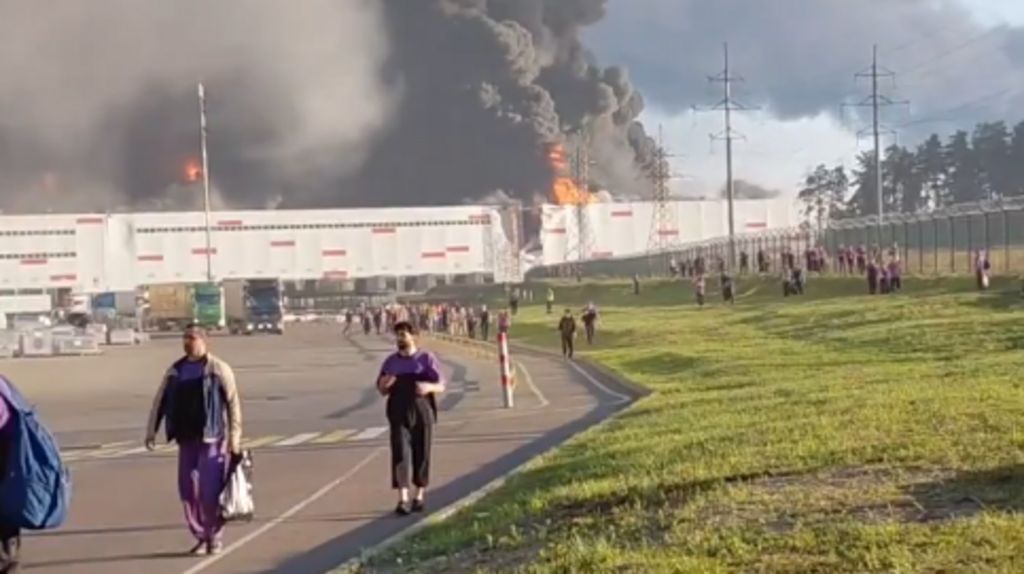
A deadly wave of Ukrainian drone attacks targeting two logistics warehouses belonging to Russia’s largest e-commerce giant Wildberries has left eight people dead and 62 others injured, Russian regional officials confirmed this week, marking one of the most high-profile cross-border strikes on Russian commercial infrastructure in months.
The deadliest incident unfolded in Tambov, a city located roughly 475 kilometers southeast of Moscow, where a nighttime drone strike killed seven workers on the night shift and left 25 people injured, seven of whom remain in critical condition. Evgeniy Pervyshov, governor of the Tambov region, wrote on Telegram that the attack was the “largest and most inhumane” strike the region has faced since the start of the full-scale invasion, noting that 28 incoming drones were intercepted and shot down before the strike. Most of the injuries reported were shrapnel wounds from the blast, he added.
A second strike hit another Wildberries warehouse in Elektrostal, a city in the Moscow Oblast, killing one more person and injuring 37, eight of whom are in serious condition. Moscow region governor Andrei Vorobyov added that 48 drones were shot down across the region overnight, and a separate falling drone debris hit a local Russian oil depot, causing what he called the incident with the “most serious consequences” of the overnight attacks. Ukrainian President Volodymyr Zelensky later confirmed that Ukrainian forces had struck an oil facility alongside the logistics targets.
Unverified footage circulating from the strike sites shows massive flames engulfing the large industrial warehouse buildings, with thick plumes of black smoke billowing into the sky over the facilities. Dozens of workers can be seen fleeing the burning structures to gather in adjacent parking lots, as emergency response teams including firefighters and local emergency services raced to contain the blaze and treat casualties. As of Thursday, response operations were still ongoing at both strike locations, with officials yet to release full details of structural damage to the facilities.
In comments following the attacks, Zelensky framed the strikes as a targeted operation against Russian military supply chains, saying the hit facilities were “major logistics facilities” that had been used to store and move “sanctioned components for drone production and navigation equipment” for the Russian military. He added that the strikes were part of a broader set of operations that also hit military and infrastructure targets in the Sea of Azov, the Black Sea, and Russian-annexed Crimea. Zelensky emphasized the attacks were a direct retaliation for recent Russian strikes on Ukrainian civilian infrastructure, which killed 14 people across Ukraine overnight Tuesday.
Wildberries, often described as the Russian equivalent of Amazon, is the country’s dominant online retail platform. In 2026, the combined RWB Group — which merged Wildberries with domestic advertising firm Russ — was valued at roughly $12.6 billion by Forbes Russia. In a statement following the strikes, Wildberries CEO Tatyana Kim called the incident a “terrible night” for both Russia and the company.
The attack comes as Ukraine has significantly intensified its long-range drone campaign targeting Russian critical infrastructure over the past month, particularly focusing on the country’s energy and refining sector. Ukrainian officials claimed earlier this July that nearly 43% of Russia’s total oil refining capacity has been disabled as a result of these repeated strikes, a figure that the BBC has not been able to independently verify. Ukraine justifies targeting Russian energy facilities by noting that fossil fuel exports are the largest source of revenue for the Russian government, which relies on those funds to finance its full-scale invasion that launched in February 2022.
Last month, Russian President Vladimir Putin made a rare public acknowledgment that Ukrainian strikes had caused widespread domestic fuel shortages across Russia. In early July, he signed into law emergency legislation designed to boost domestic fuel supplies by restricting exports and increasing domestic production. Prior to the Wildberries strikes, the ongoing drone campaign had already created significant disruptions to Russian fuel distribution networks and driven up domestic fuel prices in many regions.