
One of Australia’s most closely watched entertainment industry legal disputes is set to drag on after the losing party in a high-profile defamation case confirmed plans to challenge the recent ruling. The lawsuit pits A-list Hollywood actor Rebel Wilson, best known for her role in the *Pitch Perfect* franchise, against actor Charlotte MacInnes, who landed the lead role in Wilson’s directorial debut project *The Deb*. The dispute stems from an Instagram post Wilson shared that made claims about an incident between MacInnes and *The Deb* producer Amanda Ghost. In the post, Wilson alleged that MacInnes had complained about feeling uncomfortable during a shared bath with Ghost while both were wearing swimwear, only to backtrack on those concerns to advance her career prospects. MacInnes has repeatedly denied ever feeling uncomfortable or making any such complaint about the encounter, and subsequently launched defamation proceedings against Wilson in Australia’s Federal Court. After weeks of testimony and legal argument, Justice Raper delivered her ruling earlier this week, finding that Wilson had not defamed MacInnes in her social media comments. In her judgment, Justice Raper noted that descriptions of the incident as “unusual” or “bizarre” were more than fair, pointing out significant inconsistencies between the accounts provided by MacInnes and Ghost. Raper also highlighted that MacInnes had materially altered her version of events multiple times in the lead-up to the trial, concluding that both MacInnes and Ghost gave unreliable testimony. The judge ultimately ruled that Wilson had successfully proved her comments were substantially true, allowing Wilson’s full defense to the defamation claim. Immediately following the verdict, Wilson took to Instagram to share her reaction with followers, thanking her supporters, family, and the Australian judicial system for the outcome. She reflected on the stress of the legal process, writing that while the experience had been personally challenging, it had strengthened her commitment to standing up for what she believes in while continuing to create work that entertains audiences. Just days after the ruling was handed down, however, legal representatives for MacInnes confirmed they would not accept the outcome, confirming their client intends to file an appeal against Justice Raper’s decision. The announcement means the bitter public dispute between the two entertainment industry figures, which has gripped public attention across Australia and drawn interest from Hollywood circles, will remain unresolved for the foreseeable future as the appeal process moves forward.
作者: admin
-

Two Chinese win world’s top Maths prize for solving century’s-old problems
For the first time in the award’s storied history, two Chinese-born mathematicians have claimed the prestigious Fields Medal, widely recognized as the highest honor in the global mathematical community, marking a watershed moment for China’s decades-long push to advance excellence in mathematical research.
Hong Wang, 35, a researcher with academic positions in the United States and France, and Yu Deng, 37, a professor at the University of Chicago, accepted the award alongside two other recipients: John Pardon of the U.S. and Jacon Tsimerman of Canada, during the official awarding ceremony held in the U.S. on Thursday. Each of the four honorees received a prize purse of 15,000 Canadian dollars, equivalent to roughly $10,500 USD.
What makes this year’s wins all the more notable is that both Wang and Deng were recognized for solving open mathematical problems that have stumped leading minds in the field for more than a century. For Wang, the honor carries an extra layer of significance: she is only the third woman ever to receive a Fields Medal, since the award was first established in 1936.
Wang earned her prize for co-solving the century-old Kakeya conjecture, a problem first posed by Japanese mathematician Soichi Kakeya in 1917. The question explores what the minimum possible area is that a line segment — analogized to a rotating pencil — covers when it is rotated through a full 360-degree turn. Working with colleague Josh Zahl, Wang expanded the analysis from the traditional two-dimensional flat plane to three-dimensional space, finally resolving the long-standing open question when the pair published their definitive proof last year.
Wang explained to AFP the enduring appeal of the conjecture, noting that its core concepts naturally appear across a wide range of unrelated mathematical fields, which is why it has remained a central focus of research for more than 100 years. Wang’s research focuses on harmonic analysis, a branch of mathematics centered on the study of wave behavior and signal transformations.
For Deng, the honor came for his breakthrough resolution of Hilbert’s Sixth Problem, another open question first introduced by legendary German mathematician David Hilbert in 1928 as part of his famous list of 23 unsolved mathematical problems. The problem asks how it is possible to derive the collective behavior of a large system from the individual movement of its component particles. Deng approached the problem by modeling and analyzing the behavior of gas particles, producing the first complete solution to the century-old question.
In a statement following the award announcement, Deng called the honor “a really great honor to have my name listed after all those great mathematicians I’ve always been admiring.”
The 2026 award ceremony comes at a time of growing debate over the role of artificial intelligence in advancing mathematical research, as machine learning tools increasingly challenge traditional human-led computation and proof-building. Still, the historic wins for the two Chinese mathematicians have already sparked widespread celebration across China.
On Chinese social media platforms including Weibo and Rednote, hashtags related to the achievement, including “Fields Medal” and “First Chinese mathematicians to win Fields Medals,” racked up millions of views within hours of the announcement, with thousands of public comments pouring in from users expressing national pride. “Pride of all Chinese people,” one widely liked Weibo comment read. Another simply noted, “We are witnessing history.”
Mainstream Chinese media outlets have also dedicated extensive coverage to the two new medalists, publishing deep dives that cover everything from their early educational trajectories and personal research interests to the broader significance of their wins for China’s mathematical community. Shing-Tung Yau, the first ethnic Chinese mathematician to ever receive a Fields Medal, called the achievement a decades-long dream come true for the Chinese mathematics field.
The Fields Medal is awarded only once every four years, and it is restricted exclusively to outstanding mathematicians under the age of 40, a requirement that has kept the award’s prestige high across the global academic community.
-
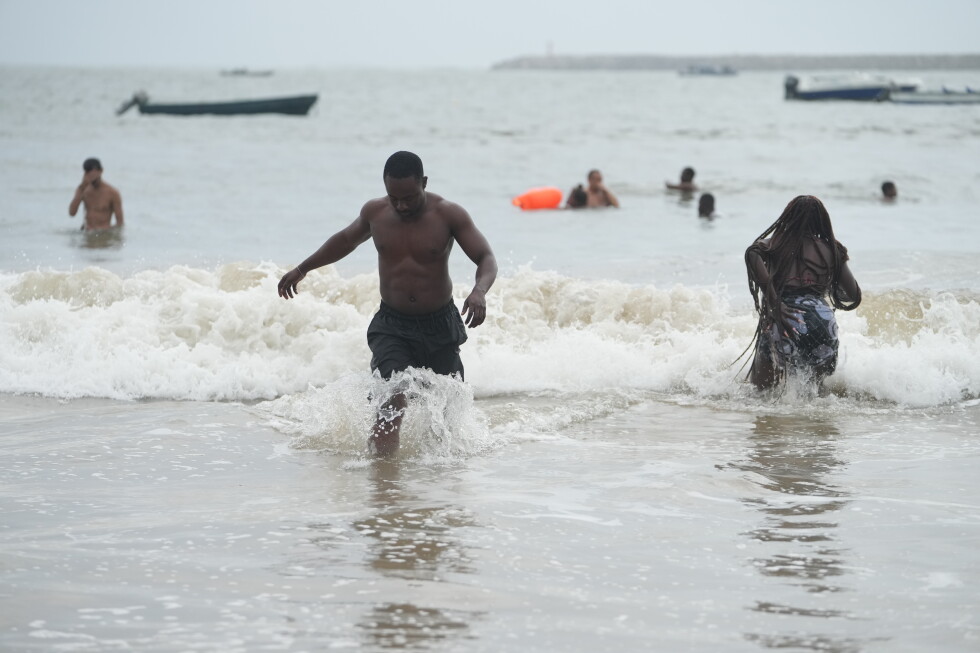
A beach break in Nigeria’s Lagos is becoming too expensive for many
For millions of residents across Nigeria’s bustling commercial capital Lagos, the Atlantic shoreline has long served as one of the only accessible escapes from the city’s relentless chaos, sweltering equatorial heat and year-round 80% average humidity. But a sweeping government-backed push to privatize most of the region’s 180-kilometer coastline has transformed this once-free public amenity into a luxury out of reach for low- and middle-income communities.
Mukthar Oladunmade, a 27-year-old writer who has made weekend beach trips a lifelong ritual, says the transformation has turned a beloved pastime into an unaffordable burden in Lagos alone. Even after traveling across West Africa for work and enjoying low-cost or free beach access in Accra, Cotonou and Dakar, Oladunmade told reporters he spends an average of 25,000 naira ($18) every time he visits a Lagos beach — a sum that far outstrips the budget of most local residents.
Takwa Bay, one of the last remaining stretches of shoreline not under private control, is where Oladunmade now travels to enjoy the ocean. For context, Nigeria’s federal minimum wage sits at just 77,000 naira ($56) per month, and more than 60% of Lagos’ 20 million residents work in the informal sector with irregular, low incomes. Entry fees alone now range from 2,000 naira ($1.50) to 60,000 naira ($44) across privatized beaches, with additional costs for seating, food, drinks and recreational activities adding hundreds of additional naira to each visit.
The privatization trend comes as part of the Lagos state government’s long-running “megacity” initiative, which aims to position the metropolis as a leading global destination for international business and luxury tourism. The strategy has delivered clear financial gains: the state’s internal revenue hit 2.6 trillion naira ($1.9 billion) in 2025, marking a 16% year-over-year increase that outpaces every other Nigerian state. To expand the initiative, the government has also reclaimed coastal land for exclusive private developments including a new deep-sea port and the high-end Eko Atlantic residential neighborhood, with more luxury projects planned for the coming years.
But critics argue these economic gains are coming at the steep cost of inclusive public access, pricing out generations of residents who have relied on beaches as their primary source of affordable recreation. “The approach of the Lagos state government for a long time has not been about the people, it is about the money,” explained Olamide Udoma-Ejorh, director of the Lagos Urban Development Initiative, a nonprofit focused on building an equitable, inclusive city. “It is about how do we build this city in a way that is making money?”
Private operators defend the higher price points, noting that large upfront investments in beach infrastructure mean businesses only turn a profit for part of the year, requiring higher markup on entry, food and amenities. In past statements, Lagos government officials have also argued that privatization has delivered tangible improvements, leaving beaches cleaner and safer for visitors. Officials did not respond to requests for comment for this report.
For ordinary residents, the monetization of Lagos’ beaches reflects a broader trend of displacing working-class communities to make room for elite development, even as the city’s daily hustle and chronic stress makes access to open public space more critical than ever. “I should have access to nature for free. This is a reflection of how everything is monetized,” said Esther Sorkpor, a final-year student at the University of Lagos. “Nigeria is already a very high-tension country, and it is just very stressful to navigate.”
Analysts and urban justice advocates are calling for a full review of Lagos’ public space management policies, arguing that coastal shorelines should be treated as a core civic asset rather than a revenue-generating commodity. As the sun sets over Takwa Bay, the last holdout of free public beach access, visitors pack their belongings to leave, passing the private luxury shores of Eko Atlantic on their trip back to the mainland — a visible reminder of the city’s growing divide between its megacity ambitions and the needs of its ordinary residents.
-

Orthodox monks are the first to live and pray at a monastery in Estonia for 80 years
Nestled 40 kilometers outside Estonia’s capital Tallinn, a converted farmhouse holds a quiet, historic milestone for one of Europe’s most secular societies: the launch of the first male Orthodox monastery launched by the Estonian Apostolic Orthodox Church in decades. Known as Kirikla Orthodox Monastery, the community marks the return of male Orthodox monastic life to Estonia after more than 80 years, a gap that stretches back to the interwar independence period before Soviet occupation.
Inside the small, curtain-partitioned chapel, ancient words of the Divine Liturgy now ring out in the Estonian language, led by 41-year-old Bishop Damaskinos, the monastery’s founding abbot, who wears traditional flowing white and gold vestments during services. Damaskinos and 31-year-old Father Paisios are the community’s first two permanent monks, splitting their days between structured prayer, manual labor, and spiritual practice in line with traditions first honed at Greece’s Mount Athos, the 1,000-year-old global center of Orthodox monasticism.
The founding of Kirikla comes amid a longstanding split in Estonian Orthodox Christianity, dating back to the collapse of the Soviet Union. The larger of the country’s two Orthodox jurisdictions remains affiliated with the Moscow Patriarchate, while the independent Estonian Apostolic Orthodox Church has worked for decades to rebuild its own monastic institutions after Soviet authorities closed most religious communities and stigmatized faith across the Baltic region. Today, the Estonian Apostolic Orthodox Church oversees more than 60 parishes and one women’s convent across the country, but has not hosted a community of male monks since before World War II.
For Damaskinos, the monastery’s purpose extends far beyond Estonia’s borders. “The monastery’s meaning is also global in the sense that we pray for the whole world,” he explained during an interview with the Associated Press at the chapel in July 2026. The abbot emphasizes that spiritual quality of community members matters far more than raw numbers; even as only two monks currently reside at Kirikla, his focus remains on nurturing faithful commitment rather than rapid growth. “What we are worried about is the spiritual quality of the monks, that the monks actually take seriously their task of praying for the whole world,” he said.
The monastery’s daily routine follows a steady, intentional rhythm that sets it apart from the fast-paced, digitally connected world outside. Days begin at dawn with solitary prayer, followed by a communal morning service, then hours of manual labor ranging from weeding garden beds and tending potato crops to small construction work. A second evening service wraps up the day, leaving only brief evening time for rest, with almost no access to cellphones or the distractions of modern life. Despite the demanding schedule, both monks report deep fulfillment: shielded from widespread external stress, they feel rested and grounded in their routine.
This deliberate, purpose-driven way of life has struck a chord with young Estonian visitors and summer volunteers, who join the monks in their agricultural work. Religious scholars note that this growing interest in faith among young Estonians is a generational shift. Raised decades after the end of Soviet anti-religious campaigns, young Estonians carry none of the inherited prejudice against organized religion that shaped older generations. “They don’t have any bad experience with religion, they don’t have any experience with religion at all,” explained Priit Rohtmets, an associate professor of church history at the University of Tartu. “This, of course, gives a chance for religious communities.”
Unlike married Orthodox parish priests, monastic vows require lifelong celibacy, poverty, and obedience; anyone seeking to join the community must first spend up to three years as a novice living the monastic routine before taking permanent vows. While other faiths already have small monastic communities in Estonia — including a Dominican Catholic community that returned to Tallinn in 1996 and a Theravada Buddhist monastery on Aegna Island — new monastic foundations are rare across 21st-century Europe, where many existing communities are shrinking and closing as fewer people take vows. That makes Kirikla’s launch a particularly hopeful development for religious observers and faithful alike.
The monastery currently operates out of the donated farmhouse, gifted to the community by a local Estonian businessman, with no additional permanent buildings completed. Damaskinos says that while the community may eventually earn income by selling homegrown produce and handcrafted religious goods such as candles and incense, his top priority is not construction or expansion. “What interests me more, rather than finishing the buildings, is to finish building the brotherhood,” he said. “It’s a work that never finishes, but at least it creates a good basis for monastic continuation here in Estonia.”
On selected days, the community opens its gates to visitors and pilgrims, promoting open days through social media to invite people seeking a break from the chaos of modern daily life to experience their routine. “Monastic life is difficult, but through all these difficulties we find true happiness,” Damaskinos said. “So I hope that when people come here they see the happiness that we represent.”
-

One month after earthquakes, Venezuelans still search for loved ones and answers
Thirty days have passed since powerful twin earthquakes tore through Venezuela’s northern coastline, and for countless grieving families, the agonizing search for the remains of missing loved ones continues, unfolding against a backdrop of unprocessed grief, mounting anger at official authorities, and deep uncertainty over the long road to recovery.
For 49-year-old fisherman Victor Calderón, the tragedy struck while he was 18 days out at sea. When word arrived via radio that his family’s apartment building had collapsed, he rushed back to shore only to learn that 26 members of his extended family—ranging in age from a 2-year-old toddler to elders in their late 70s, including his sisters, stepfather, and nine cousins—were gone. “It’s a terrible, terrible thing,” he says, his voice tight with unwept emotion. “I haven’t cried for them yet, not until I find the last ones who are missing.” Today, Calderón and his two surviving family members live in a cramped tent on a local golf course, in what was Caraballeda’s OPPE 26 public housing complex, widely recognized as the epicenter of the disaster.
Calderón’s story is far from unique. Official government data, updated daily, puts the confirmed death toll at more than 5,300, with over 16,500 people injured. While authorities have not released an official count of those still unaccounted for, independent estimates place the number of missing in the tens of thousands. As daylight faded at the OPPE 26 site recently, recovery teams pulled three more bodies from the twisted rebar and crumbled concrete, including that of an 11-year-old girl. As her small body was carefully wrapped in black sheeting, rescue workers paused their work to offer a silent prayer, while the father’s guttural howls of grief cut through the rumble of nearby earthmoving equipment. “This is soul-destroying,” said Magin Hernández, a member of a volunteer search team, wiping quiet tears. “For the rescuers, the families, the friends; just soul destroying.”
Weeks after the disaster, nearly all of the international rescue teams that deployed to assist have departed, leaving families to sift through unstable rubble on their own. This abandonment has fueled widespread, palpable resentment toward the national government, with survivors questioning how 10 out of 12 residential buildings at the OPPE 26 complex completely collapsed. Many are demanding answers about whether flawed construction designs, cost-cutting shortcuts, or substandard building materials contributed to the disaster, and whether official negligence played a role.
During a press tour of the affected area, Public Works Minister Juan José Ramírez pushed back against these claims, insisting the buildings were structurally sound. He argued that no country could have withstood the force of two nearly simultaneous earthquakes, moving in opposing directions, that leveled both public and private structures alike. “The earthquake didn’t discriminate between the two,” he said.
A short distance away in the coastal town of Catia La Mar, Laura Barrios continues to dig through the remains of a collapsed private apartment building, searching for the body of her brother-in-law, still trapped in the building’s underground parking garage. It was in that same garage that security guard Hernán Gil was pulled alive eight days after the quakes, a rare miracle that briefly lifted the nation’s collective mood. But the international teams that assisted in that dramatic rescue have long since left, and even the heavy machinery assigned to clear unstable debris has been reassigned to another site—just one day after Barrios’ family recovered the bodies of her sister-in-law and the couple’s two young children, 10 and 3, found huddled together in their bedroom. “The other day was the Day of the Child in Venezuela,” Barrios said through sobs. “But we have no children to celebrate. Ours are gone.” Furious over the slow, inadequate government response, she says the removal of the heavy equipment she still desperately needs has drained her will to keep fighting. “What more can we say that this rubble doesn’t already tell us?” she asked, gesturing to the scattered remains of lives destroyed in just 39 seconds of shaking: lost children’s toys, unused cutlery, broken crockery, abandoned T-shirts, entire lifetimes erased.
Amid the grief and anger, small acts of human solidarity persist. At meal queues run by US-based humanitarian group World Central Kitchen, survivors still share quiet jokes and warm hugs, holding onto their characteristic resilience in the face of unthinkable loss. But for most, the end of each day brings a return to flimsy nylon tents pitched along curbsides, their temporary homes for the foreseeable future. The acting government led by Delcy Rodríguez—who took office in January following the removal of former leader Nicolás Maduro by US forces—recently donated 200 temporary homes to displaced families, but aid groups estimate total need is more than 100 times that number.
The scale of reconstruction is staggering: the World Bank estimates the twin quakes caused $19.6 billion in damage, a cost Venezuela is ill-equipped to cover. With US authorities currently controlling the country’s oil industry, its primary source of national revenue, the timeline and scope of long-term recovery remain deeply unclear. Thousands of families still wait for closure, their stories of loss adding up to a national trauma that has left an indelible scar on a country already grappling with political and economic upheaval.
-
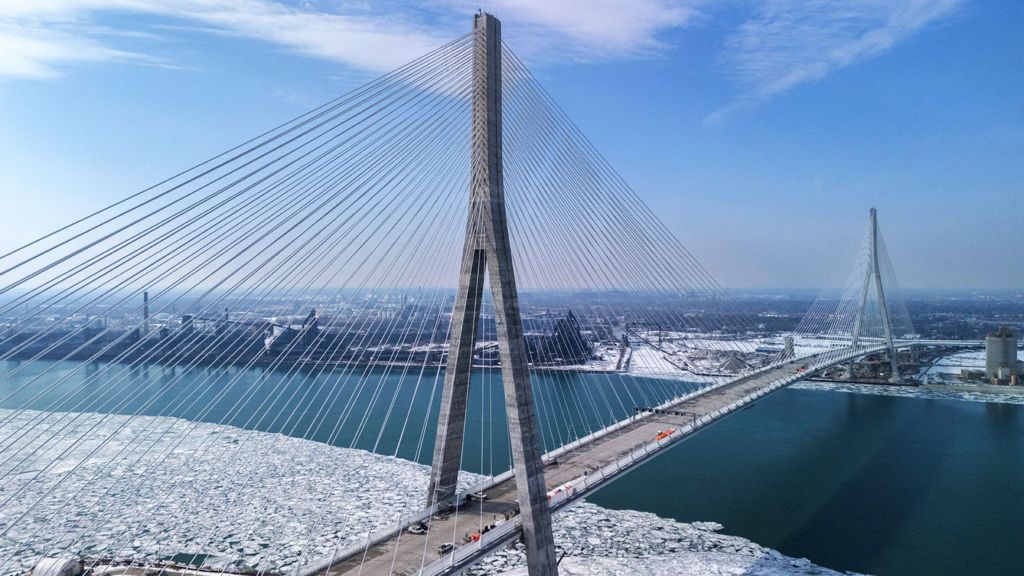
How a new $4.5bn bridge became a symbol of a strained US-Canada relationship
After eight years of construction and multiple unplanned delays, the Gordie Howe International Bridge – a C$6.4bn cross-border infrastructure project connecting the North American automotive hubs of Detroit, Michigan and Windsor, Ontario – was meant to stand as a powerful symbol of unity between long-time allies Canada and the United States. Named for the legendary Canadian ice hockey star who spent most of his Hall of Fame career with the Detroit Red Wings, the bridge was set to host a joint inauguration ceremony this week attended by senior dignitaries from both nations. Instead, Canadian organizers have disinvited their American counterparts and will proceed with a solo national celebration on Friday, a dramatic shift triggered by former President Donald Trump’s latest threat to impose new tariffs on Canadian goods.
The split inauguration is far more than a last-minute scheduling change: it lays bare the increasingly fraught trade relationship between the two neighboring countries, and amplifies mounting domestic political pressure on Canadian Prime Minister Mark Carney to navigate the ongoing standoff.
The project’s origins stretch back almost 15 years, when Canada agreed to cover the full cost of construction to cut through American political gridlock and move forward with the critical trade artery, which was designed to alleviate dangerous bottlenecks at the existing Windsor-Detroit crossing. Every day, more than C$1bn in goods moves through this border corridor, making the new bridge a high-stakes asset for manufacturers and businesses on both sides of the border. When Canada took on the construction cost, the original agreement stipulated that the bridge would be jointly owned by the Canadian federal government and the state of Michigan, with Michigan gaining access to a share of toll revenues only after Canada recouped its full construction costs.
That original framework started to unravel early this year, just weeks before a planned ribbon-cutting, when Trump announced he would block the bridge’s opening unless Canada agreed to cede shared authority and ownership to the US. “We should own, perhaps, at least one half of this asset,” Trump stated at the time. According to a New York Times report, the demand came just hours after billionaire Matthew Moroun – head of the Moroun family that owns the adjacent Ambassador Bridge, North America’s busiest privately owned commercial border crossing, and a top Trump donor – held a closed-door meeting with US Commerce Secretary Howard Lutnick.
By June, Carney had agreed to a US request to delay the bridge’s opening to allow for additional negotiations. In a move that has sparked fierce domestic backlash, Ottawa agreed to split half of all bridge revenues for the next 15 years with an economic development fund controlled exclusively by the US government, a concession designed to unlock the project’s opening. Trump quickly celebrated the deal on social media, calling it “MUCH BETTER” for the United States.
The latest rift over the inauguration comes as broader trade tensions between the two nations continue to escalate. During his election campaign, Carney vowed to tackle US trade disputes with an “elbows up” approach, a nod to the tough, physical playing style that made Gordie Howe a legend. But today, the prime minister faces growing criticism from political opponents who argue he has conceded too much to a US administration that a large share of Canadians view as acting in bad faith toward their country.
Colin Robertson, a former Canadian diplomat and senior fellow at the Canadian Global Affairs Institute, told the BBC that working with the current US administration is unlike any previous experience for Canadian negotiators. “They renege on deals. They don’t follow agreements. It’s like dealing with pirates,” Robertson said.
Beyond the bridge revenue dispute, the Carney government has already made a series of concessions the prime minister’s critics label as unnecessary, including dropping a planned digital services tax opposed by large US tech firms and rolling back some retaliatory tariffs imposed in response to earlier US trade measures. Conservative Member of Parliament Shuvaloy Majumdar argues the entire ordeal proves Canada has negotiated from a position of weakness as it pursues a broader comprehensive trade deal with the Trump administration. “Canadians are sick and tired of being made into a punching bag by President Trump and have the self-respect to fight for their existence and their country,” Majumdar said at a recent press conference. “They deserve a government that is willing to do the same thing.”
Carney has also faced scrutiny over a lack of public transparency around the terms of the new bridge deal, particularly around how revenue sharing will be structured. During a press availability Thursday, he clarified that the original agreement with the state of Michigan to recoup construction costs remains in place, and the new US-focused revenue sharing arrangement runs “in parallel” to that original framework.
Not all Canadian political leaders have criticized the deal. Ontario Premier Doug Ford praised Carney for “an excellent job of getting this deal done,” though he has also called Trump a “bully” and urged Ottawa to use Canada’s energy and critical mineral exports as leverage in ongoing trade talks. Robertson acknowledges that the revenue agreement is a clear concession, but argues it was a necessary compromise to protect cross-border commerce. “This new state-of-the-art bridge was done at a great expense, and yes we paid, but it is necessary to keep supply chains intact,” he said, noting that business communities on both sides of the border have pushed for years to get the bridge open.
The split over how to approach US trade talks has already exposed deep cracks in Canada’s provincial consensus: while Ford pushes for a harder line, Alberta Premier Danielle Smith and Saskatchewan Premier Scott Moe have called for restraint. For Carney, the path forward remains uncertain. Robertson notes that while Gordie Howe played with “elbows up”, his ultimate goal was always to put the puck in the net – a metaphor for getting the critical infrastructure open. Even so, Robertson added, Canada has already reached the limit of what it should concede. “Any further concessions would be problematic and probably not in our interest, given the behaviour of the Trump administration up to now,” he said.
-

Major thing 4.8 million Aussies must do after Origin Energy hack
One of Australia’s largest utility providers, Origin Energy, has confirmed a major cybersecurity incident that has put the personal information of millions of its customers at risk, prompting urgent warnings for heightened scam awareness across the country. The unfolding breach, which was first flagged to the public last Wednesday, took a serious turn on Thursday when company executives confirmed that unauthorized actors had successfully accessed internal systems and stolen sensitive customer data.
Initial media reports from *The Australian*, citing correspondence with the alleged perpetrator, claimed that roughly two million customer accounts had been compromised. To date, Origin Energy has not issued a confirmed number of affected accounts, out of its total 4.8 million residential and commercial customer base. According to the company’s official disclosure, the compromised data can include full names, residential addresses, dates of birth, contact telephone numbers, detailed account information, partial credit card numbers (only the final four digits), and partial bank account details (only the final three digits). Company officials have stressed that the incomplete financial information stolen cannot be used directly to make unauthorized purchases or access customer bank accounts, but that does not eliminate the long-term risk posed by the breach.
Cybersecurity experts warn that the stolen data creates a perfect breeding ground for sophisticated targeted scams. Tyler McGee, head of Asia-Pacific operations for global cybersecurity firm McAfee, who himself received a breach warning from Origin, noted that scammers routinely leverage high-profile data breaches to exploit consumer trust. “Until there is full clarity around the scope of the breach, it is impossible to know exactly how exposed impacted consumers are, but the core fact remains: any stolen personal information allows scammers to craft more convincing targeted scams, either for their own use or to sell on to other criminal actors,” McGee explained. Stolen personal details let scammers create messages that reference specific personal information, making fraudulent communications appear legitimate, as if they came from Origin or another trusted business the customer interacts with regularly. For criminal groups, McGee added, this is a numbers game: even if only a tiny fraction of targets fall for the scam, the operation turns a profit.
New details that emerged on Friday paint a clearer picture of the alleged perpetrator. *The Australian* reported that the hacker, who uses the online alias Edison Walhour, claims to be an Australian former Origin employee. The individual reportedly used a valid former employee login to access Origin’s customer management system, which is provided by third-party vendor Kraken. In a surprising development, the hacker has reportedly backed away from their initial threat to auction the full stolen dataset on public dark web marketplaces. It remains unclear what prompted this change of plans.
In response to the incident, McGee has outlined clear steps Origin customers can take to protect themselves from subsequent scams. First, he advised all potentially impacted customers to update their online account passwords immediately and enable two-factor authentication wherever possible to block unauthorized access. Second, customers should exercise extreme caution around any unsolicited emails, text messages, or phone calls that ask them to click links, share personal information, or make payments. “Consumers need to maintain a heightened state of awareness for the foreseeable future, and anyone looking for extra protection should consider investing in commercial scam protection tools,” McGee added. He also noted that once personal data is leaked by criminals, it remains in circulation permanently, creating ongoing risk for affected individuals.
McGee also pointed out that Australian companies are disproportionately targeted by hackers for two key structural reasons. Historically, Australian corporations have been more willing to pay large ransom demands to end breaches quickly, making them attractive targets. Additionally, Australian law enforcement has far limited capacity to pursue hackers based outside of the country, unlike jurisdictions such as the United States, which routinely works with international partners to extradite cybercriminals for prosecution.
Origin Energy chief executive Frank Calabria has issued a formal apology to customers affected by the incident. “I am sorry this has happened. Customers trust Origin with their personal information, and I apologize for the stress and impact this may cause,” Calabria said. The company is currently working alongside independent cybersecurity experts and law enforcement authorities to investigate the breach, secure its systems, and mitigate further risk to customers.
As the investigation continues, authorities and cybersecurity professionals are urging all 4.8 million Origin customers to remain alert to scam activity in the coming months, regardless of whether they have been formally notified that their data was compromised.
-

US imposes new tariffs on 60 partners as Trump rebuilds trade agenda
A fresh round of United States tariffs targeting 60 global trading partners entered into force on Friday, marking the Trump administration’s latest step to rebuild the sweeping import duty regime that was upended by a Supreme Court ruling earlier this year. This new measure replaces the temporary 10-percent tariff that expired the same day, after lasting just 150 days. The levies are set at two tiers, ranging from 10 percent to 12.5 percent, and impact most major global economies including China, India, and the European Union, covering the vast majority of U.S. trade volume.
U.S. Trade Representative Jamieson Greer defended the new tariffs, framing them as a push for global adoption of forced labor import bans. “The United States has had a forced labor import ban for nearly a century, and rigorously enforces it; it’s well past time for our trading partners to do the same,” Greer stated. The tiered structure is designed to reward trading partners that have already adopted or committed to enforce similar forced labor prohibitions: those economies, including Canada, the European Union, India, and the United Kingdom, face the lower 10-percent rate, while China, Japan, South Korea and more than 30 other nations are assigned the higher 12.5 percent levy. A small group of economies including the EU, Taiwan, Japan, South Korea, and Switzerland receive partial exemptions under existing bilateral trade agreements with the U.S.
The new tariffs were first proposed in June, developed after months of targeted investigation, and crafted specifically to withstand potential legal challenges. This careful legal structuring comes in direct response to a February Supreme Court ruling that struck down a large portion of Trump’s earlier tariff regime, stripping the White House of its ability to impose steep duties unchecked. Several categories of imports are carved out of the new measures: goods already subject to sector-specific tariffs such as steel and aluminum are not affected, along with certain energy products, fertilizers, and all goods covered by the U.S.-Mexico-Canada Agreement (USMCA).
The announcement drew immediate pushback from affected economies. Japan issued a formal statement saying it “regrets” the new duties, while Australia’s trade minister labeled the measures “unjustified.”
Beyond this broad tariff rollout, the Trump administration is currently conducting separate investigations into excess industrial capacity in 16 other economies, which could lead to additional targeted duties down the line. Trade experts note the structure of the new regime creates strategic leverage for Washington. By imposing a baseline tariff while keeping the threat of further increases on the table, the White House incentivizes trading partners to comply with existing trade commitments, according to Greta Peisch, a trade lawyer and former general counsel for the Office of the U.S. Trade Representative, now a partner at Wiley Rein. Peisch added that the months-long investigation process was intentional, designed to create a legally robust tariff regime that can survive court challenges.
This legal robustness makes it far more likely the tariffs will remain in place for the rest of Trump’s term, signaling a permanent shift toward a more protectionist stance from the world’s largest economy, explained Josh Lipsky, senior analyst at the Atlantic Council. Lipsky also noted that the new tariffs will deliver an added benefit to the federal government by boosting overall revenue.
Former U.S. trade official Ryan Majerus, now a partner at King & Spalding, noted that the Trump administration has actively been searching for legal frameworks that allow it to aggressively deploy tariffs. The current duties are authorized under Section 301 of the Trade Act of 1974, which Majerus said offers far more flexibility for adjusting rates and terms than many observers recognize, allowing officials to modify the measures as geopolitical and trade conditions shift.
The latest broad tariff salvo comes on the heels of two other recent protectionist moves from the Trump administration: just weeks ago, a 25-percent tariff on a range of Brazilian goods went into effect, following accusations of unfair trade practices from Washington. This week, Trump also ordered a new 50-percent tariff on a wide swathe of Canadian products, citing Ottawa’s “discriminatory treatment” of U.S. alcohol, automobile, and dairy products. That Canadian tariff, set to take effect in one month, relies on an untested legal provision, demonstrating that the White House holds additional tools to quickly impose new trade measures if it chooses. Lipsky said this flurry of activity signals that existing U.S. trade agreements remain “fragile” in the current policy environment. Despite the uncertainty, the European Union — which has a existing trade pact with Washington — reaffirmed its expectation that the U.S. will honor the commitments laid out in the EU-U.S. Joint Statement.
-

British Open winner Ryan Fox arrives back in New Zealand, hankering for sleep and a pie
After a whirlwind global victory lap that carried him across continents with golf’s most iconic prize, the Claret Jug, newly crowned British Open champion Ryan Fox touched down on home soil in New Zealand on Friday, already craving two simple post-triumph pleasures: a deep, uninterrupted sleep and one of his favorite local gourmet pies.
The 39-year-old golfer was greeted with a warm family welcome at Auckland Airport, where his father Grant Fox — a former All Blacks rugby legend — pulled him into an embrace alongside Fox’s wife Anneke and their two children. Fox secured his first-ever major championship victory last Sunday at Royal Birkdale, clinching the title with a birdie on the tournament’s final 18th hole.
“It’s good to be back,” Fox told reporters shortly after clearing customs.
Just hours after his arrival, members of the press tracked the new champion down at his neighborhood bakery, where he was already digging into his go-to order: a loaded steak, bacon, jam and cheese pie. In the coming weeks, Fox says he plans to share his historic trophy with fans across the country, fit in a few fishing trips, and squeeze in a casual round of golf with old friends — but not before he catches up on much-needed rest. Since claiming the Claret Jug, his schedule has been packed with nonstop travel, media interviews and victory events, leaving little time for sleep.
“I had a glass of wine, took a couple of sleeping pills and had more sleep last night than I’ve had the last four nights. It’s nice,” Fox shared. “I’m sure jetlag’s going to get me and I feel like I’m going to be pulled in every direction possible over the next 10 days or so we’re home. It’s definitely nice to be home.”
Fox says he has already packed his golf clubs for casual outings with friends, though uncooperative weather may put a temporary hold on his plans. “We’ll see how it goes over the next couple of days. I’d like to catch up and play with some mates. I’ve had a look at the forecast and it doesn’t look real good over the next little while. I don’t want to play golf in the rain if I have to. But I’d like to get out on the course,” he explained.
The champion also expressed deep gratitude for the outpouring of support he has received from New Zealanders and golf fans around the world since his historic win. “The support’s been unbelievable, to be honest; I can’t thank people enough,” he said.
Fox also shared a piece of valuable advice he received from two-time PGA Championship winner Justin Thomas, who reached out to congratulate him after the victory. Thomas told Fox to hold onto every small memory of his first major win, as those moments will become meaningful touchstones down the line. Fox noted that perspective from a seasoned champion who has experienced both the high of major victory and the challenges of career slumps means a great deal.
“Having someone who has gone through that — winning a major, accomplishing some dreams and then going through some down times as well,” Fox added. “I can imagine being able to draw on that is really important and a good nugget of advice.”
-

Sheikh Hasina ally to step down as Bangladesh’s president
Bangladesh is facing a new wave of political upheaval as President Mohammed Shahabuddin, one of the last remaining allies of ousted former Prime Minister Sheikh Hasina, prepares to step down from his post. The impending resignation comes amid growing speculation that Hasina, who was sentenced to death in absentia last year, will soon return to the country from her exile in India.
Shahabuddin’s exit from office follows mounting pressure from leaders of the current ruling Bangladesh Nationalist Party (BNP), multiple anonymous sources confirmed to BBC Bangla. The 59-year-old president, who only took office in 2023 with a term scheduled to run through 2028, is expected to formally tender his resignation to Parliament Speaker Hafiz Uddin Ahmad on Friday. Ahmad, who has been receiving medical treatment in Thailand, has cut his trip short to return to Dhaka to receive the resignation, according to insider reports. Sources also indicate Shahabuddin is likely to cite health issues as the official reason for his departure, though political observers widely attribute the move to shifting power dynamics in the country.
The trigger for Shahabuddin’s sudden decision traces back to recent comments from Hasina herself, who told Reuters earlier this month that she planned to return to Bangladesh to face the death sentence handed down against her by the country’s International Crimes Tribunal. Last year, widespread student-led protests against Hasina’s government erupted across Bangladesh, leaving more than 1,400 protesters dead after security forces used lethal force to suppress the unrest. The chaos ultimately forced Hasina to flee the country for neighboring India, and the tribunal later found her guilty of authorizing the crackdown, sentencing her to death in absentia.
In the months after Hasina’s ousting, an interim government led by Nobel Peace Prize laureate Muhammad Yunus took power, and her long-ruling Awami League was banned from political activity. Hundreds of the party’s leaders have been arrested, and Hasina has repeatedly condemned what she calls widespread repression of her supporters. “My party leaders and workers are being subjected to tremendous repression,” she told Reuters in her recent interview. “If death comes, I want it to come on my own soil, where my parents are buried and where their blood was shed.”
Shahabuddin was the only senior ally of Hasina who retained his position in government after the collapse of her administration. For months, he continued carrying out his ceremonial presidential duties under the new interim administration, but he made no secret of his discomfort in the role. In an interview with Reuters last December, he revealed he had felt “humiliated” after the interim government ordered his portraits removed from Bangladeshi embassies and consulates around the world. At the time, he said he would stay in office until general elections were held and allow the new elected government to determine his future.
That election came in February, when the BNP secured a landslide victory that cemented its hold on national power. Even after the election, Shahabuddin remained in the presidency, but pressure for his resignation grew steadily as Hasina’s comments about returning home reignited tensions across the country.
Current Home Minister Salahuddin Ahmed struck a measured tone when questioned by reporters on Thursday, noting that the government had not issued any formal demand for Shahabuddin to step down. He added that the Bangladeshi constitution explicitly grants the president the right to resign if he chooses to do so, confirming that the process would follow constitutional protocol.
Under Bangladeshi law, if Shahabuddin follows through with his resignation, a new presidential election must be held within 90 days to fill the vacant post. Political analysts say the resignation clears the way for the BNP-led government to appoint a new head of state aligned with its policy priorities, as the country continues to navigate its post-Hasina political transition amid ongoing uncertainty over the ousted leader’s planned return.