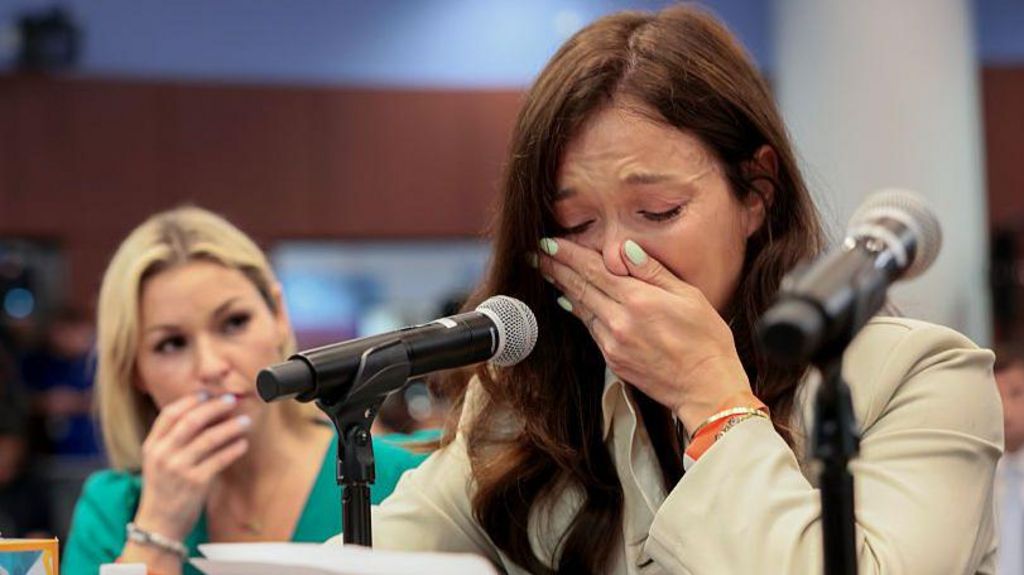
More than 15 years after Jeffrey Epstein’s first controversial conviction, one of his survivors has opened up publicly for the first time about the repeated sexual abuse she endured at the hands of the disgraced financier — even while he was serving a sentence under court-supervised house arrest. The testimony, delivered at an unofficial field hearing organized by Democratic members of the U.S. House Oversight Committee in West Palm Beach, Florida, has reignited scrutiny of systemic failures that allowed Epstein to evade full accountability for decades and put new focus on the Trump administration’s handling of the now-infamous Epstein case files.
The survivor, identified publicly only by her first name Roza, was one of multiple victims to share their accounts at the hearing. A teenager from Uzbekistan, she was recruited in 2008 by Jean-Luc Brunel, a well-connected modeling agent and long-time close associate of Epstein, who lured her with promises of a lucrative, high-profile modeling career. Coming from a low-income, financially unstable background, Roza told the tearful session she was an easy target for the trafficking network’s coercive tactics. By mid-2009, she had secured a travel visa and relocated to New York, with Brunel making the formal introduction to Epstein at his West Palm Beach estate that July — just months after Epstein’s 2008 conviction for soliciting prostitution from a minor, when he was permitted to serve most of his sentence in home confinement, with leaves of up to 16 hours per day for work at his private foundation.
It was not long before the abuse began, Roza testified. She was first called into Epstein’s private room by his masseuse, where she was sexually assaulted, and the abuse escalated into repeated rape over the course of three years. Epstein offered her a position at his Florida Science Foundation as a cover for the exploitation, framing the opportunity as a way to ease her ongoing financial struggles.
Democratic Representative Robert Garcia, who led the organization of the unofficial hearing, noted that the location was intentionally chosen: West Palm Beach is where Epstein’s pattern of criminal abuse first came to the attention of authorities decades ago, and the venue sits just a short distance from former President Donald Trump’s Mar-a-Lago resort. The Republican-controlled House Oversight Committee is already conducting a formal probe into Epstein’s coordinated sex trafficking ring, but Democratic members launched their own parallel hearing to keep public attention focused on the case, particularly over how the Trump administration managed the release of Epstein court documents. While the unofficial hearing carries no binding legal power, its organizers say it fills a critical gap for survivors who have long been denied a public platform to share their experiences.
In a newly released report published ahead of the hearing, Democratic committee members laid out how the controversial 2008 plea deal negotiated by Epstein’s legal team allowed the financier to continue his abuse and trafficking operations for nearly an additional 11 years. The deal, which reduced the severity of charges against Epstein and granted immunity to many of his co-conspirators, has been widely criticized by survivors and activists as a prime example of how wealth and connections can distort the U.S. justice system.
For Roza, the failures of the system did not end when Epstein died by suicide in a New York prison cell in August 2019, while he awaited trial on federal sex trafficking charges. She told lawmakers that she was retraumatized earlier this year when the U.S. Department of Justice accidentally released her full name in publicly posted Epstein court files, while the identities of many powerful connected associates of Epstein remained redacted and protected from public view. “Now reporters from across the globe contact me. I cannot live without looking over my shoulder. I can only imagine the long term impact this ‘mistake’ will have on my life,” Roza told the hearing. She added that the abuse she suffered while Epstein was already in court supervision “made justice feel impossible,” though she eventually found the strength to come forward to seek support.
The DOJ has previously acknowledged the error, stating that the agency “takes victim protection very seriously” and that the flawed redactions were the result of “technical or human error.” Officials quickly pulled the problematic documents from public view after multiple survivors reported that their identities had been compromised by the mistake.
Another prominent survivor, Maria Farmer, who first reported Epstein’s abuse to law enforcement all the way back in 1996, also contributed testimony via pre-recorded video. Farmer accused federal and local law enforcement agencies of repeatedly dropping investigations into Epstein over decades, turning a blind eye to his crimes because of his wealth and connections. “The government needs to start telling the truth,” she told the hearing.
The hearing comes amid ongoing pressure on congressional investigators to fully disclose all records related to the Epstein case, answer lingering questions about why systemic failures allowed his abuse to continue for so long, and deliver long-delayed accountability to the hundreds of survivors who have come forward in the years since his death.