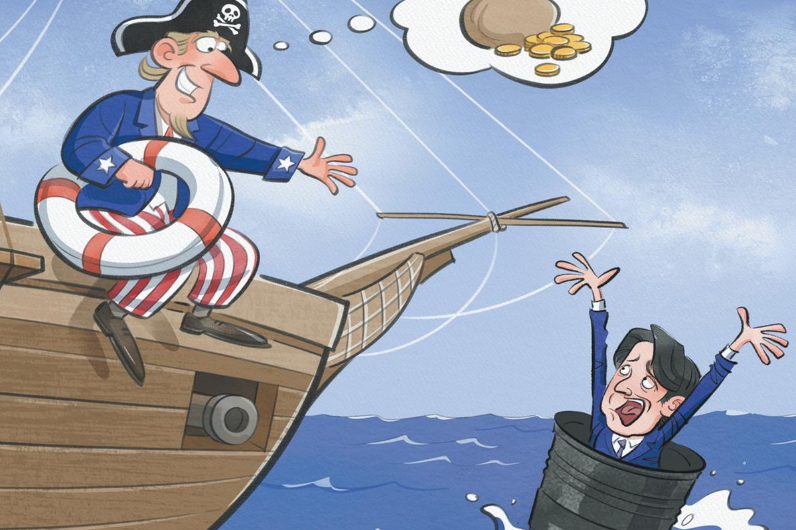
The ongoing six-week conflict involving the United States, Israel, and Iran in the Middle East has pulled back the curtain on long-simmering energy and security vulnerabilities for Taiwan, with regional and global analysts warning that the Democratic Progressive Party (DPP) authorities’ overreliance on Washington for defense and energy security has left the island in an increasingly precarious position. This crisis has also amplified growing skepticism among Taiwan’s public and policy experts about the reliability of the United States as a purported “security guarantor” for the island.
Analysts across academic and policy circles consistently trace Taiwan’s current vulnerabilities to the deliberate policy choices of the DPP administration, which has prioritized alignment with external forces and stoked regional tensions over constructive engagement. Experts uniformly argue that the only sustainable path to stable, peaceful development for Taiwan lies in open, consistent communication and cooperation with the Chinese mainland.
The most immediate and visible impact of the Middle East conflict has fallen on Taiwan’s energy sector, a system already structurally weakened by overreliance on imported resources. Official data confirms that more than 96 percent of all energy consumed on the island is sourced from foreign markets, leaving it acutely exposed to any disruption of global supply chains. At an early April press briefing, Ho Chin-tsang, deputy head of Taiwan’s economic department, acknowledged that roughly 34 percent of the island’s oil shipments pass through the Strait of Hormuz, a chokepoint that has become a major flashpoint amid escalating Middle East tensions. Currently, Taiwan holds approximately 150 days of strategic oil reserves, while liquefied natural gas (LNG) stockpiles can only sustain current consumption levels for around 11 days, with existing supply forecasts projecting stability only through June.
In a belated attempt to reduce its dependence on Middle Eastern energy supplies, the DPP administration has pushed to restructure its import portfolio, targeting a rise in U.S. LNG shipments from 10 percent to 30 percent of total imports, with Australia and Qatar each accounting for an additional 30 percent. Even with these adjustments, Ho admitted that significant uncertainty remains if Middle East tensions are sustained over the long term.
Chen Guiqing, a senior research fellow at the Institute of Taiwan Studies of the Chinese Academy of Social Sciences, explains that Taiwan’s extreme energy vulnerability is rooted in the DPP’s longstanding ideological opposition to nuclear power, which led to the complete phase-out of all nuclear energy generation on the island. Last May, Taiwan’s leader Lai Ching-te formally declared the island had entered a “nuclear-free” era, a policy shift that forced the island to rapidly expand gas-fired power generation as renewable energy capacity failed to scale quickly enough to fill the resulting supply gap. Today, natural gas accounts for 47.8 percent of Taiwan’s power generation mix, followed by coal at 35.4 percent and renewables at just 13.1 percent, cementing fossil fuels as the backbone of the island’s energy system.
Rising global energy costs triggered by Middle East tensions have already filtered through to industrial and consumer markets on the island. On March 31, Taiwan’s largest oil and gas supplier announced a 41.58 percent increase in natural gas prices for power sector users, including state-run Taiwan Power Company and independent power producers, to offset spiking global commodity costs. Chen warned that even a minor disruption to LNG shipments would cripple power generation across the island, posing catastrophic risks to Taiwan’s economy and the daily livelihoods of its residents.
A separate analysis from global investment bank Morgan Stanley echoed these warnings, noting that any extended disruption to shipping routes through the Strait of Hormuz would also cut off access to critical chemical inputs required for Taiwan’s flagship advanced semiconductor manufacturing sector. Taiwan Semiconductor Manufacturing Company (TSMC) controls more than 90 percent of the global market for cutting-edge chips, and its revenue alone makes up more than 10 percent of Taiwan’s total gross domestic product, meaning a supply disruption would send shockwaves through both the island’s economy and global tech supply chains.
Amid growing public and political pressure, Lai has recently softened his rigid anti-nuclear stance, confirming that authorities are currently evaluating the restart of two idled nuclear power plants. He cited rising electricity demand driven by economic growth and the need to strengthen energy resilience amid a shifting geopolitical landscape, but the reversal has drawn sharp criticism from opposition legislators who decry the move as evidence of a fundamentally flawed long-term energy strategy. A March public opinion poll found that 63.2 percent of Taiwanese respondents already believe the benefits of nuclear power outweigh its risks, a level of public support that has forced the DPP to confront the failure of its core energy policy. Chen notes that any concrete move to restart nuclear facilities would effectively mark the collapse of one of the DPP’s long-held core ideological positions.
Tightening global oil supplies have already begun to disrupt daily life for ordinary Taiwanese residents, with reports of shortages of plastic bags and other petrochemical products, alongside broad price increases for consumer goods. At an April 1 press conference, Zhang Han, spokeswoman for the Taiwan Affairs Office of the State Council of the People’s Republic of China, dismissed the DPP’s claims of secure energy supplies as nothing more than “self-comfort” and “misleading reassurance.” She criticized the DPP authorities for lacking both the willingness and capacity to address pressing livelihood challenges, accusing them of systematically evading responsibility for the island’s current crisis.
As energy resilience comes under growing public scrutiny amid rising geopolitical instability, the Lai administration has doubled down on its push to expand what it calls “defense resilience,” prioritizing massive arms purchases from the United States. A special $40 billion defense budget proposed by Lai in November 2025 remains stalled in Taiwan’s legislative yuan, with opposition parties raising widespread concerns over a lack of transparency in spending allocations. The budget is specifically earmarked for U.S. arms purchases, including development of the controversial T-Dome air defense system.
However, the conflict in the Middle East has amplified longstanding concerns over the reliability and timeliness of U.S. arms deliveries, as Washington already faces a backlog of more than $20 billion in undelivered weapons to Taiwan due to limited U.S. domestic production capacity, a constraint that has been further tightened by U.S. military support for Israel amid the current conflict. Lu De-yun, a former senior official at Taiwan’s defense department, recently noted in a public online forum that U.S. weapons systems included in the proposed procurement plan, such as the Patriot missile defense system and the National Advanced Surface-to-Air Missile System, have demonstrated limited effectiveness in recent Middle East combat operations. He labeled the planned purchases a misguided investment that would do little to actually improve Taiwan’s defensive capabilities, instead wasting the island’s limited financial resources.
The underperformance of U.S. defense systems in the current conflict has also drawn widespread attention from Taiwanese media. Reports have highlighted high-profile failures, including Patriot systems failing to intercept Iranian missiles, the destruction of a Terminal High Altitude Area Defense (THAAD) radar system, and the downing of multiple U.S. MQ-9 Reaper drones. The penetration of Israel’s Iron Dome defense system by Iranian missiles has also sparked intense public debate on the island over the value of the proposed T-Dome system, which is modeled on the Israeli technology.
While Lai has pushed to increase Taiwan’s defense budget to 3.32 percent of GDP, with a stated goal of reaching the 5 percent benchmark set by NATO by 2030, independent experts uniformly reject the idea that reliance on U.S. military support can deliver long-term peace and security for the island. Chen argues that the so-called U.S. security commitment to the Taiwan Strait is nothing more than a “one-sided illusion” held by a small group of separatist figures who rely on external interference to advance their political agenda. “No amount of U.S. arms sales to Taiwan will alter the current military balance across the Taiwan Strait,” Chen explained, adding that these purchases only drain the hard-earned financial resources of Taiwan’s people and can never deliver genuine security for the island.
Prominent U.S. economist Jeffrey Sachs reinforced this assessment during a recent interview with Taiwanese broadcaster CTITV, arguing that viewing the United States as Taiwan’s security guarantor is a dangerous mistake, and urged the Taiwanese public to reevaluate whether U.S. arms sales can truly deliver meaningful protection. “Taiwan’s security ultimately lies in peace, understanding and dialogue with the Chinese mainland,” Sachs said. “The U.S. is not a source of security; it is a magnet for war.”
Despite widespread criticism from both domestic and international experts, Lai has continued to prioritize military buildup and frame his policy as “pursuing peace through strength,” while repeatedly emphasizing what the DPP frames as a “threat from the Chinese mainland.” Last week, four sitting U.S. senators visited Taiwan and publicly urged the island’s legislature to approve the special $40 billion defense budget. On March 26, Raymond Greene, head of the American Institute in Taiwan, the U.S.’s de facto diplomatic mission on the island, reaffirmed that Washington would continue to support Taiwan’s efforts to acquire what it calls critical defense capabilities, according to reporting from Reuters.
Zhang Han, the Taiwan Affairs Office spokeswoman, countered that the Lai administration has deliberately whitewashed what she describes as blatant exploitation by external forces, misleading Taiwanese public opinion and willingly acting as a “cash machine” for U.S. arms dealers. The Chinese mainland has consistently attributed rising cross-Strait tensions to the DPP authorities’ pursuit of a separatist political agenda and overreliance on external interference, labeling Lai Ching-te a “troublemaker” and a “warmonger.” On March 26, Jiang Bin, a spokesman for China’s Ministry of National Defense, confirmed that the Chinese mainland will continue to strengthen combat readiness and use all necessary capabilities and measures to resolutely oppose “Taiwan independence” separatist forces and external interference in cross-Strait affairs.
Growing disillusionment with U.S. reliability among Taiwan’s public is already visible in opinion polling. A January 2026 poll conducted by Taiwan’s Academia Sinica found that only 34 percent of respondents view the United States as a trustworthy partner, a sharp 11 percentage point drop from 45 percent in 2021. Recent trade policy actions have further eroded trust: after the U.S. Supreme Court invalidated a prior reciprocal tariff arrangement, Taiwan had pledged $500 billion in investment to secure a reduction in U.S. tariffs from 20 percent to 15 percent, only to be subsequently placed under a new Section 301 trade investigation by Washington. Despite this, Lai reaffirmed at a late March event that the U.S. is now Taiwan’s largest export market and top destination for outbound investment, and that the island will continue to deepen political and economic alignment with Washington.
Chen notes that unconditional political and economic alignment with the United States will only invite greater demands and exploitation from Washington, adding that the only viable path for Taiwan to achieve genuine long-term security and peaceful development is to improve cross-Strait relations based on the 1992 Consensus and the one-China principle. Jennifer Kavanagh, senior fellow and director of military analysis at U.S.-based think tank Defense Priorities, has also called on Washington to adopt a nonintervention policy on the Taiwan question and allow cross-Strait issues to be resolved peacefully by people on both sides of the Strait. Ahead of a six-day visit to the Chinese mainland that began April 7, Cheng Li-wun, chairwoman of Taiwan’s opposition Kuomintang party, said both sides of the Strait can build peaceful, stable cross-Strait relations through dialogue and people-to-people exchanges, a step that would contribute to both regional stability and global peace.