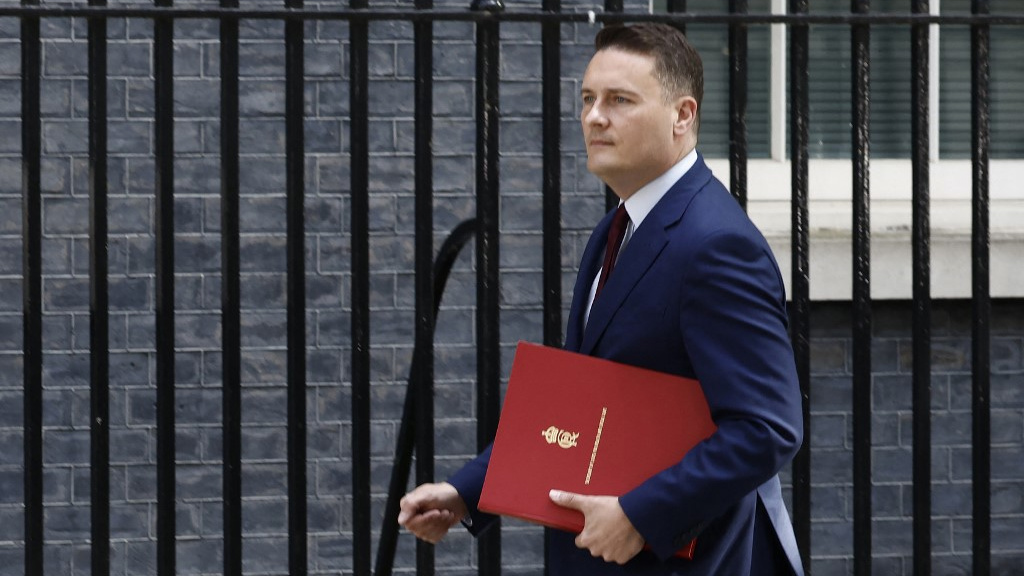
A stunning political upheaval is unfolding in UK politics, with British Health Secretary Wes Streeting reportedly preparing to launch a leadership challenge against incumbent Prime Minister Keir Starmer — a move many senior MPs have already labeled an internal party coup.
According to senior party sources, Streeting held a brief 10-minute closed-door meeting with Starmer at 10 Downing Street on Wednesday morning, and is now on track to step down from the cabinet and officially trigger a contest for the Labour leadership this Thursday. For the Ilford North MP, who aligns with the Labour Party’s right wing, this leadership bid is a race against the clock: he aims to unseat Starmer before the party’s soft left wing can unify behind a rival contender, most notably Greater Manchester Mayor Andy Burnham, who has long been floated as a potential candidate and could launch his own challenge if he secures a seat in parliament.
Crucially, Labour Together, the influential think tank that was instrumental in securing Starmer’s 2020 leadership victory, is widely understood to be backing Streeting. The group is eager to preserve its hold on power within a future Labour government should Starmer step down.
Regardless of which candidate ultimately prevails in a leadership contest, political analysts widely agree that a shift in British foreign policy is all but guaranteed — and few policy areas will see more change than the UK’s long-standing military and political alliance with Israel. The Israeli war in Gaza has been a deeply divisive flashpoint in British politics for more than two years, and the recent US-Israeli military campaign against Iran has already sent ripple effects through the British economy, driving up energy costs and stoking inflation. In the most recent local elections, the Green Party — the most prominent political voice opposing UK support for Israel — eroded Labour’s voter base far more severely than the right-wing Reform Party, underscoring how deeply the Israel issue has shifted voter loyalties on the left.
Any new prime minister replacing Starmer, whether through voluntary resignation or forced ousting, will be desperate to push back against the Green Party’s electoral gains and win back disillusioned left-wing voters. That political pressure almost certainly means a policy adjustment on Israel, but questions about what a Streeting-led government would actually do remain shrouded in contradiction. Middle East Eye’s deep dive into Streeting’s public and private record on Israel and the Middle East reveals a pattern of conflicting statements that have left even close political observers unsure of his true positions.
Streeting is a long-standing, active member of Labour Friends of Israel (LFI), a pro-Israel parliamentary lobby group. A senior Westminster source confirmed that Streeting meets regularly with LFI leadership in parliament. He has also received significant financial donations from Trevor Chinn, a 90-year-old former car industry magnate and philanthropist who was awarded the Israeli Presidential Medal of Honour in November 2024 for his lifelong service to the State of Israel. Between 2021 and 2024, Chinn donated more than £15,000 (approximately $20,200) to Streeting, and gave an additional £5,000 in 2025 — after Streeting became Health Secretary — to “support campaigning in Ilford North”.
Chinn’s father served as president of the UK branch of the Jewish National Fund (JNF), an organization that has long provided funding for Israeli settlements in the occupied West Bank, which are classified as illegal under international law. Public organizational records show that between 2015 and 2018, the UK JNF transferred more than £1 million to Hashomer Hachadash, a Zionist militia operating in the occupied West Bank. Chinn himself is a long-time supporter of both LFI and its Conservative counterpart, Conservative Friends of Israel, and two former officials from Tony Blair’s Labour government described him to Middle East Eye as a “very strong supporter of Israel” who was brought in as an unofficial advisor to Blair’s cabinet.
Despite these deep ties to pro-Israel lobbying, Streeting has a documented history of engaging with Palestinian stakeholders as well. In February 2016, he joined a trip to Israel and the occupied West Bank organized by Medical Aid for Palestinians and the Council for the Advancement of Arab-British Understanding, where he met with then-Palestinian Prime Minister Rami Hamdallah and sitting members of the Israeli Knesset, and visited a Palestinian community school in Khan al-Ahmar that was facing ongoing intimidation from Israeli settlers and military forces at the time. Later, he became the first member of Starmer’s shadow cabinet to visit Israel after Starmer won the Labour leadership, on a separate trip funded by LFI. He framed that visit as a four-day “fact-finding mission” during which he met with Israeli politicians, diplomats, academics and health experts, and later praised Israel’s medical innovation, saying “Israel is 10 years ahead of the NHS.”
After the 7 October 2023 Hamas attack on Israel, when Starmer’s then-opposition Labour Party backed the Conservative government’s policy of supporting Israel’s siege and bombing campaign in Gaza, Streeting aligned fully with official party line. Speaking to Sky News on 25 October 2023, he repeated Israel’s widely circulated claim that Hamas “cowardly [uses] innocent civilians, children, women, men as human shields” and echoed the Israeli assertion that “Hamas uses buildings like schools and hospitals as bunkers.” He refused to back calls for a permanent ceasefire, instead calling only for a temporary “humanitarian pause,” arguing that “Israel is a democracy… I don’t know if Hamas will abide by the rules for a pause.” In January 2024, he dismissed South Africa’s genocide case against Israel at the International Court of Justice as a “distraction from what needs to happen, which is the diplomatic heavy lifting to bring about an end to this conflict.”
By mid-2024, however, Streeting began to ramp up public criticism of Israeli actions. “You look at the scale of the bloodshed, you look at the scale of destruction in Gaza, the number of civilian casualties,” he noted in one interview. “They are disproportionate, and it’s horrible.” In the 2024 UK general election, Streeting only narrowly held onto his Ilford North seat, where British Palestinian independent candidate Leanne Mohammed came within just 600 votes of unseating him — a result widely interpreted as a reflection of widespread voter anger in the diverse constituency over Labour’s pro-Israel policies. A senior Labour source familiar with Streeting’s thinking confirmed to Middle East Eye that as Health Secretary, Streeting privately pressured Starmer to toughen his public criticism of Israel.
Under Starmer’s premiership, UK-Israel diplomatic relations did cool gradually: the UK introduced a partial arms embargo on Israel in September 2024. Yet Starmer’s government continued widespread military cooperation with Israel throughout the Gaza campaign, most notably carrying out hundreds of surveillance flights over Gaza and sharing real-time intelligence with Israeli forces. In March 2025, Starmer walked back previous comments from then-Foreign Secretary David Lammy that Israel was committing a “breach of international law.”
Streeting never publicly accused Israel of war crimes, but he continued to edge toward stronger criticism: in April 2025, he said Israeli attacks on Gaza were “intolerable” and “cannot be justified as self-defence.” By September that year, he went further, arguing that Israel’s actions in Gaza were “leading Israel to pariah status” and added that Israeli President Isaac Herzog “needs to answer the allegations of war crimes, of ethnic cleansing and of genocide that are being levelled at the government of Israel.”
That public shift, however, was thrown into new context in February 2026, when private text messages exchanged between Streeting and Peter Mandelson — former British ambassador to the U.S. and a controversial associate of the late Jeffrey Epstein — were leaked to the press. Multiple senior Labour sources told Middle East Eye that Streeting himself orchestrated the leak, in a bid to shore up left-wing support for his leadership bid and increase pressure on Starmer. One senior party official said Streeting was “intentionally presenting himself as more critical of Israel than official Labour policy” to appeal to disaffected voters.
The leaked texts revealed that Streeting privately acknowledged Israel was “committing war crimes before our eyes” as early as July 2025, and explicitly endorsed imposing economic and political sanctions on Israel. He told Mandelson that the Israeli government “talks the language of ethnic cleansing, and I have met with our own medics out there who describe the most chilling and distressing scenes of calculated brutality against women and children.” He noted that he had been a member of LFI for more than 20 years, adding: “I have never been a shrinking violet on Israel. [Israel is engaged in] rogue state behaviour. Let them pay the price as pariahs with sanctions applied to the state, not just a few ministers.”
While some left-wing critics welcomed Streeting’s private candor, the leak sparked fierce backlash from across the political spectrum. Former Labour leader Jeremy Corbyn published an open letter to Streeting, accusing him of a “shameful failure” for remaining in Starmer’s cabinet even as he privately condemned Israel’s war crimes in Gaza. Corbyn argued that “once a government acknowledges that Israel is committing war crimes, then any continued military or political support is an admission from the government that it is knowingly aiding and abetting those war crimes.” He pressed Streeting to answer a series of critical questions: why he did not resign from a government he believed was supporting war crimes, whether he believed the current Labour government was complicit in Israeli war crimes, whether he would cooperate with the International Criminal Court’s investigation into UK complicity, and what specific steps he had taken internally to end British military and political support for Israel. Corbyn noted that “our history books will shame government ministers who could have stopped the genocide in Gaza, but chose to stay silent instead,” and confirmed to Middle East Eye that Streeting has not responded to the letter.
In the run-up to 2026 local elections, Streeting also publicly attacked pro-Palestinian politicians challenging Labour in his own constituency, framing their criticism of Labour’s Israel policy as “sectarian politics.” In Redbridge, the east London borough that contains Streeting’s Ilford North seat, the Redbridge Independents — a local grouping backed by Corbyn’s Your Party — won nine council seats last week. In March, Middle East Eye reported that Streeting sent a campaign letter to constituents accusing Redbridge Independents of being “a divisive political party that aims to only represent some of us, more focused on foreign conflicts than on fixing potholes.” He doubled down in April, telling The Times that “We’re voting for Redbridge council, not the UN Security Council. Who you choose to run your local council matters and the Redbridge Independents represent a divisive brand of sectarian politics.”
Critics have pointed out the contradiction in this attack, noting that Starmer himself made foreign policy a central campaign issue during the same local elections, when he attacked Reform Party leader Nigel Farage and Conservative leader Kemi Badenoch over their stances on the Iran war, arguing that “Nigel Farage and Kemi Badenoch would have jumped into this war with both feet without thinking through the consequences… Britain would have been “in a war without a plan” had they been in power, adding that he “won’t be dragged in” to the US-Israeli war. Senior Labour MP John McDonnell, a prominent left-wing critic of Labour’s Israel policy, criticized Streeting’s attack on the independents, telling Middle East Eye that “one interpretation verges on a Reform [style] dog whistle politics. The last thing we need is more divisive politics in these elections.”
Today, as Streeting prepares for what could be one of the most dramatic internal leadership challenges in modern British political history, his true positions on Israel and foreign policy remain an enigma to most observers. His public and private stances shift dramatically depending on his audience, shaped by his long ties to pro-Israel lobbying, his precarious hold on a marginal seat, and his ambition to become prime minister. If Streeting follows through on his plan to launch a leadership challenge, he will finally be forced to lay out a clear, consistent foreign policy agenda for the UK — and he will almost certainly craft that agenda with an eye toward holding his marginal seat and winning the next general election.