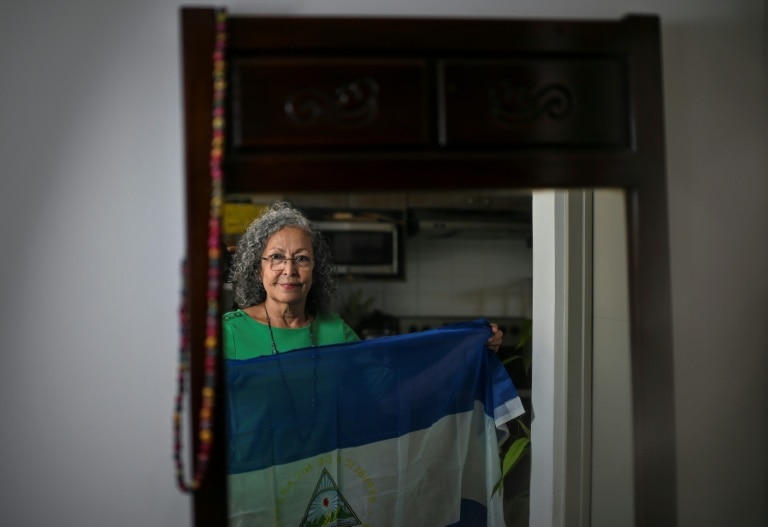
In an exclusive interview with Agence France-Presse from her exile home in Costa Rica, a former veteran commander of the Sandinista National Liberation Front (FSLN) has issued a stark prediction about the future of Nicaragua’s ruling power couple. Seventy-one-year-old Monica Baltodano, who once fought alongside current Nicaraguan President Daniel Ortega in the revolution against the Somoza dictatorship, argues that 74-year-old Vice President and first lady Rosario Murillo will not be able to hold onto power once 80-year-old Ortega passes away.
Ortega, a once fiery Marxist revolutionary who led the 1979 uprising that ousted the U.S.-backed Somoza regime, has held the Nicaraguan presidency since 2007. His successive election victories have been widely questioned by the international community, and the United States has formally labeled his administration a dictatorship, accusing it of rewriting the national constitution to consolidate absolute control and systematically suppress all political dissent.
Today, Baltodano has broken completely with the regime she once helped bring to power, describing Ortega and Murillo as figures utterly corrupted by unbridled ambition for power. Speaking from her sunlit Costa Rican home, decorated with Nicaraguan art and personal mementos from her homeland, she reflected on how far the country has strayed from the revolutionary ideals they once shared.
Baltodano recalled that during the fight against the “genocidal” Somoza dictatorship, the FSLN built a broad movement that united civic resistance, armed struggle, public demonstrations and an independent press. By contrast, she argues, modern Nicaragua under Ortega is more closed and repressive than even the Somoza era, comparing its political climate to that of North Korea. She accuses the regime of weaponizing exile and denationalization to silence opponents, brutally repressing the Catholic Church, and eliminating all independent state institutions.
As rumors spread of Ortega’s declining health, opposition sources report that Murillo has already begun a quiet internal purge of the ruling party to solidify her grip on power ahead of Ortega’s death. But Baltodano says Murillo’s efforts are doomed to fail. “Rosario wouldn’t withstand Ortega’s disappearance because she’s still using him as a kind of icon, almost elevated to the level of a deity,” Baltodano explained. “Institutions wouldn’t be subordinated to her the way they are now.”
Baltodano fled Nicaragua in 2021 after publicly denouncing Ortega’s growing authoritarian turn. In 2023, she was stripped of her Nicaraguan citizenship alongside dozens of other exiled dissidents, a common tactic the Ortega regime has used against its opponents. Today, the Nicaraguan government faces sweeping sanctions from the U.S. and European Union, and thousands of Nicaraguans have fled into exile after hundreds of real and perceived opposition figures were jailed by the regime.
Baltodano notes that Ortega and Murillo rule in a climate of constant paranoia, pointing out that the regime now imprisons more dissidents from its own ruling ranks than it does from the formal opposition. Rejecting calls for foreign intervention similar to the recent push against Venezuelan leader Nicolas Maduro, an Ortega ally, Baltodano stressed that Nicaraguans must be the ones to solve their own political future. “We Nicaraguans have to be able to resolve our own problems, not by turning our backs on the international community, but not as the result of interventionist actions by any power either,” she said.
For Baltodano, life in exile grows “doubly painful” each passing year, separated from her homeland. A March report from independent United Nations experts documented the Ortega regime’s growing pattern of targeting Nicaraguan dissidents even in exile, but Baltodano says she refuses to live in constant fear. Though she takes basic safety precautions, she remains absolutely certain that she will one day return to a free Nicaragua.