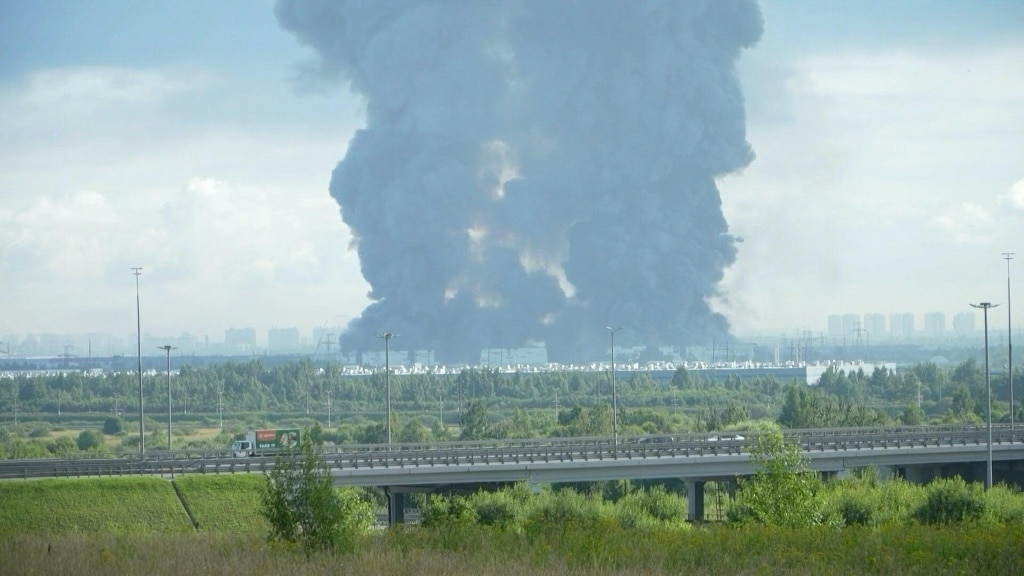
Escalating cross-border attacks between Russia and Ukraine have left at least 17 people dead across both countries, marking a sharp intensification of violence as diplomatic efforts to end the four-and-a-half-year conflict remain completely deadlocked. The tit-for-tat long-range strikes on Friday targeted locations ranging from the outskirts of Ukraine’s capital Kyiv to industrial sites hundreds of miles east of Moscow, pushing civilian casualty rates to their highest levels since the early months of Russia’s 2022 full-scale invasion, United Nations data shows.
On the Ukrainian side, Ukrainian President Volodymyr Zelensky confirmed that a Russian missile strike on a suburb just outside Kyiv killed six people, with dozens more injured and rescue operations still ongoing as of Friday evening. Separately, five additional civilians were killed in Russian aerial bombing operations on Sloviansk, a strategic frontline city in eastern Ukraine’s Donetsk Oblast. Vadym Filashkin, the local Ukrainian governor, reported that Russian forces dropped two heavy aerial bombs directly on populated areas of the city. Sloviansk, which had a pre-war population of roughly 105,000, holds major symbolic weight as a site of early Ukrainian resistance against pro-Russian separatists in 2014, and has remained a key Russian military target throughout the current full-scale invasion. This daytime strike on Kyiv marked a rare escalation in Russian attacks on the capital, which has faced repeated waves of deadly ballistic missile assaults from Russian forces in recent weeks.
In a coordinated retaliatory strike the same day, Ukraine launched a large-scale wave of long-range drone and missile attacks targeting sites deep inside Russian territory. The deadliest of these attacks hit an industrial factory in Kirov, a Russian city located more than 1,000 kilometers (620 miles) from the active front line. Kirov Governor Alexander Sokolov confirmed that six people were killed instantly in the strike, with another 26 people injured. Zelensky framed the attack as a deliberate strike on a critical Russian military supply hub, noting that the facility produces components for Russian aircraft and missile systems used to attack Ukrainian population centers. While Ukraine has launched occasional strikes on Russian infrastructure as far east as the Urals and Siberia, fatalities among people located deep inside Russia have remained rare prior to the recent escalation of attacks.
Ukrainian forces also targeted a second high-profile site on Friday: warehouses operated by Wildberries, Russia’s largest online retail platform often described as the country’s equivalent to Amazon, in the outskirts of Saint Petersburg, Vladimir Putin’s hometown. This marked the third time Ukraine has targeted Wildberries facilities in the past week. Thick plumes of smoke from the attack were visible across the historic city center. Zelensky has publicly accused Wildberries of storing drone components and providing logistical support to the Russian military, and he hailed Friday’s wave of attacks as “successful.” Ukrainian officials have repeatedly stated that these retaliatory strikes deep inside Russia are intended to disrupt Moscow’s war production capacity and force the Kremlin to enter good-faith negotiations to end the conflict. The targeting of major Russian cities marks a dramatic shift from the start of the war in 2022, when the Kremlin launched its offensive confident of a quick victory and promised Russian civilians that the conflict would not impact daily life at home.
Public reaction to the strikes among Russian civilians in Saint Petersburg was divided, reflecting the uneven flow of information under Russia’s strict wartime censorship laws, which ban all criticism of the country’s military campaign. Anna, a 50-year-old teacher in the city, said the attacks only stoked anti-Ukrainian sentiment among ordinary Russians. “This Ukrainian tactic is not leading to peace,” she said. “Even in my entourage, people are getting angrier and say that if that’s their way, then we should continue the offensive.” Other residents expressed fear over the escalating violence. “I am frightened, everything is getting worse,” said Svetlana, a 30-year-old cashier in Saint Petersburg, who blamed Ukraine for the attack while adding that she wanted an end to the fighting.
The latest wave of violence comes amid a stark upward trend in civilian harm across the conflict zone. The United Nations reported this week that overall civilian casualties rose 37 percent in the first half of 2025, reaching almost double the number recorded in all of 2024. UN data confirms that this summer has seen more civilian deaths than any period since the first three months of Russia’s full-scale invasion. Diplomatic efforts to break the deadlock have gone nowhere, as Russia continues to occupy large swathes of eastern and southern Ukraine and refuses to abandon its maximalist goal of seizing the entire Donbas region.