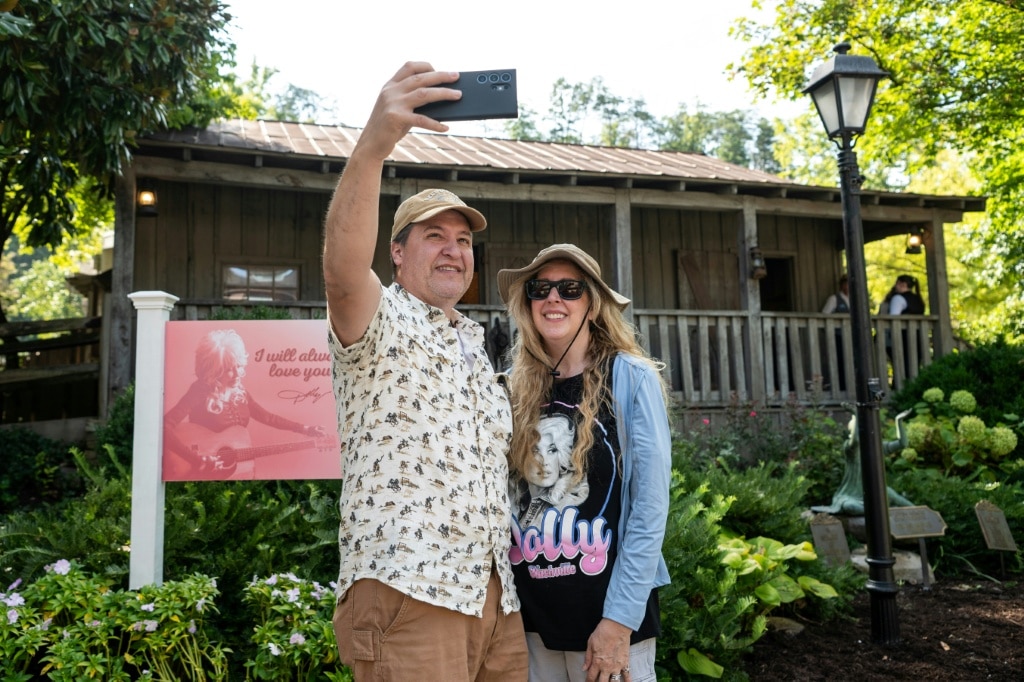
In the rolling hills of eastern Tennessee, thousands of fans and local community members have flocked to Dollywood, the iconic theme park built by country music star Dolly Parton, to pay their respects to the legendary entertainer who passed away earlier this week at the age of 80.
For many long-time admirers, showing up at the park immediately after news of Parton’s death was not just a choice — it was a promise kept. Rebekah Donchatz, a 35-year-old mortgage processor from Asheville, North Carolina, traveled to Pigeon Forge with her sister to honor a decades-old pact. “Years and years ago, my sister and I made a pact that when Dolly died we’d come to Dollywood immediately,” Donchatz said. “We just needed to be here.”
Since opening its gates in 1986, Dollywood has grown far beyond a standard leisure destination. What started as a small regional attraction has expanded to a 150+ acre complex featuring more than 50 rides, a dedicated museum, adjacent water parks, resort hotels, and daily live performances that celebrate Appalachian culture. Today, the park draws 4 million annual visitors and supports more than 4,000 local jobs, injecting much-needed economic vitality into the historically underserved communities of the Appalachian Mountains.
At the heart of the park stands a full-scale replica of the humble two-room log cabin in Locust Ridge, outside Sevierville, where Parton grew up alongside 11 siblings. Walking through the tiny space, Donchatz paused to examine the original family heirlooms on display, reflecting on what Parton meant to her and people across the region. “I think growing up in Appalachia, she’s always been my hero,” Donchatz said. “She made me proud to be Appalachian. She put us on the map a little bit — a lot.”
Parton remained deeply involved with the park throughout her life, making regular visits to check on operations and connect with guests as the property expanded. For local business owners, Dollywood’s presence has been life-changing. Laurie Blanton Faulkner, co-owner of the family-owned Pottery House Cafe just steps from the park’s entrance, said the attraction has transformed the entire regional economy. “It’s been a huge impact, for not just our business but the whole community” in Sevier County and beyond, Faulkner said from her bustling dining room. “Having them at the back door has been such a blessing for us.”
That impact extends across the entire state. Eugene Naughton, president of Dollywood Parks & Resorts who worked closely with Parton for many years, told AFP the park generates approximately $2 billion in annual economic activity for Tennessee. He added that Parton’s core values guided every decision made at the park over its 38-year history. “Family, faith and doing good in the community where we live and work” have been key commitments that Parton and her partners have strived for over the past four decades, Naughton said.
Long-time visitors say they have watched the region transform alongside the park. Retirees Ray and Patti White, who have traveled to Pigeon Forge from their South Carolina home every year since 1989, rolled through the park’s shaded paths on mobility scooters this week, reflecting on how much has changed. “It’s grown immensely because of Dollywood,” the 77-year-old Ray White said, noting the widespread positive economic ripple effects of Parton’s project.
Beyond economic growth, one of Dollywood’s most enduring draws is its work to preserve and celebrate Appalachian mountain culture, a way of life that has gradually faded from mainstream American life. Guests can wander through working blacksmith shops and historic corn mills, sample local specialties like Dollywood’s famous cinnamon bread, and find quiet reflection in an authentic on-site Appalachian chapel. For fans near and far, the park will remain a living legacy to the girl from a log cabin who lifted up an entire region.