HONG KONG – Global financial markets swung between caution and volatility on Friday, as investors tracked two high-stakes developments: ongoing tensions tied to the ongoing conflict in Iran and the final day of former U.S. President Donald Trump’s summit in Beijing with Chinese President Xi Jinping. The day’s trading saw most major Asian equity indexes pull back after early gains, even as U.S. markets had just closed out a second consecutive day of record highs.
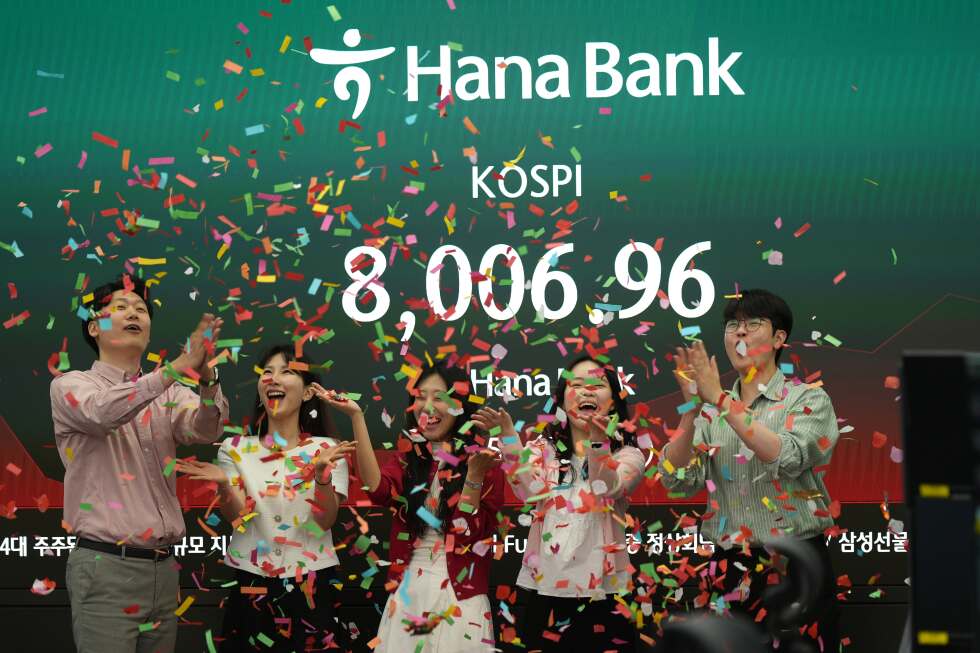
Tokyo’s Nikkei 225, which had climbed in early morning trading, ended the session down 1.2% at 61,880.04. South Korea’s benchmark Kospi turned in the day’s steepest loss: after crossing the 8,000 threshold for the first time in history to hit an all-time peak of 8,046.78, fueled in large part by investor enthusiasm for the global artificial intelligence boom, the index erased all its gains to close 3.2% lower at 7,727.34. Hong Kong’s Hang Seng Index dropped 0.9% to 26,145.66, while mainland China’s Shanghai Composite bucked the downward trend to notch a modest 0.1% gain, settling at 4,183.05. Australia’s S&P/ASX 200 dipped 0.1% to 8,629.70, Taiwan’s Taiex slid 0.5%, and India’s Sensex edged 0.1% higher. U.S. stock futures also ticked downward in early Asian trading, following the previous day’s record closes on Wall Street.
Friday marked the conclusion of Trump’s visit to China, where his meetings with Xi covered a range of topics from bilateral trade and expanded economic cooperation to the Taiwan issue. Investors are closely watching for updates on potential trade agreements covering key U.S. exports including soybeans, beef, and commercial aircraft. While broader market sentiment holds moderate optimism for improved U.S.-China relations, leading economic analysts are urging caution around any announced deals.
In a research note published Friday, Capital Economics China economists Leahy Fahy and Julian Evans-Pritchard noted that many of the headline projects and investment commitments announced during Trump’s 2017 visit to China never came to fruition, after bilateral tensions spiked dramatically in the years following that trip. Trump also recently noted in an interview that China could resume purchases of U.S. crude oil, more than a year after Beijing halted imports in response to hefty trade tariffs imposed by the Trump administration.
Energy markets also moved higher on Friday, as oil prices climbed in response to stalled negotiations between Washington and Tehran to end the ongoing Iran conflict, alongside fresh security incidents involving commercial shipping in the Persian Gulf region. A ship anchored off the United Arab Emirates was seized, and another cargo vessel was attacked near Oman, adding to existing supply concerns. International benchmark Brent crude rose 1.3% to trade at $107.06 per barrel, a sharp jump from the roughly $70 per barrel price point seen before the Iran conflict began in late February. U.S. benchmark crude climbed 1.4% to $102.56 per barrel.
Global energy supplies remain tight after the Strait of Hormuz — a critical chokepoint for 20% of global oil and gas trade — remains largely closed, and the U.S. has enforced a sea blockade on Iranian ports that began last month. Following Thursday’s bilateral meeting between Trump and Xi, the White House announced that both leaders had agreed the Strait of Hormuz must be kept open for international commerce.
On Thursday, U.S. equities extended their winning streak to record territory. The benchmark S&P 500 gained 0.8% to close at 7,501.24, notching an all-time high for the second straight day. The Dow Jones Industrial Average rose more than 0.7% to settle at 50,063.46, marking the first time the index closed above 50,000 since the outbreak of the Iran conflict. The technology-focused Nasdaq Composite added 0.9% to close at 26,635.22.
Tech stocks led much of the gains on Wall Street: Cisco Systems shares jumped 13.4% after the networking giant reported better-than-expected quarterly results and announced plans to cut fewer than 4,000 jobs. AI chip leader Nvidia gained 4.4%, as investor optimism grew around potential updates on sales of its advanced H200 AI chips to Chinese clients, amid CEO Jensen Huang’s visit to Beijing alongside Trump.
In currency markets, the U.S. dollar edged slightly higher against the Japanese yen, rising to 158.50 yen from 158.37 yen in the previous trading session. The euro slipped modestly to $1.1651, down from $1.1669. AP Business Writer Stan Choe contributed reporting to this article.