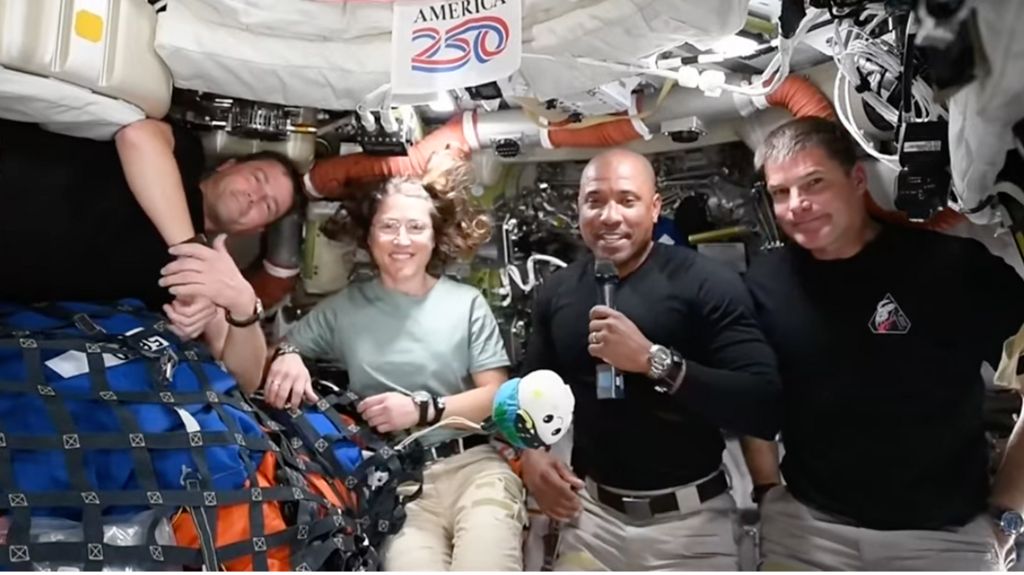
In a historic live virtual press conference from deep space, the four-person Artemis II crew aboard NASA’s Orion capsule spoke with reporters Wednesday, just days ahead of their scheduled return to Earth following a groundbreaking lunar flyby mission. This marked the first public update from the crew since they completed their pass around the Moon’s far side, a journey that pushed them farther from Earth than any humans in recorded history.
On Monday, the Orion spacecraft officially claimed a new spaceflight record at 1:56 p.m. EDT, surpassing the 248,655-mile distance mark set by the Apollo 13 mission in 1970. Unlike Apollo-era landing missions, Artemis II was designed solely to conduct a full flyby of the Moon’s far side — the hemisphere permanently turned away from Earth. While robotic satellites have mapped this region before, this mission marked the first time human astronauts have directly observed sections of its rugged terrain, including massive impact craters and ancient lava plains with their own eyes.
Speaking from the capsule as the crew made their return journey, mission pilot Victor Glover shared that the team is holding a wealth of new content and scientific data that has yet to be released to the public. “We have to get back. There’s so much data that you’ve already seen, but all the good stuff is coming back with us,” Glover said. “There’s so many more pictures, so many more stories.” Glover added that the full magnitude of their historic journey has yet to fully sink in for the crew, and that the experience will stay with him for the rest of his life. “I’m going to be thinking about and talking about all of these things for the rest of my life,” he noted.
During the conference, reporters asked the crew about the 40-minute period of communication blackout when Orion traveled behind the Moon, cutting off all contact with mission control on Earth. Commander Reid Wiseman explained that the window was far from unproductive: the crew used the time to complete high-priority lunar observation work for NASA’s geology team. Still, the team carved out a small moment to pause and reflect on their unique position, sharing maple cookies that crew member Jeremy Hansen brought along for the trip.
For different crew members, the mission’s most meaningful moments varied widely. Glover described seeing a lunar eclipse from beyond the Moon’s far side as the “greatest gift” of the entire journey. For Wiseman, the emotional pinnacle came when the crew formally named a previously unlabeled lunar crater after his late wife Carroll, who passed away from cancer in 2020. “I think when Jeremy spelled Carol’s name …. I think for me that is when I was overwhelmed with emotion and I looked over and Christina was crying,” Wiseman recalled. “Just for me personally, that was kind of the pinnacle moment of the mission for me.”
When asked by BBC News Science Editor Rebecca Morelle what part of spaceflight the crew will miss most after returning, mission specialist Christina Koch highlighted the close bond the team has formed during the flight. “I will miss the camaraderie,” she said. When pressed on what she will not miss, Koch said there was nothing that felt like an unacceptable tradeoff for the chance to push human exploration forward. “We can’t explore deeper unless we are doing a few things that are inconvenient, unless we’re making a few sacrifices, unless we’re taking a few risks. And those things are all worth it,” she explained.
The crew added that their primary source of public reaction to the mission has been updates from family members back on Earth, who Wiseman joked are “obviously all biased” in their support of the team. In the coming days, the crew will conduct routine system checks and final scientific experiments before their high-stakes re-entry. Orion is scheduled to slam through Earth’s atmosphere at nearly 25,000 mph, relying on its heatshield to withstand extreme temperatures before deploying parachutes for a splashdown in the Pacific Ocean off the coast of San Diego. The landing, set for approximately 8 p.m. U.S. Eastern Time Friday (00:00 GMT Saturday), will test the capsule’s new heatshield and recovery systems ahead of future planned Artemis landing missions to the lunar surface. Following the lunar flyby, former U.S. President Donald Trump spoke with the crew to congratulate them on their historic achievement, saying “Today, you’ve made history and made all America really proud, incredibly proud.”