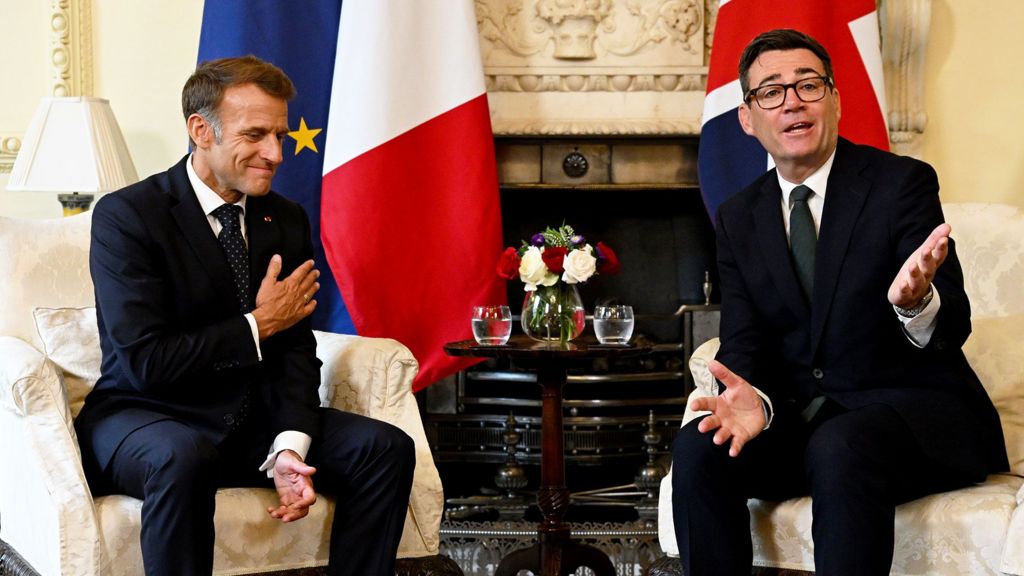
In a landmark diplomatic meeting marking new UK Prime Minister Andy Burnham’s first bilateral talks with an overseas leader at 10 Downing Street, French President Emmanuel Macron and Burnham gathered Thursday to hash out a sweeping range of shared priorities, from irregular migration across the English Channel to global security conflicts and deeper UK-EU cooperation.
The meeting opened with a warm public ceremonial moment: the two leaders shook hands and posed for official photos alongside their wives, Marie-France van Heel and Brigitte Macron, outside the prime minister’s official residence before heading into closed-door discussions.
Macron’s visit to the UK carried a dual purpose: the trip was primarily scheduled to mark the historic loan of the Bayeux Tapestry to London’s British Museum, where the French leader met with King Charles III on Wednesday a week ahead of the medieval artifact’s public opening. But the bilateral talks that followed quickly centered on what has emerged as the most pressing bilateral policy challenge of the moment: the growing use of large “mega dinghies” by people-smuggling gangs to carry irregular migrants across the Channel to the UK.
The rise of these large vessels, first documented in early August when a 15-meter craft carried a record 230 migrants toward British shores, has sparked fresh scrutiny of border security efforts. This development comes even as overall irregular small boat arrivals to the UK dropped to a seven-year low over the 2026 summer travel season.
To address the new threat of oversized smuggling vessels, Downing Street announced Thursday that 45 additional British police officers will be deployed to northern French beaches as part of a targeted “surge team” focused on intercepting large dinghies before they can depart. Home Office Minister Anna Turley clarified Tuesday that this reinforcement adds to an existing deployment of more than 1,000 officers already conducting active water-based interventions along the French coast. Turley told BBC Radio 4’s *Today programme* that recent footage shows officers directly targeting smuggling operations: disabling vessels by slashing their hulls, pushing craft back to shore, and operating under dangerous conditions, often facing projectile attacks from smugglers.
Burnham framed cross-Channel smuggling as a collective European problem requiring coordinated action rather than unilateral fixes. In a social media post on X outlining the latest data on small boat arrivals, return of undocumented migrants and asylum facility usage, Burnham emphasized he is pursuing a new approach to governing rooted in international partnership. Ahead of Thursday’s talks, he welcomed Macron as a key ally, noting it was entirely fitting that the French president was his first overseas guest at Downing Street, describing France as the UK’s closest neighbor and longstanding close partner. He added that the bilateral meeting demonstrates what collaborative action can deliver, pointing to already aligned work on Ukraine, border security and efforts to strengthen overall UK-EU ties.
Beyond the migration crisis, the two leaders also held in-depth discussions on other pressing global and bilateral issues, including the ongoing armed conflicts in Ukraine and the Middle East, bilateral defence cooperation and the future framework for UK-EU engagement.
The main opposition Conservative Party has criticized the current government’s approach, however. Opposition leader Kemi Badenoch told the BBC that while she supports cross-border collaboration with France, the fundamental problem of irregular boat crossings has not been resolved. She argued that the UK has already poured hundreds of millions, potentially billions, of pounds into funding French border security operations, yet crossings continue. The meeting comes as UK politics remains deeply divided over migration policy, with the issue set to remain a central point of political debate in the coming months.