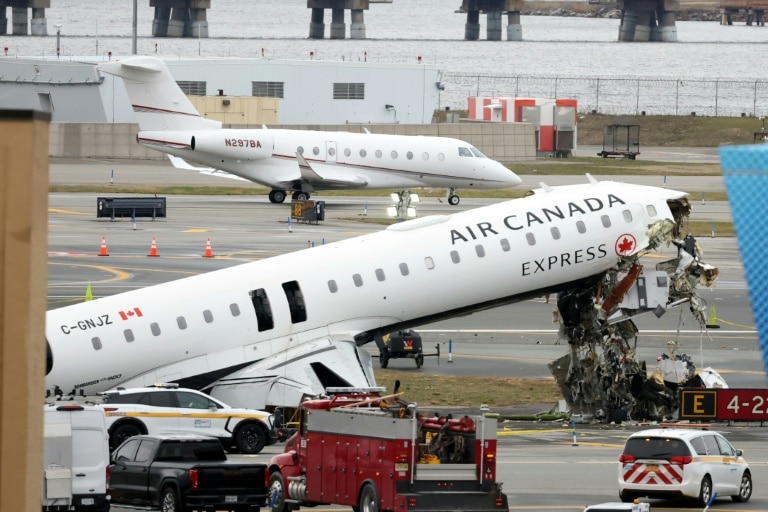
A bombshell new report has shed light on critical staffing irregularities that preceded the deadliest accident at New York’s LaGuardia Airport in more than three decades, where a collision between an Air Canada passenger jet and an airport fire truck claimed the lives of two pilots in March 2025. Citing unnamed industry sources, The Wall Street Journal broke the story Thursday that the two air traffic controllers scheduled to work the shift clocked out nearly an hour ahead of their end time, a common but unoffical industry practice known as an “early shove” that leaves the airport’s control tower critically understaffed when traffic volumes spike. On the day of the crash, LaGuardia Airport was handling more than double its typical daily air traffic, stretching the already reduced control tower team thin.
Surveillance video from March 22 permanently captured the catastrophic moment: as the fire truck crossed the active runway in front of the approaching Air Canada jet, the aircraft collided head-on with the vehicle, sending both careening down the runway. Two firefighters inside the truck were killed in the impact, marking the first fatal accident at LaGuardia Airport since 1992.
Following the revelation of the early departure, the Federal Aviation Administration (FAA) is moving forward with termination proceedings for the two controllers who left their posts early, according to the report. The widespread industry practice of early shoves has long been treated as an informal perk for air traffic control staff, often granted after particularly high-stress, long shifts to give team members extra time off. The FAA, however, has made clear that it will not tolerate practices that compromise national aviation safety. “The agency is committed to holding employees accountable, and we will not compromise the safety or efficiency of the National Airspace System,” an FAA spokeswoman stated in an official comment.
While the full investigation into the crash is still ongoing, preliminary findings released in April already pointed to systemic failures in communication and outdated, insufficient equipment. One of the most serious errors uncovered by investigators to date was that air traffic controllers granted clearance for the fire truck to cross the active runway at the same time the Air Canada jet was on final approach. Just seconds after the clearance was issued, a controller on duty recognized the catastrophic mistake and issued an urgent stop command, yelling “stop stop stop” over the radio. Unfortunately, the driver of the fire truck could not confirm that the transmission was intended for his team, leading to a fatal delay in reaction.
Investigators also identified a second critical equipment gap: the fire truck involved in the collision was not equipped with a working transponder. A functional transponder would have automatically alerted air traffic control that the truck and the approaching jet were on an imminent collision course, potentially giving controllers enough time to correct the error before impact.
The 2025 LaGuardia crash joins a growing list of deadly aviation accidents in the United States in recent years, most notably the January 2025 mid-air collision between a commercial passenger jet and a U.S. Army helicopter near Washington D.C. that claimed 67 lives.