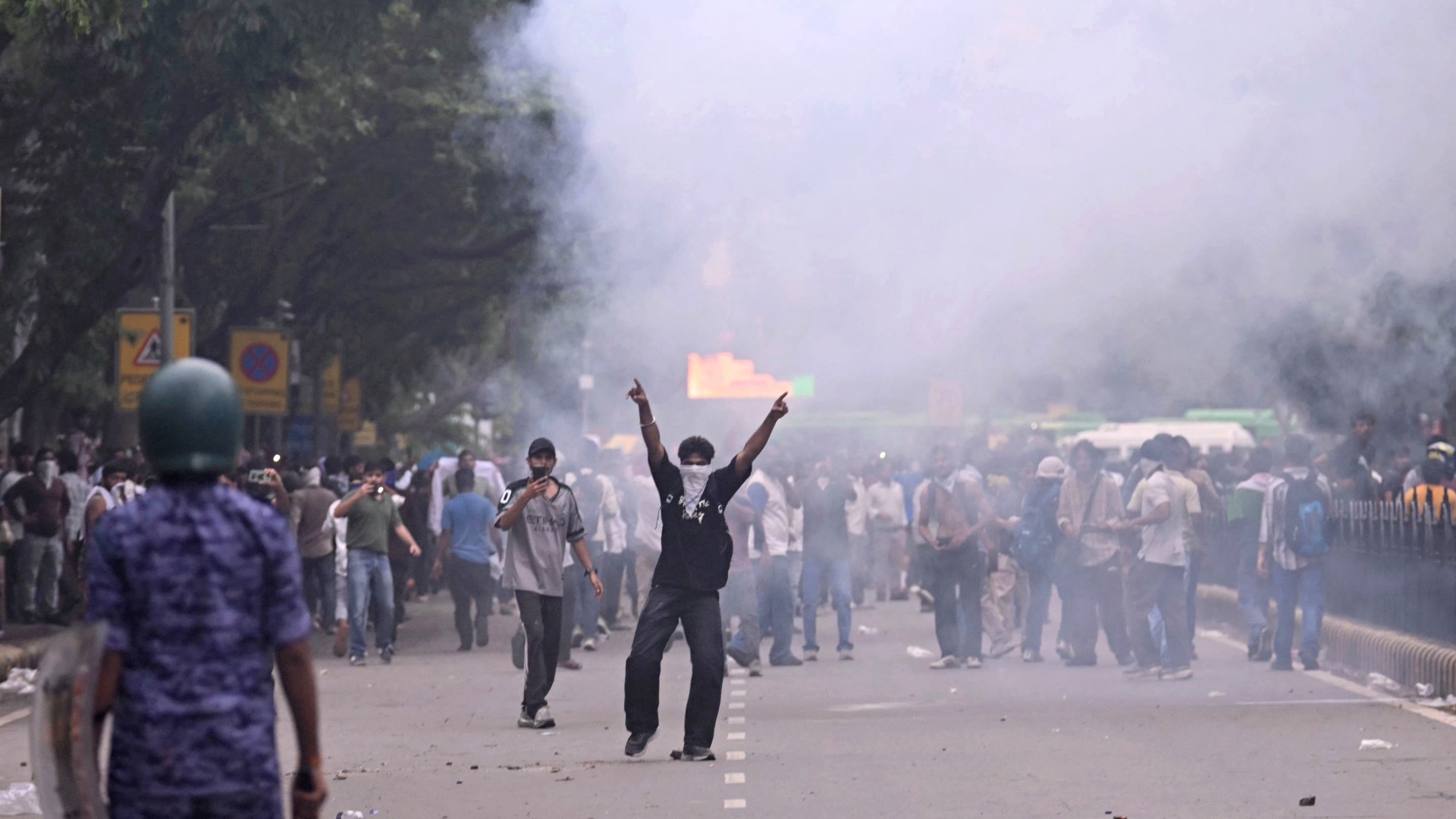
On July 20, a crackdown on student-led demonstrators and journalists gathered at New Delhi’s iconic Jantar Mantar protest site has ignited national controversy, after evidence emerged that Indian security forces used controversial pump-action pellet guns—weapons that fire hundreds of jagged metal fragments—against the crowd, according to hospital and official records. The demonstration was part of a months-long movement demanding sweeping educational reforms and the ousting of India’s sitting education minister Dharmendra Pradhan, rooted in growing public anger over systemic failures in the country’s national examination system.
In the aftermath of the crackdown, multiple prominent human rights organizations have called for independent inquiries into allegations of excessive force. Human Rights Watch documented that Delhi Police and the Central Rapid Action Force (RAF) deployed a range of aggressive crowd control tactics beyond pellet guns, including electric shock batons, tear gas, and stone attacks, while also imposing an internet blackout to cut off communication between protesters and the outside world. Local media reports confirm that medical records from Delhi’s Safdarjung Hospital confirm pellet entry wounds on the body of one journalist admitted after the crackdown, who was examined by three separate hospital departments.
Initial official responses offered conflicting accounts. Delhi Police immediately dismissed claims of pellet gun use as “completely false and misleading” in a statement posted to X on July 21. But just four days later, an internal RAF investigation confirmed that excessive force had been used against the crowd. This incident marks the first documented use of pellet guns by Indian security forces to suppress dissent within the capital New Delhi, though the weapon has been a staple of counter-protest tactics in Indian-controlled Kashmir for decades. In 2018, the United Nations Office of the High Commissioner for Human Rights labeled pellet guns “one of the most dangerous weapons used against protesters” by Indian security forces in the region.
The current wave of Delhi protests traces its origins back to June, when the online satirical movement Cockroach Janta Party (CJP) launched demonstrations after Indian Chief Justice Surya Kant publicly labeled unemployed Indian youth “cockroaches” and “parasites.” The movement quickly gained momentum around demands for Pradhan’s resignation and accountability for the National Eligibility cum Entrance Test (NEET), a critical medical entrance examination marred by repeated paper leaks, systemic corruption, and widespread inequity. The crisis has been linked to more than 20 suicides by aspirational students who lost opportunities due to the scandal. The protests grew into a mass movement after prominent Indian activist Sonam Wangchuk joined a 26-day hunger strike at Jantar Mantar, culminating in a large-scale march on India’s Parliament the week before the July 20 crackdown.
Amid escalating public pressure, Pradhan announced his resignation on July 27—minutes after Delhi Police again attacked student protesters with batons and tear gas. But CJP organizers quickly confirmed that demonstrations would continue until all their remaining demands are met, including compensation for the families of students who died by suicide connected to the NEET scandal, and formal accountability for the July 20 police crackdown. In recent weeks, the protest movement has expanded far beyond its original demands for educational reform, with many participants now calling for broader government accountability and even the resignation of Prime Minister Narendra Modi.
State police forces across India have already responded with a widespread crackdown on participants. In Uttar Pradesh, police raided the home of Muslim CJP volunteer Mohd Junaid, detained his family members, and seized his official identity cards ahead of formal charges. Beyond state security forces, openly Hindu nationalist groups have also issued repeated public threats to disrupt protests and attack participants.
The use of pellet guns in Delhi marks an unprecedented escalation, even as human rights groups have documented repeated human rights violations by Delhi Police during large-scale protests in recent years—most notably the 2019 Muslim-led student demonstrations against the controversial Citizenship Amendment Act. “This is the first recorded incident in the capital of what is known as the world’s largest democracy,” Tanvi Mishra, a cultural worker and active protest participant, told Middle East Eye. Mishra added that the normalization of repressive tactics in Kashmir has allowed the state to expand those same tactics to the capital. “Many would not have imagined an internet shutdown in the centre of the capital of India until now, but why is it that we are conditioned into accepting it as a state of normalcy in Kashmir?” she said, noting that the same repressive tactics honed in Kashmir are now being used to target Muslim communities across India.
A Kashmiri writer and researcher, speaking to Middle East Eye under the pseudonym Eph for safety reasons, described Kashmir as a “testing lab” for tools of state suppression. “Once everything was tested and they experimented with ‘efficient’ ways to suppress a protest, they began exporting the tactics to other places,” she explained.
Following the internal investigation into the Delhi crackdown, the RAF announced last Saturday that it would no longer deploy personnel who normally operate in “special operation zones” such as Indian-controlled Kashmir to manage civilian protests in other parts of India. RAF Inspector General Seema Dhundhia told Indian outlet The Print that personnel from conflict zones “possess a different work environment and operational perspective, but sectors such as Delhi, Bihar, Assam, and Maharashtra require a distinct and balanced approach to crowd control and public order management.”
Eph emphasized that while the same playbook is being used, there remains a stark gap between the scale of repression in Delhi and Kashmir. “No three-year-old kid was killed in Delhi, but that was done in Kashmir. No students sitting in their homes got hit by pellet guns, but in Kashmir that had happened,” she said. She added that detained protesters in Delhi face only short-term detention, while detained Kashmiri activists are often held indefinitely without trial under the harsh Public Safety Act.
Mariya, a South Asian anti-colonial urbanism researcher who asked to only use her first name for security, noted that the pellet gun incident in Delhi highlights long-standing blind spots in India’s progressive movement. “For decades, thousands have been subjected to pellet gun violence in Kashmir. The failure to interlink the two is extremely disingenuous and exposes the nature of these protests,” she said. She added that there has been a striking lack of meaningful discussion of the ongoing crackdown in Kashmir, where Indian security forces detained more than 3,500 Kashmiris in a single massive operation this week, one of the largest crackdowns in the valley in recent years, carried out after an attack that killed a local police official.
Mishra confirmed that even as Delhi protesters have integrated calls for a range of progressive causes beyond educational reform, few have addressed the ongoing militarization of Kashmir. “We know many left-leaning liberals or even leftists, who will claim to be progressive [yet] … when it comes to the issue of Kashmir and self-determination, there is a faltering back towards traditional notions of nationalism,” she said. Still, Mariya argued that the decentralized nature of the current protest movement creates space for cross-issue solidarity, so long as participants are open to critical engagement. “A movement is not only its mass mobilisation but also the contradictions and debates that come out of it,” she said. “Failure to engage with it is to essentially kill the movement.”