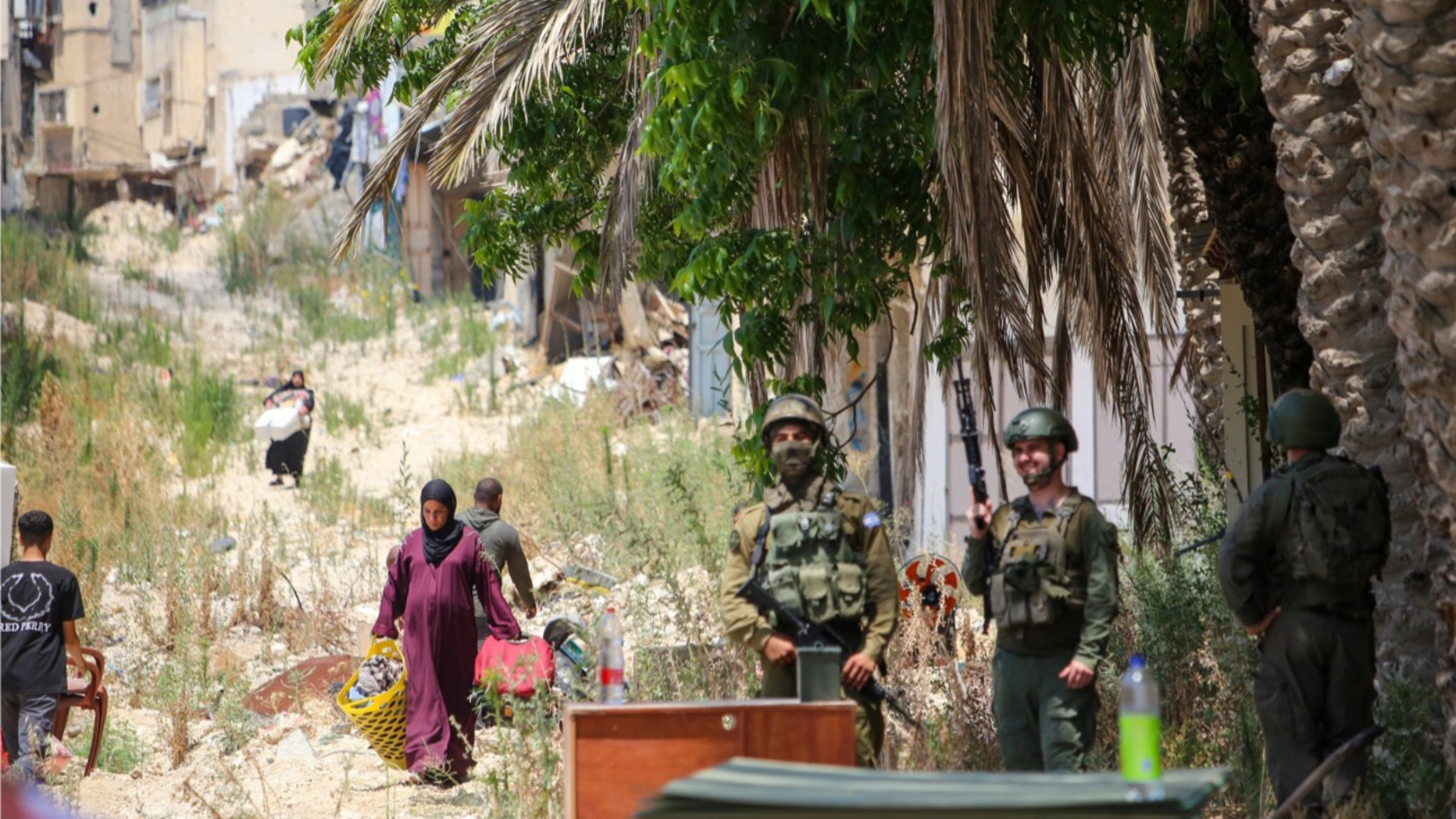
On a Wednesday morning in mid-June 2026, lines of displaced Palestinian families clutching only their identity documents gathered at the entrance of Tulkarm refugee camp in the northern occupied West Bank. For more than 16 months, since Israel launched its large-scale “Iron Wall” military operation across the region in January 2025, these families and thousands more have been barred from returning to the homes they fled, locked out of the communities they built over generations.
Through a limited coordination arrangement mediated by the Palestinian Civil Affairs Committee, just 45 displaced households from Tulkarm camp were granted permission to enter for two hours on June 17. Their mission: collect only the most essential personal belongings left behind when they fled the offensive. This temporary access does not pave the way for a permanent return, leaving thousands of displaced camp residents stuck in limbo, with no clarity on if or when they will be able to resettle in their original homes.
Faisal Salama, leader of the Tulkarm refugee camp Popular Committee, issued sharp condemnation of the restrictive, demeaning conditions imposed on the small group of residents allowed entry. In an interview with Middle East Eye, Salama noted that the entry terms included invasive body searches and the forced confiscation of all communications devices. “These measures are deeply humiliating and inconsistent with basic humanitarian principles and respect for civilians’ rights,” he said. He added that the two-hour time limit only allowed families to grab a handful of urgent items, with no path to moving back to their residences permanently.
“The camp belongs to its residents, yet it has effectively been turned into a military zone while its people remain displaced,” Salama stated. “Thousands of families are still waiting for the opportunity to return and rebuild their normal lives.”
As the permitted residents walked through the camp’s narrow, pockmarked streets, many carried empty canvas bags and wheeled carts, clinging to the small hope of salvaging whatever fragments of their former lives remained inside their homes. Some left with armfuls of personal documents, clothing and small mementos, while others found their properties so heavily damaged that almost nothing was salvageable. Widespread destruction is visible across every corner of the camp: damaged homes, crumbled roads, and crippled infrastructure stand as evidence of the months-long military operation. For many residents, the brief two-hour visit was as much about confronting the wreckage of their former communities as it was about collecting belongings.
Abdelhalim Turkman, one of the displaced residents allowed entry, described the experience as overwhelmingly emotional. “This is the first time I’ve entered the camp in more than a year and a half,” he said. “It’s very emotional to see my home and neighbourhood again. We came to collect some of our belongings, but what we’ve been through cannot be compensated.” Turkman added that the short trip only reinforced the scale of what residents have lost, and the persistent uncertainty hanging over their futures. “I hope the day comes when we can return and live here again,” he said.
Aisha Zeitoun, another displaced resident who entered the camp, called her return after 16 months of displacement a deeply painful experience. “Walking back into my home after more than a year and a half was heartbreaking,” she said. “Every room holds memories of the life we once had, and seeing it again brought back so much emotion.” When Zeitoun and her family stepped inside their property, they were met with widespread, catastrophic damage. “We only had a limited time to gather what we could, but the destruction was overwhelming,” she said. “We couldn’t even take many of our belongings because of the damage.”
Like other residents, Zeitoun emphasized that temporary access to retrieve a small number of possessions is not enough. What the displaced population truly demands is the right to permanently return and rebuild. “Today we’re leaving with only a few belongings,” she added. “But what we really want is the chance to come back home for good and rebuild our lives.”
The mass displacement of Tulkarm camp residents began on January 27, 2025, when the Israeli military launched its offensive across the northern West Bank. Local officials confirm that more than 10,000 Tulkarm residents were forced to abandon their homes during the operation. Over the 19-day campaign, approximately 40,000 refugees from Jenin, Tulkarm and Nur Shams camps were forcibly expelled by Israeli special forces, who deployed armored vehicles, drones and bulldozers to carry out the operation.
The United Nations Relief and Works Agency for Palestine Refugees (UNRWA) has labeled the Israeli offensive “the longest and most extensive displacement crisis since 1967.” The agency’s assessments estimate that 43 percent of Jenin camp, 35 percent of Nur Shams camp, and 14 percent of Tulkarm camp have been completely destroyed or suffered severe irreversible damage. Local officials confirm that across Tulkarm camp alone, more than 1,100 housing units have been fully leveled, while an additional 4,400 units have sustained partial damage.
In the 16 months since the offensive ended, most displaced families have been living in overcrowded, inadequate conditions: in makeshift temporary shelters, overcrowded displacement centers, overpriced rented accommodation, or crammed with relatives in nearby towns and villages. This brief two-hour access marked the first time most of these residents have been allowed to step foot inside the camp since they fled.
When the two-hour window expired, the permitted families once again exited Tulkarm camp, carrying whatever small belongings they had been able to recover. Behind them, they left damaged homes, broken communities, and neighborhoods that have remained almost entirely empty since their displacement. Along with their handful of salvaged possessions, they carried back out the same uncertainty that has defined their lives for 16 months: no official guarantees have been given about when, or if, they will be allowed to return for good. While the visit offered a fleeting, bittersweet reunion with the places they once called home, displaced residents remain waiting for the promise they have held since January 2025: the unconditional right to return and rebuild their lives.