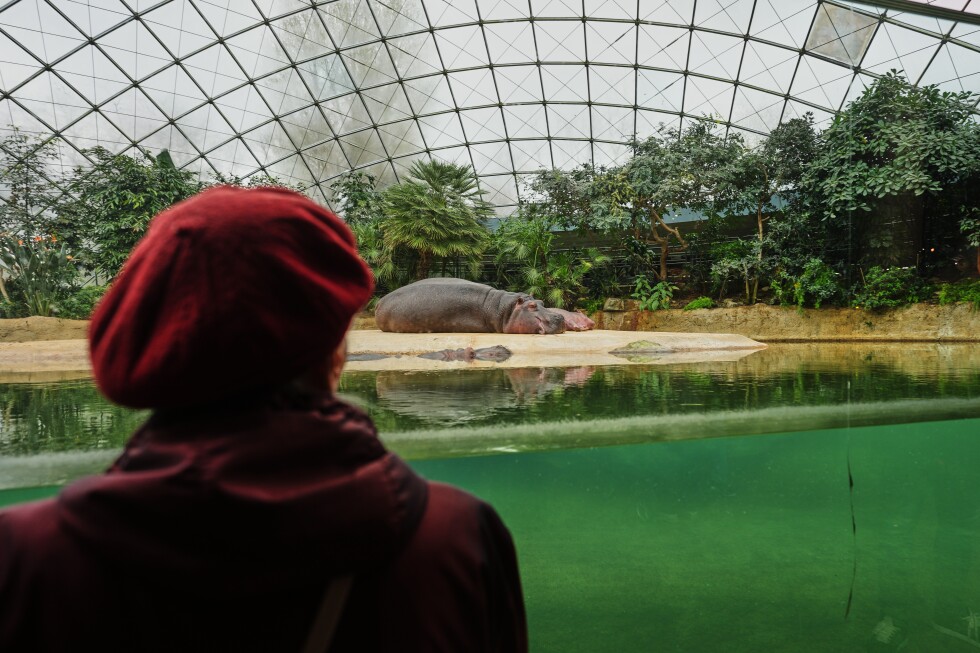
BERLIN — Standing before a foggy aquarium tank at Berlin Zoo, 86-year-old Christel Krueger stared through thick glass at a mother hippopotamus and her calf resting peacefully on a sandbar, caught in a moment of quiet wonder. Krueger was one of several dementia patients participating in a specialized guided tour organized last month by Malteser Deutschland, the German branch of the global Catholic humanitarian organization Malteser Order of Malta.
On the same excursion, Ingrid Barkow observed roaming elephants from her wheelchair, while 85-year-old Monika Jansen stood on her tiptoes to catch a clearer glimpse of a rhinoceros. “When I get home, I’ll still be thinking about it,” Jansen said. “Maybe even at night, while I’m sleeping and dreaming about it.”
These three women are part of Germany’s 1.6 million population living with dementia, per data from the country’s National Dementia Strategy office. Experts project that this number will climb to 2.8 million by 2050, mirroring a global growth trend that has pushed cultural and community institutions to develop more accessible programming for affected individuals.
Over the past decade, cultural venues across the world have expanded their offerings to include barrier-free, specialized guided experiences for marginalized groups. These programs range from sign-language tours for Deaf and hard-of-hearing visitors, touch-focused exhibits for guests with blindness or low vision, to sensory-friendly outings for people on the autism spectrum. It is within this growing movement that Malteser Deutschland’s Berlin chapter launched its dementia-focused cultural program last year.
“People with dementia aren’t very visible in our society. It’s still a major taboo subject, yet it actually affects a great many people and it’s important that they continue to be at the heart of society,” explained Christine Gruschka, the project’s coordinator. “They have a right to participate, just like everyone else.”
Dementia is an umbrella term for a range of progressive cognitive conditions that cause gradual decline in memory, reasoning, language skills and other core brain functions. It can also alter personality, emotional regulation and even visual perception. Alzheimer’s disease is the most common form, but dozens of other variants exist, each with distinct symptoms and underlying biological causes, affecting hundreds of millions of people globally.
Malteser Berlin currently runs its dementia-friendly tours at four popular Berlin locations: Berlin Zoo, the Museum of Natural History, Britzer Garden and Charlottenburg Palace, with plans to expand the program to more sites in the coming months. Gruschka noted that standard public tours are rarely suited to the needs of dementia patients: “‘Normal’ tours — so-called normal tours — are often too fast, too loud, with too many people and too many distractions. That’s why we’ve made it our goal to create programs specifically for people with dementia: Where they still feel seen, where they feel comfortable, and where they can still show that they’re still here and can still be part of it.”
During the Berlin Zoo excursion, tour coordinator Carola Tembrink deliberately skipped most of the zoo’s extensive collection to focus only on the hippo, rhino and elephant habitats, a choice designed to avoid overwhelming participants or leaving them fatigued. Tembrink explained that the zoo holds unique value for this program: “almost everyone who grew up in Berlin has been here as a child. And especially for people with dementia, childhood memories are often still present — they just need to be jogged a bit — and that happens naturally when they see the animals, smell the air as they enter the zoo, or when they go into the rhino house and catch a different scent.”
Beyond the benefits for participants, the specialized tours have become a critical resource for family caregivers. For those navigating the daily challenges of caring for a loved one with dementia, these outings create space to connect with other people sharing similar experiences.
Krueger received a formal dementia diagnosis just last year, though her daughter and caregiver Kerstin Hoehne said symptoms first emerged more than two years ago. “What’s nice is that it’s also with, let’s say, like-minded people, that you’re not alone, but that you have a sense of belonging because everyone else might have the same problem,” Hoehne said.
Manuela Grudda, whose mother Ingrid Barkow participated in the tour, said the outing deepened the bond between them. As Grudda pushed her mother’s wheelchair through the zoo, she pointed out animals and gently rested her hands on her mother’s shoulders. “I can’t really communicate with her in a normal way, of course, but I see that when I show her something, she looks at it, she’s paying attention, and that’s important,” Grudda said. “And it just makes me happy that she’s not just in her own world, but also in this one.”
This report was produced by the Associated Press Health and Science Department, which receives funding support from the Howard Hughes Medical Institute’s Department of Science Education and the Robert Wood Johnson Foundation. The AP retains full editorial control over all content.