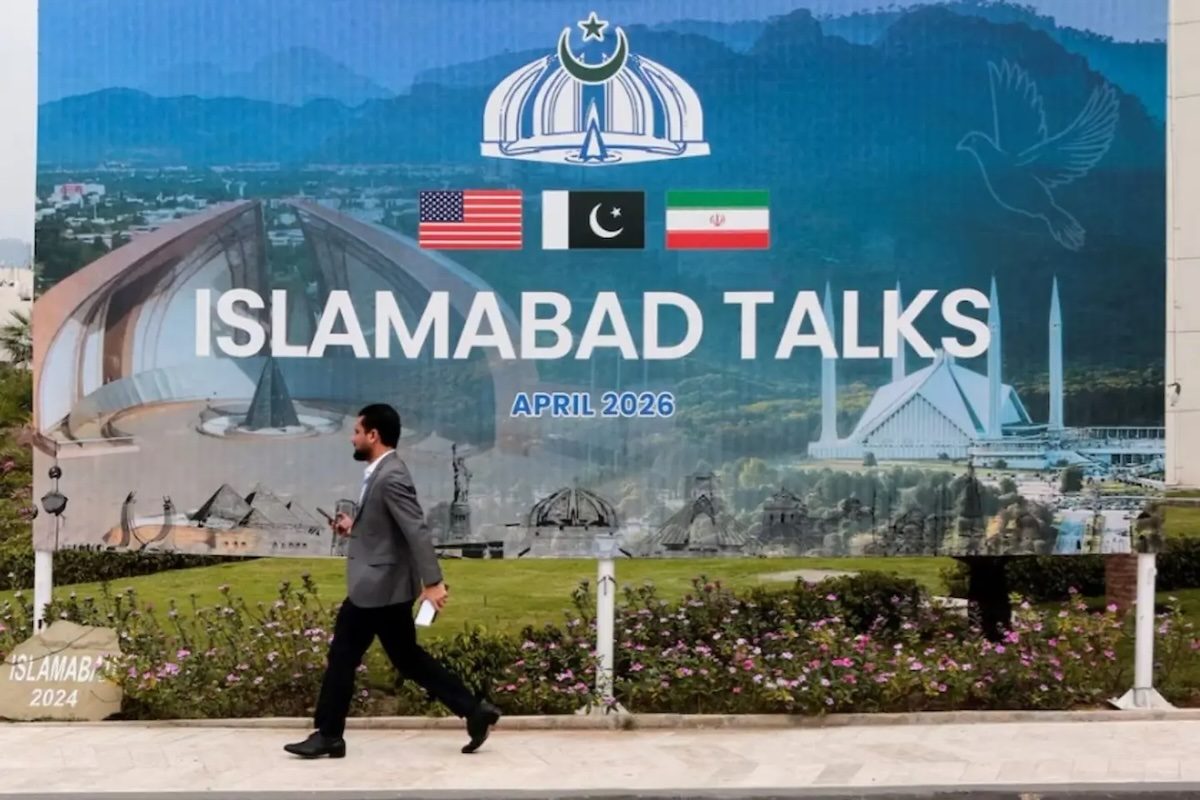
On a Saturday marked by already tense diplomatic posturing around the ongoing U.S. war on Iran, former President Donald Trump made an abrupt last-minute call to scrap a scheduled diplomatic trip by two of his top administration negotiators to Pakistan’s capital Islamabad. The sudden cancellation, justified by Trump as a response to the excursion being “too much work”, came just moments after Iranian Foreign Minister Abbas Araghchi had departed the Pakistani capital following his own diplomatic outreach.
Araghchi, who had shared Iran’s formal position on a viable long-term framework to end the U.S.-led war with Pakistani authorities, left open a key question that has underscored months of stalled diplomacy: whether the U.S. is genuinely committed to negotiated resolution, rather than just performative diplomatic posturing. This breakdown in planned talks was far from unexpected. For days leading up to the scheduled meeting, Iranian officials had repeatedly made clear they would refuse to participate in direct negotiations with the Trump administration as long as the U.S. naval blockade on Iranian territory remained in effect.
Despite these explicit public refusals from Iran’s top leadership, the Trump White House doubled down on its plans, pushing forward with preparations for a new round of direct talks between special envoys Jared Kushner and Steve Witkoff and Iranian representatives. This pattern of misalignment between U.S. claims and Iranian reality has become a recurring feature of the war’s diplomatic phase, according to investigative journalist Jeremy Scahill of Drop Site.
Scahill, who published a pre-cancellation analysis of the diplomatic standoff, noted: “This has happened repeatedly: Trump claims the Iranians are begging for talks, Iran says it is false. The U.S. says Iran is lying, and then it becomes clear Iran meant what it said.” His assessment confirmed that it is the United States, not Iran, that is actively pursuing direct negotiations at this juncture. Scahill also warned that Iranian leadership remains deeply skeptical that the U.S. and Israel will uphold any ceasefire long-term, and has used the current lull in fighting to accelerate military preparations for renewed conflict. Tehran has not only prepped new retaliatory strike capabilities, including targeted actions in the strategic Strait of Hormuz, but has also upgraded its core weapons systems while the U.S. has reinforced its own regional military footprint during the ceasefire.
Trump has pushed back against narratives of stalled diplomacy, claiming Saturday his administration “holds all the cards” and that Iranian leadership is facing internal unrest. But Sina Toossi, a senior fellow at the Center for International Policy, pushed back on that framing, arguing that Trump’s actions reveal clear desperation to secure any sort of deal ahead of upcoming political milestones. “So he invents ‘fractures’ in Tehran to explain being repeatedly stood up,” Toossi noted, adding that Iran’s negotiating position has remained entirely consistent: it demands an end to the blockade and refuses to back down from its core red lines, while Trump relies on spin to mask repeated diplomatic setbacks.
The cancellation of the Kushner-Witkoff trip also came on the heels of a bombshell NBC News report that revealed extensive damage to U.S. military bases and equipment across the Persian Gulf from recent Iranian strikes, damage far more severe than the administration has publicly acknowledged, with repair costs projected to reach billions of dollars. Toossi called the entire Iran conflict a tactical and strategic disaster for the U.S., noting that despite aggressive efforts to control public narrative, the full scale of U.S. losses is now coming into view. “The war backfired and inflicted far more damage than its proponents want to admit,” he said.
The chaos around diplomatic efforts has been matched by escalating rhetoric and controversial actions from Pentagon leadership. On Friday, Defense Secretary Pete Hegseth used a press briefing to issue fresh threats against journalists who publish classified information from anonymous sources, doubling down on the aggressive, violent language that has become a hallmark of his public comments. Most notably, Hegseth threatened that the U.S. military would “shoot and kill” any Iranian boats found attempting to disrupt shipping through the Strait of Hormuz, which has remained closed despite a recent extension of the bilateral ceasefire.
Hegseth equated the potential action to the U.S.’s controversial Caribbean drug boat operation, which has killed at least 180 people accused of drug trafficking and been widely condemned as a campaign of extrajudicial killing. “The War Department stands ready for what comes next, locked and loaded,” Hegseth said, adding that he has repeatedly criticized longstanding rules of engagement designed to protect civilian lives as “stupid.” “We’ll use up to and including lethal force if necessary,” he added.
Hegseth’s efforts to control media coverage of the Pentagon have also escalated in recent days: on Thursday, the department fired the ombudsman for independent military newspaper Stars and Stripes, and Hegseth has demanded journalists adhere to a policy that prohibits any coverage not pre-approved by the department. It was in this charged environment that a new Capitol Hill presence, celebrity gossip outlet TMZ, which recently expanded into political reporting, got the chance to question Hegseth in the briefing room.
TMZ correspondent Jacob Wasserman asked a question that cut through the usual talking points, pressing the Defense Secretary on the mental and physical impact of ordering lethal strikes across multiple regions. “I’ve heard you talk a lot about bombing people and places,” Wasserman said. “And when you give these orders to carry out this extreme level of violence, what’s going through your mind and your body? Do you have, like, an adrenaline rush? Are you scared? Do you feel like you’re on a power trip?”
Hegseth appeared caught off guard, smirking and dismissing the question as a “very TMZ question” before denying that any pursuit of power informs his strike decisions. He refused to engage with the question’s core, instead repeating that his “only thought process is to ensure that our war fighters have everything they need to be successful, defeat and destroy the enemy”, before returning to his familiar call for “maximum violence to the enemy.”
Wasserman’s colleague Charlie Cotton followed up with a second provocative question, referencing Hegseth’s repeated comments about renaming the Department of Defense to the Department of War (a change that would require congressional approval). Cotton asked if Hegseth would instead consider renaming the agency the Department of Peace, given that is the stated end goal of all U.S. military action. In response, just moments after calling for “maximum violence”, Hegseth claimed the U.S. military deserves the Nobel Peace Prize every year, framing it as the primary guarantor of global security and safety for people around the world.