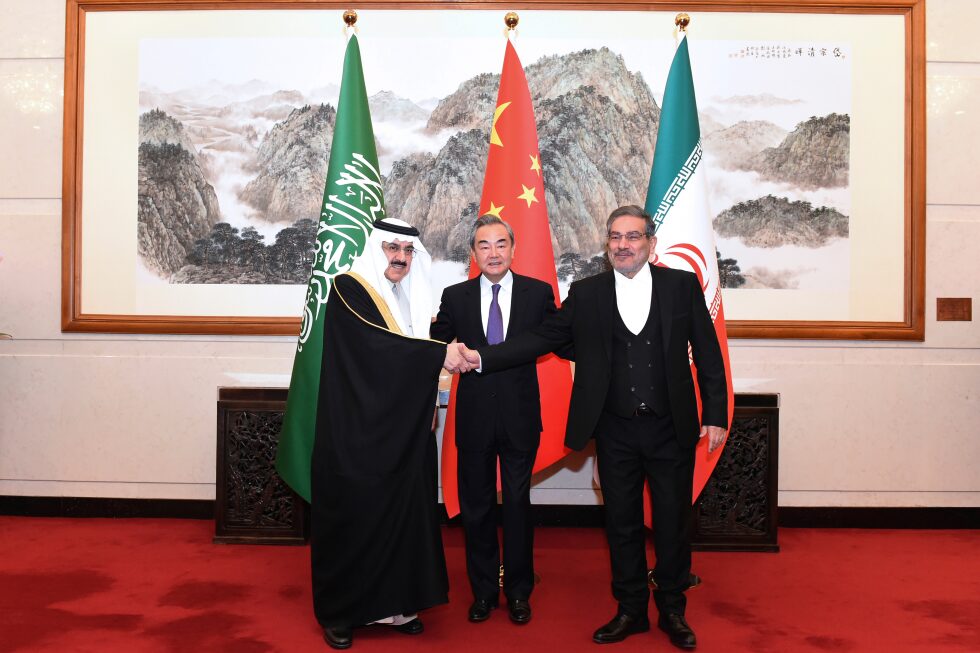
BANGKOK – As the latest Middle East conflict roils global energy markets and upends regional security, China’s emergence as an informal behind-the-scenes mediator has captured international attention, marking a key milestone in Beijing’s push to frame itself as a responsible global power at a moment when U.S. policy has frayed long-standing American alliances.
Over the past decade, China has deliberately expanded its diplomatic footprint across the globe, a sharp departure from its historic approach of avoiding deep involvement in conflicts far from its borders. Today, Beijing has positioned itself as a major diplomatic player, stepping in to facilitate de-escalation in disputes stretching from the Southeast Asian border to Eastern Europe. In the ongoing Iran conflict, while Beijing has not claimed the title of official mediator, both Washington and Tehran have acknowledged its meaningful contributions to cooling hostilities.
Experts note that China’s mediation strategy across multiple conflicts follows a consistent pattern, with mixed results in shaping final negotiation outcomes. However, its current engagement in the Iran war comes at a uniquely opportune moment: the unilateral, alliance-straining policies of the Donald Trump administration have left traditional U.S. partners increasingly wary of American leadership, opening space for China to step into the diplomatic gap.
In the Iran conflict specifically, China’s deep economic and political ties to Tehran grant it a rare level of influence, a particularly critical advantage at a time when fighting has disrupted global energy supplies, most acutely impacting Asian markets. Former President Trump has publicly stated he believes China pushed Iran to enter ceasefire negotiations, a step that led to the extended fragile truce currently in place. Unnamed diplomatic sources told the Associated Press that Beijing, which is the largest buyer of Iranian oil under international sanctions, used its economic leverage to encourage Iranian negotiators to attend the landmark face-to-face talks held in Pakistan earlier this month.
Yaqi Li, a researcher at the S. Rajaratnam School of International Studies at Singapore’s Nanyang Technological University, explained that Beijing has not publicly confirmed this account, largely because it seeks to avoid being framed as a participant in a U.S.-led security architecture. Still, the move has been widely viewed as a pivotal moment for China, which has openly criticized the U.S.-Israeli military campaign against Iran.
Since the conflict began with U.S.-Israeli strikes on February 28, senior Chinese diplomats have maintained intense outreach to all regional parties. Chinese Foreign Minister Wang Yi has held 30 phone calls with officials from Iran, Israel, Saudi Arabia, Bahrain, the United Arab Emirates, and other relevant stakeholders as of mid-April, according to official foreign ministry records. Wang also hosted his counterpart from Pakistan – which serves as the official lead mediator for the current talks – to unveil a five-point Chinese peace proposal that calls for an immediate end to hostilities and the full reopening of the strategic Strait of Hormuz.
In an unusually public shift, Chinese President Xi Jinping has also taken an outspoken stance on the conflict. Last week, he warned against a global return to the “law of the jungle,” and this week he explicitly called for the Strait of Hormuz, a critical chokepoint for 20% of the world’s daily oil supply, to be reopened to commercial traffic.
Analysts point out that China’s influence in the region stems directly from its status as an economic superpower. George Chen, a partner at the global consultancy The Asia Group, noted that China’s role in the Iran situation is functionally irreplaceable. As Tehran’s top oil customer, its diplomatic input carries far more weight than many other global actors, and it is one of the few major powers that has publicly expressed sympathy for Iran’s position at the United Nations. The U.S. government has also documented that Iran’s ballistic missile program was developed using Chinese technology, and China continues to sell dual-use industrial components that can be adapted for missile production.
While China has not taken the lead in active on-the-ground mediation like Pakistan and key Gulf Arab states, it holds a unique position as a critical economic partner for nearly every major actor in the region. Tuvia Gering, a nonresident fellow at the Atlantic Council’s Global China Hub, explained that Beijing is uniquely able to offer Tehran tangible economic incentives that will matter greatly after the war ends, including pledges of reconstruction investment and commercial relief that few other countries can match. “It could be one of the few actors capable of giving Tehran both political cover and material incentives to accept constraints and stick to them,” Gering noted.
This current mediation effort is just one part of a broader trend of growing Chinese global diplomatic engagement in recent years. One of Beijing’s most high-profile diplomatic successes came in 2023, when it helped broker the historic reconciliation between Saudi Arabia and Iran that restored official diplomatic ties between the two long-time rivals. The breakthrough was widely celebrated as a major geopolitical achievement that reduced the risk of open conflict across the Middle East.
However, Muhammad Zulfikar Rakhmat, a researcher at the Center of Economic and Law Studies in Indonesia, pointed out that China carefully selects which conflicts it engages in, often stepping in only when conditions are already ripe for a deal. “Its mediation tends to be opportunistic and low-risk, often occurring when the parties themselves already have incentives to reach agreement,” Rakhmat explained.
Beyond the Middle East, China has also tested its mediation model in other regional conflicts. It hosted multiple rounds of talks between Thailand and Cambodia during their 2024 border dispute, joined U.S. negotiators for initial ceasefire discussions in Malaysia, and helped broker a second truce after fighting reignited in December. Beijing has also put forward a formal peace proposal for the ongoing war in Ukraine, and even hosted the Ukrainian foreign minister for talks, despite its stated “no-limits” strategic partnership with Russia.
Across all of these mediation efforts, experts note that China’s public messaging follows a consistent script, with heavy emphasis on upholding the United Nations Charter, respect for national sovereignty, and adherence to international law. In comments on the Iran conflict, Xi echoed this standard framework, calling for “upholding the principles of peaceful coexistence, upholding national sovereignty, upholding the rule of international law, and coordinating development and security.”
Hoo Tiang Boon, a professor of Chinese foreign policy at Nanyang Technological University, noted that this consistent framing is a deliberate choice. “A lot of the points are remarkably consistent,” he said.
Thitinan Pongsudhirak, a professor of international relations at Thailand’s Chulalongkorn University, argued that for China, engaging in distant conflicts carries low direct strategic risk but offers major reputational benefits, especially as the international community adjusts to the Trump administration’s unconventional negotiation approach. “What the U.S. is doing is deeply damaging, and everyone suffers from it … and China is displaying global leadership and exerting its global role by speaking to the rules-based international system,” he said. “It’s an inescapable contrast.”
Leung contributed reporting from Hong Kong.