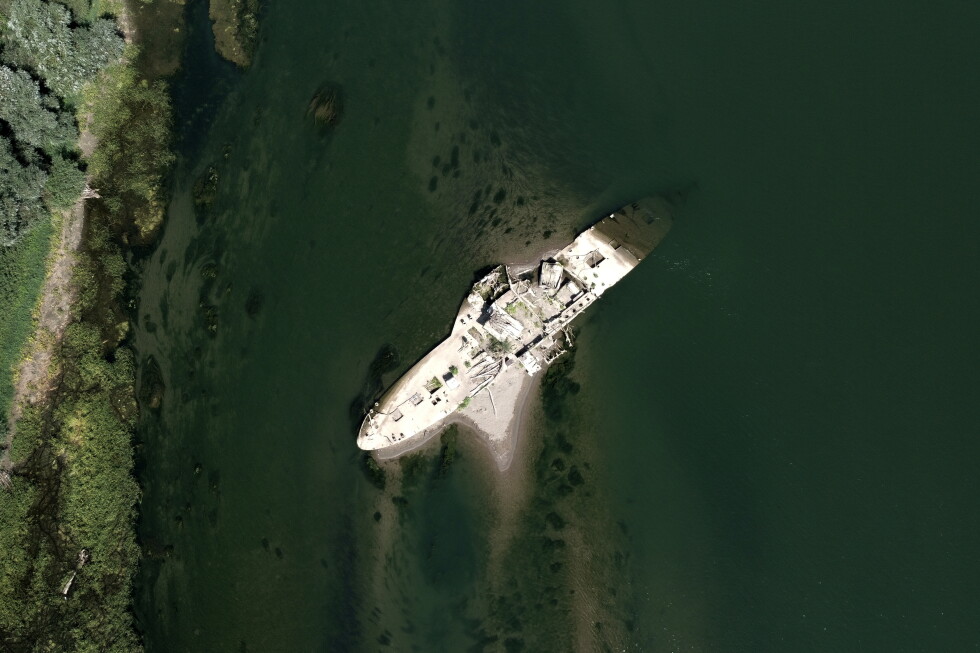
Amid an unprecedented prolonged heatwave and crippling drought that has parched major European waterways, a well-preserved early 20th-century steam tugboat wreck has become the latest historical artifact to resurface from receding river waters in northern Serbia.
Known colloquially as the Slovenian, the rusted iron hull of the vessel was exposed earlier this month along the banks of the Sava River near Sremska Mitrovica, a small town located roughly 45 miles northwest of Serbia’s capital Belgrade. While small portions of the wreck have poked above the waterline during previous dry periods, local historians and residents confirm the vessel has never been this fully visible in modern memory.
Historian Andrija Popovic, director of the Sremska Mitrovica town museum, told reporters the unusual full exposure of the wreck has sparked intense public curiosity. Dubbed “Sava’s Titanic” by Serbian national media, the vessel has a century-long history tied to two world wars and the shifting political borders of Central Europe. According to Popovic’s research, the Slovenian was originally constructed in 1913 at a Budapest shipyard, when the city was still part of the Austro-Hungarian Empire. Measuring 177 feet in length, the steam-powered boat was first named *Vag*—the Hungarian name for the Vah, Slovakia’s longest river—and worked pulling heavy cargo barges along the Danube between Budapest and regional trading hubs.
The vessel’s service paused entirely during World War I, and when the conflict ended with the collapse of the Austro-Hungarian Empire, it was transferred to the newly created Kingdom of Serbs, Croats and Slovenians (the precursor to modern Yugoslavia) as part of post-war reparations. It was at this point that the boat was renamed the Slovenian, a choice of name that Popovic says remains a historical mystery.
The tugboat saw further action during World War II, when it fell under Nazi German occupation following the invasion of Yugoslavia. When Yugoslav anti-fascist forces retook Belgrade in 1944, the Slovenian was pressed into service to evacuate wounded fighters and transport military equipment as allied troops pushed retreating German forces westward. In late April 1945, just weeks before the end of the war in Europe, the vessel struck a German naval mine off the Sremska Mitrovica coast and sank, remaining undisturbed on the riverbed for nearly 80 years until this summer’s drought.
The Slovenian is far from the only relic uncovered by Europe’s shrinking rivers this year. Along Serbia’s eastern border with Romania, rusted hulls of Nazi German Black Sea fleet warships—scuttled by retreating German troops in the final days of World War II to block the waterway—are now protruding from the Danube’s depleted waters, some still holding leftover ordnance. In Italy, the most severe drought in 70 years has exposed the stone piers of a 1st-century Roman bridge over the Tiber River, a structure used by emperors that fell into ruin by the 200s CE. On the Bulgarian banks of the Danube, paleontologists recently recovered a complete set of bones, including a jaw, tusks, and rib fragments, from an extinct woolly mammoth that had been buried in river sediment for millennia.
Beyond uncovering long-lost artifacts, the record-breaking drought has wreaked widespread havoc across the continent. Record low water levels on the Danube—Europe’s second-longest waterway—have disrupted commercial shipping and cut into cooling water supplies for nuclear power plants in Hungary and Romania, forcing output cuts. From the Netherlands to Bosnia, months of unrelenting heat and dryness have destroyed cereal and vegetable crops, while severe water shortages have reached as far inland as the high Alps. Even alpine visitor facilities in Slovenia have been forced to implement strict water restrictions: the Triglav Lodge, the highest-elevation mountain guesthouse in the country at 8,251 feet above sea level, has switched entirely to disposable paper plates this summer to cut down on water used for dishwashing.
Climate data confirms Europe is warming faster than any other continent on Earth, with average temperatures rising twice as fast as the global mean since the 1980s, per analysis from the European Union’s Copernicus Climate Change Service. By the end of July 2026, half of the European Union and the United Kingdom was experiencing some level of drought, with 9% of territory classified at the most severe “alert” level, according to the European Drought Observatory.
Scientists warn that human-caused climate change is steadily increasing both the frequency and intensity of extreme heat and drought events across the continent. Dejan Vladikovic, a leading Serbian hydrology expert, explained that this year’s extreme dry conditions stem from a combination of minimal winter snowpack and an unusually rainless spring. “What awaits us in the future is that such situations will be more frequent,” Vladikovic said. “We are entering periods when this will, unfortunately, become the new normal.”