Deep in Western Ukraine, tucked behind reinforced high walls and multiple layers of secured locked gates, sits a prisoner of war camp holding dozens of men captured while fighting on behalf of the Russian military. A closer look at the camp’s population reveals a striking, complex reality of the ongoing war: unlike the initial wave of conscripts drawn mostly from remote, economically depressed Russian regions at the start of the 2022 full-scale invasion, many current detainees are recruited from major Russian urban centers including St. Petersburg and Yekaterinburg. More surprisingly, a notable share of the prisoners are not Russian citizens at all – they are Ukrainian-born men who took up arms against their home country.
Gaining meaningful access to interview prisoners of war carries significant challenges. Reporters must first confirm that no coercion is being used to force participation, then gauge how open subjects can be under detention conditions. With independent journalists barred from embedded access to Russian military units inside Russia, however, these interviews offer a rare, unfiltered window into the shifting dynamics of the war and the varied motivations that drive men to fight for Moscow – including those born on Ukrainian soil. All participants were given the option to decline interviews, and conversations with willing subjects were conducted far from guard posts and off-camera. Beyond structured formal interviews, the reporter was able to hold direct, Russian-language conversations with detainees across multiple locations within the facility.
The camp holds detainees from two core groups: soldiers pulled from major Russian cities, and Ukrainian natives from Russia-occupied eastern Ukrainian territories. For one Ukrainian-born detainee, 20-year-old Anton, his connection to the Russian side began when he was just 10 years old, when his home region in eastern Ukraine’s Donbas fell to Moscow-aligned separatist forces. When he turned 18 in 2022, the same year Russia launched its full-scale invasion, he immediately enlisted in the Russian army.
“I don’t regret my choice. I went to defend my land,” Anton says, adding that most of his close friends also volunteered. Now, he says, he receives repeated text messages notifying him of their deaths: “Dead, dead, dead.” Multiple other prisoners echoed his account, reporting that nearly all of their original units have been killed in action, and far fewer new volunteers are stepping forward to replace them – even with the promise of massive enlistment bonuses. This trend suggests that Putin’s goal of avoiding politically unpopular large-scale domestic mobilization may soon face new pressures.
Under Ukrainian law, Ukrainian citizens captured fighting for Russia are charged with treason, but after trial they are transferred to standard POW camps alongside Russian detainees. Officially, Kyiv still recognizes these men as Ukrainian citizens and views Russia’s occupation of their home regions as temporary, but on-the-ground realities are far more nuanced. “They’re very pro-Russian, and their national identity is very blurred,” explains Petro Yatsenko, a representative from Ukraine’s coordination headquarters for prisoners of war.
Anton rejects any label of traitor, saying firmly, “I consider myself Russian. A country means nothing, it’s all about nationality. All my family are from Russia. All my roots are from there.” When asked about his Ukrainian surname, he dismisses it as a meaningless irrelevant detail.
Anton’s identity is not an anomaly: an entire generation of Ukrainians born in occupied Donbas has grown up under Russian rule, attending Kremlin-controlled schools and consuming state-aligned Russian media that has portrayed Kyiv’s government as “Nazi” and illegitimate for nearly a decade. Since the 2022 full-scale invasion, this model of cultural and political reorientation has been expanded to newly captured territories across the country. Anton has fully internalized this narrative, repeating standard Russian talking points consistently: he refers to Putin as “my President” and supports a continued push to seize the entire Donbas, even after hundreds of thousands of deaths on both sides. “It’s a shame that people died, especially those who are innocent,” he says. “But war is war. It could have been ended. But no-one wanted to do that.”
In the camp’s hospital, 20-something Artyom lies in a corner bed, his body riddled with shrapnel from battlefield fighting. He had only served two months on the front lines before being captured. Like Anton, he is a native of Donetsk and enlisted voluntarily, and he says financial incentives were not his only motivation. “We have our own grudges,” he explains, referencing the heavy shelling his region faced in 2014 when Ukrainian forces moved to stop the separatist breakthrough.
His experience in the Russian military left him deeply embittered. He describes his commander as incompetent, and says he never received the 400,000 rouble (approximately £3,470 or $5,000) enlistment bonus he was promised. To add to his grievances, the wounded Russian soldier in the bed adjacent to his received five times that signing bonus.
Within the camp, detainees are allowed to work to earn small wages that can be spent on extra food, cigarettes, and other small comforts. In one outbuilding, POWs assemble wooden coffins for local clients – a macabre assignment that comes after a previous contract to build garden sheds. In a separate workshop across the courtyard, a small group of prisoners constructs artificial Christmas trees and paints holiday decorations, work that will likely end up on the tables of Christmas shoppers across Ukraine. Both groups say their earnings go to small extra comforts they cannot get through standard camp rations.
Sergei, another detainee, was born in the occupied Ukrainian city of Luhansk, but identifies as Russian, following his parents who moved to the Donbas when both Ukraine and Russia were part of the Soviet Union. He enlisted in the Russian military a decade ago “to defend my homeland,” but says that if he is released, he will retire and never return to the front. “I’ve done my bit,” he says. For most detainees, however, that choice is not available.
Working next to Sergei stacking plastic tree branches is Konstantin, a former drug dealer who enlisted in the Russian military exclusively to avoid serving a 15-year prison sentence in Russia. “For me, 15 years in prison was too much,” he explains. “I know it probably doesn’t excuse me, but it’s a fact. I’m 44 now, I would be 60 [when I got out]. So no.” These so-called “convict soldiers” only earn their freedom if they survive until the end of the war, a grim outcome for troops assigned to high-casualty assault units. Three convicted murderers interviewed for the report shared that they had been promised release after one year of combat, only to have their contracts automatically extended without warning.
When asked about fighting and killing fellow Ukrainians on the battlefield, Sergei dismissed the question as “provocative” and declined to answer. Konstantin answered carefully, acknowledging the tragedy of the conflict: “I see nothing good in any war, and in a war like this there can be nothing good a priori. I’m not saying we’re the same as Ukrainians, but we are close. We all have relatives there. This just isn’t good.” Even so, he still believes his choice to enlist was the right one for his circumstances.
Neither Konstantin nor Sergei expect the war to end soon, and both agree that Putin will not halt his campaign until he controls the entire Donbas. “But everyone I know there has had enough,” Konstantin says. “I just want this to be over, as soon as possible.”
While most of the Ukrainian-born POWs interviewed were from 2014-occupied territories and joined voluntarily, there are exceptions. One Donetsk native said he was forcibly conscripted into the Russian army. He appeared visibly nervous during the interview, constantly scanning the room for listeners, unsure of who he could trust. Official Ukrainian intelligence estimates that more than 50,000 Ukrainians have been forcibly conscripted in occupied regions, with independent analysts putting the number far higher. This detainee said his family remained in Donetsk after the invasion not out of loyalty to Russia, but simply because it was their home. Now, his only goal is to return to his wife and children, and hide to avoid being sent back to the front if he is released: “I’m just going to hide,” he confided.
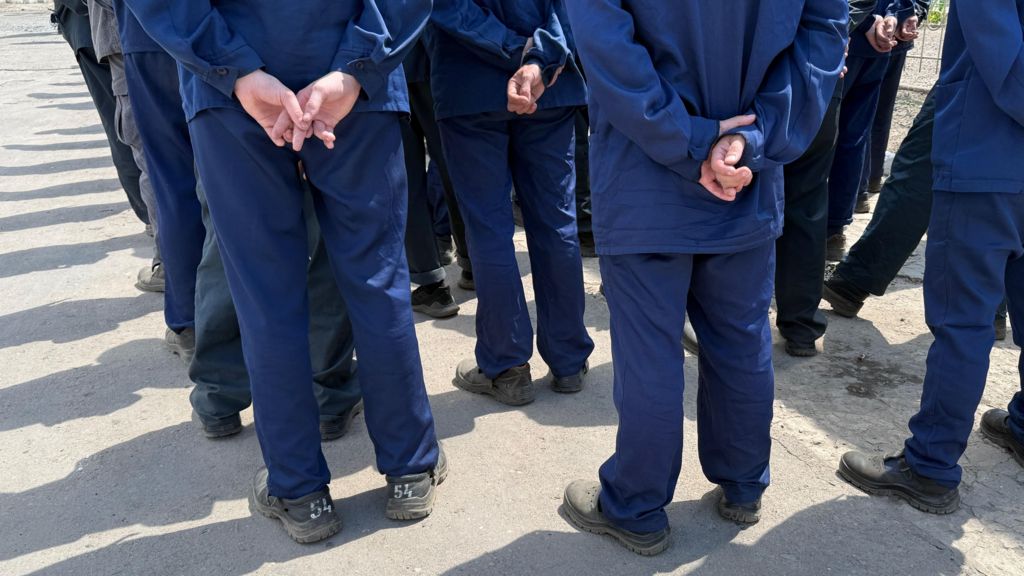
At lunchtime, detainees in navy blue overalls file into the camp dining hall, heads bowed and hands clasped behind their backs. As they eat a simple meal of soup and stew, a video titled *Myths about Crimea* plays on a loop, debunking Russia’s false claims to historic ownership of the peninsula that Moscow illegally annexed from Ukraine in 2014. None of the prisoners pay any attention to the broadcast. Kyiv’s so-called “re-education” efforts for these POWs appear half-hearted at best; the government’s core priority for the detainees is to use them as bargaining chips for prisoner swaps to bring captured Ukrainian soldiers home. Even that path to freedom is uncertain for the Donbas natives, however: Russia has shown little interest in exchanging these men. “Only a dozen or so have been transferred this year,” Konstantin says. “It seems like they don’t want to exchange us. I think we will be the last to go.”
Additional reporting by Anastasia Levchenko