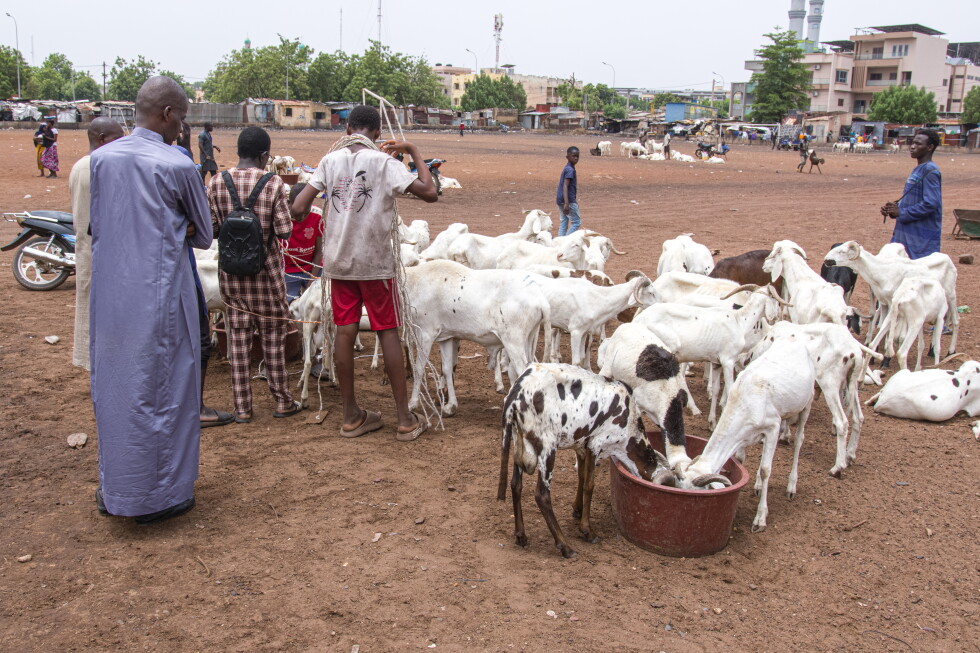
As millions of Muslims across the globe gear up for the annual Eid al-Adha festival of sacrifice, the holy occasion is tinged with heartbreak and hardship in Bamako, the capital of conflict-stricken Mali. A months-long blockade enforced by al-Qaida-affarmed insurgents has sent livestock prices skyrocketing, pushing the holiday’s central religious ritual — slaughtering an animal and distributing its meat to low-income communities — out of reach for countless local families.
The crisis stems directly from a blockade of major supply routes into Bamako announced earlier this month by Jama’at Nusrat al-Islam wal-Muslimin (JNIM), the main al-Qaida-linked militant group operating in the Sahel. The fighters have systematically targeted and burned convoys of commercial trucks carrying goods and fuel heading toward the capital, choking off the steady flow of supplies the landlocked nation depends on. Unlike many neighboring coastal countries, Mali has no direct access to international seaports, so nearly all essential goods, from fuel to livestock, are trucked in from neighbors including Senegal and Ivory Coast.
Analysts note the blockade is a deliberate strategic move: militants aim to cripple the national economy to erode public trust in the ruling military junta, which seized power in a 2020 coup. The blockade is not entirely sealed — insurgents avoid maintaining permanent roadblocks for fear of retaliation from Malian government forces, allowing small volumes of goods to trickle into the city. This limited flow has so far prevented a total breakdown of food access, but it has been enough to send prices of key goods including meat soaring and create widespread fuel shortages, forcing residents to queue for hours at the handful of gas stations still open.
This is not a sudden disruption. JNIM has already enforced a stifling blockade on oil imports into the country since September 2025, laying the groundwork for the current crisis ahead of the major holiday. For ordinary Bamako residents, the impact hits closest to home during Eid al-Adha, where the sacrifice of a sheep is a centuries-old central tradition.
Mountaga Touré, a 38-year-old local teacher, told reporters he visited multiple livestock markets across the city before abandoning his plan to purchase a sheep for his family. Since the blockade took effect, prices have jumped by nearly 50%: a small sheep that previously cost roughly $177 now sells for $266 or more, out of his budget. To adapt, many families in Bamako’s neighborhoods have begun pooling funds to buy cows instead of the traditional individual sheep, a last-minute adjustment to ensure they can still have meat for the holiday.
The current blockade follows a sweeping wave of coordinated attacks across Mali carried out by separatist and jihadi forces last month — the largest large-scale offensive the country has seen in more than 10 years of ongoing insurgency. Mali has been grappling with overlapping crises for over a decade: a separatist rebellion in the northern regions, paired with expanding insurgencies led by militants affiliated with both al-Qaida and the Islamic State group. After the 2020 military coup, the ruling junta cut ties with Western security partners and turned to Russia for military support against the insurgency. But analysts confirm that security conditions across the country have deteriorated sharply in recent months, with a record high number of militant attacks recorded. Both government forces and Russian mercenary groups have also faced accusations of extrajudicial killings of civilian residents suspected of collaborating with insurgents.
At present, the Malian army, backed by Russian Africa Corps mercenaries, has attempted to circumvent the blockade by providing armed escorts for supply convoys heading to Bamako’s markets. Military officials regularly announce strikes on militant-held positions to clear routes. But residents and traders say these efforts have not been enough to restore steady, adequate supply to the capital.
Amadou Cissé, a 45-year-old livestock trader who has specialized in supplying Eid sheep for Bamako markets for years, explained that under normal circumstances he would bring up to 200 sheep to the capital for the holiday (known locally as Tabaski) each year. This year, he has only managed to transport 50, because limited space on army-escorted convoys restricts how much livestock he can move. Most of his ordered sheep remain stranded in Diema, a major livestock producing town 215 miles west of Bamako. “I was told more escorted convoys would be organized, but so far none have left Diema, so I doubt the sheep will arrive before the holiday,” Cissé said.
Drissa Traoré, another Bamako-based sheep seller with more than a decade of experience, confirmed that overall supply has dropped by 50% compared to typical Eid seasons. “This year, we have barely half the number of sheep we usually have during Tabaski,” he said.
Beyond disrupting holiday meals, the insecurity has upended long-held holiday travel traditions. Sidi Diarra, an employee at a major Bamako financial institution, typically travels 240 kilometers to the city of Segou each year to celebrate Eid with his parents. This year, he has canceled his plans out of fear of militant attacks along the route. “This year, I am afraid to go because of attacks by extremist groups. It is safer to stay in Bamako,” he said.