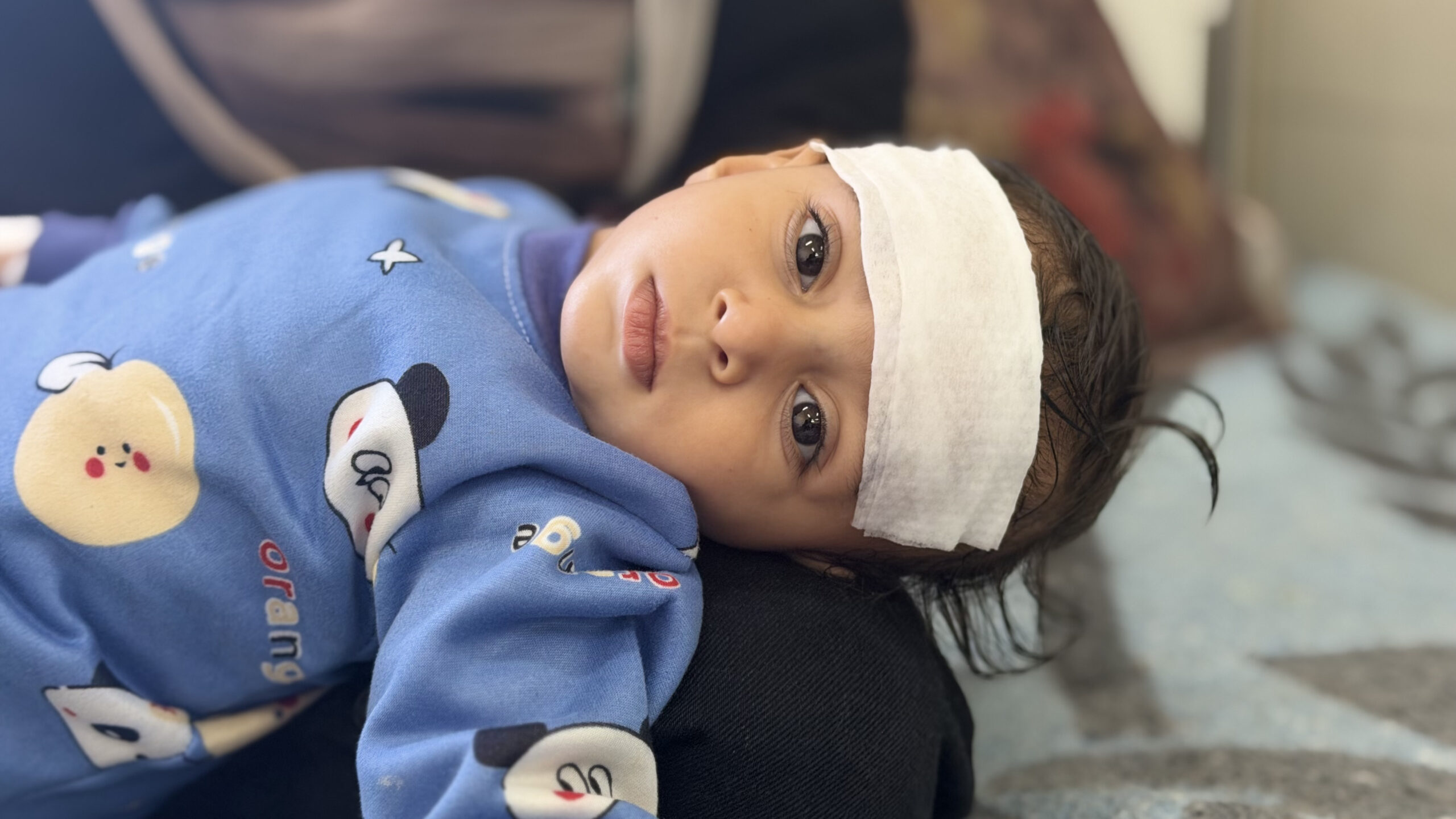
Two-month-old Palestinian infant Mostafa Hallawin has spent 10 consecutive days confined to a bed at Gaza City’s Al-Rantisi Children’s Hospital, fighting a life-threatening meningitis diagnosis that followed a persistent 39°C high fever and recurring abdominal swelling. His mother, Amal, shared that the illness first manifested as a widespread skin rash paired with the unyielding fever, and while clinical teams run daily scans and lab tests to monitor his condition, he has shown barely any signs of recovery — a setback she attributes directly to crippling shortages of critical medications across the enclave.
Mostafa is among the hundreds of young patients caught in a rapidly accelerating meningitis outbreak sweeping Gaza, where years of conflict have all but dismantled the local healthcare system, and sustained restrictions on essential medical supplies leave care providers severely under-resourced. Data from the UN Office for the Coordination of Humanitarian Affairs (OCHA) documents 413 suspected meningitis cases recorded between 27 September and 31 October alone, split between 294 viral and 119 bacterial infections, with 68% of all cases concentrated in Gaza City. On Tuesday, the Palestinian Health Ministry formally issued a territory-wide epidemic alert, flagging the sharp upward trajectory of both meningitis infections and associated fatalities. The ministry’s full year-to-date tally counts 1,790 total diagnosed meningitis cases since the start of 2024, with 15 confirmed deaths, and no fewer than 272 new confirmed infections logged in October alone.
Public health experts trace the explosive spread of infectious diseases across Gaza to cascading systemic failures spurred by ongoing conflict: overcrowded mass displacement shelters with no capacity for physical distancing, severely compromised sanitation networks, and near-total collapse of routine primary care services. A 2024 World Health Organization assessment previously warned that microbiological contamination rates in tested Gaza water samples had skyrocketed from less than 6% in January to nearly 20% by August, a figure that has likely climbed further in recent weeks following unseasonably heavy rainfall. The downpours triggered widespread flooding across residential areas, mixing raw sewage with damaged, exposed drinking water pipelines to create a perfect breeding ground for waterborne pathogens.
Al-Rantisi Children’s Hospital, which sustained heavy structural damage during direct Israeli military attacks earlier in the conflict, now operates at far over its intended patient capacity, with every bed occupied by sick children, many battling meningitis and other contagious illnesses. Amal notes that the facility lacks functional isolation wards, basic hygiene stations, clean meal services, and access to safe drinking water — conditions that allowed her son’s already fragile health to decline further during his hospital stay. “We lost our homes and our entire way of life to this war,” she pleaded in a direct appeal to global humanitarian stakeholders. “We cannot bear to lose our babies too. Lift the restrictions and let life-saving medicines and medical equipment into Gaza.”
The crisis has upended daily life for countless displaced families across the enclave. Reham Wahdan, who fled her destroyed home in Gaza City’s eastern Shujaiya neighborhood to shelter in a repurposed, partially ruined wing of the Islamic University of Gaza, watched her nine-month-old son Mohammed develop a relentless high fever shortly after a visit to a neighboring family staying in a makeshift tent. After nearly a month of failed attempts to reduce his fever with over-the-counter medications at under-equipped field medical posts, Mohammed was formally diagnosed with meningitis via a lumbar puncture procedure at Al-Rantisi Hospital. Wahdan confirmed her displaced community has no access to treated drinking water, forcing families to rely on contaminated local sources and irregular, insufficient food aid distributions.
Dr. Nidal Ghunaim, deputy director-general of primary public health care at the Palestinian Health Ministry, confirmed that both bacterial and viral meningitis case volumes have surged far above average levels recorded in previous years, driven largely by enterovirus spread that is directly tied to Gaza’s collapsing environmental and public health infrastructure. He warned that recent flood events have drastically amplified contamination risks, and any future heavy rainfall events could push the outbreak to catastrophic levels. The healthcare system also faces crippling gaps in lab testing reagents, life-saving treatment courses, and dedicated isolation space to contain transmission. Ghunaim called for urgent, coordinated international intervention to deliver sustained support for Gaza’s water, sanitation, and public health systems, emphasizing that full rehabilitation of the damaged drinking water distribution network must be treated as a top global humanitarian priority.
For 5-year-old Mohammed, who returned home from his Gaza City kindergarten with a sudden high fever that would not respond to at-home cooling treatments, his grandmother Reem Hamada has kept a constant vigil at his bedside at Al-Rantisi for 10 straight days, watching his fever persist even as he lies semi-conscious with a cool compress resting on his forehead. As his only grandchild, Hamada says the unnecessary suffering of the territory’s youngest residents has left the displaced population in a state of total despair. “We are not living anymore,” she said through tears. “We might as well already be dead.”