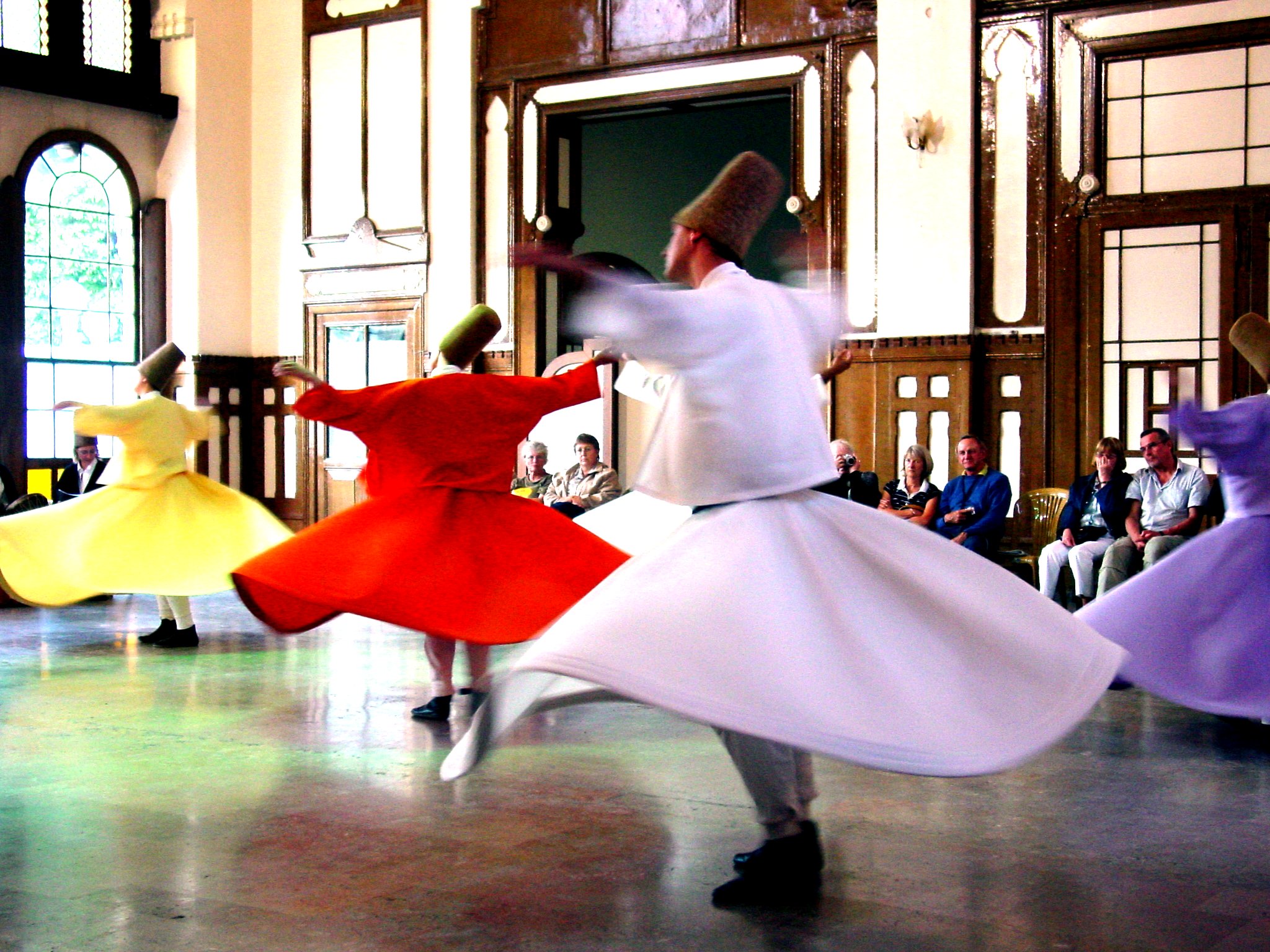
Each December, thousands of pilgrims and cultural visitors flood the historic Turkish city of Konya to honor the 1273 passing of 13th-century Sufi poet Jalal al-Din Rumi. His followers refer to the anniversary as *Shab-e ‘Arūs*, or the “wedding night”, a sacred occasion marking their belief that Rumi’s soul achieved full, unbroken union with the divine. In the centuries immediately following his death, his close disciples founded the Mevlevi Order, a Sufi mystical brotherhood widely recognized in Western popular culture as the community of whirling dervishes. Rooted in Persian terminology for a devout seeker committed to ascetic spiritual discipline under a master, the Mevlevi lodges grew into vibrant hubs of artistic and religious innovation across the Ottoman Empire, where their musicians laid foundational groundwork for classical Ottoman music, and the iconic whirling Sema ritual remains one of Turkey’s most globally identifiable cultural emblems today. The formal Sema ceremony opens with a reverent hymn honoring the Prophet Muhammad, followed by the haunting, reedy melody of the traditional ney flute. Accompanied by steady drumbeats and chanted sacred verse, white-robed dervishes spin in synchronized, gentle motion across the ceremonial hall, right palms raised upward to receive divine blessing and left palms tilted downward to pass that grace out to all the world. For Mevlevi practitioners, this whirling is never a public performance: it is a fully embodied act of Islamic worship, a living remembrance of God that engages every part of the human form. Half a world away in the United States, Rumi’s verses have become ubiquitous, printed on wedding programs, painted on yoga studio walls, and shared millions of times across social media feeds, making him one of the highest-selling poets in the country. Yet the vast majority of these casual American fans have no awareness that nearly all of Rumi’s work is deeply rooted in his identity as a practicing Muslim legal scholar and preacher, steeped in Islamic mystical tradition. As a researcher specializing in Sufism, the mystical inner tradition of Islam, Harvard religious studies PhD candidate Peter Dziedzic points out a stark disconnect between these two iterations of Rumi: the devout, faith-centered mystic venerated annually in Konya, and the decontextualized generic spiritual sage quoted freely across Instagram feeds. The wildly popular English translations that catapulted Rumi to U.S. fame systematically strip away the explicit Islamic spiritual core that forms the very backbone of his poetic vision. Born in 1207 in Balkh, a city located in modern-day Afghanistan, Rumi fled west with his family as the Mongol Empire’s sweeping military campaigns advanced across Central Asia, eventually settling permanently in Konya. Following in the footsteps of his father, respected Islamic preacher Baha al-Din Walad, Rumi trained extensively in Islamic law and theology, building a reputation as a deeply knowledgeable, beloved teacher. The trajectory of his life shifted entirely in 1244, when he formed an intense, transformative spiritual bond with Shams of Tabriz, a wandering unorthodox Sufi master. After Shams mysteriously disappeared several years later, Rumi channeled his profound longing for his beloved spiritual companion into thousands of lyrical ghazal poems, later compiled into the *Divan-e Shams*, most of which were composed during communal gatherings of devotional music and dance. His magnum opus, the *Masnavi-ye Ma’navi* (Spiritual Couplets), took the form of a sprawling masnavi: a traditional Persian poetic structure built on rhyming couplets, where each pair of lines shares a rhyme, and subsequent couplets can shift to new rhyme schemes, allowing poets to craft lengthy, meandering narratives unconstrained by a single sustained rhyme. Begun around 1258 at the urging of his closest disciple Husam al-Din Chelebi, the work runs to nearly 25,000 couplets across six full volumes, dictated by Rumi until the final days of his life. The poem opens with the iconic, mournful song of the ney reed flute, a classic Sufi metaphor for the human soul grieving its separation from the divine source it was cut from when it entered the mortal world. What follows is not a single linear story, but a rich, layered tapestry of animal fables, folksy anecdotes, retellings of Quranic narratives, and meditations on the sayings of the Prophet Muhammad and generations of earlier spiritual scholars. Rumi himself described the *Masnavi* in its Arabic preface as “the roots of the roots of the roots of religion” and “the explainer of the Quran”, a bold framing that reflects the work’s structure: nearly every section is woven with untranslated original Arabic Quranic verses, which Rumi unpacks through vivid, accessible stories and imagery to illuminate their deeper, mystical meanings. For centuries, Muslim communities spanning from the Balkans to South Asia have gathered in small study circles to read and unpack the *Masnavi* line by line, with a 15th century verse attributed to celebrated poet Jami famously calling the work “the Quran in the Persian tongue”. The gap between this sacred, faith-rooted original text and the versions most American readers encounter stems from inherent tradeoffs in translation, compounded by deliberate editorial choices. While rigorous, academically faithful English translations of Rumi’s work exist – including early 20th century versions by scholar Reynold Nicholson, and a widely praised six-volume complete *Masnavi* translation by Jawid Mojaddedi first released in 2004 – the vast majority of popular U.S. editions are the work of American poet Coleman Barks, who began publishing his reworked versions in the 1970s. Barks had no ability to read Persian, and instead rewrote existing scholarly literal translations into flowing, accessible free verse, a process Duke University Sufism scholar Omid Safi has termed “double translation”. As Mojaddedi explained in an interview with *The New Yorker*, “The Rumi that people love is very beautiful in English, and the price you pay is to cut the culture and religion.” Explicit references to the Quran, the Prophet Muhammad, and Muslim daily ritual are routinely softened or removed entirely, with the specific term “God” often replaced with the vague, generic “the Beloved” to fit New Age spiritual frameworks. Two of Barks’ most famous widely shared lines illustrate this erasure clearly: his beloved “There are hundreds of ways to kneel and kiss the ground” is a reworking of a line that explicitly references ruku and sujud, the specific bowing and prostration movements of the five daily mandatory Islamic prayers, stripped down to a vague universal image of reverence. Even more strikingly, his iconic line “Out beyond ideas of wrongdoing and rightdoing, there is a field. I’ll meet you there” is a sanitized reworking of Rumi’s original Persian, which reads directly as “Beyond Islam and unbelief, there is a desert plain.” Far from advocating a rejection of morality or religious faith, Rumi’s original line is a radical classic Sufi argument that the highest, most intimate love of God transcends the manmade labels believers use to sort insiders from outsiders – a provocative, deeply meaningful statement coming from a respected Muslim legal scholar, which the popular translation reduces to generic, watered-down advice to avoid judgment. Dziedzic argues that this widespread erasure of Rumi’s Islamic identity is far more than a trivial academic debate: for millions of Americans who have never engaged with a Muslim author before, their exposure to Rumi shapes their entire understanding of Islamic spiritual tradition. Safi describes this deliberate stripping of Rumi’s faith as “spiritual colonialism”, a process where Western audiences extract the aesthetic beauty of his poetry while discarding the centuries of Muslim community life and devout tradition that gave birth to it. This dynamic is particularly damaging in an era where Muslim communities are often framed as outsiders in mainstream U.S. public life, as it perpetuates the false narrative that profound, beloved spiritual wisdom can only be accepted if it is disconnected from its Islamic roots. The scholar does not argue that American readers should abandon Barks’ accessible, widely loved translations, which successfully introduced millions of people to a poet they would likely never have encountered otherwise. Instead, he calls for a broader shift toward reading Rumi the way Muslim communities across Turkey, Iran, Afghanistan, and South Asia have for centuries: as a poet whose radical, expansive vision of divine love grew directly out of his Islamic faith, not in spite of it.