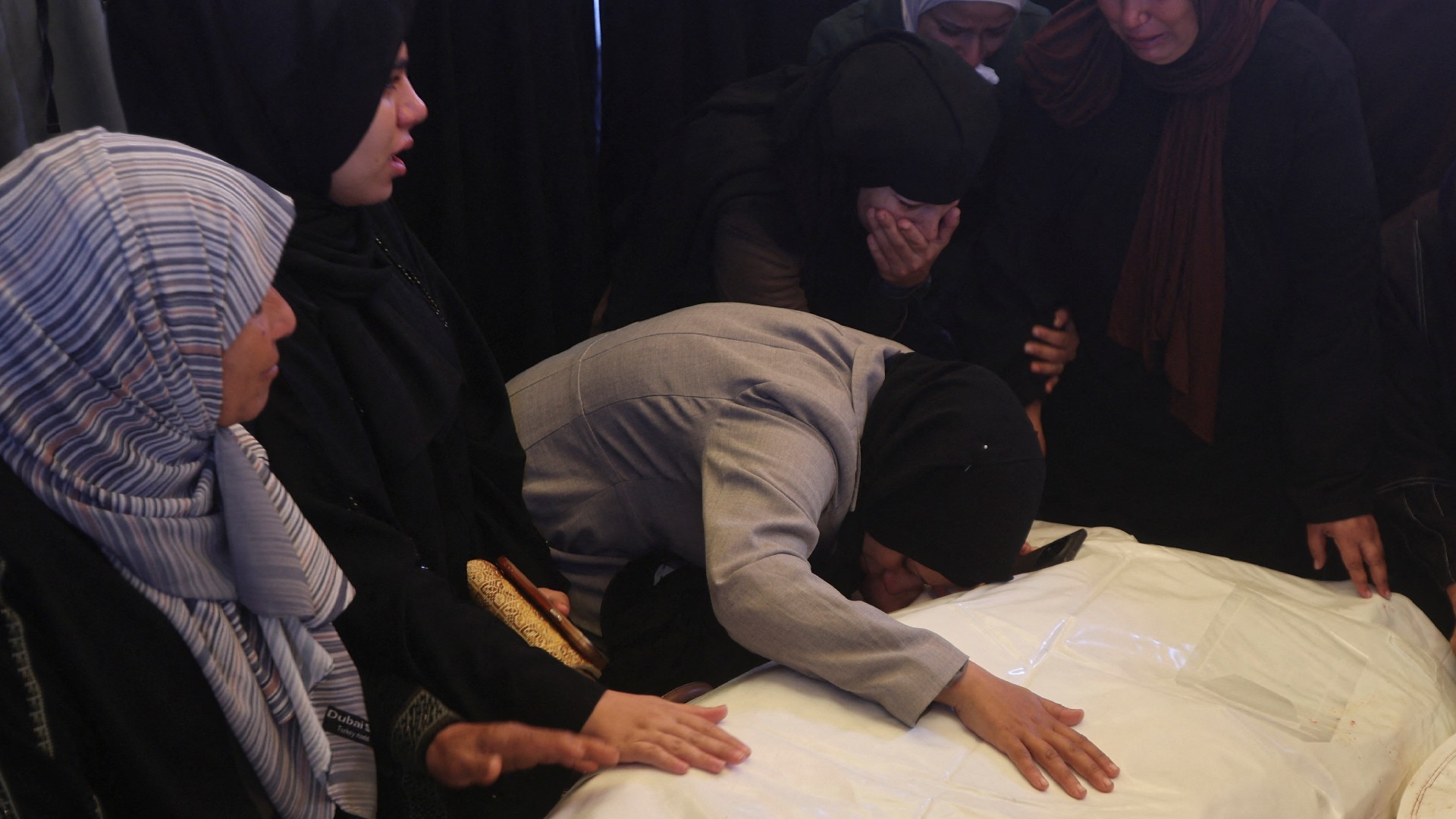
A high-ranking Palestinian education administrator and his spouse are the latest casualties in a wave of Israeli targeted strikes against Hamas senior leadership that has unfolded over the past seven days, per verified updates from Gaza’s medical response teams.
Khaled Abu Nada, the undersecretary of Gaza’s Ministry of Education, and his wife lost their lives when an Israeli strike hit a residential complex in the Deir el-Balah district of central Gaza, medics based at Al-Aqsa Hospital confirmed. The medical team noted six additional people sustained injuries in the attack, with several in critical, life-threatening condition. Abu Nada held a formal seat on Hamas’s political bureau alongside his post as deputy education minister.
On-the-ground reporting from Al Jazeera reveals Israeli Apache attack helicopters launched two consecutive, direct missiles at Abu Nada’s apartment without any prior warning, timing the assault during the traditional dawn prayer period. The outlet added that the surrounding neighborhood was densely populated with makeshift tents housing internally displaced Palestinian families who had fled earlier waves of violence.
Israeli caretaker Prime Minister Benjamin Netanyahu and Defence Minister Israel Katz publicly confirmed Abu Nada’s assassination in a joint statement, framing the killing as part of ongoing operations against Hamas. The pair characterized Abu Nada as a senior Hamas figure overseeing the group’s economic and education portfolios, and claimed that the broader targeted campaign against Hamas operatives and ranking officials has eliminated roughly 80 group members over the preceding 30 days. Notably, the two Israeli leaders did not allege any active military operational role for Abu Nada.
Abu Nada’s death comes on the heels of a string of similar targeted killings of Hamas officials in recent days. In the early hours of Wednesday, Mohammed Abu al-Ouf, the internal security chief for northern Gaza, was killed alongside his wife and two teenaged daughters, aged 13 and 15. One day prior, Naim Abu Nahl, Gaza’s top internal security director, was fatally struck in a separate Israeli attack.
Gaza’s Ministry of Interior released an official statement arguing that the wave of targeted assassinations is a deliberate Israeli tactic to sow widespread chaos and breakdown of public order across the enclave. “What is unprecedented here is the direct, deliberate targeting by Israeli forces of security and police commanders through extrajudicial assassination,” explained ministry spokesperson Abu Amra. The Jerusalem Post noted that Abu Nada’s killing represents a clear inflection point in Israel’s longstanding targeted assassination policy in Gaza, with the explicit stated goal of dismantling Hamas’s governing and administrative control over the territory.
Hamas’s official statement condemned Abu Nada’s killing as “another heinous crime added to the Israeli occupation’s decades-long track record of intentionally targeting civilians, education sector staff, residential buildings, and dense civilian neighborhoods across the Gaza Strip.”
The surge in deadly Israeli operations did not end with Abu Nada’s assassination: seven additional Palestinians were killed in separate Israeli attacks across Gaza on Thursday alone. Local Wafa news agency documented an Israeli drone strike on a gathering of people in the al-Shati refugee camp, west of Gaza City, that left at least three people dead and multiple others wounded. Al Jazeera separately verified that Israeli forces shot and killed a 62-year-old civilian man in the Bureij refugee camp in central Gaza.
A spokesperson for Gaza’s Ministry of Public Health described the months-long spike in Israeli attacks as “a deliberate, systematic campaign targeting every single foundational pillar of daily life and public function across the Gaza Strip.”
Hamas senior leader Khalil Al-Hayya, who survived a close brush with an Israeli assassination attempt in a prior unreported strike, stated publicly on Thursday that the armed group cannot sustain the ongoing volume of continuous Israeli assaults. He confirmed that Hamas plans to convene cross-factional discussions with all other Palestinian political and armed groups to coordinate a unified response to “Israeli violations and the state’s policy of daily extrajudicial killings.” “The framework of continuous targeted killings and punitive blockade is completely unacceptable under the terms of the existing ceasefire agreement,” Al-Hayya emphasized.
Gaza’s health ministry released updated casualty figures noting that Israeli forces have killed no fewer than 1,600 Palestinians, with 130 of those fatalities recorded in the current month alone, since the so-called ceasefire arrangement was imposed in October of last year. The ministry’s full cumulative data records a total of 74,746 Palestinian fatalities from Israeli military operations since the outbreak of hostilities in October 2023.
UN High Commissioner for Human Rights Volker Turk issued a stark public warning on Wednesday about the rapidly escalating risk of additional mass atrocity crimes being perpetrated against Palestinian communities in both the Gaza Strip and the occupied West Bank, calling on every sovereign nation to take immediate, concrete action to intervene and prevent further loss of life. Turk pointed to a pattern of openly inflammatory public statements from senior Israeli government officials advocating for annexation of Palestinian territory, ethnic cleansing of Palestinian communities, and collective punishment of civilian populations, paired with an increasingly widespread and systematic pattern of documented human rights violations against Palestinians. “Across broad segments of Israeli society, the open incitement to hatred and to the commission of violations that qualify as atrocity crimes – including war crimes, crimes against humanity, and even acts meeting the legal definition of genocide – has been deeply disturbing and unacceptable,” Turk stated in his formal public address.
Israel kills Gaza deputy education minister and wife in fresh attack on Gaza