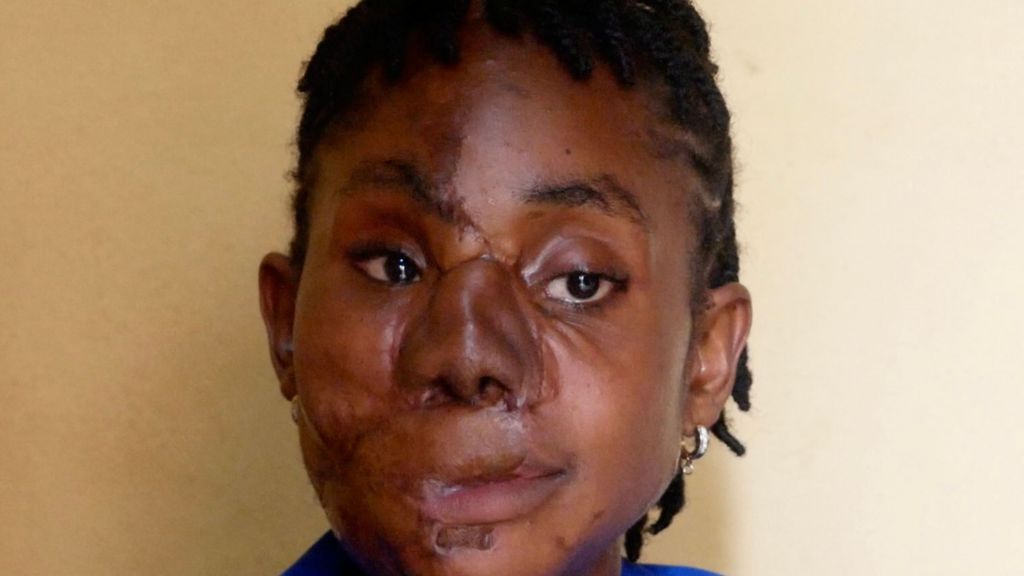
When 15-year-old Median Bah woke to the staccato of indiscriminate gunfire tearing through her family’s Southwest Cameroon compound on April 7, 2018, she could not have known that the ordinary sick day she was recovering from would irrevocably alter the trajectory of her entire life. Too weak from illness to scramble out the window alongside her fleeing older brother, the teen stumbled out the back door, where two unidentified armed assailants confronted her. Despite her desperate, trembling pleas that she was an unwell, unarmed minor, the men first shot her in the thigh before firing multiple rounds directly into her face. She lost consciousness on the spot, waking hours later to find her jaw shattered, most of her teeth blown out, and her ability to breathe or speak independently completely destroyed.
Eight years on, now 23, Median has undergone at least four grueling reconstructive surgeries across Cameroon, Ghana, and India, with more procedures scheduled for 2027. For nearly the entirety of those eight years, she relied on a tracheostomy tube inserted in her neck to draw breath, a device only recently removed to let her breathe normally for the first time since the attack. She is one of hundreds of thousands of ordinary civilians whose lives have been fractured by Cameroon’s long-running Anglophone crisis, a conflict that first ignited in October 2016 when English-speaking teachers and lawyers in the Northwest and Southwest regions launched peaceful strikes to protest systemic marginalization by the country’s Francophone-dominated central government. Demonstrators had decried the arbitrary appointment of French-speaking judges and educators to Anglophone courts and schools, but the government’s heavy-handed, excessive crackdown on the nonviolent protests paved the way for a rapid surge of armed separatist militias by 2017, groups fighting to carve out an independent breakaway state called Ambazonia.
In the years that followed, cycles of brutal violence between separatist fighters and government security forces have left a documented trail of widespread human rights abuses on both sides: separatist factions have been accused of targeted assassinations, ransom kidnappings, torture, and coordinated attacks on schools, while state security forces face well-documented allegations of arbitrary detention, extrajudicial killings, and widespread torture. Though both parties have largely denied the charges, UN data confirms the conflict has displaced more than half a million people internally, with over 70,000 Cameroonian refugees fleeing across the border to neighboring Nigeria. Human Rights Watch estimates at least 6,000 people have been killed in the fighting since its outbreak.
In the remote Ogoja border settlement in Nigeria’s Cross River State, 44-year-old Glory Akom is one of 15,000 Cameroonian refugees hosted across three local UNHCR-run camps. A disabled mother of two who survived severe burns unrelated to the conflict, she once ran a thriving small business in Cameroon that allowed her to comfortably support her family, until escalating government military raids in 2017 forced her to flee into the bush alongside hundreds of other terrified residents. For weeks, the family slept exposed in forest undergrowth to avoid being targeted by patrolling soldiers, before eventually crossing into Nigeria. Today, she lives in a UN-provided tin-roofed brick home, but survives on just $67 in monthly UNHCR cash assistance that barely covers food and the costly regular medical care required for one of her children, who lives with sickle cell disease. Like most of her fellow refugees, she has no clear timeline or guarantee that she will ever be able to return to the community and home she was forced to abandon.
For 21-year-old Maurine Mangha, who fled the Southwest Cameroon town of Akwaya with her family after separatist fighters opened fire on crowds during a self-declared “Ambazonia independence” celebration on October 1, 2017, the conflict derailed her secondary education entirely, after separatist militias imposed a strict, violently enforced boycott on all Anglophone region schools to pressure the central government. UNICEF data shared via Cameroonian education authorities confirms more than 200,000 children across the two conflict zones are currently out of school, with nearly 2,500 learning facilities fully shuttered. Though Maurine was fortunate to secure a UNHCR refugee scholarship to study microbiology at a local Nigerian polytechnic, she says she is constantly haunted by the fate of her former classmates who remained in Cameroon and never had the same chance to continue their education.
Nearly a full decade after the first protests erupted, the Cameroonian government has launched a new grassroots community dialogue initiative in a bid to end the fighting, after a similar 2019 disarmament program collapsed without stopping the violence. During public launches of the new initiative in the regional capitals of Buea and Bamenda, Prime Minister Joseph Dion Ngute urged local communities to persuade remaining separatist fighters to lay down their arms. As of November 2026, nearly 1,500 ex-separatist combatants are undergoing rehabilitation at official Disarmament, Demobilisation and Reintegration centers across the two Anglophone regions, according to a senior official overseeing the program. Former separatist commander Clovis Naseri, who spent two years fighting with the Southwest-based White Tigers of Ribbons militia before surrendering in 2019, now advocates for peace and national unity, noting that many remaining fighters have grown disillusioned with the independence movement after losing dozens of their comrades in combat.
Even so, analysts warn that the conflict will not end permanently until the central government directly addresses the original systemic marginalization grievances that sparked the crisis, a step critics say the administration of long-ruling President Paul Biya – who has held power since 1982 – has still not taken. For survivors like Median, Glory, and Maurine, the path to full recovery remains long and fraught with uncertainty, but all three cling to hard-won hope. “I defeated death,” says Median, who still resides in Cameroon as she continues her treatment. “There is nothing left that can stop me now.”
Shot in the face at 15: The lives shattered by Cameroon’s decade of conflict