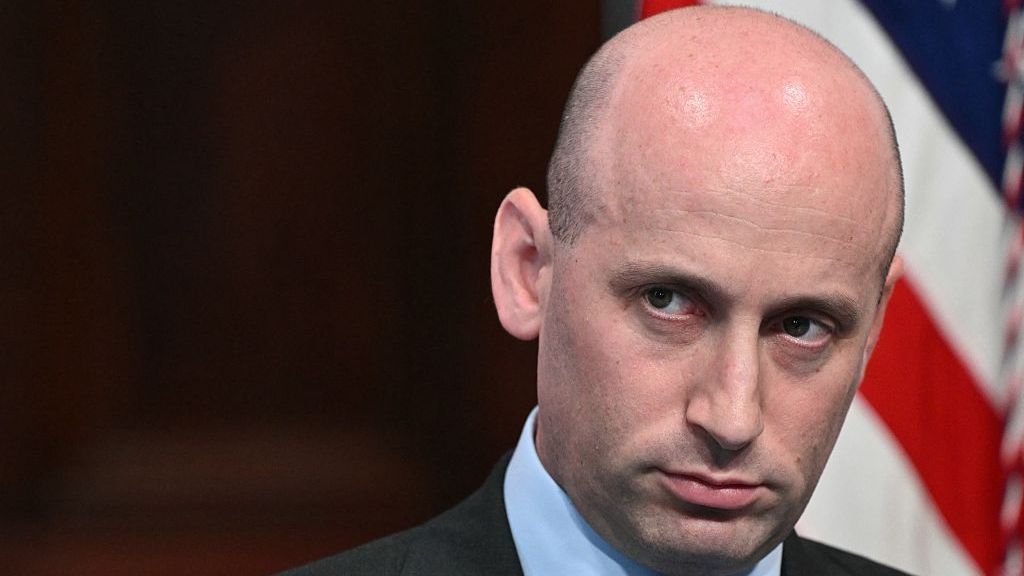
Just days after the Republican Party suffered a crushing, widespread defeat in the 2026 US midterm elections, where Democratic candidates secured majorities across key congressional chambers, President Donald Trump made a public gesture suggesting he was open to cross-party collaboration with the newly empowered Democratic caucuses on Capitol Hill. That tentative olive branch was swiftly cast aside on Friday, when Trump formally announced the promotion of Stephen Miller, his fiercely partisan, long-serving political operative, to the critical post of White House chief of staff, ousting the widely respected, operationally steady Susie Wiles from the top role. Miller, who has stood by Trump’s political orbit since the earliest days of his 2016 presidential campaign, framed his new appointment as a call to uncompromising action in a post on social platform X, writing, “The mission now is more clear than ever: Fight with all of our soul to support our president and defend this magnificent republic,” adding that he was deeply humbled by the president’s trust in him. As the highest-ranking administrative role in the West Wing, the White House chief of staff serves as the president’s primary gatekeeper, the lead architect of the administration’s daily policy and legislative agenda, and the administration’s top point person for negotiations with congressional leaders, industry stakeholders and external political groups. Trump defended his pick to reporters shortly after sharing the news on his own Truth Social platform, noting, “Stephen Miller’s been with me since the beginning. He gets it.” A defining figure behind the Trump administration’s notoriously aggressive immigration enforcement framework, Miller spearheaded sweeping expansions of federal funding for nationwide border and interior deportation operations. He drew widespread public backlash in 2025 when he labeled Alex Pretti, a civilian fatally shot by federal immigration agents during a large-scale deportation operation in Minneapolis, a “domestic terrorist” and “assassin”, before later walking back the remarks to note that federal officers on the scene may not have followed official operating protocols. He has also been cited as a central architect of recent controversial US military interventions in Venezuela, as well as counter-narcotics operations across the Caribbean and eastern Pacific, moves that human rights advocates and legal experts have repeatedly condemned as unaccountable extrajudicial actions. Prior to his initial 2016 campaign role as a lead strategist and fiery opening speaker at Trump’s packed, high-energy campaign rallies, Miller built a reputation as a no-holds-barred conservative partisan. He was one of the very few senior aides who remained in the White House for the full duration of Trump’s first term, stayed unflinchingly loyal through the 2020 post-election push to overturn the presidential vote results, and returned to a senior portfolio in the second Trump administration as deputy chief of staff for policy. His predecessor Susie Wiles, who co-managed Trump’s successful 2024 re-election bid, was widely regarded as a calm, disciplined operational leader who had largely avoided the chaotic staffing shakeups, impulsive policy pivots and inter-staff personality clashes that defined large swathes of Trump’s first term in office. Over recent months, however, Trump’s confidence in Wiles steadily eroded as his administration’s public approval ratings dipped, a downward trajectory that culminated in the devastating midterm rout this week. Reports that close associates in Wiles’ professional circle had secured high-paying consulting roles by leveraging their proximity to the White House further frayed their working relationship. The appointment of such a polarizing partisan to the administration’s top administrative post poses a steep barrier to any meaningful cross-party collaboration with the newly Democratic-controlled Congress. Miller is reviled by nearly all Democratic lawmakers, and faces significant criticism from a faction of moderate Republicans as well. House Democratic Leader Hakeem Jeffries issued a searing rebuke of the appointment on X, writing, “Stephen Miller is a dangerous xenophobe and reckless extremist who has American blood on his hands. His presence in government should be eradicated like a malignant tumor.” Earlier in 2026, Miller drew fierce pushback from Democratic Party leadership when he publicly highlighted James Talarico, the newly nominated Democratic candidate for Texas’s US Senate seat, as the party’s “first transgender Senate candidate”, prompting a blunt, profanity-laced official Democratic social media response ordering him to stop speaking on the matter. Talarico went on to win his Senate race in this week’s midterms, and will now be a sitting member of the upper chamber that Miller will be tasked with negotiating with — a dynamic made even more fraught by post-election polling showing 58% of US voters believe the Trump administration’s immigration enforcement policies have “gone too far”, and that Hispanic voters swung heavily toward Democratic candidates across the country. Even Vice President JD Vance, widely viewed as the early front-runner for the 2028 Republican presidential nomination, suggested in a post-midterm social media reflection on Wednesday that the party should adjust its immigration enforcement priorities to focus more heavily on penalizing businesses that hire undocumented workers, a policy shift that now appears highly unlikely under Miller’s leadership at the White House. Prominent moderate Republican Senator Thom Tillis of North Carolina, who is set to retire at the end of the current congressional session, has been an outspoken critic of Miller, dismissing him as “incompetent” and the “architect of some of the dumbest proposals from the Trump White House”. Other members of the Republican caucus, however, have celebrated the appointment. Utah Senator Mike Lee posted a glowing endorsement on X, writing, “Stephen Miller has been a true conservative warrior since his days as a Senate staffer, a staunch defender of law and order against illegal invasions and leftist lawlessness, and a steadfast fighter for President Trump for over a decade.” With congressional Democratic leaders already vowing to launch sweeping new oversight investigations into the Trump administration’s second-term activities, Trump’s selection of a combative, unapologetically partisan operative for the chief of staff role makes clear he is preparing for a period of all-out political confrontation, rather than the cross-party cooperation he initially hinted at in the immediate aftermath of the midterm losses.