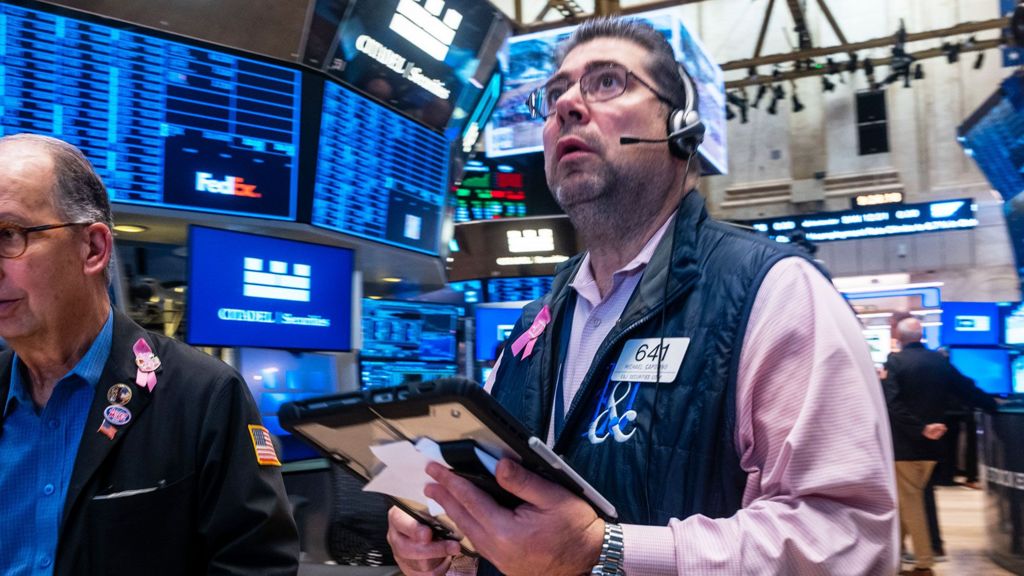
A wave of volatility has swept across global equity markets, leaving investors grappling with a pivotal question: is the historic artificial intelligence investment gold rush drawing to a close, or is the recent steep market downturn merely a long-overdue reality check for overheated valuations?
The most dramatic sell-off played out on the tech-heavy Nasdaq index last Thursday, home to industry giants including Nvidia, Apple, Meta, and Alphabet, erasing billions in market capitalization in a single trading session. The sharp correction came on the heels of a sweeping Democratic victory in the latest U.S. midterm elections, which handed the party full control of both chambers of Congress – a political shift that has sent shockwaves through the AI investment ecosystem.
Leading Democratic candidates across the country ran on platforms critical of unregulated, uncurbed data centre expansion, the very infrastructure backbone that has enabled the explosive growth of generative AI over the past two years. These campaign pledges have stoked widespread investor anxiety that sweeping new federal AI regulation is on the horizon, threatening the unconstrained growth trajectory that has driven the sector’s stratospheric valuations.
The current boom traces its origins to OpenAI’s late 2022 launch of ChatGPT, a product that ignited unprecedented mainstream and corporate enthusiasm for real-world AI use cases and kicked off the modern AI gold rush. Investors poured capital into every layer of the AI supply chain: advanced semiconductor manufacturers, high-speed networking infrastructure providers, utility companies powering energy-hungry data centres, and the generative AI developers themselves. The collective market value of large tech firms surged to historic peaks, with Goldman Sachs research projecting total global AI investments would hit a staggering $1 trillion annually by 2026. The sector’s insatiable appetite for capital was so intense that it pushed up borrowing costs for all other industries competing for limited global investment funds.
For months, however, quiet unease has been building among market participants about whether the AI sector can ever deliver on the outsize returns baked into current stock prices. These financial concerns have been amplified by high-profile warnings from leading AI researchers, who have publicly flagged unaddressed safety risks and even framed unregulated advanced AI as a potential existential threat to humanity – headlines that have only reinforced market fears of an imminent government clampdown.
While the Trump administration has embraced an unapologetically pro-AI agenda, referring to advanced AI systems as “super intelligence” and prioritizing unimpeded U.S. leadership in the space, Democratic candidates tapped into deep grassroots anger over the local impacts of data centre construction. Voter concerns centred on the facilities’ exorbitant water and electricity consumption, which residents feared would drive up household utility bills, alongside nuisances including constant operational noise, large-scale land appropriation, and widespread community disruption during construction. A May Gallup poll underscored the depth of this public opposition, revealing that 71% of U.S. residents would oppose a new data centre being built in their local community – a higher opposition rate than the 53% of respondents who rejected new nuclear power facilities in their neighbourhood.
Newly elected Texas state senator James Talarico, who flipped a long-held Republican seat to secure his victory, explicitly ran on this community scepticism. “While we are committed to preserving America’s global lead in artificial intelligence, we are still working through how this technology will reshape every part of life, from the future of work to how our children learn in schools,” Talarico stated. “We have a responsibility to protect American people, and to put clear, consistent, enforceable rules in place for businesses operating in this space.”
With full control of Congress, Democratic leadership is widely expected to push back aggressively against the Trump administration’s unregulated tech agenda, introducing new federal legislation designed to rein in uncurbed AI industry expansion. In Texas, governor-elect Gina Hinojosa has pledged to implement a full moratorium on new data centre construction, a policy that would directly challenge the operations of Elon Musk, who has relocated major portions of his SpaceX and Tesla manufacturing and administrative footprint to the once reliably red state. Musk poured nearly $450 million of his personal fortune into supporting Republican candidates during the midterm cycle, a bet that failed to pay off as Democrats made unexpected inroads across Texas.
As Tudor Brown, co-founder of UK-based semiconductor giant Arm Holdings, explains, “Public company stock valuations are always tied to projected future earnings, not current revenue.” If investors conclude that those projected future earnings will be significantly constrained by new regulation, a mass sell-off is the inevitable outcome. While the immediate trigger for the 24-hour market downturn was the midterm election results, warnings that leading AI-linked tech firms had become drastically overvalued had been circulating among analysts for months before voters went to the polls.
Market analysts remain divided on what comes next: some frame the correction as a healthy deflation of speculative froth from an over-exuberant market, while others warn it is the first crack in a massive AI investment bubble that could burst with cascading economic consequences. Nandini Roy Choudhury of Future Market Insights notes that investors will now conduct targeted reviews of how the new Democratic congressional majority could restrict data centre construction, mandate energy use limits, and impose new rules on AI deployment, meaning a broad, immediate rebound in tech stock prices is unlikely. Instead, traders will shift to far more selective investing, prioritizing firms with rock-solid balance sheets and proven near-term revenue streams. Arm’s Brown argues the downturn will be short-lived and limited in scope: he notes that share prices had been inflated by unrealistic expectations of near-infinite AI growth, and the recent sell-off is a predictable market correction driven by temporary panic. “There is a natural floor to how far these valuations can fall,” he observes. “Once that floor is hit, the market will recalibrate to reflect the simple reality that these companies are still generating massive, sustainable profits.”
Could the US midterms burst the AI bubble?