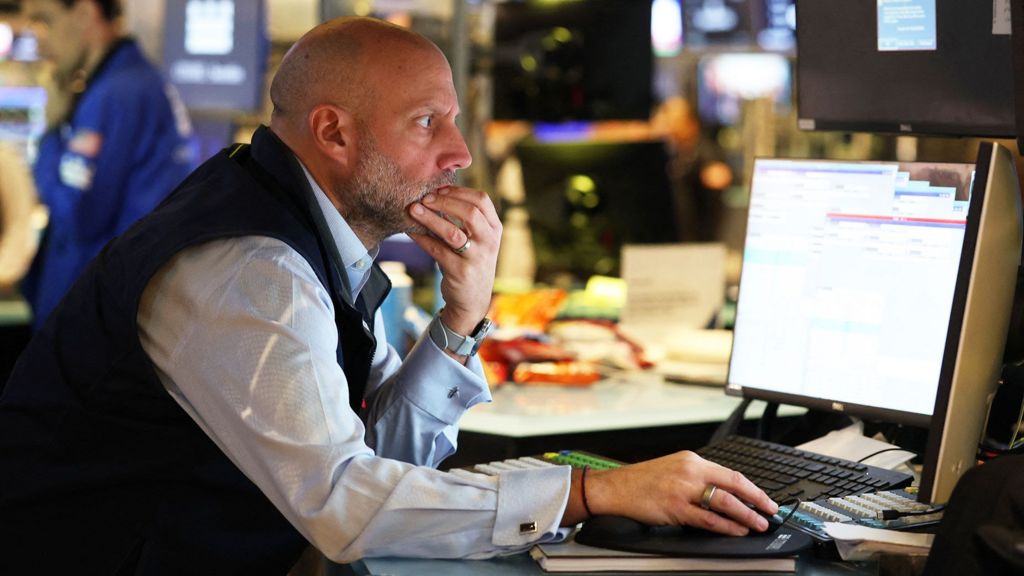
Global financial markets witnessed a dramatic swing in performance across Thursday and Friday, as a brutal multi-trillion-dollar sell-off concentrated in artificial intelligence and technology equities gave way to a partial recovery on Wall Street, even as Asian and European benchmarks extended losses through the end of the trading week. The rout first ignited in US markets on Thursday, immediately following a sweeping Democratic victory in US midterm elections that handed the party full control of both chambers of Congress, plus key state-level contests in regions that have emerged as hotbeds for AI data centre construction. A wave of investor anxiety spread rapidly across trading floors, driven by widespread expectations that the incoming Democratic-controlled legislature would push forward with strict new regulatory frameworks governing AI development, data centre operations, and tech industry oversight. The sell-off hit AI-linked semiconductor manufacturers hardest of all: industry giants AMD and Micron saw their share prices plummet more than 17% apiece in Thursday’s session, while AI chip leader Nvidia shed over 9% of its value, wiping out hundreds of billions of dollars in total market capitalization in a single day. High-flying tech names with close ties to AI advancement, including Tesla and SpaceX, also suffered steep double-digit percentage losses in Thursday’s market rout. By the opening bell on Friday, however, Wall Street began to claw back a portion of those losses. The tech-heavy Nasdaq Composite index climbed steadily through the morning, stabilizing roughly 1.7% above its previous close by lunchtime to reverse nearly a third of its 5.5% Thursday decline. The broader S&P 500, which tracks the performance of America’s largest publicly listed corporations, traded 0.9% higher at midday, while the Dow Jones Industrial Average briefly dipped into negative territory in early trading before edging into positive gains. Individual AI-linked stocks mirrored this upward momentum: Nvidia opened Friday more than 6% higher before settling at a roughly 4% gain as trading progressed, AMD recovered around 12% of its lost value, Micron rose over 8%, Tesla notched a nearly 5% uptick, and SpaceX posted a more than 6% gain. This partial Wall Street rebound unfolded against the backdrop of unexpectedly robust US labour market data released Friday morning by the Bureau of Labor Statistics, which showed the US economy added 165,000 new jobs in October – a figure more than double the average analyst forecast and well above typical monthly job growth levels in recent months. The national unemployment rate also ticked down slightly to 4.1%, marking its 8th consecutive month of remaining within a tight 4.1% to 4.3% range dating back to March. In stark contrast to Wall Street’s partial recovery, major Asian and European markets closed deep in negative territory on Friday. South Korea’s benchmark Kospi index finished the session 6% lower, with domestic chip manufacturing leader SK Hynix seeing its share price collapse more than 10%. All major Western European indexes posted losses, with leading benchmarks in Germany, France, and Spain closing firmly in the red, while London’s FTSE 100 index declined 1.01% as UK market participants also digested the Bank of England’s latest interest rate hike, alongside official signals that additional monetary tightening could be implemented in coming months to curb persistent inflation. Market analysts offered cautious assessments of the volatility, noting that the full trajectory of AI stocks remains highly uncertain. Dan Coatsworth, head of markets at investment platform AJ Bell, described the preceding week as “brutal” for global equities, emphasizing that it remains unclear whether Friday’s partial US market rebound will prove sustainable. “While no-one knows what happens next, it’s clear that we’ve just seen a significant shift in market sentiment,” Coatsworth noted. “Once investors have had the weekend to catch their breath, next week could give a clearer indication of whether the tech trade is going down the pan or fighting back.” Russ Shaw, founder of global tech advocacy group Tech London Advocates, pointed out that the midterm election results signal a coming paradigm shift for AI oversight, and that tech firms have failed to effectively communicate the public benefits of their AI projects to local communities that are facing rising energy costs amid a boom in data centre construction. “The incoming Congress is going to really focus on AI in a very dramatic way,” Shaw explained. “I’m a big fan of AI, but I’m watching what these companies are doing, and they’re not communicating effectively at all, particularly in the US, about what the benefits of AI are all about… those companies have to be better neighbours.” For his part, US President Donald Trump took to public platforms Friday to restate his full support for what he termed “super intelligence”, arguing that only “foolish leadership” would reject the massive economic prosperity that AI advancement generates. Neil Birrell, chief investment officer at Premier Miton Investors, added that the stronger-than-expected jobs data suggests the real US economy remains far more resilient than recent market volatility would imply. “The US economy is running hard which may mean the risks the markets are worrying about at the moment are not such a risk to the real economy as is being feared,” Birrell observed.